For Debbie’s Ond Word Sunday’s Lines Prompt
I was going through my computer erasing duplicate files and found about 12 copies of this letter my four year old sister Patti sent to my mother when she was in the hospital after having me. She dictated the letter to my 11 year old sister. A bit of a puzzle because she says she celebrated her birthday the day before so it must have been July 10 when she wrote it and I was born on July 3. Did they keep new mothers in the hospital for a week after delivery back then? At any rate, I love these lines, especially “I am glad I have a baby brother. I want to name it Bobby Jerry. Not Hazel! I don’t like that! (She had heard my dad say jokingly that if they had a girl, he wanted to name her Hazel. Patti insisted I was a boy right up to the day they brought me home.
I also like the lines, “Oh, bumble bees is on flower to flower today,” and “a rose is getting purty good today.I am getting purty good today!”
I’m just surprised at the handwriting as Betty Jo, who wrote it for her, had immaculate handwriting by the time she was in high school. I wonder if she wrote it in the car on the way to the hospital to pick my mom and me up. The nearest hospital was 60 miles from where we lived.
I can’t find a photo of Patti when she was four, but here we are when I was five or six and she was nine or ten. 
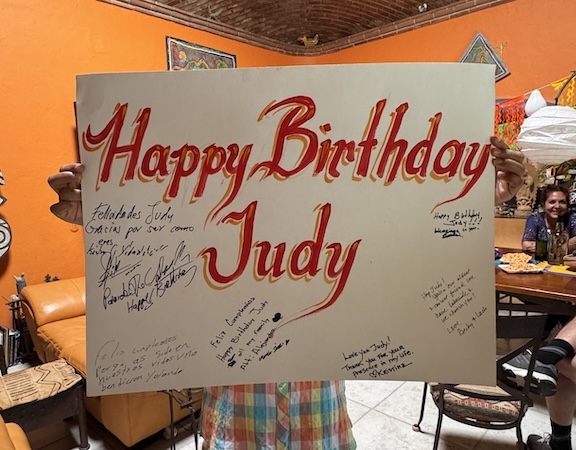
And, the plot thickens, for 70 year later, when I flew to St. Louis to visit Forgottenman, he met me at the airport with this sign!


I’d make conversation but my upper plate
seems to be grinding my lower of late.
I fear there’s a fissure that’s preventing their matching
and somehow my back teeth just seem to be catching
and locking which creates a problem in chewing,
so eating’s another thing I won’t be doing.
I’m bungling everything done by my jaws.
At talking and eating I’m taking a pause.
For now I’ll just listen and watch you eat pie.
If you give me a straw, I’ll simply get by
by sipping my tea and nodding my head
in avid agreement with everything said.
I could have stayed home and stared at the wall,
but I couldn’t face not seeing y’all,
so I will just sit here and soak in the news,
forsaking my own chance to thrill and amuse.
Until I’ve seen my dentist, you’ll just have to wait
for the juicy story I was going to relate!
The SOCS prompt this week is “straw.”
From Heather Cox Richardson via Letters from an American
Today the story broke that a long-neglected document held by Harvard University Law School, believed to be a cheap copy of the Magna Carta, is in fact the real document. More than 700 years ago, the Magna Carta, or Great Charter, established the concept that kings must answer to the law. (If you wonder what relevance this has to the America of today, please be sure to read the last two paragraphs, printed in bold at the end of this post)
King John of England and a group of rebel barons agreed to the terms of the document on June 15, 1215, at Runnymede, a meadow a little less than an hour from London near the River Thames. After the king had raised taxes, barons rebelled, insisting that he was violating established custom. There were rumors of a plot to murder the king, and the barons armed themselves.
Those two armed camps met at Runnymede, where negotiators for the king and the barons hammered out a document with 63 clauses, mostly relating to feudal customs and the way the justice system would operate. But the document also began to articulate the principles central to modern democracies. The Magna Carta established the writ of habeas corpus—a prohibition on unlawful imprisonment—and the concept of the right to trial by jury.
Famously, it put into writing that: “No free man shall be seized, imprisoned, dispossessed, outlawed, exiled or ruined in any way, nor in any way proceeded against, except by the lawful judgement of his peers and the law of the land.” It also provided that “To no one will we sell, to no one will we deny or delay right or justice.”
The Magna Carta placed limits on the king’s ability to tax his subjects and established the law as an authority apart from the king. Anticipating the idea of checks and balances, it set up a council of barons to make sure the king obeyed the charter. If he did not, they could seize his lands and castles until he made amends.
|
The original charter did not last. King John convinced the pope to declare the document illegal because it circumscribed the power of the monarch, and in reaction, barons fought for the rights outlined in the Magna Carta. After the death of King John in 1216, the Magna Carta was confirmed and reissued, becoming an accepted part of the understanding of British rights. In 1297, and then again in 1300, King Edward I reissued the Magna Carta and confirmed that it was part of England’s law. The copy in Harvard’s possession is from 1300. Harvard bought the document after World War II for $27.50, about $500 today. It is one of seven original copies of the 1300 Magna Carta, and in the United States of America in 2025, it is priceless. In the early 1600s, King James I and King Charles I both reasserted the power of the king. Jurist Sir Edward Coke used the Magna Carta to insist that longstanding English customs guaranteed liberties to British subjects and required the king to comply with the law. There were limits to a king’s power to tax his subjects and his power to punish them. This legal struggle was unfolding just as British subjects were colonizing the North American continent, and the charters of the new colonies echoed Coke’s arguments. The 1629 charter of the Massachusetts Bay Company, for example, established that colonists and, crucially, the children they might have in the colony, “shall have and enjoy all liberties and Immunities of free and naturall Subiects.” As constitutional scholar Mary S. Bilder notes, lawyers and political figures put into the documents of the early British settlement of North America the belief that liberties were the birthright of English subjects. That belief informed colonists’ opposition to the 1765 Stamp Act, which imposed a new tax to which they had not given their consent and called for those who violated the law to be tried not by a jury of their peers but rather in admiralty courts. The Massachusetts Assembly declared the Stamp Act to be “against the Magna Carta and the natural rights of Englishmen, and therefore, according to Lord Coke, null and void.” British politician William Pitt told Parliament: “The Americans are the sons not the bastards of England.” In September 1774, as tensions between the king and the colonists intensified, the first Continental Congress met in Philadelphia and wrote a declaration of rights and grievances, claiming the liberties guaranteed by “the principles of the English constitution, and the several charters or compacts.” Showing the unity of the colonies, the Congress published an image of 12 arms holding a column crowned by a liberty cap and resting on the words “Magna Carta.” In 1776 the colonists threw off the monarchy to establish a government based on the idea that all people must answer to the law. As Thomas Paine wrote in Common Sense: “in America the law is king. For as in absolute governments the King is law, so in free countries the law ought to be king; and there ought to be no other.” In 1776 the new states were writing their own constitutions that defended their liberties, including their protection from loss of life, liberty, or property without due process of the law. That concept went directly into the first ten amendments to the Constitution, known collectively as the Bill of Rights. The Fifth Amendment provided that no “person shall be…deprived of life, liberty, or property, without due process of law,” and in 1868 the Fourteenth Amendment applied that principle to the states as well as the federal government, saying: “No State shall make or enforce any law which shall abridge the privileges or immunities of citizens of the United States; nor shall any State deprive any person of life, liberty, or property, without due process of law; nor deny to any person within its jurisdiction the equal protection of the laws.” The Harvard document is not the only Magna Carta in the U.S. In 2007, philanthropist David Rubenstein bought a 1297 copy of the Magna Carta from former presidential candidate Ross Perot. It was the only copy in the U.S., and Perot had permitted the National Archives to display it. Rubenstein bought the document for $21.3 million, hoping to keep it in the U.S. “to ensure that Americans could continue to see it, and to thereby be continuously reminded of its importance to our country.” He promptly lent it to the National Archives for public display, “as modest repayment of my debt to this country for my good fortune in being an American.” And yet the fundamental principles on which the government of the United States is based are under attack. In an interview that aired on Sunday, May 4, President Donald J. Trump told NBC’s Kristen Welker that he “didn’t know” if persons in the United States had a right to due process. When Welker reminded him that the right to due process is written into the Fifth Amendment, he said: “I don’t know. It seems—it might say that, but if you’re talking about that, then we’d have to have a million or two million or three million trials.” Musician Bruce Springsteen has no doubts about those rights, embedded as they are in the country’s DNA. At a concert in Manchester, England, yesterday, he warned: “In America, the richest men… [are]… abandoning our great allies and siding with dictators against those struggling for their freedom. They’re defunding American universities that won’t bow down to their ideological demands. They’re removing residents off American streets and, without due process of law, are deporting them to foreign detention centers and prisons. This is all happening now.” He criticized lawmakers who have “no…idea of what it means to be deeply American.” And yet, Springsteen told the crowd: “The America that I’ve sung to you about for 50 years is real and, regardless of its faults, is a great country with a great people, so we will survive this moment.” — Notes: https://apnews.com/article/harvard-magna-carta-rare-copy-97754aee08aaab65a36e49bedebd5992 https://www.parliament.uk/magnacarta/ https://www.bbc.com/news/uk-england-surrey-32828251 https://www.archives.gov/publications/prologue/2010/winter/magna-carta.html https://avalon.law.yale.edu/17th_century/mass03.asp Mary Sarah Bilder, Charter Constitutionalism: The Myth of Edward Coke and the Virginia Charter,” North Carolina Law Review 94 (June 2016): 1545–1592, at https://scholarship.law.unc.edu/cgi/viewcontent.cgi https://www.archives.gov/exhibits/featured-documents/magna-carta/legacy.html https://www.law.cornell.edu/wex/magna_carta https://www.nytimes.com/2025/05/04/us/politics/trump-meet-the-press-interview-due-process.html https://www.loc.gov/exhibits/magna-carta-muse-and-mentor/magna-carta-and-the-us-constitution.html https://www.nytimes.com/2025/05/15/world/europe/harvard-magna-carta-original.html https://www.forbes.com/sites/abrambrown/2014/03/31/the-man-who-owns-a-magna-carta/ https://www.cnn.com/2025/05/15/entertainment/bruce-springsteen-trump-criticism-scli-intl |
For Fibbing Friday, the task at hand is:
1. What is pilau rice? One grain of your rice
2. What are eggs benedict? Why ask him? I can tell you that they are items laid by chickens to produce more chickens or omelettes.
3. What is a souffle? A slight altercation
4. What is baked Alaska? Summer in Juneau
5. What is crème brulee? Coffee served with dairy and a flower necklace.
6. What is a victoria sponge? An English birth control device
7. What is a raspberry roulade? Something that helps one set up regulations for Driscoll’s.
8. What is cannoli ? A small canister
9. What is kamaboko? A security/surveillance system in a library
10. What are sweetbreads? Humans genetically engineered to have kind dispositions.
Curling her palms around her usual potion, Robin tried to seal her ears to the bombastic recitations of the exploits of the geriatric uni-cyclist seated on a barstool to her right. Friday afternoon club was less fun in one’s seventies.
The words for “Can You Tell A Story In––” are: Curl, Potion, Robin, Uni–cycle and Bombast, and the word limit is 40 words:
I drove up the hill to my house following this pickup. I was so tempted to follow it to its destination to ask what its story was. Now I’m sorry I didn’t. Can you furnish a story for me? HERE is the pingback to include with your post to make sure we all see it..
Every Wednesday, I will publish a photo. Please publish a poem or short story inspired by the photo and link to this blog in the comments.
I loved this song that came out the year I turned 6 years old. Seems to still be having an effect.
My childhood dollhouse was a helium balloon,
caught in a tornado with a flock of flying squirrels,
equal novices in these midnight adventures
soaring out into the world away from horses,
wheat fields, henhouses and unpaved roads.
Escape was a constant theme in that jumprope, hopscotch life
where costumes were for Halloween and dreams kept silent under wigs.
Sailing rainwater rivers down deep ditches,
wearing vestigial vernix as protection against inevitable dunkings,
my uncle’s porkpie hat my umbraculum against hot prairie skies.
The only exit from that world I escaped in time was too often an ossuary:
tunafish Catholics buried under Papal supervision in one part of the cemetery,
Methodists in another, lily-white in their observance of the rules:
Sunday morning church a prerequisite for Saturday night dances.
Jazz nights under covers, Jesus Loves me in the light of day.
Inner tube boats traded for planes and ocean liners,
orange juice traded for absinthe, I sailed and flew into the world.
Using my first world as a grounding place,
I seized chance’s fortune as well as its mistakes––
to venture out and earn a life.
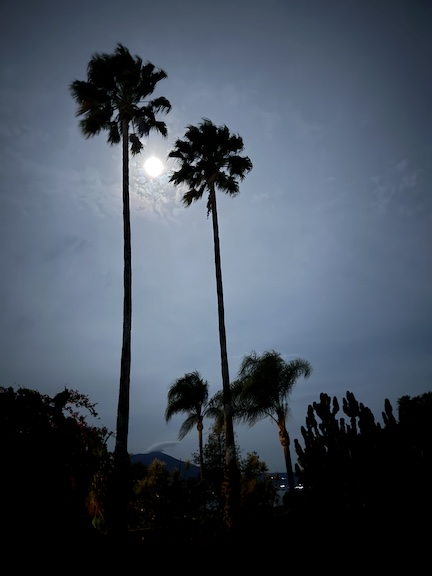
Matin
What kind of a world
does a bird feel itself a part of
that prods it to such a joyous song
in celebration of her beauties?
Sun barely risen,
air crisp and cool,
not a breath of air stirs the
vibrant golden hibiscus
to cause the fall
of one palm-sized petal
onto the dew-damp grass below.
No clouds obscure
one puff of steam
rising from the distant volcano
that peeks over the
hills above the lake––
not one ripple on its calm surface.
I lie on my bed,
apart from this still morning,
making lists––
only a glimpse
of that bird’s world
on view through my window’s parted curtain,
as I listen to this constant oration
of its joy over being born
into this world.
I somehow in the editing erased the prompt for this poem and I can’t for the life of me remember what it was. If it strikes a chord with you and you think you know of a prompt it might have been written for, please put a link in comments. I am definitely losing it, folks!!!
Image by Alireza Dolati
Divine Providence
The wings of destiny are stilled, waiting for our play.
Astonished at our slowness, confused at the delay.
Disappointment in mankind by now’s a usual thing.
What new human horror will the future bring?
We’ve poisoned oceans, sullied air and burdened earth with junk.
Enough to put Ma Nature in a perpetual funk.
She balks and sends out warriors to try to curb our lusts,
but still mankind continues to turn shouldn’ts into musts.
She now sees she was misguided in creating human fools,
with all of their excesses flaunting all her rules.
Soon she’ll find another way to try to clear her slate of them
as destiny stands waiting to see what is the fate of them.
For dVerse Poets, we were to choose a Spanish term to use for the subject of a poem. In Spanish, Divina Providencia means destiny with choices and spiritual interventions. My poem is about how mankind has unfortunately chosen to respond to that divine providence.