Tag Archives: Judy Dykstra-Brown

Fresh Worms for Sale

Fresh Worms for Sale

Many have not come to terms
with the benefits of worms.
They find them repulsive and squishy.
Revolting, creepy, crawly, ishy.

But these folks tend to just react
without examining each fact
of all that folks could find to do
with worms if they’d just buy a few.

Granted, worms that wad and mingle
lack the charm of just a single
worm that can be used for bait
on a hook and with a weight,

but every person knows this use,
which always calls for worm abuse.
Worms, however, also toil
to break up and aerate the soil.

In jars with holes poked in the lids,
worms make good pets for little kids.
Good for hours of watching, they need
little care and little feed.

Worms don’t need collars, leashes, dishes,
never go against your wishes.
They are not barkers nor run-arounds.
None of the nastiness of hounds.

They have no hair to grow and shed.
You do not have to pat their head.
They have no other nasty habits
like gerbils, hamsters, cats or rabbits.

You don’t have to change their litter.
When traveling, you don’t need a sitter.
No vet bills when your pets are worms–
no fleas nor ticks nor mites nor germs.

Worms take up very little space
and may be trained to run a race.
And if you make a well-placed bet,
they just might get you out of debt.

The benefit of worms now told,
May I consider this worm sold?
Surely you’ll find much to do
with one or two that leave with you.

If you’re not a  fisherman
and if a pet’s not in your plan,
If you are a sadistic sickie,
just put one down your girlfriend’s dickie!*

*for the youth among us, a dickey is a turtle neck or collared inset
that may be worn under a vee-necked sweater or jacket to create the illusion that one is wearing a sweater or blouse under it.

The Prompt: Embrace the Ick–Think of something that truly repulses you.  Hold that thought until your skin squirms.  Now, write a glowing puff piece about its amazing merits.

Revelation, Writer’s Block and Tweet, Twitter, Ping!!!!

I had a revelation the other day that I actually enjoy writing about life more than living it! I used to dream about achieving this state, but now it rather bothers me.

okay, a further thought: My (unfortunately deceased) husband was a poet who promptly stopped writing as soon as we married. A few years later, I asked him why. He answered, “I think it is because I can only write when I’m unhappy.” There was not much I could say to protest his writer’s block after that, but I did start worrying when he started writing again.

These are two comments I wrote in Listentothebabe‘s blog.  A friend told me they were tweet-worthy, but I think they are too long and no one reads my tweets anyway, so forgive me for tweeting my own song here.  (Babe, if you’re having to read these over again, sorry. Next time I’ll just ping you.)

Damn, now there is something else I just have to say:

Twenty years ago, would any of us have dreamed that one day we’d be using the words “tweet, twitter and ping” so frequently?

Okay.  Over and out.  Promise.  I’ll go watch an episode of something sent to me by a kind benefactor. —Judy

South Dakota Gumbo

South Dakota Gumbo

When the rains came in hot summer,  wheat farmers cursed their harvest luck, for grain sodden by rain just days before cutting was not a good thing; but we children, freed from the worry of our own maintenance (not to mention taxes, next year’s seed fees and the long caravans of combines already making their slow crawl from Kansas in our direction) ran into the streets to glory in it.

We were children of the dry prairie who swam in rivers once or twice a year at church picnics or school picnics and otherwise would swing in playground swings, wedging our heels in the dry dust to push us higher. Snow was the form of precipitation we were most accustomed to–waddling as we tried to execute the Xs and Os of Fox and Geese bundled into two pairs of socks and rubber boots snapped tighter at the top around our thick padded snowsuits, our identities almost obscured under hoods and scarves tied bandit-like over our lower faces.

But in hot July, we streamed unfettered out into the rain.  Bare-footed, bare-legged, we raised naked arms up to greet  rivers pouring down like a waterfall from the sky.  Rain soaked into the gravel of the small prairie town streets, down to the rich black gumbo that filtered out to be washed down the gutters and through the culverts under roads, rushing with such force that it rose back into the air in a liquid rainbow with pressure enough to wash the black from beneath our toes.

We lay under this rainbow as it arced over us, stood at its end like pots of gold ourselves, made more valuable by this precipitation that precipitated in us schemes of trumpet vine boats with soda straw and leaf sails, races and boat near-fatalities as they wedged in too-low culvert underpasses.  Boats “disappeared” for minutes finally gushed out sideways on the other side of the road to rejoin the race down to its finale at that point beyond which we could not follow: Highway 16–that major two-lane route east to west and the southernmost boundary of our free-roaming playground of the entire town.

Forbidden to venture onto this one danger in our otherwise carefree lives, we imagined our boats plummeting out on the other side, arcing high in the plume of water as it dropped to the lower field below the highway.  It must have been a graveyard of vine pod boats, stripped of sails or lying sideways, pinned by them.  We imagined mind soldiers crawling out of them and ascending from the barrow pits along the road to venture back to us through the dangers of the wheels of trucks and cars.  Hiding out in mid-track and on the yellow lines, running with great bursts of speed before the next car came, our imaginary heroes made their ways back to our minds where tomorrow they would play cowboys or supermen or bandits or thieves.

But we were also our own heroes.  Thick black South Dakota gumbo squished between our toes as we waded down ditches in water mid-calf.  Kicking and wiggling, splashing, we craved more immersion in this all-too-rare miracle of summer rain.  We sat down, working our way down ditch rivers on our bottoms, our progress unimpeded by rocks.  We lived on the stoneless western side of the Missouri River, sixty miles away. The glacier somehow having been contained to the eastern side of the river, the western side of the state was relatively free of stones–which made for excellent farm land, easy on the plow.

Gravel, however, was a dear commodity.  Fortunes had been made when veins of it were found–a crop more valuable than wheat or corn or oats or alfalfa. The college educations of
my sisters and me we were probably paid for by the discovery of a vast supply of it on my father’s land and the fact that its discovery coincided with the decision to build first Highway 16 and then Interstate 90.  Trucks of that gravel were hauled  to build first the old road and then  the new Interstate that, built further south of town, would remove some of the dangers of Highway 16, which would be transformed into just a local road–the only paved one in town except for the much older former highway that had cut through the town three blocks to the north.

So it was that future generations of children, perhaps, could follow their dreams to their end.  Find their shattered boats.  Carry their shipwrecked heroes back home with them.  Which perhaps led to less hardy heroes with fewer tests or children who divided themselves from rain, sitting on couches watching television as the rain merely rivered their windows and puddled under the cracks of front doors, trying to get to them and failing.

But in those years before television and interstates and all the things that would have kept us from rain and adventures fueled only by our our imaginations, oh, the richness of gumbo between our toes and the fast rushing wet adventure of rain!

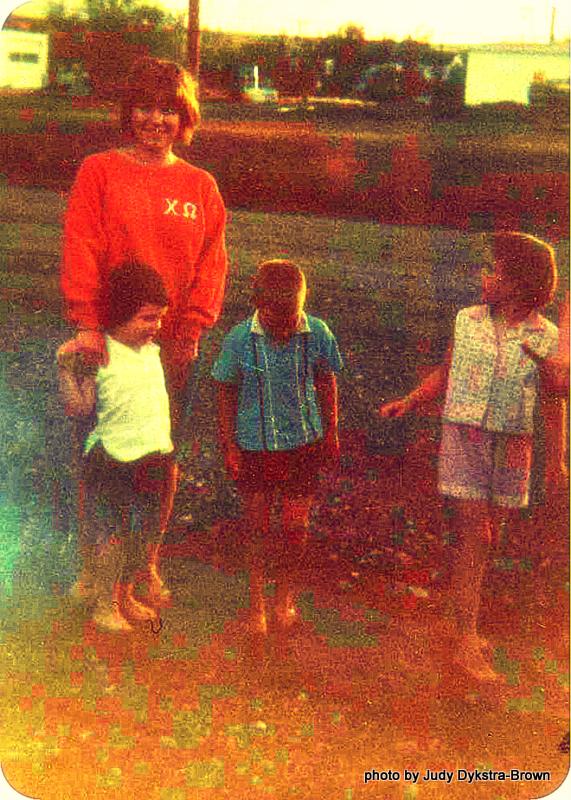
Writer’s note:  I know my sister Patti is going to read this and cry, and so I want to present you with this mental picture of her, college age, Levi cuffs rolled up above her knees, surrounded by five-year-old neighbor kids, enjoying her last big adventure out into the ditches of Murdo, South Dakota, during a July rain.

But wait!  A mere two hours of digging and another hour of editing has produced this proof of my former statement, so to augment your mental image, here is the real one:
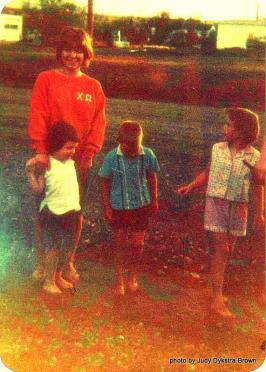
Patty in mud 001-001

Not quite the gusher depicted in the childhood vignette, but nonetheless, Patti’s final puddle adventure. She had taken my visiting niece out. The next day the neighborhood kids rang our doorbell and asked my mom if Patti could come back outside to play! Ha.

The Prompt: Free Association–Write down the first words that come to mind when we say . . . home. . . soil . . . rain. Use those words in the title of your post.
Enough’s Too Much

Enough’s Too Much!!

Enough’s too much when it comes to fish
or any other smelly dish.
Too much for castor oil in spoons
or relatives on honeymoons.
Amoebas?  Any one’s too much,
and a date who wants you to go Dutch
clearly tells you he’s not “it.”
One mosquito, when you’re bit,
is not “enough,” but “one too many.”
when your preference is “not any!”

Kids with colds and snoopy neighbors,
tiresome chores and heavy labors,
bitter pills and jerked-off scabs,
rainy days with no free cabs,
diarrhea, scabies, gout?
Too much! Too much, without a doubt!
“Enough’s enough” is repetitious,
obvious and almost vicious.

So don’t go spouting it at me.
I hate cliches from A to Z.
I won’t have any said to me.
If you use them, you’re dead to me!
“It is sufficient” I will accept.
“I’ll have no more”  is most adept.
But don’t go muttering platitudes
at folks like me with attitudes,
or I promise we’ll be getting rough
enough to prompt, “Enough’s enough!”

In response to The Daily Post’s writing prompt: “Enough Is Enough.” Wow, this sounds so grouchy.  It is meant tongue-in-cheek.  I’ve probably used the phrase hundreds of times myself—usually directed at myself when I have lost my keys or glasses for the dozenth time that day!

Once Upon a Lime in Mexico

Once Upon a Lime in Mexico

I was just a small amoeba living on a lime,
and though Judy disinfects her fruit every single time,
I fear that the bartender doesn’t bother to
so that is how the tale occurred that I am telling you.
She squeezed her lime above the ice, then dropped it in the drink.
The Coca Cola fizzed up and the ice began to clink.
As she took her first big swallow, I lost hold of the lime
and slid down a soft pink chute into another clime.

I’d heard of other journeys and knew how this might end,
but I decided I’d enjoy every curve and bend.
I wound up in a reservoir where I gave in to sleeping,
but woke up to a million of me jumping, kicking, leaping.
It wasn’t half so pleasant as it had been before,
so I commenced to swim around, looking for the door.
Unfortunately, though I found it, it seemed to be blocked.
The wind was brisk, the waters churned, but the way out was locked.

When I heard the one who had consumed me groan and cry and cuss,
I rued the fate to which that Cuba Libre had doomed us!
For as distressed as she must be with headache and each cramp,
I was suffering equally from jostling and the damp.
For two days she lived on Electrolit, in bed and with no food.
And I held on for my dear life, listening to my brood
tell of what we could expect, flushed to a watery hell
down in the earth with all our kin—this legend they knew well.

Two days I lived like this, just holding on for my dear life,
listening to her pleas as spasms cut her like a knife—
too ill to go for help and unable to even sit.
I wondered how much worse this grisly tale was going to get.
Then suddenly, this morning, I felt the waters swirl.
I felt myself slip-sliding right out of the girl
into a clear container where I could see the world
from prison I’d once more escaped, or rather, I’d been hurled!

I felt the jostling and the engine of the moving car
which set up small vibrations in my little jar.
Yet still my progeny and I enjoyed the five mile ride.
It was so much better now that we were not inside
that dark and windswept place where we’d resided for two days.
Though I’ll admit none of our legends accounted for this phase.
No other amoebian Aesop had written any story
that took a turning such as this. Former endings had been gory!

I heard the car door open, footsteps and a creaking door.
Other footsteps, blinding light, and I was freed once more!
Spread onto a sheet of glass, surveyed by a big eye,
I breathed a sigh of pure relief. I’m such a lucky guy.
While they weren’t looking, I slipped off and landed on a shelf
where ever since I’ve been observing others like myself
who have escaped amoeba hell at least for a small time.
While I’m in amoeba heaven, and my dears?  It is sublime!!!

So clean, well-lit and active. Just like a picture show.
I sit here so languidly and just go with the flow,
calling out encouragement to visitors like myself.
And now and then, others come and join me on my shelf.
The girl who works here likes to put her sandwich very near,
where it serves as a good cushion for those of my kind, I fear.
The moral? Take care what winds up inside you, please, my friends;
for in spite of all my warnings, this story never ends.

In response to The Daily Post’s writing prompt: “Once Upon a Time”—tell us about something that happened to you in real life last week — but write it in the style of a fairy tale.

Sorry, friends, this one is another groaner!!!!

A Small Adjustment at the Fairy Ball

A Small Adjustment at the Fairy Ball

Her gold tiara, finely pearled,
came undone as she danced and whirled
and across the room was often hurled
as the hair that held it came unfurled.
Then her attendant tightly furled
her fairy hair as they fussed and girled.
For the rest of the night, she bowed and twirled,
for now that her hair was tightly curled,
all was right in the fairy world.

The Prompt: Easy Fix—Write a post about any topic you wish, but make sure it ends with “And all was right in the world.”

Near

Near

My father went from obscurity to a sort of small renown.
He worked hard as a rancher and the mayor of our town.
He met my mother at a dance in her sister’s borrowed gown–
both of them lonely visitors to a faraway strange town.
I’ve thought about it often since we laid him down.
Why didn’t I ask more questions? Why didn’t I write it down?

Many a calf he helped to birth and many a field he’s mown.
Avoided his mother if he could–long-suffering aged crone.
Not many highways traveled,nor many airwaves flown.
He died in his angry daughter’s arms–the two of them alone.
I’ve thought of it often till regrets have turned into a drone.

His eyes were always looking further over yon.
Over a ripening field of wheat or over a fresh-mowed lawn.
Working, often, until dark and up again at dawn.
A man of camaraderie and wit and brains and brawn.

He liked to tell a story and sing a rousing tune.
Stand on the porch at midnight to piss under the moon.
He gave me a turquoise ring, a baby rabbit and a coon.

Now that he’s very gone away.  Now that I’m very grown,
I know my flesh is of his flesh. My bone is of his bone.

And I wish that I’d asked more questions. That we’d both been less alone.

DSC02618
The form of this poem is one consisting of six stanzas, the first with 6 lines and each thereafter one less line.  Each line in each stanza rhymes with all the other lines in that stanza and each stanza’s rhyme is a near rhyme to the last. The name of this form is Sylvestrian Near Rhyme and since “Near” describes both the theme and form of my poem, it is also the name of the poem.  And yes, I did make up the form!  I’d love it if poets given to rhyming and meter would attempt the form and send me the results as comments or a link to this blog.

Update: Here is Sam Rappaz’s response to my challenge.

The Prompt: Fireside Chat—What person whom you don’t know very well in real life — it could be a blogger whose writing you enjoy, a friend you just recently made, etc. — would you like to have over for a long chat in which they tell you their life story?

Daily Duty

The Prompt: What are the things you need to do within 30 minutes of waking up to ensure your day gets off on the right foot? What happened the last time you didn’t do one of these things?

Daily Duty

When I wake up—early or late,
each day I feel I have a date.
The thing I need to do the most
is to check The Daily Post;
then, to write until I’m done—
sometimes drudgery, sometimes fun.

Today it’s just a little ditty.
This waste of time is such a pity,
but superstition drives me to it,
for I feel if I don’t do it,
that I’ve committed a major sin,
and that I’ll never write again.

Home from the Sea

The Prompt: Re-springing Your Step–Tell us about the last experience you had that left you feeling fresh, energized, and rejuvenated. What was it that had such a positive effect on you?

The Answer: Two months living on the beach in La Manzanilla really did leave me feeling energized, relaxed and a bit nostalgic. I posted some words and photos earlier here and here and here. Below is the rest of the story:

Home from the Sea

That good old salty sea air combined with grainy sand
defined my beach vacation and went great with being tanned.
Felt great under my bare feet and squished between each toe.
And left footprints behind me, wherever I chose to go.
It crusted up my toenails and powdered all my floors.
Seeped into my keyboard and creaked up all my doors.
It told the upstairs neighbors when I’d gone and got back home.
It sneaked into my ear canals and caked up brush and comb.
In spite of all the nuisance of the sand within my bed,
those memories of beach life still swirl within my head.
Yet I needn’t wax nostalgic, for I find behind each knee,
in pockets, luggage and the floor—the beach came home with me!

Rocky Balboa and Uriah Heep Meet on Rodeo Drive

The Prompt: Write a post in which the protagonists of two different books or movies meet for the first time. How do  they react to each other? Do they get along?

I was a witness as Uriah Heep just happened to stumble upon Sylvester Stallone gazing at his reflection in the front window of a chichi little shop on Rodeo Drive.  I admit that I loitered nearby, eavesdropping. I knew this was going to be good!

Rocky Balboa and Uriah Heep Meet on Rodeo Drive

Uriah sidled closer to get an autograph,
but he was intercepted by a member of Sly’s staff.
“Please do not loiter here, sir,”  the officious flunky said.
Her expression was most haughty. Her eyes just cut him dead.

Uriah’s voice was cloying as he said, “My esteemed sir,
I’m just an ‘umble man. I didn’t want to cause a stir.
But it would be so gratifying for a worm like me
to get to touch the pants hem of a real live star like thee!”

Sylvester spun upon his heel, surveyed the quivering mess.
“It won’t hurt to please the little man one time, I guess,”
Sly thought as he bestowed a smile meant to relieve the tension,
at the same time, putting out his hand with condescension,

thinking he might kiss it, but instead that low man’s knee
was brought up to make contact with Sylvester’s fabled vee,
causing his pitch forward ’til in the street he lay.
And this is what Uriah said as he walked away:

“I may be sly and unctuous–a real pain in the ass,
but even a lowlife like me still has a little sass.
My humble’s spilling over ’til it doesn’t seem quite real,
and so I thought I’d show Stallone some of what I feel.”

How the great man is brought down to eating humble pie.
For once Uriah can look down to meet him in the eye.
As he writhed in agony, the star made not a peep.
Now Uriah is the Sly one while Stallone’s become a heap.

Note: Okay, I’m sorry. For the poem. For the sick pun. Everyone has an off day now and then.