Tag Archives: Murdo

Genealogy, Murdo News, 1922 for Writer’s Workshop


Murdo News, 1922

I grew up in a tiny prairie town in South Dakota, population 700 when I left it, 500 now. (Photo above, 1950’s by my guess.) I’ve talked of this place many times on my blog, published two books on growing up there, but just today, someone on the town’s website published these newspaper stories from 1922 which I found fascinating, as many of the people mentioned were known to me.  Judge Parish lived across the street from me, Louis Simpson was my dad’s cousin  and many of the other family names are well known. This may not be interesting to anyone other than my sister Patti and friend Jim, who read my blog and who grew up in Murdo as well, but for what it is worth, here are some of the stories:

JONES COUNTY, SOUTH DAKOTA

News Items

Murdo, April 18. – Statistics are said to show that after every great war nature replenishes herself through twin babies. Mrs. Burke of this place has the distinction of being the mother of three sets of twins and one set of triplets.

Mrs. M. P. Kerlin, also of Murdo is the mother of twin boys, who are now a few years of age. During 1921 Mrs. A. O. Kimble and Mrs. Roy Guthrie each became the mother of twin girls. Mrs. Sam Hubbard gave birth to twin sons, both of whom died.

Recently twin boys were born to Mr. and Mrs. Rex Williams.

Thus, out of nine births in Murdo, nineteen children were born, seventeen of whom are living. It is believed that no other town of Murdo’s size in the state or northwest has a birth record equal to this.


John Connery
Two Boy Swimmers Drown
Lads Meet Death While Bathing at Murdo, S.D.
Deadwood, S.D., June 17 — A telephone message from Murdo, a small town east of Rapid City, tells of the accidental drowning there of John Connery and a companion named Pomberr. Both boys, who were sixteen years old, were in swimming at the railroad dam at that point and are supposed to have been seized with cramps. Neither body has been recovered.
[17 June 1910; Aberdeen Daily News] *Note from Judy: In my part of South Dakota, little manmade lakes were called dams, probably due to the fact that they were created by digging out the earth and rolling it up to the side to create a depression large enough to collect rainwater and snow runoff. In this dry cattle  country, it was necessary. My dad got his start building such dams. Below is a photo of a dam in process. That’s my dad, Ben Dykstra, sitting on the back of the grader adding his weight to smoothing out the dam grade.

M. L. Parish [crime]
Four Fleeing Men Battle Posse and Flee in Prosecutor’s Auto
Sioux Falls, S. Dak. Aug 25 — Four convicts, who escaped from the penitentiary on August 17, fought a posse near Stamford early today. After mortally wounding State’s Attorney M. L. Parish and wounding Sheriff J.C. Babcock, they escaped in the State’s Attorney’s automobile.
The men were pursued from Murdo, S.D., by a hastily formed posse when it was learned they had recrossed the Missouri River into this State and were heading toward the Bad Lands. Airplanes have been sent to aid in locating them. [26 Aug 1922; Philadelphia Inquirer]

Louis Simpson [injury]
RATTLESNAKE PROTESTED
Struck Boy Who Tries to Pull It From Its Hole Near Murdo

Murdo, May 19. – Catching a rattlesnake by the tail to prevent it escaping him nearly caused the death of Louis Simpson, the young son of Mrs. Charles Luken, living near here. The reptile struck the boy on the left hand with its fangs, and but for prompt work he would have died

When the boy discovered the snake the reptile beat a retreat for its nearby hole, and was partially down this, when the boy grasped it by the tail and attempted to pull it back to the surface of the ground. The rattlesnake doubled back and buried its fangs in the boy’s hand, this being one of the tricks of the average rattler when grasped while partially in its hole.

For Writer’s Workshop  the prompt is genealogy.

The China Bulldog was a finalist for the Next Generation Indie Book Awards

Books2024. New Generation Independent Book Award Finalist:
The China Bulldog And Other Tales of a Small-Town Girl
(Prose, poety and images of growing up in a small town in South Dakota. )


I just discovered that my book The China Bulldog (Available on Amazon and at Diane Pearl’s)
was a finalist for the 2024 New Generation Indie Book Awards in the Memoir category. 

Old Feelings

Old Feelings

Our prairie  town  stood
in an unending stretch of South Dakota plain
that rolled on for as far
as any eye could see
with not one tree.

Here I dreamed
in the crouched shade of rabbit nests
and killdeer flight,
in the shade of the feigned broken wings of mother birds,
in the shade of tractor blades and haystacks.

This was where  I  would sunburn  and sand stick and deer fly scratch.
Where the ticks waited for me on the wood of the thickets.
Where no dangerous animals lurked
since the gray wolves were ghosts
and the brown bears memories.

Here the Sioux were sequestered in the bars and the reservations.
The horses were safe behind fences,
the cattle wore the tattoos of their owners,
and  feral  cats  were the only descendants left
in the decaying houses  of the homesteaders
of half a century before.

The  floorboards of my Grandmother’s  homestead
sagged  to the dry dirt,
and the roof and timbers
fell  to blanket them.

The ribs of  plows  rusted
in the spring  rainstorms.
Prairie fires burned away  rust
and  snow peeled away ashes
to the muscle of iron
which it picked at like scabs—
iron to rust to ashes to iron to rust.

Kicking the hard clods with my feet,
I knew that under me were arrowheads
and flint strikers
and white stone buttons
in the shape of thunderbirds—
All the rich Indian treasures
buried under the soil
to be turned up some day  by the plow of my dad .

Curled up into the furthest corner of the couch,
I listened to the stories traded between my dad and his friends.
Tales of gray wolves
and children lost in snowstorms,
Indian wanderers and recluse homesteaders
to be lifted out of my dad
like he lifted the Indian relics from the soft soil.

And I feel a part of the prairie dogs and the wild kittens,
the rabbits and the killdeer in their nests.
I feel both threatened and protected by the land––
like a child given asylum under the shadow of trees.
Like myself sheltered in the arms of  the child  I’ve grown from.
That child who, wanting to grow up and feel  less,
Comforts its  grownup self,  who wants the feeling back.

For dVerse Poets Open Link Night.

Murdo News, 1922

I grew up in a tiny prairie town in South Dakota, population 700 when I left it, 500 now.  I’ve talked of this place many times on my blog, published two books on growing up there, but just today, someone on the town’s website published these newspaper stories from 1922 which I found fascinating, as many of the people mentioned were known to me.  Judge Parish lived across the street from me  and many of the other family names are well known. This may not be interesting to anyone other than my sister Patti and friend Jim, who read my blog and who grew up in Murdo as well, but for what it is worth, here are the stories:

JONES COUNTY, SOUTH DAKOTA

News Items


Mrs. Burke [people]Aberdeen Journal (18 Apr. 1922) transcribed by Marla Zwakman

Murdo, April 18. – Statistics are said to show that after every great war nature replenishes herself through twin babies. Mrs. Burke of this place has the distinction of being the mother of three sets of twins and one set of triplets.

Mrs. M. P. Kerlin, also of Murdo is the mother of twin boys, who are now a few years of age. During 1921 Mrs. A. O. Kimble and Mrs. Roy Guthrie each became the mother of twin girls. Mrs. Sam Hubbard gave birth to twin sons, both of whom died.

Recently twin boys were born to Mr. and Mrs. Rex Williams.

Thus, out of nine births in Murdo, nineteen children were born, seventeen of whom are living. It is believed that no other town of Murdo’s size in the state or northwest has a birth record equal to this.


John Connery
Two Boy Swimmers Drown
Lads Meet Death While Bathing at Murdo, S.D.
Deadwood, S.D., June 17 — A telephone message from Murdo, a small town east of Rapid City, tells of the accidental drowning there of John Connery and a companion named Pomberr. Both boys, who were sixteen years old, were in swimming at the railroad dam at that point and are supposed to have been seized with cramps. Neither body has been recovered.
[17 June 1910; Aberdeen Daily News] *Note from Judy: In my part of South Dakota, little manmade lakes were called dams, probably due to the fact that they were created by digging out the earth and rolling it up to the side to create a depression large enough to collect rainwater and snow runoff. In this dry cattle  country, it was necessary. My dad got his start building such dams. Below is a photo of a dam in process. That’s my dad, Ben Dykstra, sitting on the back of the grader adding his weight to smoothing out the dam grade.


Charles Eaton [fire]Aberdeen Daily News (5 May 1916) transcribed by Marla Zwakman

Murdo, May 5. – Fire early Wednesday morning in the residence of Charles Eaton here cost the lived of two members of the family, severe burns to others and the entire destruction of their home.

Mr. Eaton had started a fire in the kitchen stove, stepped outside and when he returned the fire was smoldering. He picked up a kerosene oil can, pouring the contents into the stove.

The explosion which followed set fire to his clothing. He rushed from the building, followed by his wide, who tried to extinguish the flames, but failed. He died in a few minutes from the burns. The wife turned to enter the building to rescue her three children who were asleep at the time. She was stopped by the flames. Neighbors, however, rescued the little ones, but a baby sleeping in a crib was taken out too late and expired in a short time. Mrs. Eaton was severely burned about the face and body, but is expected to recover.

Mr. Eaton was a member of Eaton Brothers elevator and dray line.

Owing to the early hour the fire was not discovered by neighbors until the building was all in flames. Although the firemen responded promptly when the alarm was given the building and contents were entirely destroyed.


George Heiterifer [people]Aberdeen Weekly News (8 Nov. 1906) transcribed by Marla Zwakman

Murdo – George Heiterifer of Butternut, Wis., is here making inquiries into the death of his son, who was picked up on the streets in a dazed condition and died in the hospital. His body showed marks of violence.


I.W.W. VandalsI.W.W.’s Suspected of Setting Blaze
Try to Burn a Train near Murdo – Railroad Officials to set Watch
Mitchell, July 16 — Activities of alleged I.W.W. vandals spread to South Dakota today, when an attempt was made to burn a Milwaukee freight train early this morning near Murdo. Several are alleged to have set fire to an empty car in which they were riding from Rapid City to Murdo, leaving the car just as the train was pulling into Murdo.
Two members of the I.W.W. party were rounded up by Murdo officers and placed in jail. The box car was destroyed, the flames being discovered in time to prevent destruction of other cars.
Earlier this week the Milwaukee oil house at Scotland Junction, S.D. was burned. It is believed to have been the work of I.W.W. members.
According to local railroad officials, strict orders have been issued to watch and guard against depradations by I.W.W.’s. [16 Jul 1917; Aberdeen Daily News]


I.W.W. Members
I.W.W.’s Arrested at Murdo
Murdo, S.D., July 13 — Two I.W.W. members were arrested here today after they had made an alleged attempt to burn a freight train on which they rode here from Rapid City. They were locked up in the local jail pending investigation. [14 Jul 1917; Aberdeen American]


Bert Johnson [visit]Aberdeen American (3 Feb. 1915) transcribed by Marla Zwakman
Ashton – Bert Johnson of Murdo, S.D., formerly barber at Ashton, is visiting old friends here this week. Bert has been married since leaving Ashton and is now postmaster at Murdo.


Ray and Guy Kirkendall [people]Aberdeen Daily News (16 Nov. 1922) transcribed by Marla Zwakman

Salem, Nov. 18. – The Kirkendall twins, as they are known everywhere around Salem are leaving for the west river country this week and the Epworth league of the Salem M. E. church gave them a farewell social on Friday evening.

Ray and Guy Kirkendall were born in Salem some 23 years ago, but their old schoolmates are not yet able to distinguish them apart. Many amusing mistakes were made by those who had known them almost from birth even at their farewell.

The party was a very pleasant function. Dee Wood the president of the league, made a presentation to Mrs. Ray and Mrs. Guy of pieces of plate on behalf of the league and the evening ended with community singing and hearty good wishes for the future.

The brothers are going to farm 300 acres of land together near the town of Murdo.


Meyers Baby [injury]Murdo Baby Steps on Rattlesnake
Murdo, S.D. – July 12 – Albion the 2 year old son of Mr. and Mrs. Charles Meyers, who live 11 miles northwest of Murdo, was bitten on the foot by a rattlesnake the other day. The little fellow wheeled his express wagon over the snake and stepped on the reptile with his bare foot. Mrs. Meyeters brot the child to the hospital in Murdo, and it is thot he will recover. [13 Jul 1919; Aberdeen American]


John V. Neisses [crime]Murdo Prisoner Gives Up His Hunger Strike
Murdo, April 5 — John V. Neisses, who is serving a 30 day sentence in the county jail here, went on a “hunger strike” and for a period of about 48 hours refused to eat anything. He claimed he was not going to eat anything “until some good Christian came to his rescue,” but as no one came to his rescue he decided to declare the strike off.
Neisses decided that this is a cruel and heartless world because the expected sympathizers did not appear and demand his release before he starved to death in the jail. After declaring the strike off he was taken to a restaurant by Sheriff Babcock and has since been regularly making his trips three times a day for meals.
This was the first time a prisoner in the county jail went on a hunger strike. [05 Apr 1922; Aberdeen Daily News]


M. L. Parish [crime]Four Fleeing Men Battle Posse and Flee in Prosecutor’s Auto
Sioux Falls, S. Dak. Aug 25 — Four convicts, who escaped from the penitentiary on August 17, fought a posse near Stamford early today. After mortally wounding State’s Attorney M. L. Parish and wounding Sheriff J.C. Babcock, they escaped in the State’s Attorney’s automobile.
The men were pursued from Murdo, S.D., by a hastily formed posse when it was learned they had recrossed the Missouri River into this State and were heading toward the Bad Lands. Airplanes have been sent to aid in locating them. [26 Aug 1922; Philadelphia Inquirer]

Louis Simpson [injury]
RATTLESNAKE PROTESTED
Struck Boy Who Trys to Pull It From Its Hole Near Murdo

Murdo, May 19. – Catching a rattlesnake by the tail to prevent it escaping him nearly caused the death of Louis Simpson, the young son of Mrs. Charles Luken, living near here. The reptile struck the boy on the left hand with its fangs, and but for prompt work he would have died.

When the boy discovered the snake the reptile beat a retreat for its nearby hole, and was partially down this, when the boy grasped it by the tail and attempted to pull it back to the surface of the ground. The rattlesnake doubled back and buried its fangs in the boy’s hand, this being one of the tricks of the average rattler when grasped while partially in its hole.
[Source: Aberdeen Weekly News (SD) May 25, 1916] tr. by mkk


John Spencer [crime]
Gun Play at Murdo During Celebration
Murdo, S.D., June 13 — At the Old Settlers’ picnic just closed, only one occurrence marred the day. A gambler from Sioux City by the name of John Spencer ran a 40 per cent flat device. He used a table that had been “borrowed” without permission, it is said, from F.L. Lyman, a real estate dealer, who demanded the return of the table. Spencer drew a gun, but Lyman took the table.
Shortly afterwards Spencer went to Lyman’s office looking for trouble and got it. Lyman knocked him off the sidewalk into the gutter. Spencer drew his automatic and fired, but Lyman knocked the gun away and thus saved his life. Spencer was taken into custody by Marshal Petrie. Spencer was placed under arrest, charged with shooting with intent to kill, was examined before Justice McKee and discharged. He had a permit from the authorities, but popular sentiment does not concede that he was licensed to do shooting. Spencer afterwards pleaded guilty to assault and was fined $5 and costs, amounting to $40.
[14 June 1907; Aberdeen American]


Clyde Whiting and Oliver SchroederKilled by Dynamite
Two Railroad contractors Meet Horrible Deaths Near Murdo
Chamberlain, S.D., Oct 1 — Two men by the names of Clyde Whiting and Oliver Schroeder, who were in the employ of one of the railroad contractors about 25 miles west of Murdo, were badly mangled and killed while preparing their breakfast about 7 o’clock last Friday morning by the explosion of a stick of dynamite.
The two men were employed in the dynamite gang and had taken several sticks home with them to experiment with it, or that is the supposition, and it is thought that they had either put one of the sticks in the stove to see if it would burn, or that they had put one of them in there accidentally. [02 Oct 1906; Aberdeen American]
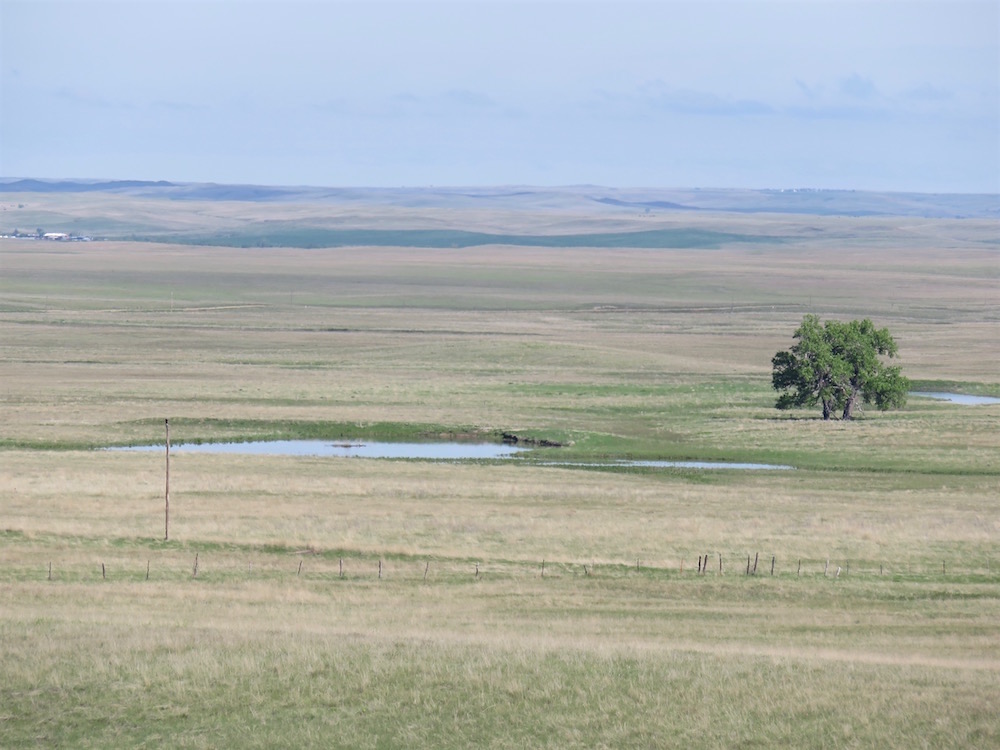
“The Big Empty”, for the Cosmic Photo Challenge: Wide Open Spaces

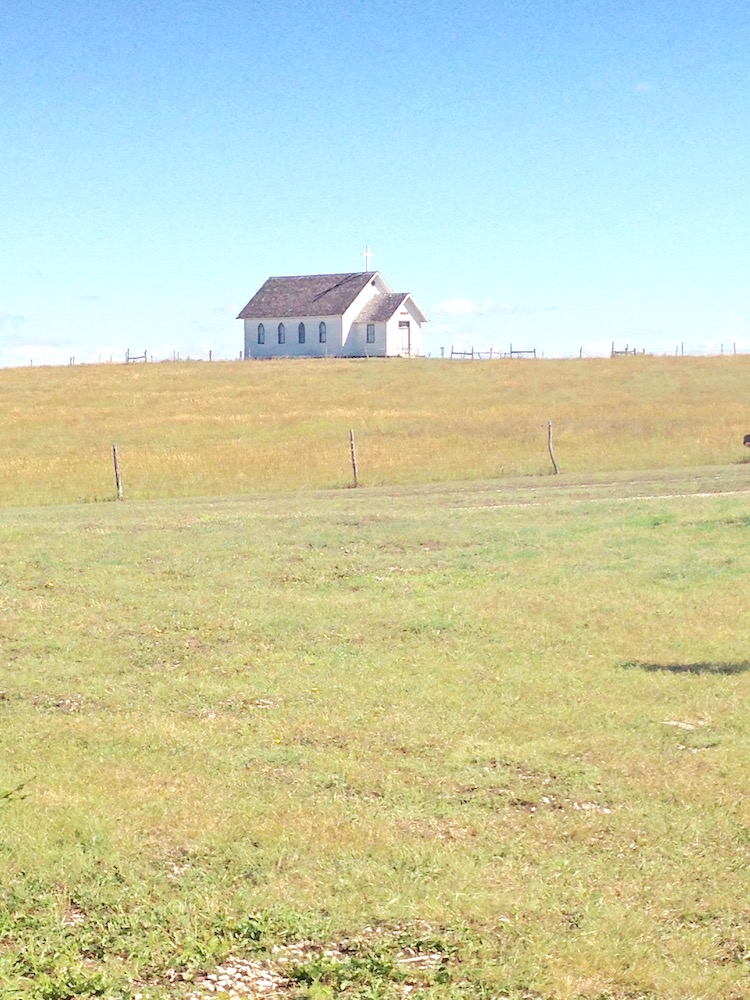
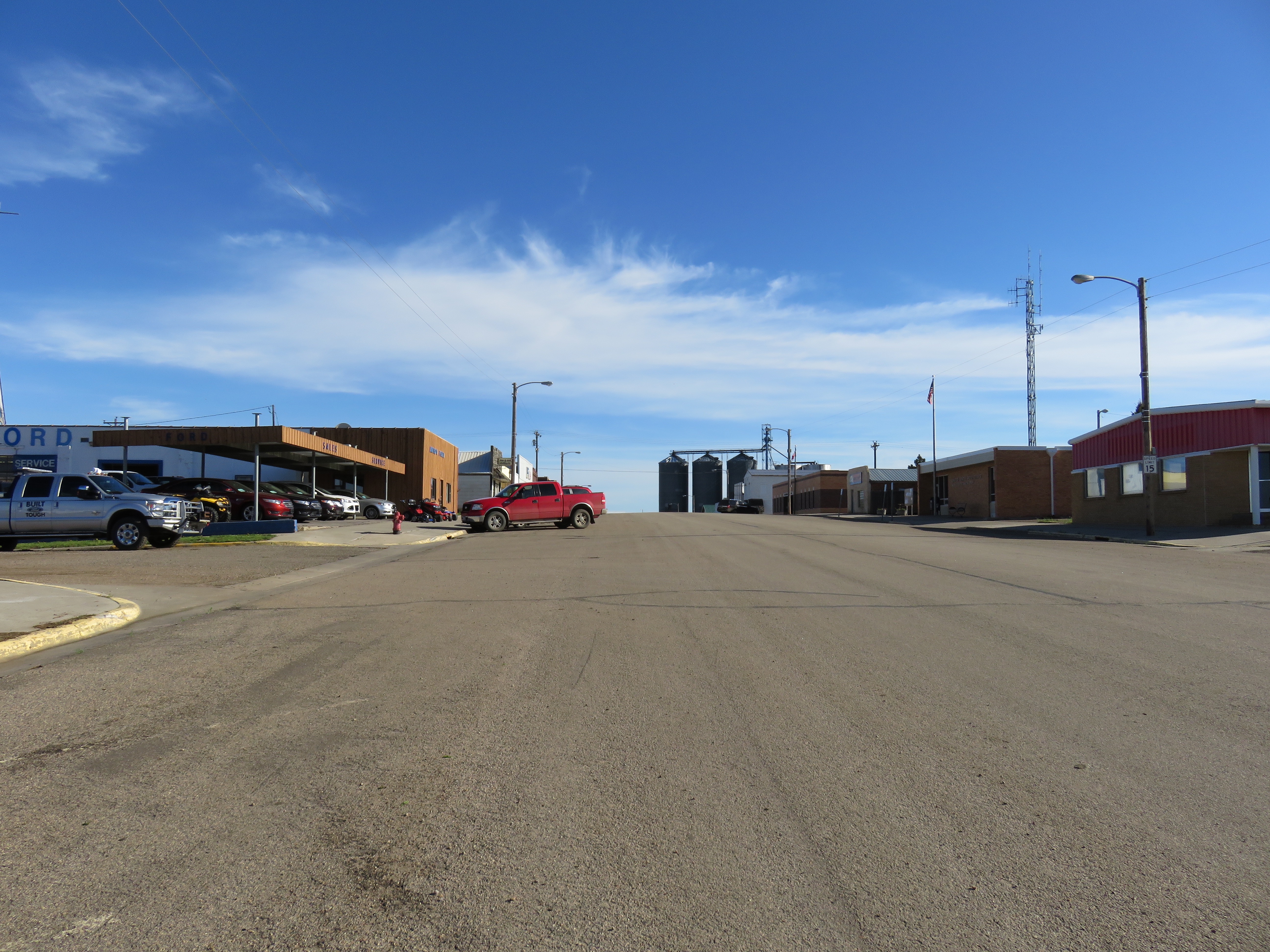
These are all photos of  the country around Murdo, South Dakota, where I grew up.  First, Interstate 90 which cut through the edge of the town, and the country just to the west of  town. The third and fourth photos are of the last piece of land my sister and I owned there which we sold a few years ago. It had once contained the last house my parents lived in  there which had since blown away in a tornado. Do these qualify as wide open spaces???

For the Cosmic Photo Challenge: Open Spaces

Small Town South Dakota

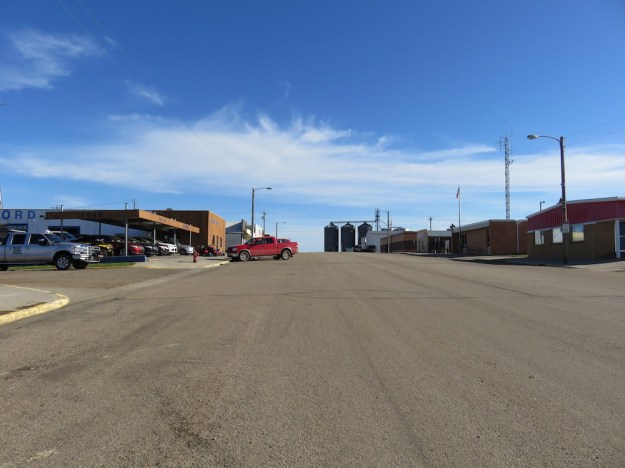
Believe it or not, this was our main street, two blocks long!

Still Life With A Small Town Girl

For many years when I was small and far into my teens,
my summer days were filled with little else than magazines
and books and all the other things a girl in a small town
brings into her summers just to make the days less brown.

Day after day of reading soon led to dreaming, and
my shade beneath the cherry tree became a foreign land.
I did not know the name of it, but in this foreign place
the people did such lovely things. They kept a faster pace.

There were many things to see and people who liked doing—
circuses and carnivals, badminton and horse-shoeing,
imaginings and plays and travels. People who liked dancing.
Instead of trudging down the street, these people would be prancing.

I dreamed such dreams of bigger towns, and far-away towns, too.
All summer, I lay in the grass, dreaming what I’d do
when I was so much older and could go out on my own.
I’d wander off into the world. Explore the great unknown.

Now six decades later, I have done it all—
so many of those things I yearned to do when I was small.
I’ve been to places far and wide—Africa and Peru.
In England, France, Australia—I found so much to do.

Plays and concerts, dances, films, museums, garden walks.
Lectures, movies, workshops, classes, roundtables and talks.
Tours and treks and trips and sorties—guided meditations.
Somehow life seemed fuller packed with exotic vacations.

But now that I am seventy-six, I’d appreciate
if all this activity would finally abate.
I dream of slower days that I’d spend dreaming in the shade
where all my memories of days spent doing would just fade

into the past and leave me to dream here in this place,
swinging in my hammock, at a slower pace.
Leaving my activity to stream from head to pen,
filling up the page with all the places I have been.

Thus making sense of why I had to go and go,
speeding up the days that back then seemed to me so slow.
I guess I had to travel to find others of my kind
to teach me that life’s riches are mainly in the mind!


For dVerse Poets, we are to write a poem about a city. If you’d like to see more photos of my small town and environs, go HERE. And you can see how others responded to the prompt HERE.

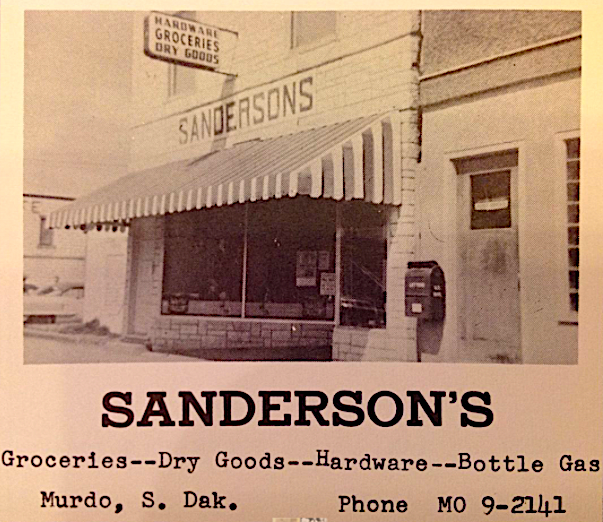
SANDERSON’S STORE

Sanderson’s Store

Allowance day on Saturday dispelled the winter’s gloom
of trudging through the snow to school or sealed up in my room.
Too cold and blizzardy outside, my mother had the gall
to ban me to a play space of room and stairs and hall.

No Fox Fox Goose, no snow forts. No sliding on the ice
of sidewalks frozen over.  Just games of cards and dice,
dolls and dressing up in my older sister’s clothes.
No snow boots shedding ice and sludge. No chilblains on my nose.

Oh but on certain Saturdays, with weather calming down,
armed with dough, we kids would form a caravan to town
six blocks away, ploughing the snow with boots sliding in front of us,
a column of five kids or more made snowdrifts feel the brunt of us.

Flashing our allowances, we plundered penny sweets
in the big assorted box of Tootsie Rolls and treats
like Double Bubble, Chicken Bones, Fireballs and Nik-L-Nips.
Now and Laters, Jelly Beans and chewable Wax Lips.

Tootsie Rolls and Red Hots, M&Ms and Jaw Breakers.
Malt balls, Sugar Babies, Lemon Heads and Necco Wafers.
As we counted out our pennies, Tet would add one candy more
every Saturday that we could get to Sanderson’s Store. 

Prompt words today are caravan, gall, gloom and candy. (Jelly beans, M& Ms and candy heart photos thanks to Unsplash. Used with permission.)


Here is a note I got from Mary, She is the grandniece of Tet (of Sanderson’s Store.) 

“This certainly brings back warm memories. I remember getting my brown bag of candy at Sanderson’s to take to the show with me on Saturday night. Aunt Tet loved all the kids and wouldn’t take her lunch break until after all the kids had stopped to buy their treats on their way back to school. I had forgotten some of the candies you mentioned. Thanks for sharing this with me. I loved it!  Mary.”

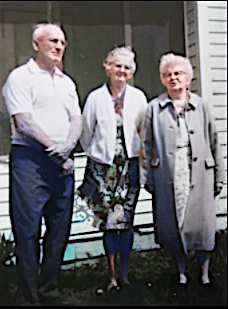
Below is a photo of Tet, standing between her sister Melitha and her brother, M.E., who was a recruiter for Cornell College in Iowa and who recruited my older sister Betty Jo to go to college there. My middle sister, Patti, also went there for one year. Lots of connections in a small town.

With Reservations: True West

I think it is only appropriate that I rerun this piece written many years ago for Indigenous People’s Day

IMG_0078

True West: Racial Stereotypes in a Small South Dakota Town

I grew up in a very small town (population 700) on the prairies of South Dakota. I was not aware of a wide disparity of classes at the time; but looking back, I see that there really were classes based on economic and racial factors.  Since my town was situated quite near to several Indian reservations, there was often at least one native American in my class.  In the second grade, it was Clifford Leading   Cloud—14 years old and placed in the second grade.  Needless to say, he towered over the 7-year-olds. No doubt this was why he was constantly stoop-shouldered and his demeanor was apologetic and shy.  He was a wonderful artist, and I still have several of his drawings.  “Clifford drew this for me!” I proudly wrote beneath two colored-pencil sketches in my scrapbook, but when I took them home to show them to my mother, she said, “Be sure to always wash your hands after you touch those.”  Obedient at this stage of my life, I remember complying, but I was always puzzled about why.

Since my name began with a “D” and our placement was always determined alphabetically, I sat behind or in front of all of the Native American kids who joined our class for a year or two before disappearing: Clifford Leading Cloud, Phoebe Crazy Bear, Nordine Fink (Who was my assigned “date” for Freshman initiation, but who somehow disappeared during the year.) Phoebe had very long black hair that I loved to brush during Geometry. (In spite of former warnings from mothers who told us to be careful not to contract lice from the “Indian” kids.) She was a good student, and I liked her dry sense of humor; but although I invited her to slumber parties, she never came and she, too, vanished by the end of our Sophomore year.

I know there was a division in our community between the white population and the Native Americans, many of whom still lived in tents along the railroad tracks because it was federal land and the head of the railroad allowed them to live there free of charge.  When I was given release time from study hall to teach P.E. and reading to first graders my Jr. year in high school, the sweetest and most beautiful first grader was another Leading Cloud—who, probably due to living in a tent with no bathroom facilities and no running water—had such a strong stench that it brought tears to my eyes to stand over her for long as I guided her in her reading.  My mother attributed this to the use of “bear grease” in the hair, but I think she was a few generations behind in her thinking.

The factors of difference in culture, living arrangements and economic factors divided us from the Native American citizens of our town so that aside from actual classes as school, they faded away into the environment in a manner that should have been impossible in a town as small as ours.  They did not attend games, dances, or participate in any of the extracurricular activities of the school. They did not attend church or hang out in restaurants.  I do remember my mother asking us to sit in front  and back and either side of her when we went to the movies in White River, 32 miles away.  Closer to the reservation, there was a higher Native American population and my mother, sensitive to smells, wished to take all proper precautions.

My mother was not unkind. She fed any hobo who showed up at our door. She took boxes of clothing out to the dump and set them where foragers could easily find them.  She also told me never to mention that clothing had been mine if any of the Native American kids showed up wearing one of my give-aways. But she was the product of an age where we had not yet thought to struggle against racial stereotypes.  My father regularly employed seasonal workers from the reservation and even learned to speak some Sioux.  He was a natural born storyteller who loved gleaning material from all and sundry and a broad-minded thinker. One of the few Democrats in town, he counted everyone among his friends–from his Hunkpapa Sioux employees to the Governor of the state.

Yet, should the doorbell ring when my dad was not at home and  if my mom were to see that it was someone from the reservation stopped at our house to ask for work on his way into town, she would tell us not to answer the door and would cower in the hallway out of sight. Again, I know my mother well enough to know it was genuine fear that prompted her actions, not meanness or hatred.

There were two families of Sioux lineage in the town who did manage to bridge the gap of cultures.  In one case, it was a handsome young man who was an incredible basketball player whose name revealed his mixed Sioux and French genes. He was the secret heart-throb of many a girl, and his sister, as beautiful as he was handsome, was a cheerleader and generally accepted, I believe, although they were enough older than I am for this all to be hearsay.

The other family that was able to bridge the two cultures was also of mixed lineage–white and Sioux.  Another beautiful family, their son was also an excellent ball player and both of their daughters were cheerleaders. (This was the highest rank of success in our town—far above Valedictorian.) In both cases, the cultural differences were only a matter of skin color. They were not living in tents along the railroad tracks or migrating back and forth from the reservation.  In  most respects, their lifestyles were no different from our own.  Still, I have heard that when one of our most popular young men married one of the popular young ladies I’ve just mentioned, that his mother was heard to say, “He’s marrying that squaw.”

It seems as though the major factor, then, that created a class structure in our town was one of culture coupled with economic duress.  Yes, there were poor families in our town and many times they did not participate as fully in what little social life there was in our town, and yes, although I started out inviting everyone in my class to parties, in time the parties got smaller and the guest list included mainly those friends from my neighborhood or those I found to be the most fun or who participated in the same activities I participated in.

This narrowing of social circles is natural, I think, but when I look at who was excluded, I don’t feel as though I used any criteria other than whom I enjoyed being around. I would have loved it if Phoebe had come to my slumber parties. She was smart and even then I had a curiosity about other cultures and other ways of life. I was the first friend of any new girl who moved to town—a fact that caused some resentment on the part of my old friends, I now see clearly.

We all make excuses for ourselves when it comes to discussing our own prejudices, and I am no exception to the rule. Native Americans were stereotyped because the most extreme cases of behavior were the most obvious. The few women from the reservation who came to drink and lay sprawled in the street created the stereotype that all “Indian” women were “drunken squaws.” No one ever saw any of the mothers of the Native American children we went to school with. They were no doubt at home trying to scrape out a meal or school clothes for their children’s next next day at school.  And their fathers were probably out working in the fields for our fathers. But we did see the drunks on the streets every Saturday night as we exited the movies, and so this is the stereotype that formed in our minds, no matter how much our actual experience with kids at school rivaled that stereotype.

Many years ago, I started to write a book called “Vision Quest” about a young Native American boy who grew up in our town. This was a work of fiction, but I drew of course upon actual experience for details of plot.  I know I came back to it at least twice, but never got beyond the first few chapters, probably because I had so little experience to draw upon; for in spite of the fact that I grew up in a state that contained numerous reservations and in spite of the fact  that all of the surrounding towns contained a Native American population, in fact our cultures were so widely divided that I had as little insight into their lives as they must have had into mine.

The term “Native American” had not been coined when I last lived in my hometown, and neither had the sensibilities that I hope go with it. When Dennis Banks and Russell Means were heroes to much of the rest of the world, they were outlaws and trouble makers to those non-Native Americans who lived in their midst. To someone stopped from driving on highways where they had always driven, they appeared to be highwaymen or brigands. It is hard to make a hero of someone you grew up feeling superior to, and hard not to stereotype any race or cultural group according to what you know about the few representatives of that group with whom you have come in contact.

But I have to say that coming back to my town and hearing one of the supposedly kindest and admittedly hardest-working members of the church I grew up in describing the wife of a local boy as a “N—–” and scathingly speaking of the Native American Rights movement of the seventies made me take a really long look back at my own past as well as to reappraise my former affection for this woman whose small-mindedness revealed itself at a time when I myself was in love with an African man, teaching African children and living with African housemates.

The last time I visited my hometown, I did not go to see this lady and by the time I next went, she had passed away. Hopefully with the demise of these last citizens of the old ways, prejudice will pass away with them. I am afraid, however, that prejudice is born anew in each generation—perhaps towards yet a new group of immigrants or transplants who threaten the so-called “American Way of Life.” It would do us all well to remember that America was meant to be a melting-pot, and as in any recipe, it is made more palatable by a variety of spices.

Close enough to touch,
we came from two different worlds,
so never quite met.

for dVerse Poets I’m sort of breaking the rules as this introductory prose piece is too long to be a Haibun, but at least it is on the correct theme.

Cowboy Identity Revealed––and with A Twist!!!

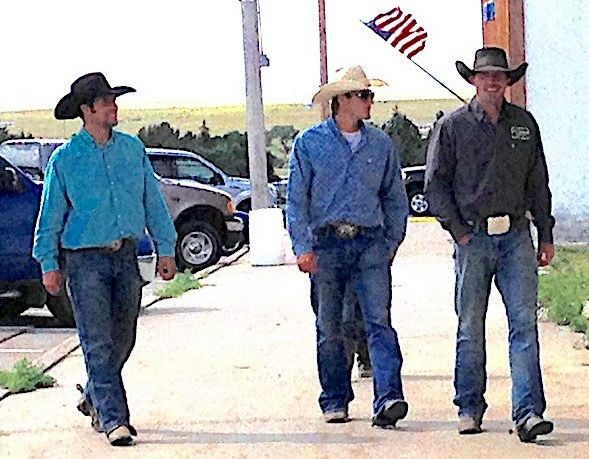
Earlier this week, I published a poem about cowboys and illustrated it with a photo of three cowboys that I took on the street during the 100th anniversary parade of the little town I grew up in in South Dakota.  I had no idea who they were, but today I received this communication on my Facebook page that not only identified two of the handsome young cowboys, but which also informed me of an unusual twist of fate concerning the identity of one of the cowboys.  Here is that Facebook conversation with Wayne Esmay, who still lives in (or near) my hometown of Murdo, South Dakota:

Judy Dykstra-Brown Does anyone know who these Jones Co. cowboys are?
Wayne Esmay On Left: Craig McKenzie
On Right: Chauncey Labrier
Center: ?
Judy Dykstra-Brown Thanks, Wayne. Is Craig related to Mackie McKenzie or Evelyn McKenzie? Trying to think of any other McKenzies I knew…

Judy Dykstra-Brown And are you Vickie’s brother?

Wayne Esmay Yes, I am Vicki’s oldest brother. My dad’s name was also Wayne.
Craig McKenzie is the son of Chester, and who is the son of Bud McKenzie. Bud was Macky McKenzies brother.
Chauncey Labrier is the son of Larry Labrier, who now is the owner & resident of your dad’s ranch and home place.
Small world, Isn’t it!

Judy Dykstra-Brown How ironic. Thanks so much, Wayne. I’m going to copy your comment into my blog. Your sister Vicki visited me in Australia and I believe I was the Sunday school teacher of your youngest sister (Wanda?) who was an adorable little girl. I also remember your mother, Margie, well. We had some connection when I was a little girl. Did she stay with the Brosts when she went to high school? Trying to jog my memory. I remember she was an older girl that I admired.

Note from Judy:  My father’s ranch has been resold several times since its first sale in the late 1960’s and I had no idea who the present owner was.  It is so ironic that the one photo I took of people on the street after the parade should be the son of the present owner.


Playing in the Air

Two children fell from the top of this slide in the playground across from the house where I grew up. One of them was my sister Patti, pictured nearest the top in this photo. The second child to fall tragically died, but the slide was not removed or altered until the old school building was replaced years after I had grown up and moved away. I am the third and lowest child in this photo, following along, as usual.        photo circa 1949/50 by my other sister, Betty Dykstra Wilcox

https://ragtagcommunity.wordpress.com/2018/10/26/rdp-friday-slide/