The Prompt: Think Again—Tell us about a time you made a false assumption about a person or a place — how did they prove you wrong?
Naïve in Africa
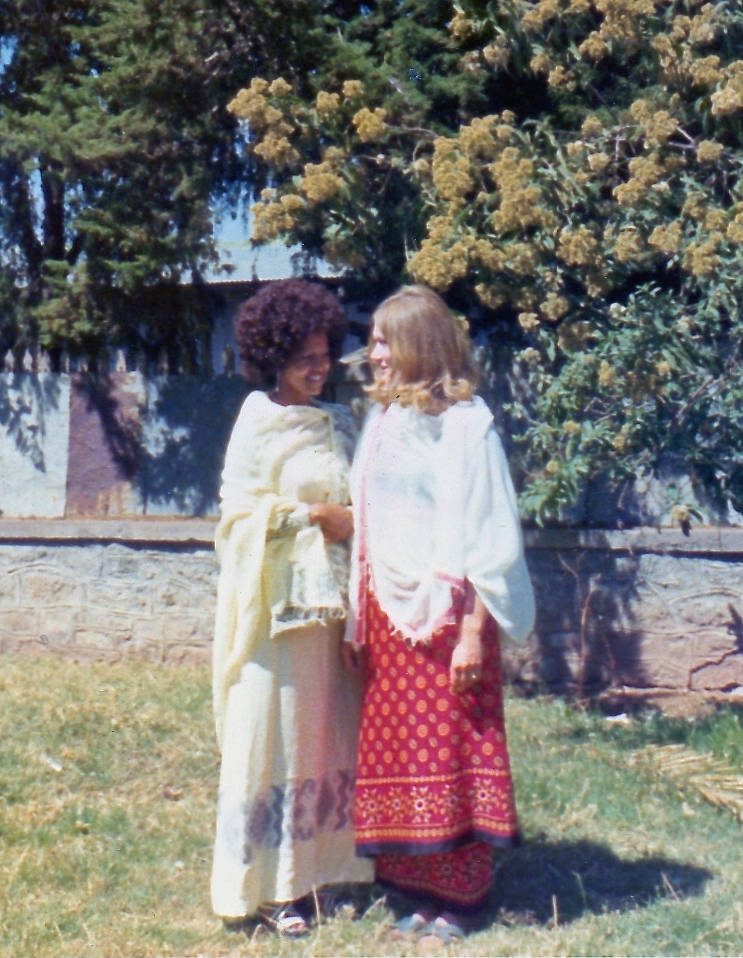
The year was 1973. I was traveling with my friend Deirdre enroute from Australia, where I had emigrated when I graduated from college, to London. Or so I thought! We had set out from Sydney and traveled overland to Darwin, then flew to Timor. After a very adventurous few weeks, the story of which is too long to tell here, we traveled through Bali and other Indonesian islands, by boat up to Tanjung Pinang and to Singapore, to Sri Lanka, then to Kenya, Tanzania and Ethiopia.
In Ethiopia, Deirdre wanted to see Lalibela, an extremely isolated area of 12 stone underground churches carved in the 1100’s from the living rock. After more adventures traveling through the terrible drought areas via local buses and then by plane, we ended up in Lalibela. Another long and romantic story would detail how I met Andu Alem, one of the loves of my life, and how Diane and I became separated, then how I decided the relationship wouldn’t work and boarded a plane to go back to Addis Ababa to rejoin her. (If you haven’t already read that part of the story and want to read it before you continue, you can read it here. There is a link at the end of that story that will bring you back here.)
When I got on the plane, I was crying, knowing I was leaving someone I cared about but also knowing a relationship would never work as his father was very prejudiced against Americans and my father, who was very ill at the time, would probably not survive the news of an African son-in-law.
I didn’t notice the man who sat a few aisles behind me, watching every detail of my departure. I didn’t see him watching me sobbing into my last soggy Kleenex. I didn’t see him move to the seat across the aisle. I had no idea of what was about to happen, and how it would change my life. I was as ignorant of the next chapter of this story as you are—caught up in the sad ending of my love story, with no idea that there were much worse endings than unrequited love.
I watched Andu Alem below as the small plane lifted off the grass landing field.
For the next 15 minutes I sobbed as quietly as I could. I must add here that I am not a pretty crier. My eyes swell and turn red, as does my drippy nose. Eventually, I regained some composure and then noticed that the young African man who had spoken to me before was now sitting across the aisle from me. Since I was in a window seat, there was an empty seat between us. After a few moments, he asked if I was all right and if he could help me. I said no, that I’d rather just be alone, and he left me alone for a few more minutes.
Eventually, he started talking again and asking if there was something wrong. I said no, that I had just left a good friend and was very sad. He said that he was a student and asked if I would mind talking to him for a few minutes so he could practice his English. This was a common request as we traveled from country to country and as usual, I felt it was the least I could do; so we fell into a conversation and he eventually moved into the seat next to me.
He was extremely good-looking and looked a bit old for a student, but he showed me an identification that did in fact identify him as a student named Solomon Kidane. I knew that often students from the country could not afford to go to high school until they were in their twenties, so I was not too surprised that although he looked older that he was still in his last year of secondary school. He was pleasant and his English was good so we talked most of the way to Addis.
When we were about 15 minutes from landing, he asked a favor of me. He explained that he had been offered a scholarship to attend college in the U.S. but that his mother was unwilling to have him accept it as she feared racial prejudice in the U.S. and that she was afraid he would be mistreated or even killed. He asked if I would be willing to meet his mother to show her that all Americans were not prejudiced and unfriendly. I told him I was sorry, but that I really didn’t have the time as we were leaving the next day to fly to Khartoum.
He pleaded with me, saying that this was something that could change his entire life if I would just do this one kind act. He said that if I would come for dinner at his mother’s house, that I could meet his family. He would send a taxi for me and we would be with his mother and sisters and nieces and nephews the entire time. Then I could take a taxi home to the motel where I knew Deirdre was staying, awaiting my arrival.
Feeling selfish and the usual embarrassment that American travelers oftentimes experience regarding the imagined rudeness of many of their fellow countrymen, I eventually agreed. What could happen? And it could be a turning point in his life.
When we landed, Deirdre was at the airport waiting and we took a taxi home together. When I told her about my arrangement for that night and asked her to accompany me, she refused, saying it was just too dangerous. I didn’t know him. Anything could happen. With my usual small town naïveté, I insisted that I couldn’t be safer. We’d be in a taxi, then with his family, then I’d take a taxi alone back to the motel. What could go wrong? Little did I know.
At almost exactly the prescribed time that night, Solomon Kidane showed up at my door. Deirdre was still disapproving as we left and got into the waiting taxi. We rode for about 15 or 20 minutes to a part of town I’d never been in before. We drew up to a large gate and when he knocked, the sabanya (watchman) opened the gate and admitted us. Most homes in Addis were in enclaves around an open courtyard and the houses within the walls shared one guard.
Just inside the gate was a set of steps that led up to the second story of a house. We entered into one large room with doors leading off to the right. Inside were a number of women and children, one of whom was introduced to me as his mother. The other women and children were said to be his sisters and nieces and nephews. There were probably about 12 people in the room. He drew up low stools and produced beer. Three of his male friends had been invited and I realized rather quickly that they all looked familiar. They had all been on the plane!
We had a meal of injera and wat, all eating with our fingers from the same large plate, as was the local custom. Prior to and after the meal, one of his sisters leaned down in front of each of us with a pitcher of water and bowl with a bar of soap on its bottom. As she poured the water over our hands, we used the soap to lather up, then rinsed them in another stream of water and dried them with the towel hanging over her arm.
As the evening progressed, the men drank quite a bit of beer. I noticed that some of the women and children had left and told them it was perhaps time for me to leave. I’d talked to his mother and Solomon had said he thought she liked me and that it had helped, but he said to stay for just a little while more. By now, he especially was quite affected by drink.
One of his friends leaned forward to reach for a new beer and his suit coat fell open to reveal a shoulder holster and gun. I looked around and realized that they all had slight bulges under their suit jackets. I grew alarmed and seeing that I had noticed, he admitted that they were all security agents on Air Ethiopia. Earlier that year, the first air hijacking had occurred, of an Ethiopian Airlines plane flying from Kenya to Addis. Since then, they had had undercover security agents on all planes.
I asked him about his student ID and he showed me four different sets of identity papers. He said they used various “disguises” so no one knew they were on the plane and that they were all armed at all times. As members of the special forces, they were skilled in martial arts, combat techniques and gunmanship. During the progress of the conversation, their tongues grew loose and I realized that they were all Tigrian or Eritrean—two northern areas, formerly countries in their own right, that had been agitating for their freedom from Ethiopia ever since the British had unified the three countries at the time of their draw-out. I also grew to understand that they were in fact all double agents who had infiltrated the Ethiopian security forces but who were really sympathetic to the rebels.
At this point I looked up and realized there were no women left in the room! I got up and headed for the door, saying that I had to leave, but Solomon stood and gripped my arm, saying that he couldn’t let me leave. At this, the three other men left the room. I begged them to let me leave with them, but they said nothing—just left. When they opened the door, I screamed out, hoping someone else in the compound would hear me, but to no avail.
He was talking crazier and crazier. He pulled me into the bedroom and threw me on the bed. When I screamed and started to get up again, he hit me and started strangling me. I stopped struggling and said to him, “You know, if you hurt me, I am a very good friend of George McGovern, who comes from my state, and I will tell him and he will tell Haile Selassie, and he will punish you!”
He replied, “No you will not, for since I love you, I had to take you and afterwards I will have to kill you.”
At this point, I knew I had to use my brains as I was not accomplishing much with brawn, so I quieted down and let him kiss me and then said, “Okay. I can see that you love me, but this will be better if I comply, so I want to get ready for you. Would you please leave the room for a moment so I can get ready.”
Dear God, thank God! He left the room! Immediately, infused with the energy and strength of panic, I shoved a very heavy freestanding closet in front of the door, which didn’t lock, ran to the window and threw open the shutters. Again, thanks to a God whom I didn’t completely believe in, there was no glass! I could hear him beating at the door and the chest was moving, so I just jumped out the second story window, hurting my ankle and skinning my leg but not even noticing as I ran to the front gate screaming for help.
I beat on the gate, but the sabanya (watchman) did not leave his enclosure. No one in any of the small houses surrounding the courtyard came to my aid. I saw one old woman peek out of her door and I screamed, “Help me! Help me, please!” Of course, no one spoke English. She immediately slammed her door shut and pulled the bolt. At this point, Solomon came down the stairs and said, “You have lied to me, and now I will have to punish you!” He grabbed me by my hair, which was very long at the time, and pulled me back up the stairs. I continued screaming for help, but none came.
When we got to the top of the stairs, he pulled me into the house and slammed the door, which bounced on its frame and opened a crack behind us. He was still pulling me by the hair, but as we left the living room, my hand, grabbing out for anything to use as a weapon, struck a heavy ceramic lamp. I grabbed it and gaining a foothold, swung it at him, hitting him over the head and knocking him down. Running again for the front door, I saw it open and a tiny little lady I had never seen before grabbed my arm and pulled me down the stairs. At the gate, she called for the guard to open the gate. I ran out into the street and into the first door I found open…back through a large room and into a back bedroom, screaming “Help me, please help me!” A woman came and I kept saying “Police, Please call the police!”
At this point, the man I knew only as Solomon Kidane came into the room and charmingly tried to convince the crowd of women who had now gathered to let me go with him, but they folded around me and the police soon arrived. ( I eventually learned that it was a brothel that I’d run into and that the women who had helped me were all prostitutes, as were the women Kitane had hired to pose as his family in the house he had set up as his family house in the compound. All had been a ruse—mother, children and sisters!)
I told the police my story, although they had no English and I had very little Amharic, but eventually they put me in the back of a police car, and feeling safe again, I felt a huge surge of relief, at least until I turned around and saw that Solomon Kidane was in the back seat with me! He had convinced them that this was a lovers’ spat and that if he could just talk to me, that all would be well.
I screamed bloody murder, kicked and hit at the door and window glass, and eventually the police told him to leave the car and took me to the police station where I was examined by a doctor who took pictures of my scrapes and bruises. When they finally took me back to the motel, it was very late and of course, Deirdre got to say her “I told you so’s” which were well deserved.
The next morning I called the American Embassy and they sent a car for me. It turns out that this was not the first time an American woman had been abducted, but any of the others who had survived had always been so frightened that they had left Ethiopia as soon as possible without pressing charges. The embassy was very interested in bringing the matter to the court and said they would pay for legal counsel, translators, and provide protection for me if I would stay to testify; but I needed to understand that the Ethiopian legal procedure was very different from the American system and that most cases dragged on for years. Usually, a case was assigned a few hours a day once a week. Any prominent businessman just set aside a day or two a week to sit in court and wait for his part of any legal proceedings he was involved in to come up. Was I willing to stay in Ethiopia for a year, maybe two, to see that this man was brought to justice? I was fighting mad. I said yes!
Deirdre, of course, said I was crazy and that she was unwilling to spend any more time in Ethiopia. I could understand this, so I waved her off as she caught a plane for Khartoum. Another traveler we’d met, who was named Sue, got intrigued by my story and decided she would stick around to see what happened, so she spread her sleeping bag out on the floor of my motel room, as did Richard, another young backpacker we had met.
The embassy had said they’d find me another safer hotel, but in fact, the Organization of African Unity was meeting in Addis during that month, and so there was not a free room in town. In lieu of moving me, they provided an armed guard who stood outside the wall of my motel. When I left the compound, however, I was on my own. The police had not arrested the man, so he knew where I was and I knew he knew!
The first time I left the compound and crossed the street, his three friends were standing at the corner, as though waiting for the light to change. I was standing behind them before I realized who they were and when I tried to leave to go back to the motel, they formed a circle around me.
They said, “Do you know who is the father of the man you are accusing?” I said no, and they said, “He is a very important and a very dangerous man—the head of a revolutionary group that will one day change things in this country. If you do not drop the charges against our friend, he will have you killed, and if he cannot reach you, he will kill all your friends. No one will help you. You need to drop these charges.”
I pulled away and ran back into my compound. The next day I went with my attorney and we started making the rounds of government leaders, eventually making it up to the equivalent of the national Attorney General. He finally granted special dispensation for my case to be heard in one or two long sessions…or for as long as it would take…so I could be free to leave the country. A court date was set for the following week.
One very interesting twist to the story is that I was in sympathy with the cause that the men had mentioned and felt it justified, and so I never did reveal to police, my attorney, the embassy or the judges that these men were all members. If Solomon Kidane was to go to jail, I wanted it to be for his personal actions, not his political ones. I believe to this day that the men didn’t realize that I could understand their political ravings as they got drunker and by the time the night was over, they had given away a secret that I was wise not to reveal I understood.
The many frustrations and coincidences of the trial are another story, and since this part of the tale has already run on for too long, I will just say that the man responsible for my kidnapping was finally put into jail. Yes, his friends harassed me for a short time but no, no retaliatory measures were taken, at least at that time. I did not in fact leave Ethiopia for another year. During that time I taught in a local secondary school at a time when students were starting the revolution that the military would later take over, leading to the arrest of Haile Selassie and a series of revolutions that would lead to the eventual takeover of government by the group that Solomon Kidane claimed to be a member of.
My love story would resume—but would result in a tragic ending—one I will never be sure was not a result of the trial and arrest of Kidane. But that is another story in this tale of a traveler who moved through worlds not her own, never quite sure of the whole story, just traveling in that way that we all travel when we are young—centered on our own story, sure that it is our story alone and of no consequence to anyone but ourselves.
(If you haven’t already read that part of the story, you can read it here.)




 lifelessons - a blog by Judy Dykstra-Brown