I have only read two definitions other than my own for the word “flangiprop,” but can’t imagine any definition will beat this one, so I had to reblog.
Daily Prompt: The Return of the Flangiprop
Leave a reply

I have only read two definitions other than my own for the word “flangiprop,” but can’t imagine any definition will beat this one, so I had to reblog.
 “Flangiprop, Flangiprop, oh Flangi Flangi Flangi!”
In response to The Daily Post’s writing prompt: “Flangiprop!.” Invent a definition for the word “flangiprop,” then use the word in a post.
Now here is a prop after my own heart! What fun.
A flangiProp is of course a lipped support for a Mac computer that lifts the back of the computer to make it more ergonomic!
From:
“flange”––an external or internal ridge, or rim (lip), for strength, as the flange of an iron beam such as an I-beam or a T-beam; or for attachment to another object, as the flange on the end of a pipe, steam cylinder, etc., or on the lens mount of a camera; or for a flange of a rail car or tram wheel.
“i”––a letter of the alphabet whose exclusive copyright is held by Mac computers, i.e. iPhone, iTunes, iCloud. (Permission for my use of “i “in “i.e.” was granted by Apple for one-time usage in my blog on 10/3/2015. Any copying, reblogging or other transferal of that part of this blog is punishable to the full extent of the law!!! And you’d better believe, Apple is watching!)
“prop”: verb––to position something underneath (someone or something) for support. “She propped her chin in the palm of her right hand.” To hold up, shore up, bolster up.
noun––a pole, post, support, upright, brace, or buttress. “The roof is held up by props.”
“ergonomic”: (especially of workplace design) intended to provide optimum comfort and to avoid stress or injury. synonyms: well-designed, usable, user-friendly
The Artist
 My friend and fabulous artist Isidro. He illustrated two of my books and will work on my third once I get it translated. If you want to see some of his work, go Here. It is all over the walls of my house, inside and out. His are the paintings of the leg, the fish, the fish with human hands…You’ll probably recognize his style in a few others. Later, I’ll take a picture of all his murals and paintings in my house and post them. If you want to see the poem that goes with these paintings and the wall art, go HERE. You can also go to my Books for Children page if you wish to see the cover for Sock Talk. I’m sorry I haven’t put up more of the illustrations he did for the book as they are fabulous. Coming up: Sunup Sundown Song which he finished in January. I just need to get it to the printer.
http://ceenphotography.com/2015/10/02/shannons-creative-photo-challenge-artist/
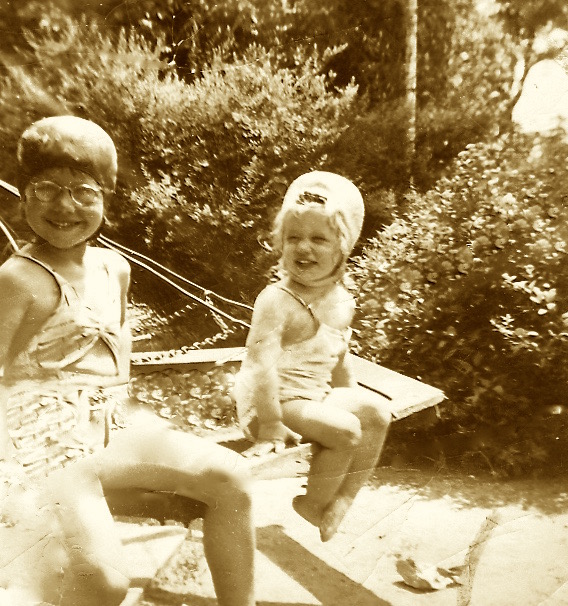
My sister and I at a park near my grandma’s house in Kansas on a merry-go-round similar to the one in the school playground across from our house in South Dakota.
Merry-Go-Round
Their creaks were my alarm that kids were on the elementary school playground across the street and if my biggest sister was downstairs or away from home or even sleeping as soundly as she always did after coming home late the night before, I’d sneak into her room to look out on the playground from above and see who was there. I knew the difference in the sound between the merry-go-round and each set of swings—the little swings next to the little slide, or one of the three big sets directly across from the block my house was on. Higher, with longer and more flexible chains, these swings could be made to loop de loop—pass up so high that you actually went over the top of the frame the swings were suspended from and wound the chain once around the pipe.
Some of the boys could repeat this three or four times until the swing got so high that none of the little kids could get up to it. Then the janitors would have to get their tallest ladder and go up to push the seat over and over the cross pole with one of their big push brooms to straighten it out again and bring the seat down closer to earth.
There were rules forbidding loop de looping, but the boys would come after school when all the teachers had gone home and even our janitors, Mr. and Mrs. Polachek, who lived kitty-corner across from the south end of the playground, were at home in their backroom away from the sounds of kids in the neighborhood, sealed up tight and safe. They were Polish, and now that I think of it, probably displaced persons from WWII. Their accents were thick and her temper was short and they were the objects of constant tauntings from the boys. One year the boys had hung a dead cat from their front porch on Halloween. I wish I could remember whether I thought this was funny, as many of the kids did. I hope I didn’t––that I was as sickened by it then as I am now.
The creak I was listening for was the creak of the merry-go-round. Teepee shaped, it had a wooden runner all the way around it a foot up from the ground. There was a handrail about thirty inches above it, so you could stand on the wooden runner, facing the center pole, hold onto the hand rail and enjoy the ride as the big kids ran around in circles around the merry-go-round, pulling it with them to go faster and faster, then stood on four sides of it, grabbing the handrail pipe and pushing it off to make it go faster still. One by one, more onlookers would be enrolled in the joint effort to get it going fast enough. Then they’d jump on and everyone would pump up and down, sticking their bottoms out into space as they bent their knees, pumping to keep up the momentum.
There were other ways to use the Merry-go-round. The bigger girls like Marie Holstedt who lived on the street that faced the opposite side of the playground from the one my house faced, would sit on the foot board with her boyfriend Robert. Their feet side by side on the ground, they would sway to and fro in a kind of two-step movement—two to the right, then one to the left––their knees touching with their swing to the right, their hips touching when they swung to the left. When they did this, the sound of the merry-go-round reminded me of the strange rhythmic creaking I’d hear sometimes late at night in my house.
It was probably the TV antenna on the roof, my mother had said. Or maybe the furnace trying to pump out heat, she had speculated when I pointed out that it had been a windless night.
Life was simple and I believed her. Only now do I make sense of it and of my father’s late night short trips down the hall to the bathroom—the washcloth always draped over the tub faucet the next morning.
It was an innocent age where it was entirely possible to be eleven years old and to never have had the least idea that anything like sex existed in the world. Yet a good deal of what eventually led up to it went on in the playground across from my house. Older girls would sit in the swings, swaying back and forth without ever taking their feet from the ground. Or, take fast running steps forward and backward without really letting go and allowing the lift off. To their side or in front of them would be their crush of the day or the week or the hour. If he was not the boy of choice, sometimes the girls would switch swings. If the boy switched again, too, and the other boy let him, then it was a sign language of sorts that indicated which boy favored which girl, and if the girls went home, a clear message that things had not matched up correctly to their satisfaction.
But at other times––usually during games of ditch ‘em played in the twilight and darkness of summer, courtships could progress toward hunkering down in the ditches around the playground, close up to some culvert where the ditches were their deepest, the girl in front, the boy with his arms around her waist, holding her back from running to try to get to home base when one of the littler kids who was “it” ran past without seeing them. In these junior high years just past childhood, the objects of the games started to shift until finally in high school, the rituals of the old games were left behind entirely and ditch ‘em became merely a starting place––as did the swinging back and forth, the pumping, the dance.
Today, with merry-go-rounds a thing of the past, they are still an appropriate metaphor for what life pushes us toward from our birth. It begins with our rocking in the arms of our mothers, the rocking chairs of our grandmothers, the wild swings through the air locked hand-to-hand with our fathers. It is what slippery slides and swings and merry-go-rounds and dancing move us towards. Everything going around and around and in doing so really going back and forth from generation to generation. Passing the world on and fading away. Now and then doing a loop de loop just because we can.
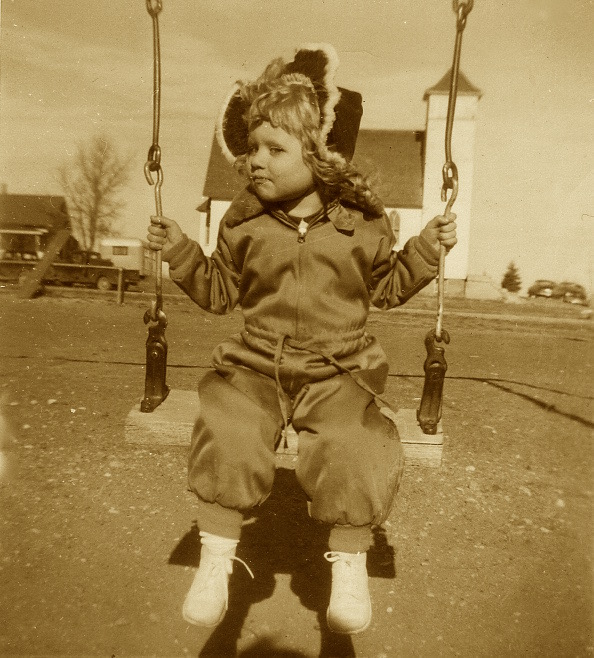
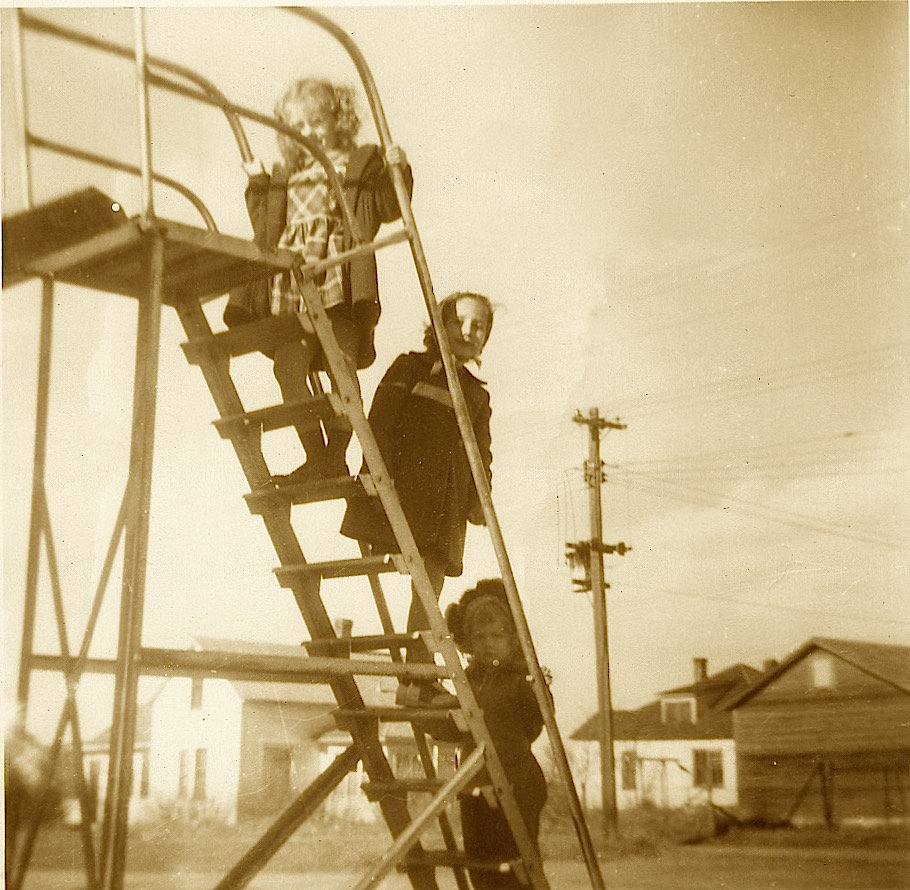
In response to The Daily Post’s writing prompt: “Ode to a Playground.”A place from your past or childhood, one that you’re fond of, is destroyed. Write it a memorial.

Random Thoughts on the Nature of Perfection
Everything in the natural order is perfect.
If you doubt this,
look closely at any flower
or consider the workings
of any animal,
including man.
Each part of nature is so intricately bound up
in the web of it all that its perfection
is only a small part of the whole.
Man makes the mistake of overlooking this
as he pokes and prods and institutes changes
in the natural order.
What man believes is of benefit to himself
is not necessarily of benefit
to the whole cycle of interdependence,
and it may not even be of benefit to himself.
PERFECTION
Potentially,
Every
Reaching
For
Excellence
Contains
This.
It’s
Opposite?
Nadir.
But all perfection is not to be aimed for.
There is perfect evil in the world
as well as perfect beauty
or perfect kindness.
If everything in the natural order is perfect.
In seeking to alter nature, it is man who has created imperfection.
Monsanto is the enemy of perfection.
MONSANTO
Perfect
Evil
Rebounds
From
Every
Can
That
Is
Opened
Now.
Perfection is best observed very close by and very far away.
Here is a printable list of Monsanto owned companies: http://www.realfarmacy.com/printable-list-of-monsanto-owned-food-producers/
Cast in Potato Salad, Carved in Stone
The last thing I ever thought I would do would be to pose for a nude sculpture, but when I married a sculptor, I guess it was inevitable. Since I never had children, this probably marked the longest period in my life that I ever lay nude being observed by a second party. I remembered having no reservations about doing so, in spite of the fact that I am really rather modest–that is about revealing myself physically. Words are another matter all together.
My husband first sculpted me in plasticine clay. (No, not the ubiquitous Sculpey, but a very dense artist’s clay used to make the originals for bronze sculpting.) He then made a plaster mold followed by a rubber reverse mold that would enable him to make further plaster molds once he destroyed the plasticine original so he could reuse the plasticine. After mastering the intricacies of wood carving, bronze casting, welding, clay, sandblasting, paper making and stone carving, he was in a difficult spot. A tool junkie, he had already purchased or made every tool necessary for working in these media. How could he justify buying any more tools or building another studio addition to add to the seven studios he had already set up?
The answer came when our artist friend Diana moved to town. Her medium was cast glass and Bob soon became fascinated with the process. Of course, this necessitated the purchase of dozens of large jars of different colored glass casting pellets as well as books, chemicals and other supplies necessary for the process. Unfortunately, we already owned a large kiln, so he couldn’t justify buying a new pristine kiln to be used only for the melting of glass. True, some molecules of clay might permeate the glass castings, but he decided at least for his first project, to use our existing kiln.
I can’t remember what his first few castings were, but after a few experiments, he decided that his first large glass project would be–ta da–a glass casting of his recumbent nude wife!
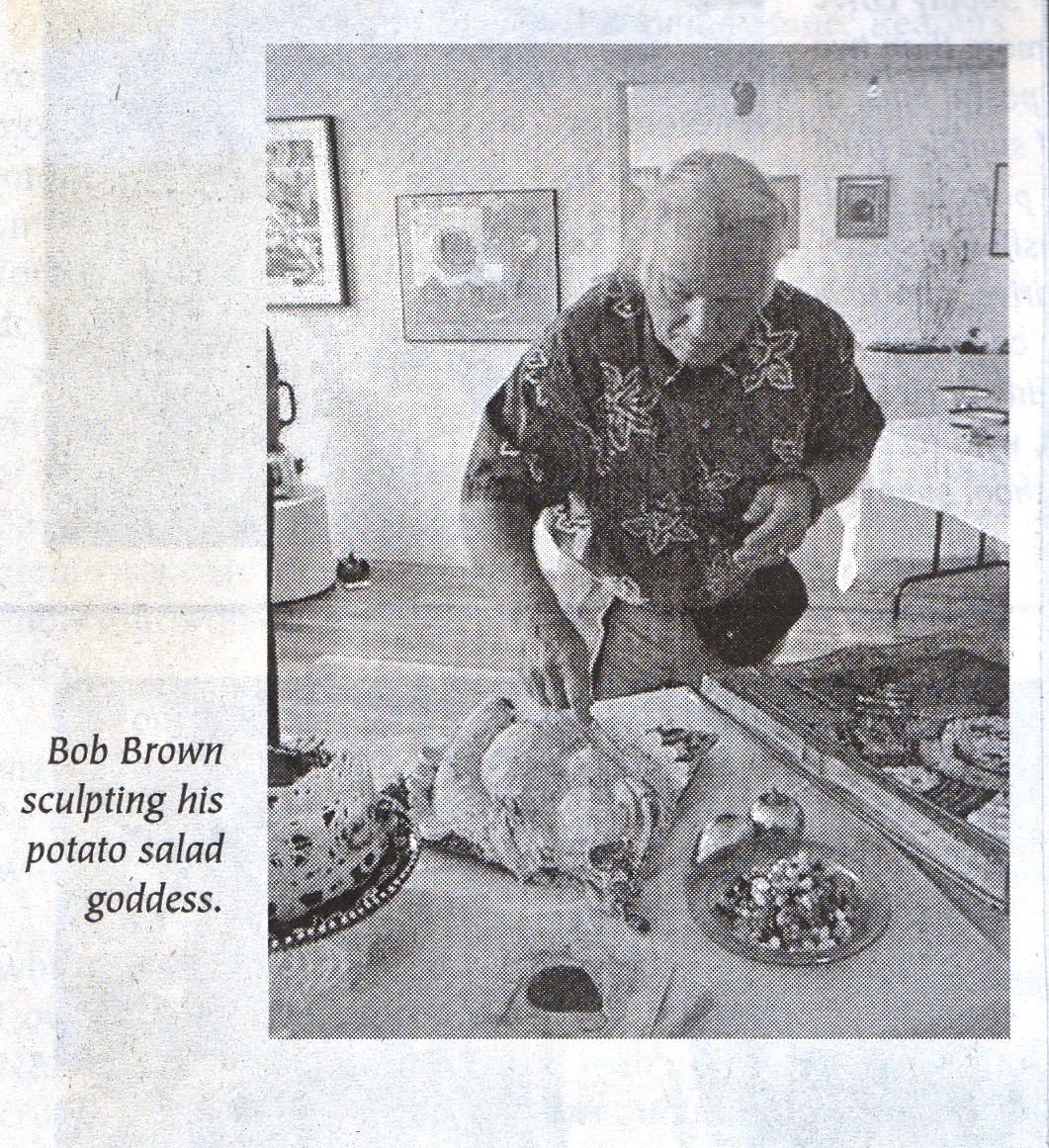
The thing was, this necessitated ordering a good deal more glass, and in the meantime, he had this wonderful rubber mold just sitting there unused! He tried to busy himself with carving stone and wood, but meanwhile that mold beckoned! Enter fate in the guise of the next show at the Santa Cruz Mountains Art Center, where we were both members. And the next show was–Edible Art! In addition to food-centered art themes, there was to be a cookbook of artist’s favorite recipes and the piece de resistance was–an edible category, to be consumed at the reception!!! Thus it was that I came to be cast in potato salad–first molded in “the” well-washed and disinfected rubber mold and then fine-sculpted by Bob’s hands.
I must admit I felt some trepidation about first being viewed nude, then being consumed by my fellow artists and friends. This smacked of the Donner party or some sort of sixties orgy, but how we suffer for our art. I requested Bob not reveal who his model was and all went well. Later, the judge told us that he would have won first place for edible art if I had not forgotten and used some of the water I used to boil the eggs to add moisture to the potato salad. I had forgotten that I always put a half cup of salt in the water to seal the eggs in case they cracked during the boiling process and that addition made the potato salad totally inedible. The judges could do nothing but award his sculpture fourth place prize in place of first, right ahead of a jellybean mosaic in the Byzantine style, but behind my third place for my “Garden of Earthly delights!”
Yes, the glass grains did arrive and yes he cast the sculpture, but what happened during the further fiasco of my chain of nude effigies must be left to another time and post lest this one grow too long for certain (unnamed) friends to read. Suffice it to say that once cast in potato salad, twice in glass, it seems only appropriate that my grave be marked by my magnificent if inedible body rendered into stone!!! It will be the sensation of my little town, I can promise you.
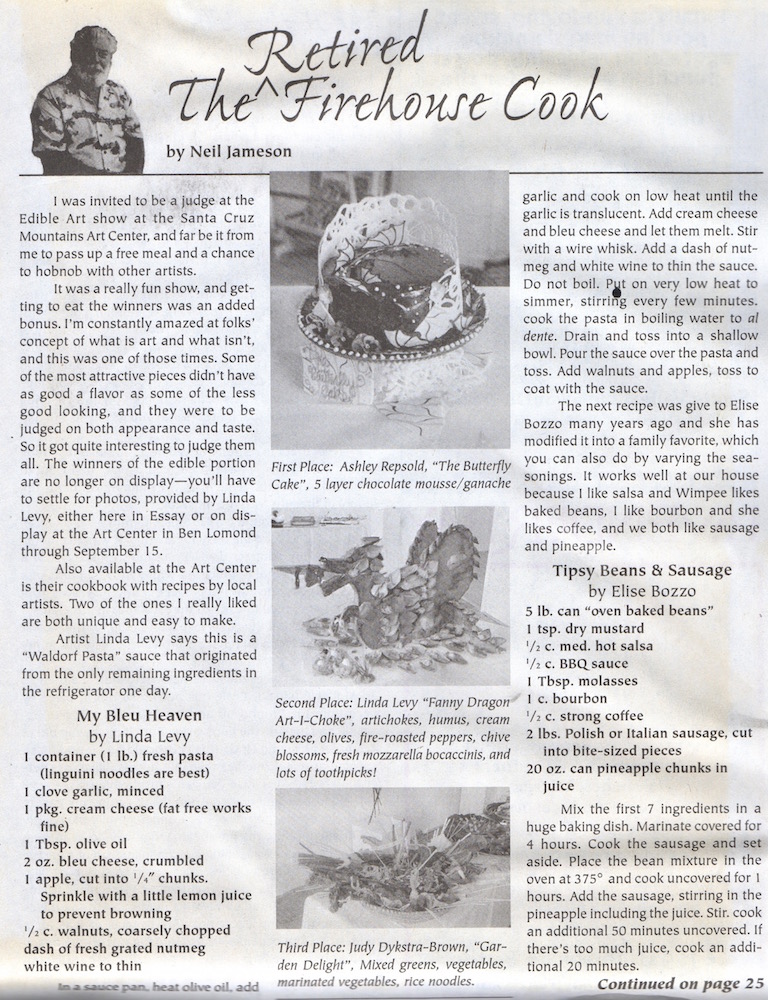
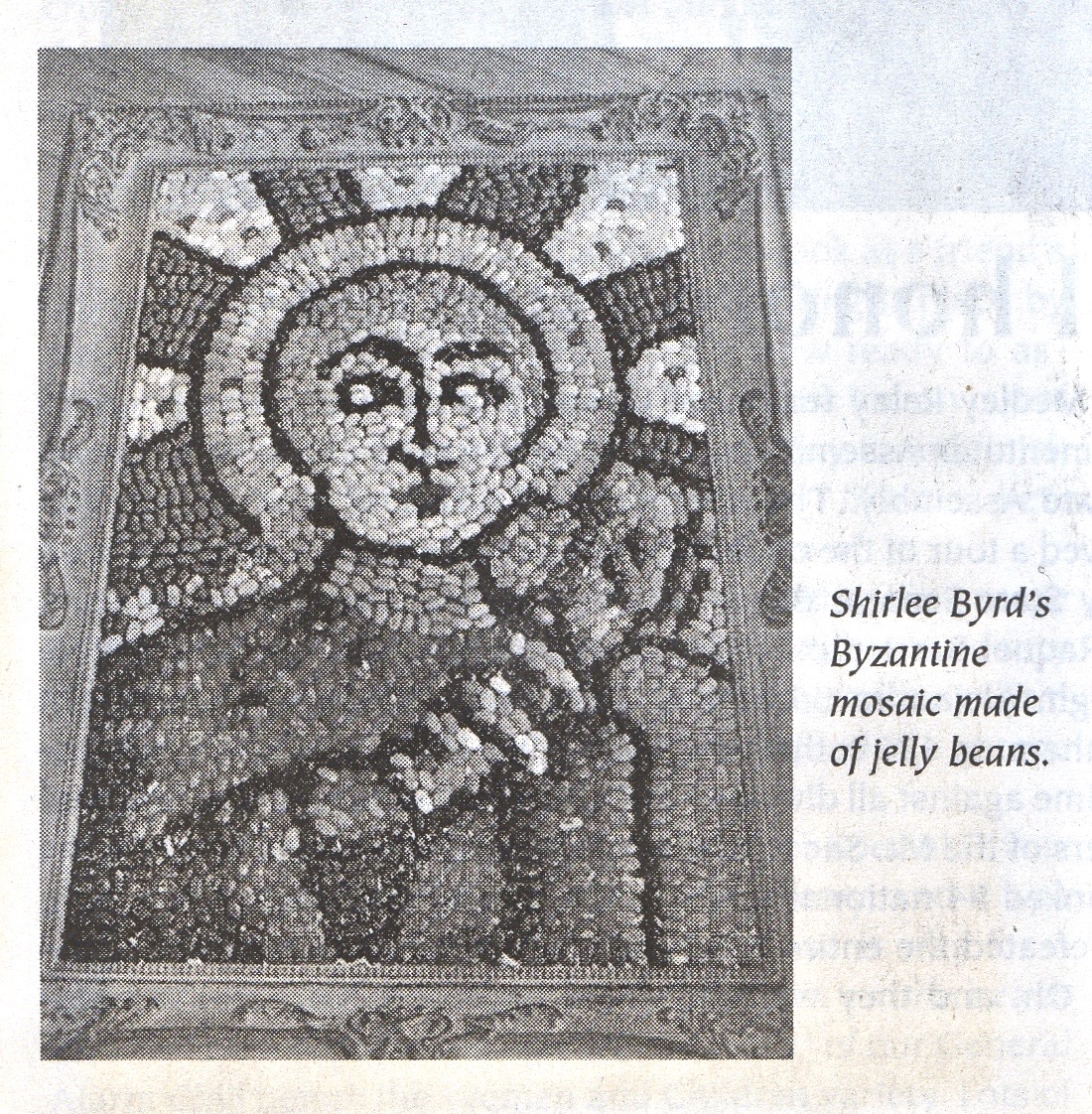 (photos and copy above taken from the Valley Press)
In response to The Daily Post’s writing prompt: “Immortalized in Stone.”Your personal sculptor is carving a person, thing or event from the last year of your life. What’s the statue of and what makes it so significant?