Author Archives: lifelessons

Unknown's avatar

About lifelessons

My blog, which started out to be about overcoming grief, quickly grew into a blog about celebrating life. I post daily: poems, photographs, essays or stories. I've lived in countries all around the globe but have finally come to rest in Mexico, where I've lived since 2001. My books may be found on Amazon in Kindle and print format, my art in local Ajijic galleries. Hope to see you at my blog.

Plagiarist, For the Sunday Whirl, Apr 21, 2024

Plagiarist

I track my sleepy footprints down to the salty sea,
with only tide and sand to keep me company.

Now and then a wispy cloud silvers the rising moon,
breaking into filigree, then vanishing too soon.

A moonbeam cracks the tidal swell and draws a slender line,
whispering this story that now I claim as mine.

Huddling on the outskirts of wave and slivered light,
I nonetheless declare my self as part of this calm night.

Sly interloper that I am, still all I hear and see
opens up its arms and seems to welcome me.


For the Sunday Whirl the prompt words are: draw cracks sly sliver sleepy footprints stories moon outskirts wispy sky sea

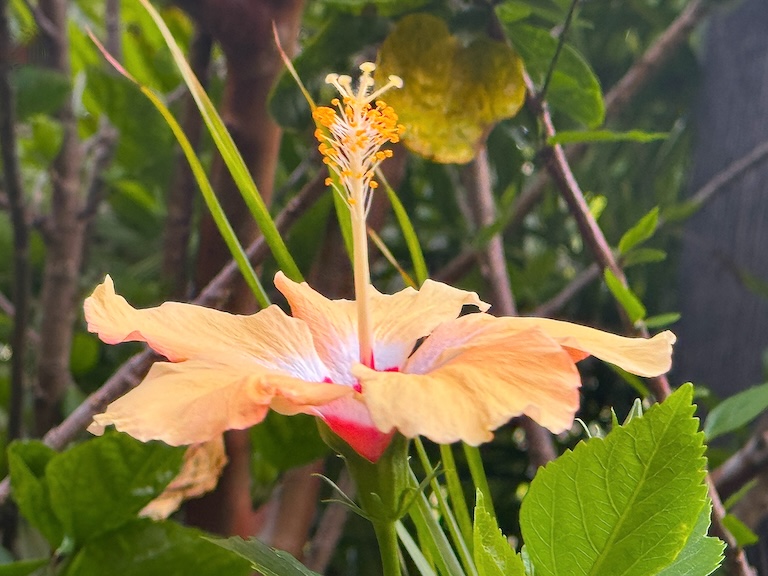
Hibiscus: Flower of the Day, Apr 21, 2024


For Flower of the Day

“Yellow” for NaPoWriMo 2024 Day 21

Yellow

You were so red, so white.
So much of you was blue.
Yellow is what I missed in you—
that brilliant optimism—
that power of the sun.
There was that black in you
that cancelled it out.
You were the artist who understood color the most.
That color created by the union of yellow and black, you knew.

Your white hair, confined in a pony tail
or streaming down your back
in your wild man look
prompted strangers to ask
if you were a shaman,
or declare you to be one.

That red that flamed out from your work,
subtly put there even in places where it had no
logical purpose for being.
That red tried to make things right.

All of us who knew you
knew the blue.
It was the background color of all of your days.
It was the blanket in which we wrapped ourselves at night,
trying to be close,
but always always divided
by blue.

For fifteen years,
I believed that one day I’d bring you to yellow.
There were splashes of it, surely,
throughout our lives together.
You on the stage, reading your heart,
me in the audience, recognizing
all the colors from within you—even yellow.

Finding the pictures you had taken of me
at the art show, looking at your work—
those pictures taken even before we ever met.
I discovered, after you’d passed,
that you had recognized
me even then, when I thought
I was the only one
angling for a meeting—
sure of my need to know those secret parts of you
that I will never know
now that you have given yourself
to the black
or blue
or red
or even to the white.

Whatever your ever after
has delivered you to.

A new life later,
I am suffused
by my own canvas
of memories of you—
every other pigment
splashed against
a vivid background
of yellow.


The NaPoWriMo prompt is to write a poem that repeats or focuses on a single color.

Leaves in a Dry Wind: NaPoWriMo 2024, Day 20

 Leaves in a Dry Wind

I was in Ethiopia in the drought years of 1973 and 74. I saw the sacks of grain for sale in the market in Addis Ababa that said, “Gift of the people of the United States of America.” The grain was being sold and the money pocketed by government ministers. One month the teachers in my school (Medehane Alem T’mhrtebet) elected to forego our salaries and use the money to buy food and hire trucks to take it to the drought areas. I was on the committee set up to deal with this transfer, but the government said it could not allow private citizens (or expats such as myself) to handle the money or the distribution. What actually happened was that the government did hold back the money, but they merely used it to pay our next month’s salary. Not a penny of that money was ever used for drought relief.

Many people at that time were not even aware of the drought because the starving people were not allowed to migrate into the cities but were held back by military. We were only aware because we traveled out in the country via bus. Dead cattle dotted the countryside and in places people formed human chains across the road to stop the buses. This was in Wollo Province, enroute from Addis to Dessie. We threw all the food and money we had out of the windows of the bus, but then traveled on. There didn’t seem to be anything being done at that time nor any means for anyone to deal with the problem.

There was one relief agency and I can’t remember whether it was Swiss or Swedish, where the aid was brought to Africa and distributed by the country it was being sent from. I had a friend who was employed by this organization and I traveled with him at one point. He told me that this was the only aid that was actually getting to the people and that no other country actually sent people to insure that the aid was being distributed to the people who needed it. This was a long time ago and my memory is spotty, but I am thinking that they were setting up schools that he was inspecting, but it may have been other agencies.

We traveled from Addis past Bahir Dar and Lake Tana (source of the Blue Nile) and Gondar, up to Asmara. This was through the Semian mountains, noted for shiftas (robbers) and we traveled by caravan with armed guards as actually I had earlier when I had come out of the Lalibela region and back into Addis. Other trips were to the Awash Valley and then later to Gambela, to camps where Sudanese refugee camps had formerly been set up. My friends were Ethiopian nurses there.

When we traveled to Harrar, it was because all of the schools in Addis had been closed down due to student demonstrations and strikes. They had started stoning buses. The rumors were that the buses were all owned by members of the royal family, but I don’t know if this was true. In spite of the fact that almost no students were still attending school, we teachers were told that so long as one student showed up for class that we needed to show up. On my last day of school, I was on a bus that was stoned. A large stone shattered the glass near the window where I was standing, as the bus was full. The next stone whistled past just grazing my ear. After that, the buses all stopped running and they closed down my school. We had been wanting to go to Harrar, so we traveled by train. The trains were totally full with people standing and sleeping in the aisles as well. At times we would see people standing by the side of the tracks with camels. Someone from the train would open one of the doors and throw huge sacks of smuggled goods out to these desert nomads who were contraband runners.

After a few days in Harrar, we rode the train back into Addis and as we rode into the city, we saw the students swarming over the tracks behind us. I think we were on the last train back into Addis. The revolution had been going on for some time but we were just seeing it as student protest. The military later took over the airport and the night of my birthday and good-bye celebration, (my sister and I were due to leave the next day to travel further in Africa and then to go back to the states to see my father who was very ill) the coup was staged. The military had used the students to start the revolution but in the coming years, most of the young people I knew were killed by one wave of revolutionaries after another. They had more or less been used by the military for their own purposes and my only friends who made it through that period alive were ones who came to the U.S. or Canada.

My boyfriend who was shot defending me the first day after the coup miraculously survived a bullet that went all the way through his body and out the other side. I stayed for another month until he was out of hospital, then came back to the United States and have never returned to Ethiopia. My boyfriend became involved in politics and two years later, he was warned to leave Ethiopia by yet another wave of revolutionaries espousing a different branch of communism. When he refused, he was assassinated in the road right outside the hospital where we had spent our last month together.

I blindly stumbled through this very sad and violent slice of Ethiopian history not fully understanding all that was going on. My efforts to write about it since have always been stopped by my realization that I really didn’t fully comprehend the magnitude of everything that was happening and probably still don’t. But, for sure, I realize that my experiences in no way equalled those of Ethiopian citizens caught within those circumstances. They could not just travel blithely through them as I did. And few of them lived to tell the story I am telling only sketchily, according to my own experience and probably faulty memory.

I was there for that lavish celebration staged for Haile Selassie’s birthday. When members of the royal family were arrested after the coup, they were put in the prison that was on the other side of the garden wall of my house near Mexico Square.

In my years in Ethiopia, I had seen Selassie riding around the countryside in the backseat of his Rolls Royce, sitting on a jumper seat to raise him up enough to see and be seen through the windows, his Chihuahuas running back and forth in the back window. Everyone along the roads bowed as he passed and Andy tried to pull me down into a bow. “It is for respect for our emperor,” he told me, but I told him I refused to bow to this man who lived in a palace and rode through his country in a Rolls and walked through the marketplace dispensing birr notes to the people when other subjects were starving. If he saw us, and if he saw the little Volkswagen bug parked at the side of the road, little did he know that one day he would be driven away in a car exactly like it.  History can be chilling and its stories full of ironies that, known by few, blow away like leaves in the winds of the next event and the next and the next.

For NaPoWriMo day 20, we are to relate an historical event.

Saturday Morning Hibiscus, for FOTD Apr 20, 2024


While Cee is on vacation, still can’t break the habit!!

Wild Orchid: FOTD April 19, 2024

This gorgeous wild orchid was viewed on the terrace of a friend.

For Cee’s FOTD

The Hunting for NaPoWriMo 2024, Day 19

The Hunting

When bells toll at midnight, the chiming of each bell
signals that the scarlet one has begun the knell
to release the ghoulish souls and all the bats of Hell!

They seep up through our floorboards and wait for light of day,
twist themselves into our minds as we helpless lay,
toying with our dreaming as they pause along the way.

They seek out the damp corners everywhere they go,
trying to relieve the parch of the fires below,
cooling off scorched spirits in the river’s flow.

As a sort of trial, they may choose a wild horse,
winding bony fingers through its mane, they guide its course,
streaming through the heather and leaping over gorse.

But when dusk comes to dim the sun and tuck away the light,
it is the time for spirits to begin their fearsome flight
and the frightening of humans will become their main delight.

Then as children mime their horrors while going trick-or-treating,
when they see a darker shadow or hear a wild heart beating,
they may feel more evil presences in spirits they are meeting.

As they go door-to-door or wander a dark lane,
they may detect the real creatures that they seek to feign,
and feel a certain horror that they can’t explain.

So, children out on Halloween, heed each one that you meet.
Be sure the ghoulish one you pass really just wears a sheet,
and remember that a human ghost will be possessed of feet!


For NaPoWriMo 2024 Day 19  the promt is: What are you haunted by, or what haunts you? Write a poem responding to this question. Then change the word haunt to hunt.

Silly Answers for Fibbing Friday, Apr 19, 2024

(A Hint)

Our words to “define” for this Friday Are:

1. Sardoodledom  Traditional time of leisure for the highest official during the Russian Empire.
2. Callithumpian  The brutal hazing of freshman students from California by ruffian seniors in Texas.
3. Turdiform  What Shitologists study
4. Persiflage The whipping of an intruder with one’s pocketbook
5. Palpebrous Easily pinched and fondled
6. Chary My favorite kind of pie
7. Malapert Herb’s mom
8. Dowsabel  The loud ringing of the bell in the stock exchange that signals a brilliant trade.
9. Maquillage The result of a fight between a big hamburger and a porcupine
10. Dysania An addiction to shooting craps


For Fibbing Friday, Apr 19, 2024

Murdo News, 1922

I grew up in a tiny prairie town in South Dakota, population 700 when I left it, 500 now.  I’ve talked of this place many times on my blog, published two books on growing up there, but just today, someone on the town’s website published these newspaper stories from 1922 which I found fascinating, as many of the people mentioned were known to me.  Judge Parish lived across the street from me  and many of the other family names are well known. This may not be interesting to anyone other than my sister Patti and friend Jim, who read my blog and who grew up in Murdo as well, but for what it is worth, here are the stories:

JONES COUNTY, SOUTH DAKOTA

News Items


Mrs. Burke [people]Aberdeen Journal (18 Apr. 1922) transcribed by Marla Zwakman

Murdo, April 18. – Statistics are said to show that after every great war nature replenishes herself through twin babies. Mrs. Burke of this place has the distinction of being the mother of three sets of twins and one set of triplets.

Mrs. M. P. Kerlin, also of Murdo is the mother of twin boys, who are now a few years of age. During 1921 Mrs. A. O. Kimble and Mrs. Roy Guthrie each became the mother of twin girls. Mrs. Sam Hubbard gave birth to twin sons, both of whom died.

Recently twin boys were born to Mr. and Mrs. Rex Williams.

Thus, out of nine births in Murdo, nineteen children were born, seventeen of whom are living. It is believed that no other town of Murdo’s size in the state or northwest has a birth record equal to this.


John Connery
Two Boy Swimmers Drown
Lads Meet Death While Bathing at Murdo, S.D.
Deadwood, S.D., June 17 — A telephone message from Murdo, a small town east of Rapid City, tells of the accidental drowning there of John Connery and a companion named Pomberr. Both boys, who were sixteen years old, were in swimming at the railroad dam at that point and are supposed to have been seized with cramps. Neither body has been recovered.
[17 June 1910; Aberdeen Daily News] *Note from Judy: In my part of South Dakota, little manmade lakes were called dams, probably due to the fact that they were created by digging out the earth and rolling it up to the side to create a depression large enough to collect rainwater and snow runoff. In this dry cattle  country, it was necessary. My dad got his start building such dams. Below is a photo of a dam in process. That’s my dad, Ben Dykstra, sitting on the back of the grader adding his weight to smoothing out the dam grade.


Charles Eaton [fire]Aberdeen Daily News (5 May 1916) transcribed by Marla Zwakman

Murdo, May 5. – Fire early Wednesday morning in the residence of Charles Eaton here cost the lived of two members of the family, severe burns to others and the entire destruction of their home.

Mr. Eaton had started a fire in the kitchen stove, stepped outside and when he returned the fire was smoldering. He picked up a kerosene oil can, pouring the contents into the stove.

The explosion which followed set fire to his clothing. He rushed from the building, followed by his wide, who tried to extinguish the flames, but failed. He died in a few minutes from the burns. The wife turned to enter the building to rescue her three children who were asleep at the time. She was stopped by the flames. Neighbors, however, rescued the little ones, but a baby sleeping in a crib was taken out too late and expired in a short time. Mrs. Eaton was severely burned about the face and body, but is expected to recover.

Mr. Eaton was a member of Eaton Brothers elevator and dray line.

Owing to the early hour the fire was not discovered by neighbors until the building was all in flames. Although the firemen responded promptly when the alarm was given the building and contents were entirely destroyed.


George Heiterifer [people]Aberdeen Weekly News (8 Nov. 1906) transcribed by Marla Zwakman

Murdo – George Heiterifer of Butternut, Wis., is here making inquiries into the death of his son, who was picked up on the streets in a dazed condition and died in the hospital. His body showed marks of violence.


I.W.W. VandalsI.W.W.’s Suspected of Setting Blaze
Try to Burn a Train near Murdo – Railroad Officials to set Watch
Mitchell, July 16 — Activities of alleged I.W.W. vandals spread to South Dakota today, when an attempt was made to burn a Milwaukee freight train early this morning near Murdo. Several are alleged to have set fire to an empty car in which they were riding from Rapid City to Murdo, leaving the car just as the train was pulling into Murdo.
Two members of the I.W.W. party were rounded up by Murdo officers and placed in jail. The box car was destroyed, the flames being discovered in time to prevent destruction of other cars.
Earlier this week the Milwaukee oil house at Scotland Junction, S.D. was burned. It is believed to have been the work of I.W.W. members.
According to local railroad officials, strict orders have been issued to watch and guard against depradations by I.W.W.’s. [16 Jul 1917; Aberdeen Daily News]


I.W.W. Members
I.W.W.’s Arrested at Murdo
Murdo, S.D., July 13 — Two I.W.W. members were arrested here today after they had made an alleged attempt to burn a freight train on which they rode here from Rapid City. They were locked up in the local jail pending investigation. [14 Jul 1917; Aberdeen American]


Bert Johnson [visit]Aberdeen American (3 Feb. 1915) transcribed by Marla Zwakman
Ashton – Bert Johnson of Murdo, S.D., formerly barber at Ashton, is visiting old friends here this week. Bert has been married since leaving Ashton and is now postmaster at Murdo.


Ray and Guy Kirkendall [people]Aberdeen Daily News (16 Nov. 1922) transcribed by Marla Zwakman

Salem, Nov. 18. – The Kirkendall twins, as they are known everywhere around Salem are leaving for the west river country this week and the Epworth league of the Salem M. E. church gave them a farewell social on Friday evening.

Ray and Guy Kirkendall were born in Salem some 23 years ago, but their old schoolmates are not yet able to distinguish them apart. Many amusing mistakes were made by those who had known them almost from birth even at their farewell.

The party was a very pleasant function. Dee Wood the president of the league, made a presentation to Mrs. Ray and Mrs. Guy of pieces of plate on behalf of the league and the evening ended with community singing and hearty good wishes for the future.

The brothers are going to farm 300 acres of land together near the town of Murdo.


Meyers Baby [injury]Murdo Baby Steps on Rattlesnake
Murdo, S.D. – July 12 – Albion the 2 year old son of Mr. and Mrs. Charles Meyers, who live 11 miles northwest of Murdo, was bitten on the foot by a rattlesnake the other day. The little fellow wheeled his express wagon over the snake and stepped on the reptile with his bare foot. Mrs. Meyeters brot the child to the hospital in Murdo, and it is thot he will recover. [13 Jul 1919; Aberdeen American]


John V. Neisses [crime]Murdo Prisoner Gives Up His Hunger Strike
Murdo, April 5 — John V. Neisses, who is serving a 30 day sentence in the county jail here, went on a “hunger strike” and for a period of about 48 hours refused to eat anything. He claimed he was not going to eat anything “until some good Christian came to his rescue,” but as no one came to his rescue he decided to declare the strike off.
Neisses decided that this is a cruel and heartless world because the expected sympathizers did not appear and demand his release before he starved to death in the jail. After declaring the strike off he was taken to a restaurant by Sheriff Babcock and has since been regularly making his trips three times a day for meals.
This was the first time a prisoner in the county jail went on a hunger strike. [05 Apr 1922; Aberdeen Daily News]


M. L. Parish [crime]Four Fleeing Men Battle Posse and Flee in Prosecutor’s Auto
Sioux Falls, S. Dak. Aug 25 — Four convicts, who escaped from the penitentiary on August 17, fought a posse near Stamford early today. After mortally wounding State’s Attorney M. L. Parish and wounding Sheriff J.C. Babcock, they escaped in the State’s Attorney’s automobile.
The men were pursued from Murdo, S.D., by a hastily formed posse when it was learned they had recrossed the Missouri River into this State and were heading toward the Bad Lands. Airplanes have been sent to aid in locating them. [26 Aug 1922; Philadelphia Inquirer]

Louis Simpson [injury]
RATTLESNAKE PROTESTED
Struck Boy Who Trys to Pull It From Its Hole Near Murdo

Murdo, May 19. – Catching a rattlesnake by the tail to prevent it escaping him nearly caused the death of Louis Simpson, the young son of Mrs. Charles Luken, living near here. The reptile struck the boy on the left hand with its fangs, and but for prompt work he would have died.

When the boy discovered the snake the reptile beat a retreat for its nearby hole, and was partially down this, when the boy grasped it by the tail and attempted to pull it back to the surface of the ground. The rattlesnake doubled back and buried its fangs in the boy’s hand, this being one of the tricks of the average rattler when grasped while partially in its hole.
[Source: Aberdeen Weekly News (SD) May 25, 1916] tr. by mkk


John Spencer [crime]
Gun Play at Murdo During Celebration
Murdo, S.D., June 13 — At the Old Settlers’ picnic just closed, only one occurrence marred the day. A gambler from Sioux City by the name of John Spencer ran a 40 per cent flat device. He used a table that had been “borrowed” without permission, it is said, from F.L. Lyman, a real estate dealer, who demanded the return of the table. Spencer drew a gun, but Lyman took the table.
Shortly afterwards Spencer went to Lyman’s office looking for trouble and got it. Lyman knocked him off the sidewalk into the gutter. Spencer drew his automatic and fired, but Lyman knocked the gun away and thus saved his life. Spencer was taken into custody by Marshal Petrie. Spencer was placed under arrest, charged with shooting with intent to kill, was examined before Justice McKee and discharged. He had a permit from the authorities, but popular sentiment does not concede that he was licensed to do shooting. Spencer afterwards pleaded guilty to assault and was fined $5 and costs, amounting to $40.
[14 June 1907; Aberdeen American]


Clyde Whiting and Oliver SchroederKilled by Dynamite
Two Railroad contractors Meet Horrible Deaths Near Murdo
Chamberlain, S.D., Oct 1 — Two men by the names of Clyde Whiting and Oliver Schroeder, who were in the employ of one of the railroad contractors about 25 miles west of Murdo, were badly mangled and killed while preparing their breakfast about 7 o’clock last Friday morning by the explosion of a stick of dynamite.
The two men were employed in the dynamite gang and had taken several sticks home with them to experiment with it, or that is the supposition, and it is thought that they had either put one of the sticks in the stove to see if it would burn, or that they had put one of them in there accidentally. [02 Oct 1906; Aberdeen American]

For Thursday Doors, Apr 18, 2024


Click on photos to enlarge.

For Thursday Doors