Author Archives: lifelessons

Unknown's avatar

About lifelessons

My blog, which started out to be about overcoming grief, quickly grew into a blog about celebrating life. I post daily: poems, photographs, essays or stories. I've lived in countries all around the globe but have finally come to rest in Mexico, where I've lived since 2001. My books may be found on Amazon in Kindle and print format, my art in local Ajijic galleries. Hope to see you at my blog.

For Fibbing Friday, May 9, 2025

Iggy Pop

For Fibbing Friday, the words to redefine are:

1.   Poggers: Female members of Edgar Alan’s fan club.
2.   Simp: Bart’s father. (Bart is Simp son) 
3.   Bussin: What you be doing if you run out of money to buy gas for your car.
4.   Delulu: DeTubby’s little friend
5.   Gucci: The vital life force or flowing energy that makes one a successful mud-wrestler.
6.   Vibing: What Canadian geese are doing when they fly in formation.
7.   Rizz: What they eat with red beanzz in New Orleans.
8.   Cheugy: Nickname for a wrestler known for biting his opponents.
9.   Booed up: What they label a ghost who is all stoked up for Halloween.
10. Beige Flag: What be Mr. Pop’s banner. 


Going Spiral


Georgia O’Keeffe, A Piece of Wood I (1942), oil on canvas, Georgia O’Keeffe Museum, gift of The Burnett Foundation

Going Spiral

Few easily attain the goals that are their aspiration
without initial effort that requires perspiration.
Most of us must labor to gain what we desire,
but although we go in circles,  each circle spirals higher.


For dVerse Poets we were to write a poem based on a Georgia O’Keeffe painting.

Kissy Cat and the Wicker Stepmother

Kissy Cat and the Wicker Stepmother

     Once there was a house built up on stilts on the side of a mountain covered with redwood trees. There were so many redwood trees that squirrels used them like freeways, running along their long branches to jump from tree to tree. There were so many redwood trees, that when the deck for the house was built, they just built it around the redwood trees, so that three large trunks rose right through the deck. There were so many trees that no other houses could be seen from the house–just forest and sky and the mountains across the valley.

In the forest lived racoons and possums and deer. In the forest there were squirrels and blue jays. And also in the forest, there lived an unusual cat with long legs and a tail that was crooked into the shape of a “y”. Although her face and body shape were those of a Siamese cat, she was gray all over: coat , whiskers, nose. There was not a color on the cat that was not a shade of gray except for the eyes, which were chartreuse with a black inner lid. In the city, she would have been an alley cat, but here in the redwoods she was a wild cat who wanted the company of people but didn’t know it yet.

For years, this cat had given wide berth to the house because she knew that a fierce and loud dog lived there. From her hiding places in the woods, she could hear him growling and barking from the end of his very long chain. Like the deer and the racoons, she moved in a large circle around the house, never entering the domain of the dog. Then one day weeks before, she had stopped hearing the dog. Since then, she had watched the house, moving closer each day, still expecting the dog to lunge out at her if she moved too close, but for many days she had seen no sign of him.

Slowly, day by day, she moved closer to the house. Still, no dog appeared. Until finally, she could curl on the deck in the sun or sharpen her claws on the redwoods rising through the deck with no fear of a snarling, barking surprise.

The first time she saw the human unpacking boxes in the house the dog had left, she maiouwed like a high-pitched dial tone until the woman slid open the door and followed her a little way into the bushes. When she got to the hill, the woman stopped following.

On her second day in the house in the forest, the woman was working in the garden when she saw a flash of gray streaking between two trees. A short time later, she saw the cat sitting on the garden bench. When she approached, it darted away. But an hour later it was again sitting on the bench.

The cat was very thin. The woman fed her canned tuna for three days in a row and on the fourth day fed her potted shrimp so rich the cat had to come back twice to finish it. First, she had gently lapped up the thin salted liquid around the shrimp. Then she ate the shrimp one by one, very slowly––not because she didn’t like them as much as the tuna or because she wasn’t as hungry as before, but because she carefully examined each shrimp before eating it as though it were a new animal.

By the end of the first week, the cat had moved into the house. She was a muscular cat who stood on her hind legs and bucked her body up for a rub. She was a talkative cat who maiouwed frequently in a conversational manner. At night she sang.

Now, although only the woman lived in the house when the cat first decided to join her, she had a husband working in a city far away whom she missed very much. One day soon he would join her, but for now she was alone. And so by the time the husband came to live in the forest, the cat was sleeping at the foot of the bed at night, or curled up on the chest of the woman. The husband would shake the cat off when it lay on top of him; but the cat could count on remaining upon the woman, who had named the cat “Kissy Cat” because of her soft and fragrant fur, which invited burrowing and kissing.

Now, although the woman had no children of her own, when she married her husband she had acquired three stepchildren. She told them that they were called stepchildren because they were like stair steps–eight, seven and four. When they moved to the house in the forest, the children didn’t move with them, for they were living with their mother, but they would come visit on all the school vacations, for weeks at a time, and it was during one of these visits that the youngest child gave her her name. He was trying to kid her, but instead of calling her his “Wicked Stepmother,” he had called her his “Wicker Stepmother.” Since she loved baskets and wicker furniture, the house was full of both. And so the name stuck. And that is how she came to be called “The Wicker Stepmother.”

The husband of the Wicker Stepmother was called Bertie. All day long he worked in his garage studio carving wood. All day long his wife worked in her basement studio making jewelry. Kissy Cat didn’t like the sawdust or the loud machines in the garage, but she liked the warmth and quietness of the basement, where she spent most of her days curled up between the Wicker Stepmother’s back and the back of her chair. When the woman insisted on settling further into the chair, she would hop out and go to sleep in the corner, under the rod that held their spare clothes. And so a month passed.

One day the Wicker Stepmother and Bertie were eating lunch on the patio. It was mid-June and the sun was bright, the air was warm. Kissy Cat came up the stairs which led downstairs to the studio. When she jumped onto the chair between them, the Wicker Stepmother noticed that she was getting heavy. A few weeks later, they were both watching the cat, who now spent most of her time indoors. “I’ve figured it out,” said the Wicker Stepmother. “That cat isn’t just getting fat. She is going to have kittens!”

A few days later, the Wicker Stepmother entered her studio to find Kissy Cat on her chair. “You are going to be a Mama soon,”she said to the gray cat, “and you need a cozy place in which to have your kittens.” She ran up the stairs and returned with an armload of clean towels. These she formed into a nest on the floor under the hanging clothes. Just as she had gathered Kissy Cat into her arms, Bertie came clumping down the outside stairs and slid the sliding glass door open. And so he heard her tell Kissy Cat that this was the place she had made for her to have her kittens. And he had seen her take Kissy Cat over to show her the nest.

“That cat is not going to have her kittens in a place you pick out for her!” said Bertie, laughing. “She’s going to have them in my sock drawer–or more likely in a place hidden away where you’ll never see them until they’re weeks old.”

“Well, we’ll see,” said the Wicker Stepmother. Kissy Cat got up from the warm nest, stretched, and then sauntered out the open door.

As the days grew warmer, the cat grew eccentric. Once they found her curled up on the top shelf of the bookcase–up near the ceiling where it seemed impossible for her to climb. Once they found her asleep in the abandoned rabbit hutch on the trail near the garden. Another day they found her rolled up like a very large sock in Bertie’s sock drawer. In spite of the heat of July, she sought warm places–the trunk where they stored blankets–the sleeping loft made sauna-like by the sun beating on the roof above it.  Once, when the Wicker Stepmother was taking clothes from the dryer and left to answer the phone, she returned to find the cat curled contentedly among the still-warm clothes in the dryer.

It was weeks later and they were again eating lunch on the deck when Kissy Cat came up the steps. “Miaouw, miaouw,miaoooouw,” crooned the cat, in a loud and insistent voice.

“Are you hungry?” asked the Wicker Stepmother, pouring cat food in her bowl. But Kissy Cat ignored the food.

“Miaooooouw,” repeated the cat, in a yet louder voice.

“Do you need water?” asked the Wicker Stepmother, pouring water in a bowl. But Kissy Cat ignored the water.

“Are you ready to have your kittens?” said the Wicker Stepmother.

“Miaoooooouw,” confided Kissy Cat, and when the Wicker Stepmother opened the sliding glass doors, the cat ran past her. Her gray coat a blur, she ran across the living room and into the hall. She ran past the bookcase and the door to the bedroom and the sock drawer. She ran past the blanket trunk and the ladder to the loft. She ran down the basement stairs, past the cat door that led out to the garden and the rabbit hutch, into the studio, and directly to the nest the Wicker Stepmother had prepared for her.

“Well I’ll be,” said Bertie, arriving downstairs a minute after the cat and the Wicker Stepmother.

During the next hour, Kissy Cat gave birth to three tiny gray kittens who looked just like her. Except, their eyes were closed, their fur was matted and wet, and each had a different tail. One was crooked like her mother’s, but crooked in the opposite direction. The other had a zigzag tail–like a road with many sharp corner turns or a chain with lots of kinks in it. And the third had a tail that was very long and very straight, with no kinks at all.

The whole time that Kissy Cat was giving birth, she insisted that the Wicker Stepmother stay right by her side. When she tried to leave to go get a drink of water, Kissy Cat tried to follow her–so Bertie had to go get the drink and bring it down to her. Not that the Wicker Stepmother wanted to miss a moment of the births, for she had never seen anything being born before,and she thought it was a wonderful miracle.

After the kittens were born, the Wicker Stepmother lay on the floor near them for three hours––watching the mother cat lick them dry,watching the kittens find the teats for their first drinks of milk,watching them wriggle and writhe over each other.

For a week, if she wasn’t working in her studio, she still went to their nest to see them at least once every hour. She carried food and water down to the mother cat so she wouldn’t have to leave her kittens, and when the mother cat left them and went outside via the cat door, the Wicker Stepmother went over to the nest and watched over the kittens until she returned.

When the kittens’ eyes opened, they became more vocal and more active. Now they would venture a short distance away from the nest.  Now the Wicker Stepmother could hold and caress the kittens without the mother cat becoming distressed. Soon they were becoming so adventurous that the Wicker Stepmother decided to take them all upstairs. Very carefully, she carried them one at a time to a nest she’d prepared in the living room. As she was carrying up the last kitten, she met the mother cat on the stairs, carrying one of the kittens down again. Soon,the mother cat had seized each of the kittens by the ruff of its neck and carried it back down to its birth nest.

The next day, the Wicker Stepmother again tried to carry the kittens upstairs. With the same results.

On the third day, when the Wicker Stepmother went down to try to move the kittens upstairs, she discovered them all missing. She looked for them in the laundry room. In the hall. She looked in Bertie’s sock drawer. She looked behind the sofa. She looked in the lofts. But nowhere were the kittens to be found. With Bertie, she looked in the studios. She looked behind the television. She looked in all the closets. But nowhere were the kittens to be found.

Finally, she decided to go work in the garden. Grabbing her rake and her trowel, she descended the three flights of wooden stairs to the garden, far below. As her foot hit the landing that separated the porch steps and the last short flight of stairs down to the garden, she heard a small squeak. Then she heard another small squeak. They sounded like tiny high-pitched miaous. Getting down on her knees, she peeked through the boards beneath the porch. And there she saw the three wriggling shapes of the tiny kittens. In the background were Kissy Cat’s beautiful chartreuse eyes, shining out from the darkness.

“Okay, you win,” said the Wicker Stepmother. “You are the mother. You are the boss.” And she left them alone for the rest of the day.

The next morning, the Wicker Stepmother woke early and went out to peep beneath the porch for the kittens. But the space was empty. “Okay, you need your privacy,” she thought. And she climbed the stairs to the back of the house, entered her bedroom and put on her work clothes. She would have some breakfast and then work hard all day on a new jewelry order. But first, she would have some breakfast.

Pulling on her shoes, she left the bedroom and headed for the kitchen. But on the way to the kitchen, she found a big surprise, for as she entered the room that contained living room, dining room and kitchen all in one large space, she could see the mother cat sitting on her haunches staring out the dining room sliding glass doors. Outside was a huge gray stray cat with very long bushy hair. And, as she drew nearer, she could see between them, lined up in perfect order along the inside of the glass–the three kittens. When the large gray cat outside saw her, it ran quickly away. Then Kissy Cat turned and calmly walked away.

“So you brought them up to see their Poppa, did you?” said the Wicker Stepmother.

“Miaouuuw,” purred the mother cat contentedly, moving over to turn on her side to allow her kittens to nurse.

And from that day onward, the kittens roved throughout the living room and kitchen and t.v. room. They continued their explorations into the bedrooms and soon were large enough to crawl up and down the stairs on their own.

In the years to come, Kissy Cat and the kittens and the Wicker Stepmother would have many adventures. And never again did Kissy Cat hide them away.


Judy’s note: I just found this story tucked away in a corner of my computer. Bob’s youngest son, Dylan, really did call me his “Wicker Stepmother,” a pretty cute joke for a little boy.  The details of this story are all true, although the names have been changed to protect the guilty.  The wild cat I call Kissy Cat in the story did slowly move in with me in our “new” house in the redwoods of the San Lorenzo Valley   while Bob was still completing the school year teaching in Canyon Country, 300 miles away.  He came on weekends, but during the week, Kissy Cat and I made do. All the other details happened as described.

I am wondering if the story could make a children’s book, as-is, or if it is too adult-oriented. I’d appreciate your views on the matter.

As a further note, the mother cat I named Kiddo disappeared again shortly after the kittens were weaned and I never saw her again. Perhaps the neighborhood jaguar (really) got her, but I’m hoping she ran away to rejoin the father of the kittens, who was the Russian Blue who visited them from the other side of the sliding glass door that day when the mother finally moved them back into the house.

Name-Dropping Confession # 8

From Bruce Bishop

I was trying to think of a famous person(s) who I’ve met to add to your blog post, but only three came to mind from when I was in my 20s. I was a waiter in Toronto and served the singer k.d. lang; author Margaret Atwood; and British actor Michael York.
When I was in my last year of university in Halifax, I was the Arts Faculty representative. I booked ‘Mandrake the Magician’ to give the students and faculty a show…The poor man was so elderly and frail at the time, his performance was less than magical, and quite underwhelming, to say the least. That was in 1975!
Judy’s Note:  Leon Mandrake, a real-life magician, had been performing for well over ten years before Lee Falk introduced the comic strip character. Thus, he is sometimes thought to have been the source for the origin of the strip. Leon Mandrake, like the fictional Mandrake, was also known for his top hat, pencil-line mustache, and scarlet-lined cape. Ironically, Leon Mandrake had changed his stage name to Mandrake to match the popular strip and then legally changed his surname from Giglio to Mandrake later. The resemblance between the comic-strip hero and the real-life magician was close enough to allow Leon to at least passively allow the illusion that the strip was based on his stage persona.[7] Leon Mandrake was accompanied by Narda, his first wife and stage assistant, named after a similar character, who appears in the strip. Velvet, his replacement assistant and eventual lifetime partner, would also later make appearances in the strip along with his real-life side-kick, Lothar

Name-Dropping Confession #7 by Laurie Devine


Name-Dropping by:  Laurie Devine

This has been on my mind all week. Hope it qualifies, although we didn’t actually talk.Fergie & Me at Harrods.

This must have happened in mid 1980s when I was living in London writing a novel. One afternoon I was wandering around not really shopping but cruising Harrods, the legendary department store, trying to understand why it was so famous. I had always been a big shopper but excelled at sales, boutiques and street markets. Harrods seemed boring, staid and crazy expensive.I was in ladies hats, but making for lingerie when, across a wide table of ugly hats, I spied someone I knew.Sort of.Could that be Fergie? Sarah Ferguson!Married to Prince Andrew (who was not yet disgraced).I stopped, as they say, in my tracks.And I stared. Really, I stared at her like she was on wide screen tv, Lifesize.

She, like me, was young then. Good red hair. Not fat at all. Pretty. By herself.And what she was obviously doing was shopping for one of those big royalty hats they all wore.I stood and stared. Blue hat,  yellow, one of those goofy “fascinator” confections.She tried on every hat on the table, while I raptly watched. I mean, relentlessly stared. We must have been about ten feet away from one another, but I never relaxed that state, never made any human connection, just stared at the British princess.Of course she noticed.She got into the swing of it, began smiling and pretending to cry or get mad or flirt as she tried on each hat, obviously not happy with any but turning this speechless encounter with the staring stranger into a laugh.

This went on for awhile, as I stared, so captivated that it wasn’t until she finally tired of the hats, actually blew me a kiss, and walked away, that I realized what a dork I was. She had me totally spellbound. But she had been so naturally warm and funny and fun.In the years to come, with her divorce and scandals and breast cancer, I always smile when I remember that chance meeting with the likeable princess and Harrods hats. Blessings to her! Thanks for opportunity to share! –Laurie Devine

In and Out, May 5, 2025

In and Out

IMG_8400

The Lapdog

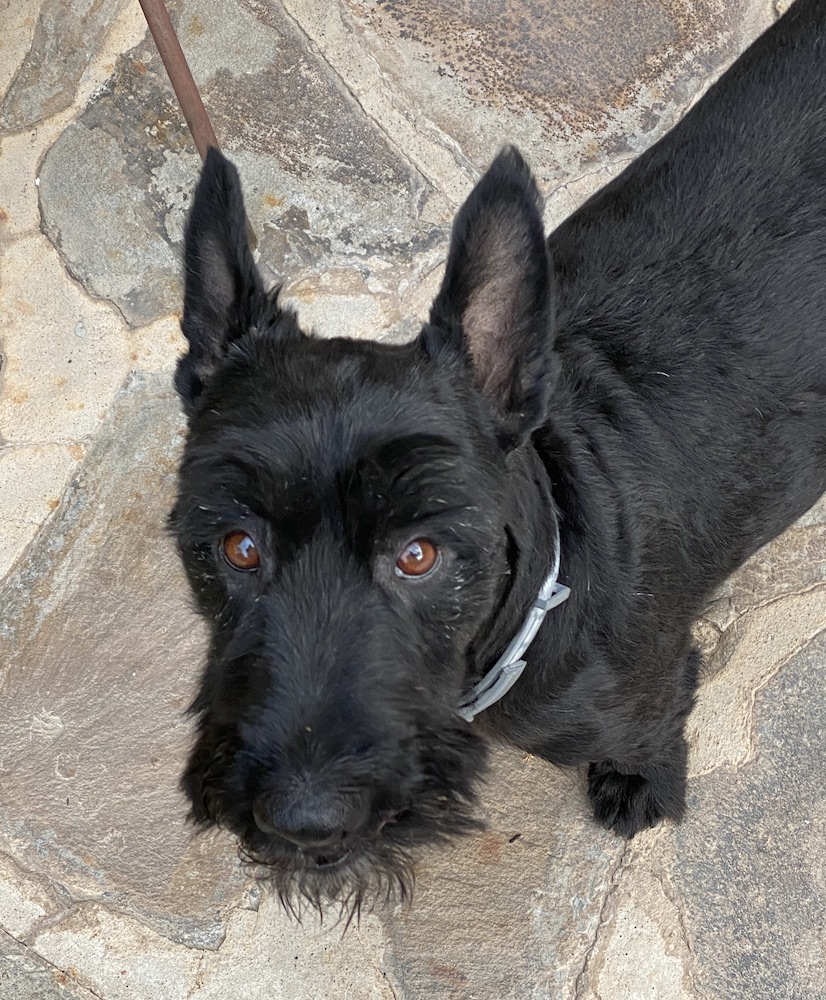
Dogs that stand outside and seek admittance to within
overlook the worth of what they’ve seen and where they’ve been.
Those of us sealed fast inside yearn to see the world
that we have been deprived of as we lie securely curled
in the safety of our houses, away from chasing cars
and other fun activities kept from us by bars.
We would feel such ecstasy racing after squirrels,
other dogs and cats and lizards, skunks and boys and girls.
We seek to flee the rules that those street dogs seem to flout.
We would have such wild adventures if we only could get out!!


IMG_8024

The Street Dog

Lucky little dogs with collars sit there looking out
as though they do not know what life for street curs is about.
We’d love to have their pampering and their daily feeding.
What they seek escape from is exactly what we’re needing!


Seeing Santiago’s new pup longing to get outside and my dogs yearning to get in put me in mind of these poems I wrote years ago so I had to add this last photo on to the poem and repost it.

Name-Dropping: My Confession #6

A while ago, I issued a challenge for people to tell me about their unusual meetings with famous people. I said that once enough people had told their stories, that I would tell mine. I’ve been publishing their stories as they tell them and now I’m ready to tell mine. I actually have another one I’ll tell once I hear a few more of yours as well!!

One of the first gringos I met when I moved to Mexico in 2001 was Betty Petersen, who was a wonderful artist and a great fan of the song “Coo Coo Roo Coo Coo Paloma.” One day in 2005, she asked me to join her for lunch at the Hotel Real de Chapala because her favorite mariachi band was playing there and since she had gifted their leader with a portrait of himself years before, they always played the favorite song mentioned above for her.

We had been serenaded and were enjoying our meals when a man came in and sat down at a table next to ours.  He hadn’t been there long when he struck up a conversation with me, asking about whether I was visiting, as he was. I said no, I’d lived here since 2001 and after asking me a few questions, he began telling me about his life.

Since most of the details sounded rather implausible, I asked him his name, and when he told  it to me, I must admit it was even more implausible than his stories, for he was claiming to be Billie Sol Estes!

Yes, of course I knew who Billie Sol Estes was, but I must say that little as I would ever imagine meeting him, it seemed even less plausible that I’d meet him in Ajijic, Mexico! Sensing I didn’t believe him, he then pulled out his book, which had just been published, and proceeded to tell even more outlandish stories, dropping names like JFK and Lyndon Johnson–at one point insisting that he had proof that Johnson had had Kennedy assassinated, saying Dorothy Kilgallen had been murdered because she had the proof of a further conspiracy in Kennedy’s murder.  All-in-all, he talked for over an hour, and when I got up to leave, he handed me a copy of his book. It was not until I got home that I opened it and saw what he had written inside.  (Since it took me some time to interpret his scrawl, I’ve written it out for you below.)


Yes, my jaw dropped when I read it, but not as much as it did when I read some of this other information about him online. This is part of an article that appeared concerning events that occurred after he had been indicted on a number of counts of fraud:

“Soon after the Estes indictments, however, Mr. Freeman, the agriculture secretary, disclosed that a key investigator on the case, Henry Marshall, had been found dead in Texas — bludgeoned on the head, with nearly fatal amounts of carbon monoxide in his bloodstream and five chest wounds from a single-shot bolt-action rifle. Local officials ruled it suicide, but the body was exhumed and the cause changed to homicide.Six other men tied to the case also died. Three perished in accidents, including a plane crash. Two were found in cars filled with carbon monoxide and were declared suicides. Mr. Estes’s accountant was also found dead in a car, with a rubber tube connecting its exhaust to the interior, suggesting suicide, but no poisonous gases were found in the body, and his death was attributed to a heart attack.In 1963, Mr. Estes was convicted on federal charges and sentenced to 15 years. A state conviction was overturned on grounds of prejudicial news coverage. After exhausting appeals and serving six years, he was paroled in 1971. In 1979, he was convicted of tax fraud and served four more years. He was released in 1983. A year later, in what he called a voluntary statement to clear the record, Mr. Estes told a Texas grand jury that Johnson, as vice president in 1961, had ordered that Mr. Marshall be killed to prevent him from disclosing Johnson’s ties to the Estes conspiracies. He said a Johnson aide, Malcolm Wallace, had shot him. The Justice Department asked Mr. Estes for more information, and the response was explosive. For a pardon and immunity from prosecution, he promised to detail eight killings arranged by Johnson, including the Kennedy assassination. He said that Mr. Wallace had not only persuaded Jack Ruby to recruit Lee Harvey Oswald, but that Mr. Wallace had also fired a shot in Dallas that hit the president. Mr. Estes also claimed knowledge of a White House plan to kill Fidel Castro and a plot by the former Teamster boss Jimmy Hoffa to kill Robert Kennedy. Mr. Estes reiterated his allegations in a book, “JFK, the Last Standing Man” (2003), written with William Reymond, as well as his own memoir, “Billie Sol Estes: A Texas Legend” (2004). As with similar allegations in books, articles and documentaries over the years, none of the Estes claims could be proven. Johnson had died in 1973, and everyone else, except Mr. Estes, was also dead.

In case you are wondering, no, I was not Billie Sol Estes’ mistress. I had never seen him before our encounter in 2005. Nor did I ever see him again.  He died on May 14, 2013.

Please rest assured that I am not supporting the truth of anything he said.  Just reading what he had written inside the book he gave to me made me fairly sure that I would take anything he said with an entire box of salt!!!!

Name-Dropping Confessions #4

Here are the stories people told me about their unusual meetings with famous people:

Ana Daksina

18m ago The Poet’s Public Record

I pissed off Miss People’s Republic of China once, by out-modeling her at her own fashion show. The designer invited me to China for the new spring line. I knew better! 🤣

Marilyn Armstrong

27m ago SERENDIPITY – SEEKING INTELLIGENT LIFE ON EARTH – teepee12.com

When I was 14 I was in the hospital (Columbia Presbyterian) in Manhattan. Eleanor Roosevelt was in there too — for the last time because she died a few weeks later. I met her in the elevator, each in our wheelchairs. I was too shy to have a conversation except to tell her that I enormously admired her. I was just 14 and she was so important.

Second? Getting to actually know Alfred Eisenstadt and actually spending time with him. He greatly changed and hugely improve my concept of photography.

bushboy
Tiny Tim – He had a show in a large club in Sydney where my brother-in-law was on the committee.After the show I went backstage to meet him. I have his autograph on a beer coaster somewhere in my boxes of treasures. Shaking his hand was like a wet fish.

He put on a good show

Name-Dropping Confessions #5 — From Dolly at Koolkosherkitchen

The assignment was to tell a story about an unusual meeting with a famous person. I love this one!!!

Due to the nature of my work in the old country, I’ve had to work with quite a few famous people (please don’t see it as bragging – it was my job!). When the Perestroika opened the borders, they started trickling here one by one to perform. I have many stories of their first encounters with America, but I think the funniest was the visit of the late great MIchail Zhvanetsky, the foremost Russian satirist, who always requested my borscht when he came to Miami. Having enjoyed the borscht, this time he wanted to be taken to one of the restaurants “with Spanish music” on South Beach. We went to Il Paparazzi, famous for its Northern Italian cuisine, and I translated the menu. He wanted Veal Parmigiano. As soon as the wines were discussed and his choice presented, he requested that it be warmed up. That was a shock which the sommelier managed to bear with a smile because I explained that our guest had a slight throat coarseness after his show and needed warm red wine.
Then the food came. He demanded soy sauce – in a posh Italian restaurant. The Chef ran out of the kitchen, brandishing a ladle dripping with tomato sauce, screaming, “I am Chef Vittorio! There is no soy sauce in my restaurant!” By the time we calmed him down and explained that our guest was a Russian celebrity, who might be allowed his quirks, the veal was stone cold. Chef Vittorio, understanding the importance of international relations, sent someone to the nearby Japanese restaurant for soy sauce and prepared a brand new plate of Veal Parmigiano, delivered by the Chef himself with a flourish.

You replied to this comment.


Hello, Madam


i am republishing this story in response to a comment in this earlier post: https://judydykstrabrown.com/2025/05/05/the-numbers-game-71-may-5-2025-come-play-along/  wherein someone commented about a photo of a dried seahorse I had included in the photos. I wrote back a comment about how I had acquired the seahorse from a man I met on the beach and then remembered that I had included that encounter in an unfinished book that includes numerous stories I’ve experienced or heard in Mexico. In this version, I told it from that man’s point of view.  In the fictionalized account, he says I had purchased a beach house. I actually just rented it for a few months a year for a number of years.  Again, here the story is told from his point of view but everything else is more or less true:

Hello Madam

My story begins years ago, when the gringo woman first bought the palapa house that fronts the beach in our village. It is many years now since that day I first passed her walking on the beach—her heading south as I headed north. I saw her falter when I drew close enough for her to see the machete in my hand. It was held down by my side, as this is how I always carry it, so I think perhaps she didn’t see it until I was quite close. I saw her alter the cadence of her walk, start to turn around, then instead, veer out into the water so as to cut as wide a swath as possible in our passing. I bid her good morning, trying to be as non-threatening as a six-foot-tall Mexican man carrying a machete could be on this deserted section of the beach. No other people walk in the dawn darkness before the sun comes over the palm trees and palapa rooflines.

She bid me good morning as well, saying “Buen dia,” in our fashion, instead of the usual “Buenos dias” that would brand her as a gringa. Not that anyone would have mistaken her for anything else. She wore the sackish coverup that many norte americanos adopt as their bodies get older and wider. Her skin was white, her hair straw-colored. She carried a big bag and stooped often to retrieve shells, stones, driftwood and other objects from the beach that she made into art. I have seen these objects spread out on the palapa-covered front porch of her house on the beach, very close to the water. Sometimes when she was not outside, I had peeked at her new constructions and after our first month of passing daily on the beach, I held out to her a small treasure I had found: a seahorse, bright orange, no longer than half my thumb. It was dead but still pliable. When I held it out to her, she was at first taken aback. Then I saw the pleasure on her face, as though I’d handed her a rose. The next day, I handed her a small rock imprinted with the fossil of a shell. It was gratifying to give these small ordinary things to someone who found them to have value.

The third day, I gifted her with three seahorses I’d found lying side-by-side on the beach, as though ready for a communal funeral. After I gave them to her, spread out to dry on a small section of a palm seed sheath that I had hacked out with my machete, it was she who initiated a conversation by asking why I carried the machete; and this is what I said back to her:

“Hello Madam. Someone has already told me that you are looking for stories, and knowing that I have many that I remember well and also have been said to share interestingly enough, he has recommended that I seek you out. In spite of this, do not think that our meeting on this beach was anything but coincidental. I have walked here every morning at this time for many years. It is fate that engineered our introduction, not I.

I am Fernando, but everyone here calls me “The Machete.” There is a story to this, of course, as there is a story to everything in Mexico. Sometimes I think our country is composed more of stories than of flesh or blood or clay or concrete. Stories and dreams and reality. Almost always, it is hard to know the difference.

Many years ago. Well, not really so many years—maybe twelve or fifteen—it was not as it is now. Few gringos lived in our community. Instead, there were dogs. Many wild dogs who roamed the beach. Sometimes some of them were rabid and there were at times problems when people carried food onto the sand. A few times, they even invaded the restaurants that opened onto the beach, rushing past tables, grabbing arrechera from plates and sometimes catching a hand or leg in the process. This brought a good deal of fear because of the fear of rabies, and everyone was talking to those who ran our pueblo, asking them what they were going to do about it. Finally, some of the men of the pueblo took guns and machetes and went in search of these dogs, disposing of many of them. For a while, peace reigned on the beach, but every few years, another wild pack would form and people would again be afraid to go onto the wilder parts of the beach—those parts where you and I like to walk.

Since I live a few miles from the place of my labor, it has been my practice for all these years to walk to work on the beach and as you might have guessed, this machete was my weapon against the wild dogs. Through the efforts of the many gringos who now live in our town, and the free spay and neuter clinics they provide twice a year, the problem of the wild dogs has disappeared; but I still carry my machete. It is as though my body has altered itself to accept this extra weight on my right side, so that without the machete, I cannot walk right. I cannot stride. I am not as sure-footed. This daily encumbrance has become a part of me, so always I carry it by my side. The story is simple. This is all there is to it.”

We passed on then, each in our particular direction, but I believe we parted as, if not friends, at least as congenial acquaintances. This was my first conversation with this woman who would one day have such an impact upon my life. It seems an inconsequential thing—this exchange of four seahorses and an imprinted stone—but these simple objects of seemingly no value were to be the golden key to my future—a story I will perhaps tell you one day if kind fate should set us in each others’ path.

This was the last chapter I wrote in a book entitle “Cucumber” that I was writing a few years ago. I never completed it, but I feel it stands on its own, so when I found it stashed away in a forgotten folder on my computer, I decided to share it as-is. Perhaps I’ll share some of the other chapters in the future–or perhaps I already have. I’ll have to check..Let me know if you think it works as it is. It is actually based on a true story, but told from the point of view of a real person I encountered many times on the beach.  The event mentioned is true, although the book will be a blend of fiction and real happenings.