Category Archives: Aging

NaPoWriMo 2015 Day 1: At 67–I Guess that It’s Too Late for Me to Live A Life Of Sin.

In case you are wondering why I have two posts, they actually gave us an earlybird prompt on March 31, so we had two prompts for April 1.  No fooling!  Here’s the first one I wrote:

At 67

I guess that it’s too late for me to live a life of sin.
I’m simply going to have to make do with the life I’m in.
Although life’s dance has furnished me with many a wild whirl,
my past is littered with false starts at being a bad girl.

It seems that dirty dancing doesn’t fit my constitution,
for somehow I just seemed to fail the sexual revolution.
Strange sexual positions never seemed to please.
They only did my back in and ruined both my knees.

It’s much too late to try to build a palate for champagne,
for experience has taught me that it’s safer to abstain.
The guilt I felt for shoplifting had just one resolution.
I felt the only answer lay in complete restitution.

Cocaine made my nose drip and pot just made me fat.
And that’s how I got into the position where I’m at.
Too chubby now for hot pants and too frigid for them, too,
I’ve found that there is only one more thing for me to do.

Rather than complete the acts that formerly I would,
it’s easier to only do the tame things that I should.
So though I must confess my bad girl days are at a halt,
I’ll admit I am a paragon merely by default!

Today’s Prompt: Lamentation for the other lives we could have led is something we probably have all felt. Today, why not try writing your own poem that begins “I guess it’s too late to live . . . .

https://dailypost.wordpress.com/dp_prompt/fool-me-once/

Plot for Life

Plot for Life

The Prompt: If you were given a plot of land and as much money as you need, what would you do with it?

I’d build a large house with five wings surrounding a central kitchen/living room space.  Each of four of the wings would be a private quarters where  I and three  friends could live as we grow older.  The fifth wing would be for guests until it became necessary to have live-in help or a nurse.  Each private area would consist of a bedroom, bathroom, living room, small efficiency kitchen and additional room that could be used for writing, art, crafts or whatever hobby the occupant wanted to pursue and would also have its own small fenced-in garden.  There would be a larger garden surrounding the house and a small studio/gallery at the street entrance.

Reminder

Reminder

Use it or lose it is advice that you might find
in books of pithy phrases or others of their kind.
Though trite, it seems to really work in matters of the mind,
which we should always try to use when we are in a bind.

Unfortunately, panic too often enters in
and takes the place of where our minds really should have been.
Our fears and doubts and terror creating such a din,
distracting us and so we lose what otherwise we’d win.

“I’ve lost my mind” are words that I have often overused.
(Another phrase the use of which is really much-abused.)
And although exaggeration is a sin widely excused,
it’s hyperbole when meant to mean that we are just confused.

I don’t think  we had these problems when we were in our prime.
Our minds were so much emptier and we had so much time.
We used our minds for calculus or conjuring up a rhyme.
Our wheels were always spinning and could turn upon a dime.

But later on in life our minds are full to overflowing.
We remember where we’ve been but often forget where we’re going.
We try to still go fast when it is fact we should be “Whoa” ing.
and letting life evolve away from simply being knowing.

A baby sleeps within the womb and out of it as well.
He ruminates and plays for years before the school bell.
And so perhaps re”tire”ment is a story we retell–
recalling us to rest and play  before that final knell.


The Prompt:  Use it or lose it.  https://dailypost.wordpress.com/dp_prompt/use-it-or-lose-it/

I’ve Come Undone

I’ve Come Undone

If I could undo anything that’s happened in my life,
I would not undo enemies or illnesses or strife.
For all led up to my life now that really isn’t bad.
All given, I am happy, and frequently I’m glad.
My palm trees may need clipping and my dogs may have the mange,
but all in all there’s really only one thing I would change.
I’d undo one tequila or two or three or four.
I think that that is all I drank. I can’t remember more.
And after that, that dance I did as others ringed the floor?
I fear I chose to party when I should have chosen the door!

And that knee I rocked on back and forth, remembering the twist?
I fear I chose to overdo instead of to desist.
My friends did not remove me, but cheered me on instead.
And now I have a throbbing knee and needles in my head.
That knee I’d earlier injured when I fell on cobblestones
had healed, I thought, relieving all that aching in my bones.
But now I’m hobbling back and forth–gimpy once again,
for you gotta pay the piper when you choose a life of sin.
I know my knee will heal and that this agony will end,
but please remind me next time that tequila’s not my friend!!

The Prompt: If you could undo something, what would it be? Discuss why, potential repercussions, or a possible alternative.

Near

Near

My father went from obscurity to a sort of small renown.
He worked hard as a rancher and the mayor of our town.
He met my mother at a dance in her sister’s borrowed gown–
both of them lonely visitors to a faraway strange town.
I’ve thought about it often since we laid him down.
Why didn’t I ask more questions? Why didn’t I write it down?

Many a calf he helped to birth and many a field he’s mown.
Avoided his mother if he could–long-suffering aged crone.
Not many highways traveled,nor many airwaves flown.
He died in his angry daughter’s arms–the two of them alone.
I’ve thought of it often till regrets have turned into a drone.

His eyes were always looking further over yon.
Over a ripening field of wheat or over a fresh-mowed lawn.
Working, often, until dark and up again at dawn.
A man of camaraderie and wit and brains and brawn.

He liked to tell a story and sing a rousing tune.
Stand on the porch at midnight to piss under the moon.
He gave me a turquoise ring, a baby rabbit and a coon.

Now that he’s very gone away.  Now that I’m very grown,
I know my flesh is of his flesh. My bone is of his bone.

And I wish that I’d asked more questions. That we’d both been less alone.

DSC02618
The form of this poem is one consisting of six stanzas, the first with 6 lines and each thereafter one less line.  Each line in each stanza rhymes with all the other lines in that stanza and each stanza’s rhyme is a near rhyme to the last. The name of this form is Sylvestrian Near Rhyme and since “Near” describes both the theme and form of my poem, it is also the name of the poem.  And yes, I did make up the form!  I’d love it if poets given to rhyming and meter would attempt the form and send me the results as comments or a link to this blog.

Update: Here is Sam Rappaz’s response to my challenge.

The Prompt: Fireside Chat—What person whom you don’t know very well in real life — it could be a blogger whose writing you enjoy, a friend you just recently made, etc. — would you like to have over for a long chat in which they tell you their life story?

Thanks Be to Sara Lee

I just couldn’t get going using today’s WordPress Daily Prompt—someone else’s first line—so I elected to follow another prompt, now that we have this option. In response to The Daily Post’s earlier writing prompt: “Thank You,” I am reposting a parody of “Pied Beauty” (better known by its first line, “Thanks be to God for dappled things.”)

“Thanks Be to Sara Lee for Appled Things” was the irreverent first line that I wrote for its parody for NaPoWriMo in April of last year. I think this was before most of my followers knew who I was, so I’m hoping you won’t be too put out by it.

By way of explanation, I will tell you part of a story—that story being that I actually read a poem to one of my favorite authors of all time today. I won’t interfere with her privacy by naming her or revealing how I happened to meet her, but it was scary and thrilling at the same time. This is how I have come to be sitting here at 4 PM, still not having posted a blog entry for today. This time I can’t blame it on the lack of a computer or the presence of a computer that speaks a different language. It is just me, still a bit dazzled from meeting this very nice, down-to-earth friendly lady who possesses one of the finest minds of our century. So fine that for today, at least, I feel unable to write. All I am thinking is that yes, she liked my poem. (I read “The Ways I Do Not Love You” which was also posted earlier as a NaPoWriMo poem.) I just couldn’t bring myself to read one of my silly ditties in front of someone whose writing I respect so much, fearful that she would think this was all there was to me! How can it be that at this age I still care what people think of me? At least it is to my credit that it was my words I was worried about, not my hair or my weight or what I was wearing. I guess I’ve made some advancements with age. “What are you, sixteen?” my super-critical alter-ego is whispering in my ear right now. “Exactly!” the real me shouts, and wishes it could fit a swim in before dinner.

Okay, here is the NaPoWriMo prompt: Our prompt today was to write a curtal sonnet in the style of Gerard Manley Hopkins’ famous poem “Pied Beauty”. This form consists of a first stanza of six lines followed by a second stanza of five, closing with a half-line. The rhyme scheme is abcabc defdf. I chose to make it a parody of “Pied Beauty” as well.

Here is the original:

Pied Beauty

Glory be to God for dappled things –
For skies of couple-colour as a brinded cow;
For rose-moles all in stipple upon trout that swim;
Fresh-firecoal chestnut-falls; finches’ wings;
Landscape plotted and pieced – fold, fallow, and plough;
And áll trádes, their gear and tackle and trim.

All things counter, original, spare, strange;
Whatever is fickle, freckled (who knows how?)
With swift, slow; sweet, sour; adazzle, dim;
He fathers-forth whose beauty is past change:
Praise him.

—Gerard Manley Hopkins


And now, my version:

Pied Beauty II

Thanks be to Sara Lee for appled things—
For pies, for apple fritters and for thin-rolled strudel crust;
For pastries of the fruit of Eve and sauce it swims within;
Fresh-cooked in ovens, how their sweet juice sings;
The sugar clotted and pierced—place it on plate we must;
And all taste, for how can tackling it be such a sin?

All things made of flour and Crisco and of apples sweet;
(How can they by nutritionists be so sorely cussed
With words professing they won’t make us thin?)
With their tart flavor are sure our lips to meet;
And meet again.

—Judy Dykstra-Brown

Who Knew?

In response to The Daily Post’s writing prompts: New and Skills.

Who Knew?

When new was new, I was crazy about it. A new friend, new dress, new favorite food. But what I liked best was new places. I yearned to travel, even if it was just to the next town. Strangely enough, as tiny as the towns were in my part of South Dakota, people from neighboring towns did not mix. We went roller skating in Draper, 7 miles away, but when our eyes chanced to stray to Draper boys, we were taken aside by several of the “popular” Draper girls—the cheerleaders, in fact, and told to stay away from their boys. This really happened. We played their school in sports, went roller skating every Sunday in their school gym, even went to movies in their tiny theater, but we did not mix. When we tried, we’d been warned.

I think I visited Presho, Vivian and Kennebec—all 20 to 40 miles away—no more than once in the 18 years I lived in Murdo, population 700. White River, 38 miles away, we more regularly visited since they had shows on Mondays as well as weekends, and the movies were just ten cents, whereas ours cost twenty-five cents! But, never did we ever socialize with White River girls. The boys, however, were a different matter.

The first boy I ever kissed was from White River, and we went steady for two years. I think I’ve told the story of that first kiss in another blog posting. Suffice it to say that after putting it off until age 16, it was about time. And, it worked. I was literally dizzy and he had to hold me up for a minute afterwards. He had opened my car door, helped me out, then folded me in his arms and kissed me. I was so discombobulated that instead of walking to my own car, I opened the back door of his car and started to get into the back seat. Not for the reasons you might think. My best friend and a boy who (as I recall) later turned to cattle rustling were already in the back seat. I just did so in utter confusion. And no, I had never had a drink in my life at the time.

At any rate, this story has veered off in a direction unintended, so just suffice it to say that after that, life continued to present new after new and I accepted most of them. I traveled widely, loved a few loves, pursued a few careers and wound up in Mexico. Now, at age 67, I suddenly find that new isn’t as necessary to me. The older I get, the more I realize that everything is everywhere. You just have to look for it closely.

No longer is it necessary for me to travel to faroff third world countries. It is exciting to take the same walk on the same beach day after day since the sea presents new treasures each day. I love getting up each morning and writing first thing, having Pepe come each Monday to give me a 1½ hour massage after which I plop into the hot tub. I love spending hours in my studio and sometimes hate having to leave home even for activities I have enjoyed in the past.

The point is, that the older I get, the more I want to spend all my time doing what I love most. Writing. Art. The fact that each endeavor creates a new piece is getting to be enough “new.”

Bearings

Bearings

“I’ve lost my bearings,” she said to me, perplexed. She was sitting alone in her room, piles of clothing on the bed and floor around her—the collapsed small tents of abandoned full skirts, the shards of scarves and small mismatched clutterings of shoes.

She had been abandoned in a world that only she lived in, that she knew less about than any of us who tried to visit her there. For her, even changing clothes became an insurmountable obstacle—a challenge that rivaled childbirth, her master’s thesis, an unfaithful husband, an addicted son, an autistic grandson. It rivaled the war she’d staged against her much-younger sister—the power she held over that sister by her rejection of her. It rivaled her efforts to enter the world again as a single woman and to try to win the world over to the fact that it was all his fault. It rivaled her insistence that it was the world that was confused in refusing to go along with all her beliefs and justifications.

She had barely if ever left a word unspoken when it came to an argument. It was so simple, really. She was always right. That everyone in the world, and more particularly her younger sister, refused to believe this was a thorn in her side. The skin on her cheek itched with the irritation over the unfairness of the world. She had worn a path in it, carving out a small trench so that the skin even now was scaly with that road traversed over and over again by one chewed-off fingernail. “Are you she?” She asked me, and when I admitted I was, she added, “Oh, you were always so irritating. Even as a little girl. Why could you never be what anyone else wanted you to be? You were always so, so—yourself!”

It was my chance, finally, for an honest conversation with this sister 11 years older—more a crabby mother always, than a sister. A chance if she could keep on track long enough to remember both who I am and who we both once were.

“So what was wrong with how I was, Betty? With how I am?”

“Oh, you were always so—“ She stopped here, as though struggling for a word or for a memory. I saw her eyes stray to the floor between the door and the dresser. “There’s that little fuzzy thing there,” she said. I could see her eyes chart the progress of this creature invisible to me across the room.

“But me, Betty. What do you find wrong with me?”

Her eyes came back to me and connected, suddenly, with a sort of snap that made me think we were back in the same world again. I tried to keep judgment out of my own gaze—to keep her here with me for long enough to connect on at least this one question.

“You were,” she said, and it was with that dismissive disgusted tone she had so often used with me since I was a very small child. “You were just so mystical!”

I was confused, not sure that the word she had used was the one she meant to use.

“What do you mean by mystical, Betty?” I sat on the bed beside her and reached out for the static wisps of hair that formed a cowlick at the back of her head—evidence of the long naps which had once again taken over her life, after a long interim period of raising kids, running charities and church prayer circles, and patrolling second-hand-stores, traveling to PEO conventions and staying on the good side of a number of eccentric grandchildren.

“Oh, you know. All those mystical experiences! The E.S.P. and all those other stories you told my kids. And Mother. Even Mother believed you.”

Then a haze like a layer of smoke once more seemed to pass over her eyes, dulling her connection to this time and reality and to me.

Her chin trembled and a tear ran down her cheek. She ran one fingernail-chewed index finger over and over the dome of her thumb and her face broke into the crumpled ruin of a child’s face who has just had its heart broken, the entire world of sadness expressed in this one face. I put my arms around her, and for the first time in our lives, she did not pull away. We rocked in comfort to each other, both of us mourning something different, I think. Me mourning a sister who now would never be mine in the way that sisters are meant to be. Her mourning a self that she had not been able to find for a very long time.

“Oh, the names I have been called in my life,” I was thinking.

“Oh, the moonshadows on the table in the corner. What do they mean?” She was thinking.

The last time I gave my sister a fortune cookie, she went to the bathroom and washed it off under the faucet, chuckling as though it was the most clever thing in the world to do. She then hung it on a spare nail on the wall.

When I asked her if she needed to go to the bathroom, she nodded yes, and moved in the direction of the kitchen. Then she looked at the news scroll on the television and asked if those were directions for her. If there was something she was supposed to be doing. And that picture on the wall. What was it telling her she was supposed to do?

In the end, I rubbed her head until she fell asleep, covered her and stole away. I’d fly away the next morning and leave her to her new world as she had left me to mine from the very beginning.
Blue-footed Booby

DSC00284DSC00285 - Version 3

Blue-footed Booby

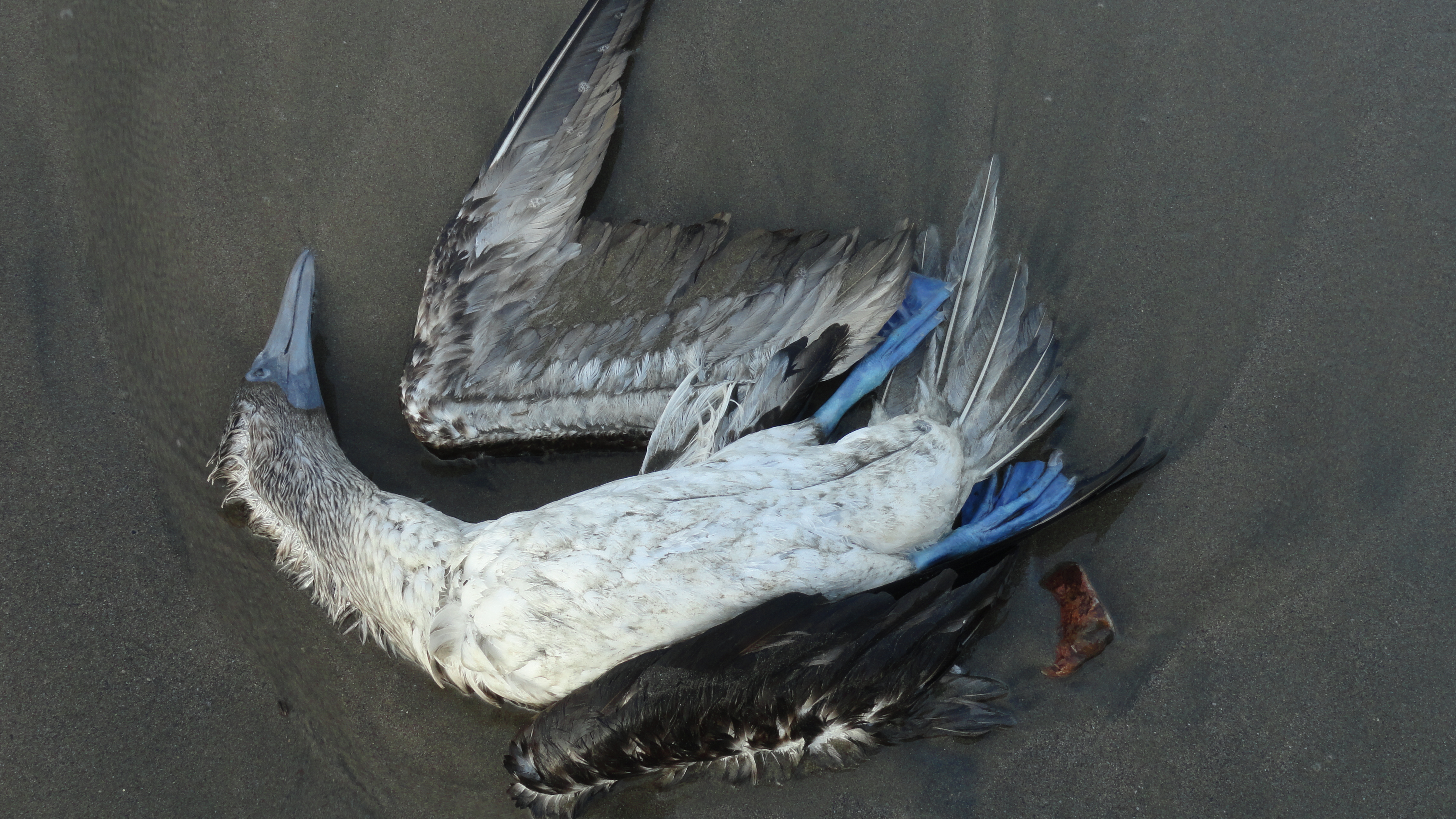
Graceful Vee of wing and curve of neck
laid out in sea foam on the beach—
it is as though you are making a final goofy move
on feet dressed up in blue first for dancing and then for love.
The means of your death is less a mystery to me
than what has left you and where it is now.
Perhaps, as I cup my hand through air above you,
I hold a part of you not soon enough departed.

Remembering those tiny sea turtles,
alone in the sea for moments,
picked off by the birds,
these mysteries worry me
like tiny flippers
resisting
that next great adventure
of the inside of a pelican
as I finally understand why anyone
would choose to have their ashes scattered at sea.
I have always dreaded descent
to the ocean’s dark floor,
when I could have been imagining
washing up on a favorite shore.


Work Ethic / Canción de México: Two Poems

The Prompt: Gut Feeling—When’s the last time you followed your instinct despite not being sure it was the right thing to do? Did it end up being the right call?

Work Ethic

There’s something stirring in me. I do not know its name.
It whispered to go seawards, so that is why I came.
I do not know the object, though once I thought I did.
Once here the book I thought I’d write left my mind and hid.

I find that I am drifting like a seabird on the swell;
and so far that is fine with me, in fact I like it well.
Instead, I write these ditties that I finish every day,
forsaking what I think I should to just write what I may.

No need for all the boring things: research, footnotes, citing.
Whatever is in front of me is what I end up writing.
Some might say that it’s responsibility I’m shirking,
but I say that I’ve simply learned to go with what is working.


Canción de México
(Song of Mexico)

This small café sits on the square, or rather the rectangle.
The gas trucks pass by, blaring “Gaaaaas,” their grounding chains a-jangle.
Trucks and cycles lacking mufflers roar by every minute,
bass blaring from each car window without much music in it.

The guinea fowl make such a ruckus that they sound insane,
but to complain about the noise in Mexico’s inane.
The daily garbage trucks, the water truck and all the rest
all live by the assurance that what’s loudest is the best.

I drink my coffee, eat my muffin, try to grin and bear it;
but when she sets a napkin down, I grab at it and tear it.
And even though one part of me says that I shouldn’t dare it,
I use a bit to wipe my lips. The other part? I wear it!

I stuff a wad in either ear, and though I still hear all,
I go by the illusion that I hear it from afar.
Sometimes I feel the threat of age, so quickly it is nearing;
but if I lose one faculty, dear God, please make it hearing!