 Ghost?
That sudden soft midnight footfall outside my room? I’m hoping it was you.
The Weekend Writing Prompt is to write a poem in 13 words.
Ghost?
That sudden soft midnight footfall outside my room? I’m hoping it was you.
The Weekend Writing Prompt is to write a poem in 13 words.
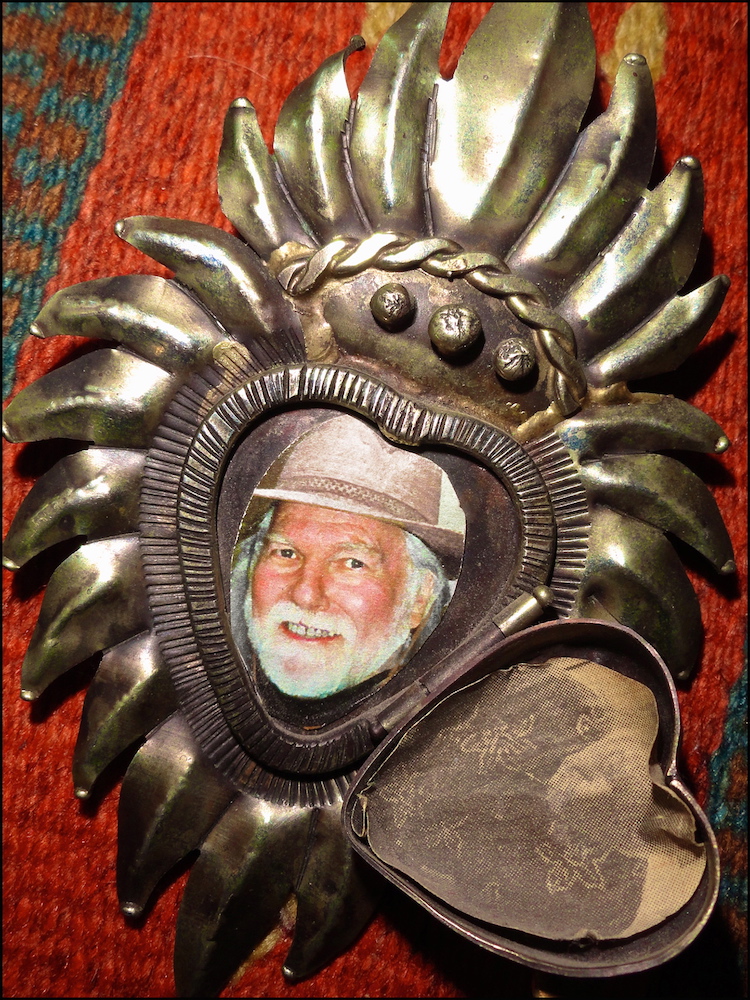
Final Message
For Bob
They echo in my memory, those footsteps heard in that early hour the morning after you left. The creak of the floor board outside my door as I lay rooted to my bed, waiting for the door to open. Years after, that last sound of you loops in my memory. “Send a sign,” I said, just before I heard your footsteps stir the early morning silence as you shared a sound of you, if not one final look, before you slipped away.
For The Sunday Whirl the prompt words are: rooted years footsteps creaks look stir hour loop clock echo before slips


Thank you to Yolanda and Yoli and Carmen and Oscar for being such wonderful friends and taking on my problem as their own!!! Click on photos to enlarge and read captions.
I intended to just publish these photos of Yolanda, Carmen and Yoli helping to deal with the damage the skunk had wrought the night before, but as you will see if you read to the end, there was an interesting twist that lead to my relating another skunk story from 24 years ago. . If you haven’t already read it, to read Monday’s story, go HERE, Then return to this page to read the rest of the story.
On the morning after the great skunk attack, Carmen and Yoli arrived for their usual English lesson, but instead, generously bathed and rebathed the dogs in a solution of hydrogen peroxide, dish soap and baking soda while Yolanda washed their cages and pads.
After an hour’s efforts and another hour of lessons, when I returned to my blog, I found these comments by Annie and my responses
When I had published the story of my dogs being sprayed by a skunk in the early morning of March 17, I could not remember the Spanish name for skunk and every time I looked it up in a translator, it gave the traslation “Mofeta” which I had never heard of. It was Yolanda, arriving for work the next morning, who reminded me that skunk in Spanish was zorillo (as in that other fictional midnight visitor Zorro.)
So it was with some surprise that when I finally found time to look at comments for my blog that had described the encounter, I found these comments from Annie H: (I’m repeating them here, along with my comments durring the two-day conversation that ensued:)
Annie H March 17, 2025 at 4:42 AM: Zorrillo = skunk. Mofeta is more of a badger-type of animal, still stripey but not a skunk
Judy: March 18, 2025 at 6:40 AM: This is uncanny, Annie. How did you happen to mention a mofeta? I blanked out on the Spanish name for skunk and every time I tried to look it up in a translator on either my phone or computer, it said the translation was mofeta. I knew this wasn’t right, but just tried again and it said the same thing. It was the next day when Yolada finally clued me in that it was zorrillo! I never did mention the word mofeta in my blog, however, so your mentioning it seemed a bit of mental telepathy. Is your AI reading the mind of my AI?
Annie H March 18, 2025 at 7:09 AM: I like a challenge, even if it was nearly midnight here!Mofeta rang a bell and as we don’t have skunks in Europe, I checked it out. This is where common names become confusing, and I had to look at the Scientific names. Both Mofeta and Zorillo are Spanish names for Skunk.Then I found this:”The Spanish word Mofeta for skunk originates in Europe but skunks are not native to Europe. In French is mouefette and in Italian it’s moffetta. It could be a corruption of the word Italian word muffa which means – mildew, mould, must or mustiness. All of which smell bad, generally.Skunks are also called polecats. There is a member of the badger/marten family here called a polecat, it is one of the smelliest of that family. And is occasionally referred to as a skunk. Ignore my previous comment about Mofetta being a relative of badgers. So, I was confused, especially at midnight when I was thinking of going to bed! Once zorillo came up, I thought – that’s it, I’ve heard that one before. I include westerns in my reading material, so that’s where I’d heard it.
Judy, March 18: Even more amazing, Annie, that you should mention polecat. I’m going to reprint a story in my blog that is a chapter of a book I published 8 years after my husband’s death. Look at today’s post to read it.
:And here is the story that Annie’s comments prompted me to retell:
Finding Spirit through the Sense of Smell.
Lourdes wants to throw away the used up Virgin of Guadeloupe candle glasses on the mantle, but I stop her. It seems dishonorable, like abandoning friends who have sustained injuries while acting in your service.
These candles have been burning almost continuously since I arrived in Mexico. One is by Bob’s picture on the window ledge in the kitchen and the other by his picture in the large locket propped up on the chimney mantle in the bedroom. The candle that would be hardest to throw away was purchased on a kayaking trip to Baja California a few years ago. I’ve burned it on special occasions ever since and have used its last few inches to keep a vigil for Bob.
It is not that Bob is around me all the time. It’s that he’s there when I need him, like my own personal spirit. I don’t even know if I think he’s really aware of me. The point is that I’m aware of him and appreciative of the valuable things he brought to my life.
On that day in early December, after Pasiano the gardener left, I was overcome by a longing for Bob to be seeing the shadow of the tree outside the frosted glass of the bathroom window with the primitive Mexican sculpture on the window ledge, along with the blue glass jar full of papyrus. I was so overcome by the beauty of the house and the view every single day. With my heart, I wished that Bob could see it. With my brain, I knew that if he could see it now, as spirit, it would be unimportant to him. When he needed to have seen it was while he was still in his body, still human enough to find beauty one of the most important things.
The day Rita and I moved my things into the house, Mario and I had moved Bob’s tall plasticine figure from the van up the steps to the second story studio. He had made the figure in San Miguel and we had stored it in a storage facility here in Ajijic. He had intended to cast it in Bronze, but in moving it, it had been much damaged. I was not fond of it before. I found it’s large feet somewhat silly–like a “Keep on Truckin’” figure. Now I wondered about the integrity of changing it into something I liked before casting it. I feel the need to have his undone things finished for him–as I had done for 14 years. His son Jeff had taken the only large metal sculpture which was not yet finished. In the studio loft, I had found all of the molds for his sculptures. Perhaps I would have them cast in Mexico. Since we had worked so much together, even on the sculptures he finished in his life, it did not bother me to think of embellishing his bronzes in the way he had always done–each one different.
Bob had not been always with me since I moved to Mexico, but he had been much with me. And although he seemed to be indicating to me what might be wise to do, his presence seemed more humorous than sinister.
On the day he died, skunks moved in under our house in California for the first time in 14 years. The house was full of Bob’s kids and their wives, everyone working on a different project to honor Bob for his memorial celebration. We could smell the faint odor of skunk, but were too busy to deal with it. Maybe it would go away, we thought. But on the day of his memorial celebration, we woke to an all-pervasive scent. Debbie, our daughter-in-law, feared that we would have to cancel the celebration, but by afternoon the scent had wafted away.
A week or so later, I finally called the skunk removal man. I had awakened in the middle of the night to a scent of skunk so strong that it brought me from a dead sleep. “Bob,” was my first thought when I awoke, and before I fell back to sleep I expressed the deep sobbing sorrow I had expressed only a few times in the days since his death. When I awoke, the scent was gone.
Every day in the weeks before I finally left for Mexico, I smelled the odor of skunk. We found seven different tunnels under the foundation into the dirt-floored part of the basement. We sprayed, we trapped, we filled in. In addition to three skunks, I managed to trap a mouse, a jay and three baby raccoons, who made such a racket that I thought I’d trapped a cougar. As I opened the trap, they came tumbling out screeching, wrestling with each other, frenzied in their need to be free. But the moment they were a few feet from the cage they stopped, looked at me, then ambled back in my direction, more curious than frightened.
As I drove away from my home of fourteen years, I had more than skunks on my mind. For four months, I had been packing, arranging documents, moving and storing and selling two lifetimes of accumulations. I had closed down six studios, cleared out the two annexes to the wood studio, moved and sold and given away numerous tools. I had engineered two moving sales with the help of friends, nursed Bob through two months of illness and three weeks of dying, talked to every friend either of us had ever made in our lives, written dozens of thank-yous. Now I was about to drive alone to Phoenix to pick up the friend who would drive with me to Mexico. But I was so bone weary that I could not keep my lids open. The drive to L.A. was torturous as I bit my lip, slapped my face, jiggled my legs, turned the air conditioning on high, pounded my arms on the steering wheel until they were black and blue. Somehow, I managed to keep myself awake. When I dropped into bed in a motel north of L.A., I fell immediately asleep. The next day was just as bad. Now and then through both days of driving, I would again catch the odor of skunk. It was the cat, I’d think, but he was so buried in the mound of objects that filled the van that it seemed unlikely. True, he had picked up the faintest odor of skunk from just being in the proximity of the odor for so long, but this scent that I smelled would come and go, whereas he was always present in the car.
Once in Mexico, the skunk theme persisted. On my trip down with Bob, we had seen dead horses, dead burros, dead cows, dead cats and dead dogs in the road. Once we had seen a possum, another time what appeared to be a badger. But we had seen not one skunk.
On this trip down with Rita, however, we must have seen at least two dozen dead skunks in the road–probably many more.
Rita was in San Juan Cosala with me for about 4 days before having to return to the States. After she left, the odor of skunk returned. Every day I would catch a whiff –just one–of skunk odor. Usually it was in the sala, but once it was in the bedroom. Then a few nights after Rita’s departure, I awoke in the middle of the night to a pervasive odor of skunk. I sat up, moved to the door to open it and smell the outside air. Nothing. When I returned to my bed, the odor was gone. On the mantle, the candle by Bob’s picture flickered once, twice, three times.
The next day, I asked Celia if she believed in spirits.
“But of course,” she said. “What is important is that you learn to enjoy them.”
When I told her about the skunk odor, she said, “But if you had a candle burning, you should not have been able to smell the skunk. It is true, the candle it makes you not to smell the skunk.”
I then told her that that very day I had found the bag of Bob’s ashes in the closet. The night before I left the states, my friends Dan and Laurie had brought over the seed-shaped urns for his ashes. The plan was to fill each of ten urns with ashes, to seal them with wax, and when the kids all came in May, to give each an urn to scatter as they wished and to scatter mine in the back yard. His sister Barbara would get the remaining urn. But I didn’t want to distribute the ashes by myself, so I had decided to wait until my friend Sharon came in December. So, although Bob’s pictures resided in places of honor, his ashes were relegated to obscurity in the closet.
“Oh, we must bring Bob out of the closet,” said Celia. “Tomorrow when we go to Guadalajara, it will be the first thing we do.”
And so within 24 hours, Bob was residing on the mantle in a terra cotta cookie jar with white spirals. Next to him were the seed pod urns which seemed to number 11 instead of 10. I knew this was for a reason, but I guessed that reason would reveal itself later. After that time, there was no odor of skunk for two days. Then came the day that my new friend Robert appeared at the gate. It was the day that we went to the San Juan Cosala square and heard the computerized Christmas music at the shrine to the Virgin of Guadeloupe. The day I met Michael and Nan. The day we went for hamburgers in San Antonio. My relationship with Robert was completely innocent. There had never been a whisper of flirtation or sexual energy. Yet when Michael called him “Bob,” it caused a shock wave to go up my spine. It had occurred to me that his name was Robert and that Bob’s real name was Robert, but It had never occurred to me that this new Robert was a Bob as well. My eyes teared over a bit, as they were wont to do at the strangest times. Sometimes these chance mentions of something I associated with Bob would bring about a brief spell and then be over, but at other times I seemed not to be able to contain the emotion, which would spill over in tears and sometimes sobs–especially in the presence of a sympathetic soul. This was one of the times when the sensation passed quickly.
What would Bob think if he could see me out with another man? Would he believe that it was innocent? It was true that I felt still tied to him. When the man at the Fiesta had asked me to have a drink with him, it was not just the fact that I was with Celia that held me back. I had answered him as a married woman might. If Bob as spirit was aware of my actions in the world, surely he was also aware of my true feelings. Perhaps more than I was. So why was it that as we opened the car doors to go into the restaurant, that the familiar smell wafted over us?
“Huh, skunk!” said Michael, dispelling for once and for all the feeling that all of these aromas might reside only in my imagination.
What I have written is the unexaggerated truth. Perhaps a string of coincidences, but I prefer to call them synchronicities, and if I draw a measure of comfort from labeling this string of synchronicities as spirit–then what is the harm of it?
As Bob lay dying he yearned for me to accept his philosophy of life after death, in fact was angry with me for most of the last day we had alone together. If I did not believe in his concept of a heaven where we could be together, then it made that union impossible. He could not accept the fact that it could occur even though I had a different definition of life after death. That I couldn’t accede to his dying wish is the thing that could torture me most if I would let it. His irritation with me as I tried to nurse him and help him seemed just an outgrowth of his natural temperament and the intense pain he was going through. The same thing had happened to my father. Yet I wondered if part of the irritation was tied to what he saw as my stubborn refusal to accept his faith. Over and over again he had asked me to read Swedenborgian literature. I had tried, but the reading was so torturous for me and brought me so far from where he wanted it to bring me that I just couldn’t do it. When I asked him instead to explain the philosophy in his own words, he couldn’t do it. It was as hard for him to break through his wall of silence as it was for me to read boring pedantic words.
In this we were worlds apart–always were. I needed to experience firsthand anything before seeing the truth in it. For Bob, it was more a matter of reading about it and then spending long hours staring into space and thinking. I learned by talking or writing or doing. He learned by reading and thinking. He could never believe that I could come to the same wisdom by experience that he came to through reading. Nor did I ever feel that he had as much confidence and comfort in his faith as I had in mine. A few days before dying, he had approached the topic in his own way when he said to me, “I can’t believe that someone who professes not to believe in God could live her life so much as though she did.” Now as I think about this I see that it is an exact statement of the difference between us. He was coming so close to an understanding of the similarity of our faith but his own faith kept him from seeing it as anything but a difference.
Somehow, as I lived on without him, I felt like this question of our communication was still being worked upon, each of us in our own way, with our own degree of dedication to the matter. I continued to work out in life what he needed to figure out as pure abstraction. That this could happen without either of us being kept from progressing on in the stage of life we were proceeding through did not seem impossible to me. I was letting myself be led by Celia as well as the mystic happenings that continued to happen now and then. In giving my whole life over to this new country, new friends, new experiences, I was trying to proceed along the path which would lead to what came next. I had to believe that what ever path I took, I would carry Bob with me. And it was appropriate to his personality that the messenger who brought me back to what I should remember was a bit of a stinker–insistent, beautiful, tenacious, impossible to deny with the senses.
It was my sister who reminded me a month or so ago that my dad’s nickname for me as a child had been “Polecat.” I could imagine the two of them–Bob and Dad, who never met in life, meeting for the first time as spirits and coming up with this joint joke on me. I hope it is true. But unlike Bob, I don’t have total faith that it could be. I just take the part of it I can hold on to. And I hold on.
Judy’s note: I guess that what goes around comes around. Do you agree? There is a further tale to be told about my father and Bob’s otherworldly relationship that I discovered not long ago when going through Bob’s journals, but I may or may not tell it in the future.
Remembering Bob
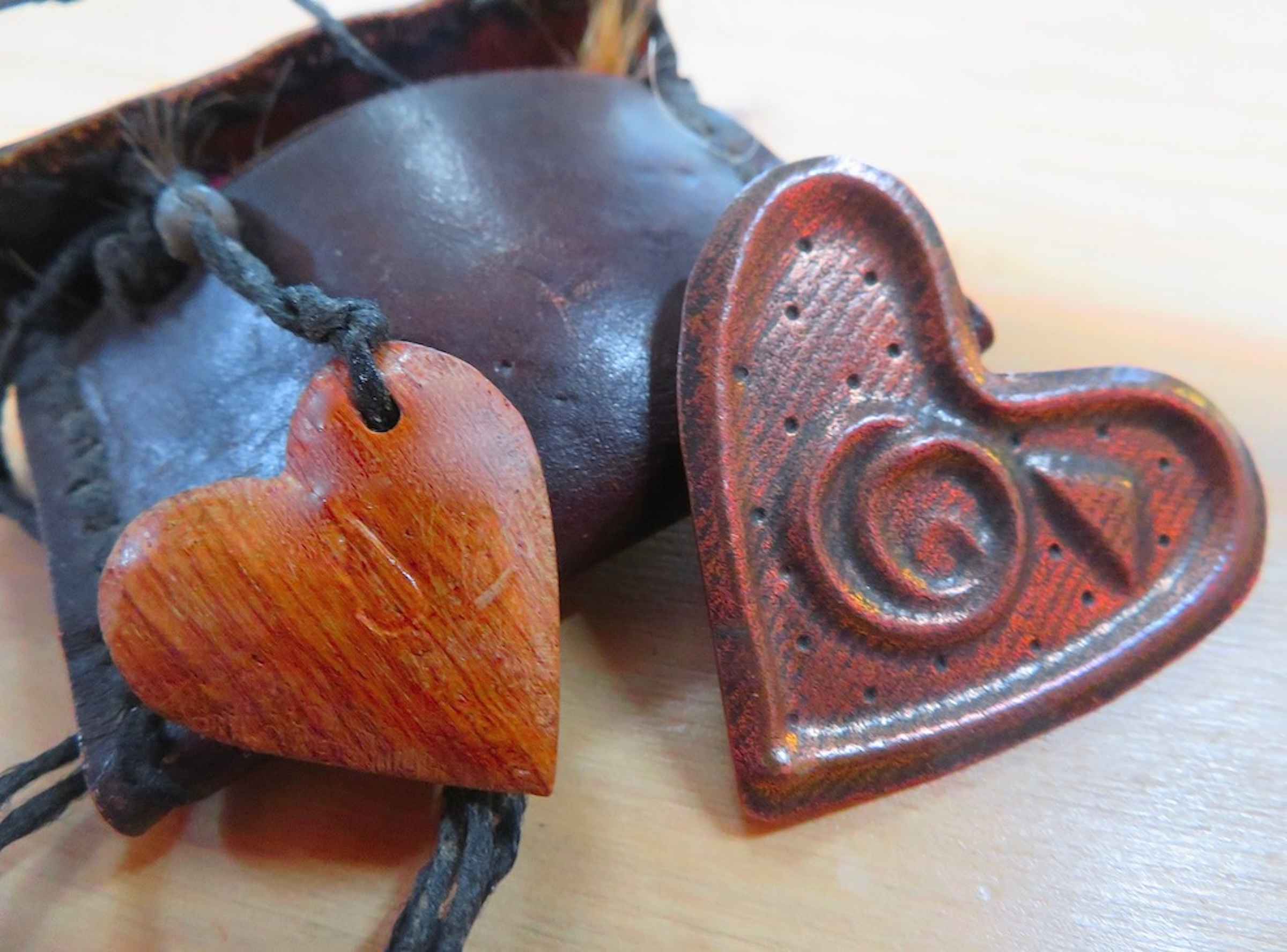
“Wooden Heart”
He handed it to me without ceremony—a small leather bag, awl-punched and stitched together by hand. Its flap was held together by a clasp made from a two fishing line sinkers and a piece of woven wax linen. I unwound the wax linen and found inside a tiny wooden heart with his initials on one side, mine on the other. A small hole in the heart had a braided cord of wax linen strung through that was attached to the bag so that the heart could not be lost. He had woven more waxed linen into a neck cord. I was 39 years old when he gave me that incredible thing I never thought I would receive: his heart—as much of it as he could give.
It was the first handmade gift I’d ever received from a man. Inside, over the years, I have put a lock of his hair and a tiny tiny animal of indeterminate species hand-cut out of wood by his youngest son and presented to me. And, after his death, a small copper heart pin I had made and given to him two years after we married. Twenty-eight years later, this bag is all that is left of what was once my union with the man and his eight children from three different women. When he died, we returned him to the inevitable earth and all of the children returned forever to their real mothers.
The bag lies in a box with other relics of our past together: a silver heart brooch, another carved of wood with wings attached and, strangely enough, a miniature computerized hand piano. Years after his death, it struck a chord on its own, just lying on the shelf beside my favorite picture of him. One last dying gasp from the tiny gadget I’d put in his Christmas stocking but then grown tired of hearing him play and so had hidden away, only to enter our bedroom one night to find him playing it under the covers like a guilty pleasure hidden from the adults, although he was already in his sixties.
For our first Christmas, he gave me a large sculpture he had made that was also a musical instrument—three hand-raised copper gongs in the shape of breasts suspended over a wooden keyboard played by rawhide mallets, the gongs suspended from the long horizontal neck of a copper wind instrument with two necks and two mouthpieces, so two notes could be blown at once. When he died, it was the sculpture chosen by his youngest daughter, and I let her take it. Now, the remnants I have of him are only the leftovers that remained after eight children had chosen. I was moving to another country and could not hold onto everything he’d given.
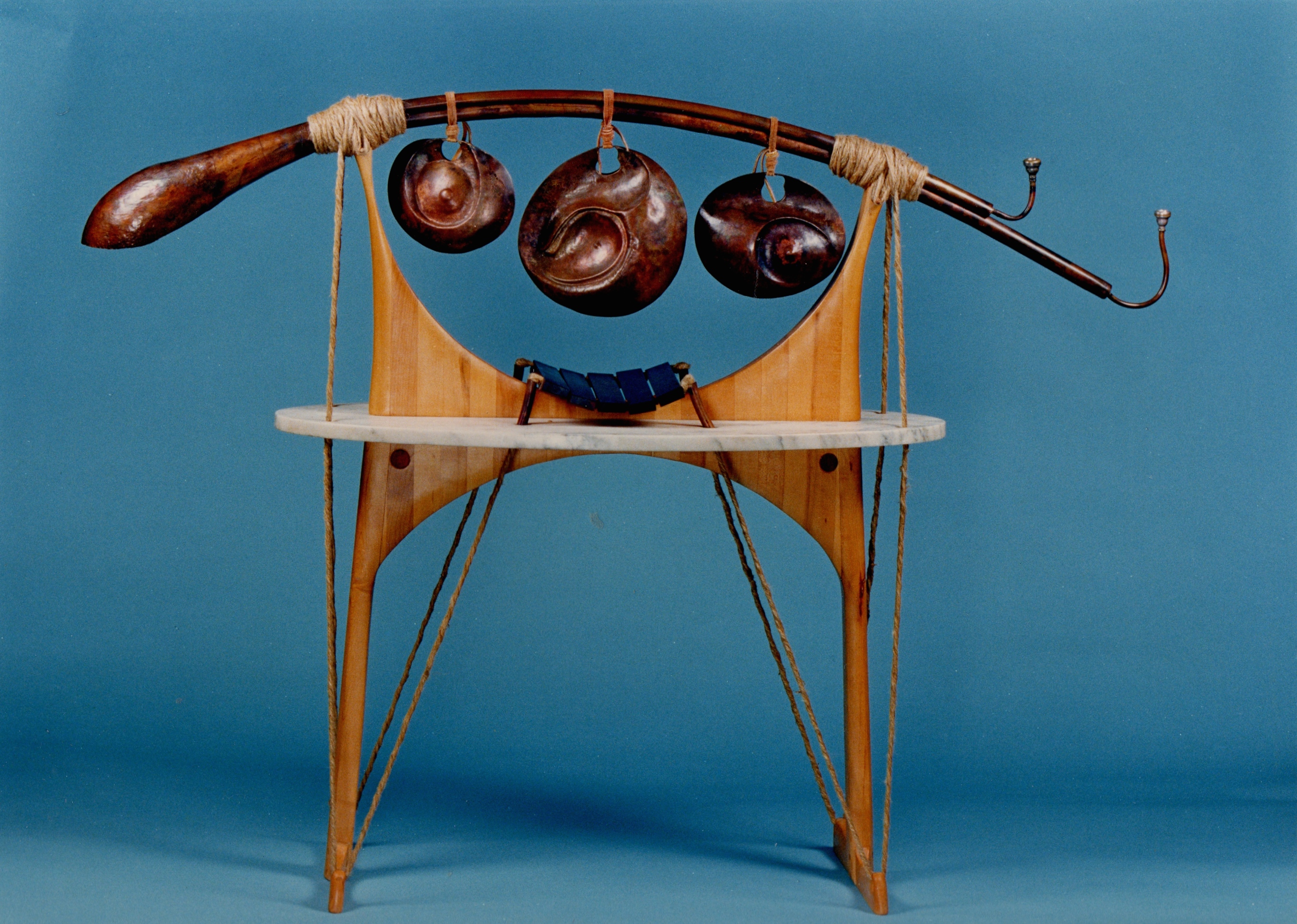
Sculpture by Bob Brown,1986. 4′ X 5.5′, wood, hand forged copper, marble and hemp.
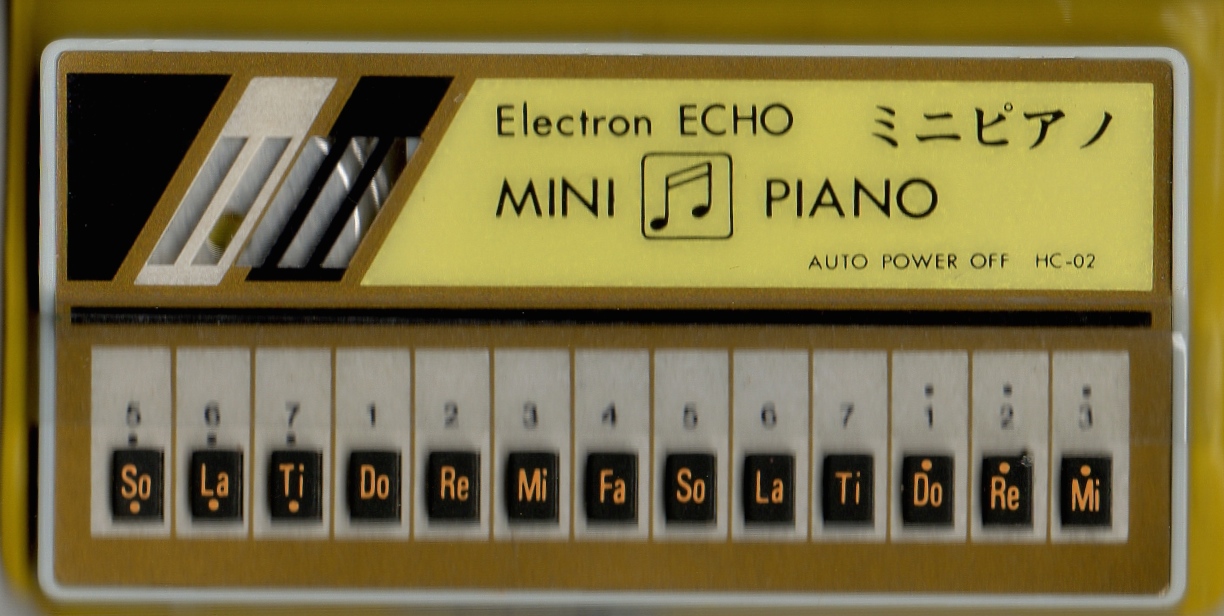
Miniature hand piano, 4″ X 2″
I moved away from most of those things we had collected over the years, but somewhere hidden away in the thousand objects in my studio is the small leather bag and the tiny hand piano, now forever mute, his father’s pocket watch, his biking medals and the other assorted pieces of his life that will one day wind up in a secondhand store in Mexico. All of our gifts finally melding with the parts of all those billions of other lives that strike their brief chord before blending, inevitably, back into the cacophony of the universe.
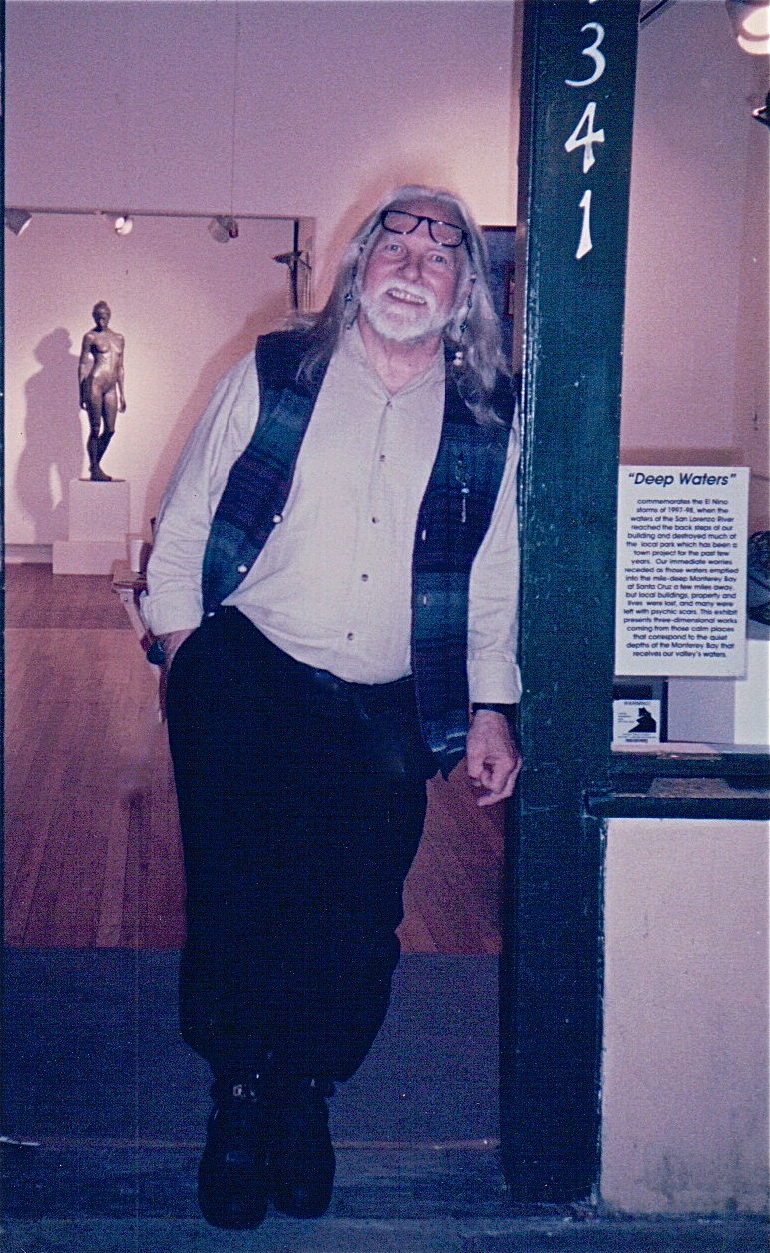
The prompt for RDP is “Bob.”
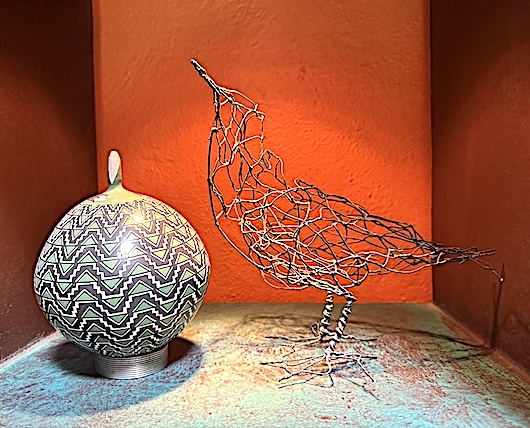 Wire Crow
A black crow formed of bent wire, specific in its detail, with the look of chicken wire, yet individually twisted. You had seen me come back to it again and again at the art show and you had taken note. You, who usually worried me about how hard I was to buy for, asking what I wanted, making me responsible for my own gift. How I hated Xmases and Birthdays for this reason. Hard enough finding the perfect gift for you and each of your 8 children and my family, but to have to determine my own needs and wants? Unfair.
Yet this gift, a surprise on my 42nd birthday, so perfect. A reminder of that black crow poem you had written about the end of your first marriage and the decline of your second—that poem that ranged so far and wide that it included even me, gathering your children and taking them to safety when we broke down on the freeway. The first poem not about other loves and past loves, where I was the heroine. A part of your official biography.
This crow, then, has seen beyond you. Seen your death and my relocation. It sits on the highest shelf of my sala, bent over a mata Ortiz lidded bowl, an ear of corn rising up from its lid, as though the crow is about to feast. It is one of the objects that gathers you around me, even now, 23 years after your death. The wooden statue you carved in Bali, Your giant spirit sled of copper and hide, Your Tie Siding sculpture that fills the corner near my desk, The spiral lamp–one of our favorite collaborations.
My whole life a continuation of that collaboration—your pulling out of me the art and words that surround me now on my walls, my tables and swirling through my head, disconnected or connected. Metered in rhyme or collecting into paragraphs. All parts of my life ones we bolstered in each other, pulling the world in around us with wood and stone and metal and paper and ideas and words. That metal crow a part of all of it that I have overlooked for so many years now. Of the few objects brought the long miles from California to Mexico, this crow was selected innocently, perhaps more by intuition than by conscious thought, and yet it stands, highest of all, to project its message.
No one who has formed us ever dies. New loves do not cancel out the old. Like one glorious recipe, our lives accumulate ingredients. Sweet and salty, tart and crusty, effervescent and meaty. Like your presence. Ironically represented by that crow that is mainly emptiness, really. Or perhaps unseen mass. Like thought. Like poetry. Like love. Like a forgotten important detail suddenly remembered.
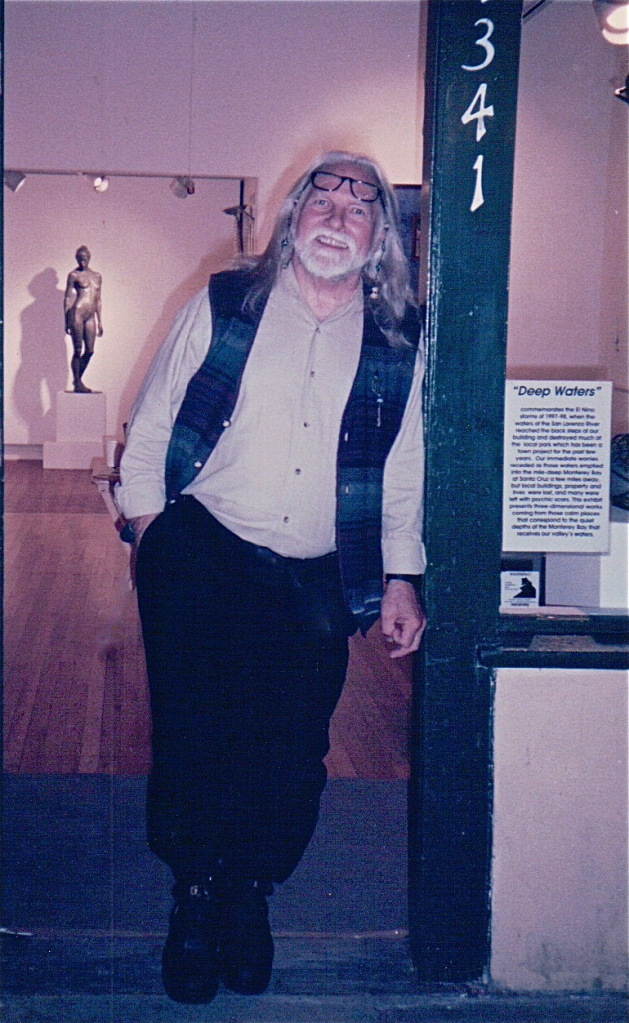
If this poem left justifies, click on it to get it to center as it is a shape poem!
After 15 Years
Your memory cuts so sharply
through my dream’s beginning that I wake,
gasping like a fish on the sand
left by some fisherman
too intent upon his next catch
to end it cleanly.
In its tight skin,
I gasp for air,
rise as it cannot rise
and like you cannot rise
out to that night sea air
which is the only coolness
in a month of burned days.
My memory, curving round,
pulls in the memory of you
like gills seeking to understand
the waterless air.
Landed by some bigger fisherman
whose bait you couldn’t resist,
“Oh,” you said, just “Oh,”
before you took the hook,
slipping from my grasp
as I held on, held on,
let go.
This is one of the poems in my book of 50 years of love poems titled
If I Were Water and You Were Air, about to be published on Amazon.
Posted in response to the dVerse Poets Open Link Night.
See how others responded to the prompt HERE.
Yellow
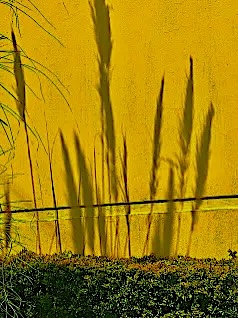
You were so red, so white.
So much of you was blue.
Yellow is what I missed in you—
that brilliant optimism—
that power of the sun.
There was that black in you
that cancelled it out.
You were the artist who understood color the most.
That color created by the union of yellow and black, you knew.
Your white hair, confined in a pony tail
or streaming down your back
in your wild man look
prompted strangers to ask
if you were a shaman,
or declare you to be one.
That red that flamed out from your work,
subtly put there even in places where it had no
logical purpose for being.
That red tried to make things right.
All of us who knew you
knew the blue.
It was the background color of all of your days.
It was the blanket in which we wrapped ourselves at night,
trying to be close,
but always always divided
by blue.
For fifteen years,
I believed that one day I’d bring you to yellow.
There were splashes of it, surely,
throughout our lives together.
You on the stage, reading your heart,
me in the audience, recognizing
all the colors from within you—even yellow.
Finding the pictures you had taken of me
at the art show, looking at your work—
those pictures taken even before we ever met.
I discovered, after you’d passed,
that you had recognized
me even then, when I thought
I was the only one
angling for a meeting—
sure of my need to know those secret parts of you
that I will never know
now that you have given yourself
to the black
or blue
or red
or even to the white.
Whatever your ever after
has delivered you to.
A new life later,
I am suffused
by my own canvas
of memories of you—
every other pigment
splashed against
a vivid background
of yellow.
The NaPoWriMo prompt is to write a poem that repeats or focuses on a single color.
 Closets
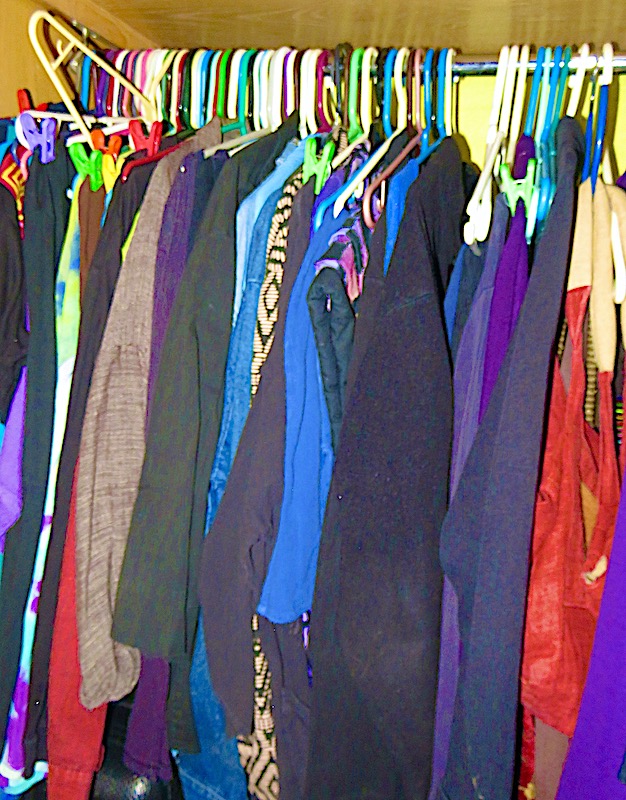
The signs of my leaving were clear. Closets were open in every location of the house where clothes could be stored, for gradually over the years, as each family member in turn left our house, they left not only a space in my heart, but also an extra closet for me to appropriate.
The front bedroom, which had been first Jodie’s room and then Chris’s—stepchildren now gone on to new lives—was now the guardian of my heavy winter coats, extra robes and the too-flamboyant clothes of my thirties. In the basement closet of what had formerly been a guest bedroom, then converted into my metalsmithing studio, I stored sizes 10 through twelve, suggestive lingerie from my past, Halloween costumes and spring jackets.
My “fat” clothes, unfortunately, were presently residing in the closets of the master bedroom–size 14 through 16 in my own closet, sizes 18 through 1X hanging like abandoned lives in “my” portion of Bob’s closet, his clothes having been culled by five of his kids and their spouses and girlfriends who, just weeks ago, had gathered for his funeral. I wish I had taken a photo of them as they stood around the nearly empty TV room, each of them in a pair of his wild pants or one of his t-shirts or both, wearing their recently departed dad or near-dad like a skin. He had been a wild dresser. Red suede sneakers, drawstring puffy-legged pants we’d had made from batik in Bali, Guatemalan shirts.
Now, beside his few remaining garments, hung mine. It was like a major filing system spread throughout the house. Unfortunately, clothes seemed to migrate from closet to closet–my hot pink suede cowboy boots walking over for a visit with my old office clothes or my winter capes winding up mysteriously amidst teddies and feather boas.
So it was that closet doors all over the house stood open as I searched for items that would cover climatic necessities from thirty below zero to tropical.
The floor was covered by my big suitcase and my small suitcase, peeled open like bananas awaiting their stuffing. Around the suitcases, the floor was littered by various personal items that had spilled out from a dropped cardboard box. I lay belly down now, my hand swinging out in arcs in search of the flashlight which had rolled under the bed when it tumbled from the box.. Like the Halloween “body parts” game wherein in a darkened room a peeled grape became an eyeball and cold spaghetti was reputed to be intestines, my hand skittered over various small objects. A dust ball that felt like a small mouse, hairpins, paperclips, a missing black sock, before finally settling on the flashlight .
I tossed it into the front zippered compartment of my canvas suitcase. I believed in being prepared for any contingency in travel and so I carried a mini drugstore that would cover emergencies from scorpion bite to constipation as well as a small tool kit, flashlight, book light, alarm clock and mini umbrella all tucked into the front two zippered sections of my suitcase that I had dubbed my “utility” compartments.
“You won’t need all that stuff,” Jayson had told my as he surveyed my knitted muffler and mittens and winter coat. “Isn’t it pretty much hot all year round in Mexico?”
“Yes, but I have friends and relatives in Wyoming and Minnesota. I might visit them. Or take that trip up the west coast of Canada to the Northwest Passage that Bob and I always meant to take. No need to have to buy new clothes. And the Mexico house has lots of closets, too.”
Surreptitiously, I slipped Bob’s Mudcloth African shirt ornamented with the x-shaped metal studs into one of the boxes, along with a pair of Bali pants the daughters-in-law had overlooked, and his “Art Can’t Hurt You” T-shirt that I had thought would be cremated with him, but instead had arrived back intact with his ashes, along with his red suede sneakers, another pair of batik pants and his metal dental crown, complete with fake teeth. I packed them, too, setting aside his cremation urn, for which I had a special place. The family would all come down to Mexico in the spring to help my spread his ashes in Lake Chapala. In the mountains above it was the beautiful domed house we had meant to make our retirement home, but we had waited too long to find it. Now I would soon start the long journey down to it, from Boulder Creek, CA to Mexico, where I would fill out the closets of a new home.
I folded my Mother’s Japanese cotton kimono jacket and slid it into the box. It had been an old man’s housejacket, my Japanese friend had told me, and please not to wear it when I met her family. But, my mother and I had loved it when we found it in Nobu, a Japanese shop in Santa Monica, and she had worn it for years before dying just three months before Bob and I left for Mexico to find a new home, buy it, and return to California to sell our home of 14 years. Two months later, although we had not sold the house, we had sold most of its contents. We had packed most of the van—mainly with books and tools, reserving packing our clothes to the very end, thinking we could perhaps stick them into the cracks between other items–– before discovering, during our last-minute medical check-ups, that he had cancer. He lived for three weeks.
So, I’d be moving alone to Mexico, but would always have the option to be surrounded by my dearly departed. My closets would be full of my own past and present selves, but one small portion of them would carry Bob and my mother with me as well.

I can’t see tools without thinking of my husband Bob who had every tool on earth. Here is a poem I wrote about him. It’s been on my blog before so hope this is acceptable. Click on this link to read the poem: https://judydykstrabrown.com/2016/11/27/you-have-become-the-art-you-lived-for/
Here is a photo of him at his happiest, in the studio creating:


Agastopia*
(For Bob)
At my dear departed husband’s behest,
my ode extols the female breast.
In a dream world of his making,
breasts on beaches would be baking,
naked in the sun, to gold,
then, unashamed, to brown and bold.
No petty thoughts would cloud his mind,
his excitation, an artful kind,
and as he paints or sculpts or molds,
each scoop of plasticine he holds,
will take a shape of his devising,
as he works, his hands revising
all that God and nature wrought,
their perfect beauty therein caught.
While some malinger at their tasks,
a breast is all my true love asks—
to do what nature first has done
and duplicate them, one by one.
*Agastopia is the admiration of a particular body part.


Prompts today are dream world, petty, malinger, revise, excited and agastopia (the fetishestic admiration of a specific body part.)
Forgottenman reminded me of this post of more of Bob’s sculptures: https://judydykstrabrown.com/2019/07/12/mentor/
 lifelessons - a blog by Judy Dykstra-Brown