Tag Archives: Daily Prompt

Deep Voice


DSC09534jdbphoto


Deep Voice

The stranger on an airplane in the seat next to me
never said a single word, and so I let her be
until our arrival, when I prepared to stand
and she produced a paperback—put it in my hand.

“It’s time for you to read this,” she said, then went away.
I didn’t say a word to her. Didn’t know what to say.
That book, however, changed my life and attitude and choices—
encouraged me to listen close to interior voices.

Buscaglia, Jampolsky and all of Carl Jung’s books
drew my mind away from appearances and looks
and into that finer world of instinct and of mind;
then drew me westward to the sea and others of my kind.

After a writer’s function, a stranger sent to me
“The Process of Intuition,” which I read from A to Z.
I read it twenty times or so, then sent it to a friend.
Then bought up every copy left to give as gifts and lend.

I don’t remember talking to the one who sent it to me,
but if I need a proof of faith, I guess that this will do me.
For I believe there is some force that draws the next thing through me
and if I follow instincts that hint and prod and clue me,

they are the truths that guide me on the path towards the new me.
The signs are there in all our lives if we choose to see.
No, I don’t believe a God guides our destinies.
I don’t believe in lifelines or spirits within trees.

I don’t believe in any faith that has a name or church.
I do believe, however, that I’m guided in my search
by something that unites us and sets our pathways right
so long as we listen to our own interior sight

that urges us to follow the right side of our brain
even though those choices are logically inane.
I know that it takes many types of brains to run the world,
but for me it’s intuition that when carefully unfurled

guides me best—towards art and words and unplanned days and oceans
and prompts me make a Bible of what others may call notions.
And so to simplify I’d say that I must have faith in
that voice we’re all a part of that speaks to us from within.


If you haven’t already viewed it, Word Press would not let me link to their Weekly Photo site yesterday, so please view also: https://judydykstrabrown.com/2018/02/08/tending-house/

This is a rewrite of a post from four years ago. The prompt today was simplify.

Tending House


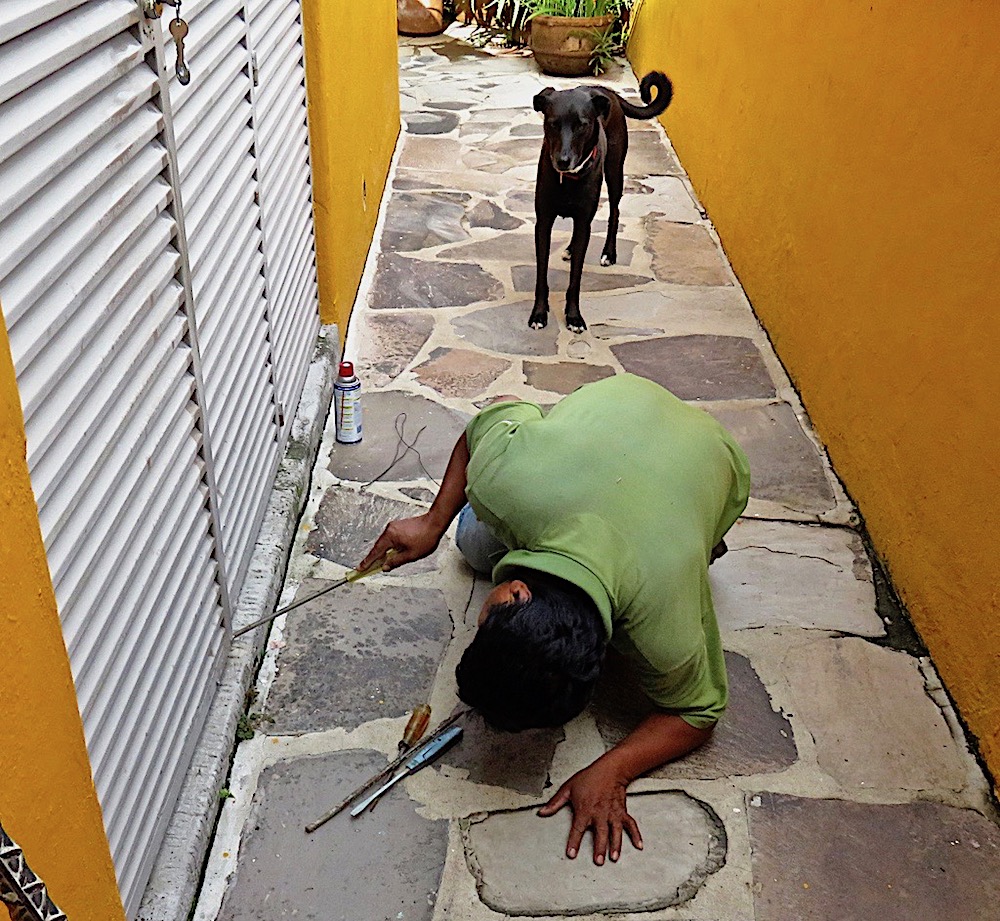
Diego supervises as Pasiano “tends.”  jdb photo

Tending House

In no place I have ever lived do so many people seem to be necessary to maintain one house. On any given day, in addition to my efforts, it is likely two or more of the following caretakers will be present: housekeeper, gardener, plumber, locksmith, bricklayer, tree-trimmer, cistern-cleaner, fumigator, carpenter or appliance-repairer. Do things really break more frequently in Mexico? Do locks jam more or garage openers go on the blink with greater regularity? Do more brick pathways need to be laid? More roof tiles slide down and go boom? More solar water heaters spring more leaks? Do pools develop cracks more easily and pipes pop open just for the fun of it? Do houses cry out to be added onto? In my sixteen years of living here, it certainly seems so. I especially remember the day described in THIS POEM as being one where the entire world seemed to be directed toward the care of my house. It was the monarch. We were its slaves.

The prompt today was tend.

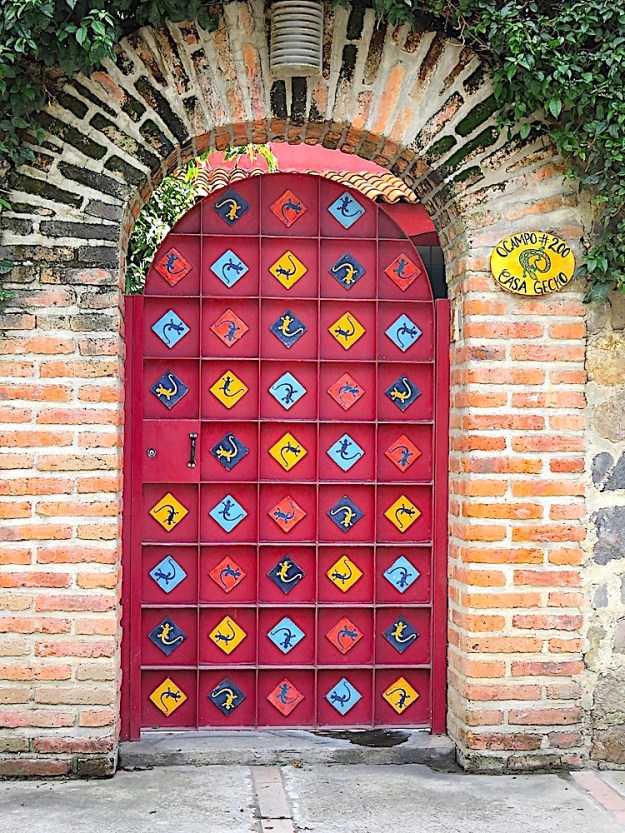
I think this photo also qualifies for the Thursday Doors prompt!

Bewildered: Gray Walls with Boxes


Gray Walls with Boxes

Once I knew words that fit together.
Now my mind still has the answers,
but rarely lets me in to find them.

People who seem to know me
bring pizza in a box
and we eat it in front of another box I’ve forgotten the name for––
a small world with other people moving in it that I don’t know.
Sometimes words appear in a ribbon on the bottom edge of that box
and I wonder if I understood them
if they ‘d tell me what I’m supposed to do.

On the walls are other flat boxes
with people frozen in them
and I think it is my fault.
There is something I am supposed to be doing.
“They are your pictures, Mother.
They’re there for decoration—
for you to enjoy,”
a woman tells me
when I ask her
if she’d like to take them
home with her.

I don’t belong here.
My high school boyfriend
must be wondering
where I’ve gone
and my daughter is as confused as I am,
claiming to be her own child;
and then one day my sister comes
and I have to laugh because they all
look so much alike—
my sister and her niece and her niece’s daughter
whom they try to convince me
are my daughter and my granddaughter––
so many layers of daughters
that it is too hard to keep them
all in mind.

But then that floats away
and I am trying to remember
when I am leaving this hotel
and I feel I’m not suited to run for president
although all those people
cheering at that big convention in that little box
want me to––
that little box they turn off and on each day,
sometimes before or after I’m ready
to have it turned off.

And they take me to that large room
where all those silent older people sit.
I do not want to go into this room,
but I am lucky, and we move through it.
Someone’s daughters have come to put me
into a box that moves us through the world
without walking. At first, I am so surprised by it,
then I remember what it is
but can’t remember the word for it.
As we sit in it, the world moves by
too fast, scaring me, and I try
to weep unnoticed.
But then they take me out of it,
give me popcorn
and lead me into a very large room
with many people sitting down
and an entire wall with larger people
moving on it, and it is so confusing, like déjá vu,
for I remember being in a room like this before,
but I don’t know if I’m supposed to
make them do something other
than what they are doing
or if I’m already controlling them with my thoughts
or if I’m supposed to be
up there on the wall with them.
I can’t remember whether these people
on either side of me are my sisters
or my children or strangers,
sitting chair after chair down the long aisle.

Most days, I am so sad all day long,
but sometimes my real self
comes to visit and I think,
how did I become a martyr like my grandmother
and why can’t I stop myself from crying, just like her?
One gray wall meets another at the corner
and I’m sure
that I am being punished
for things I did but can’t remember.

That blank face
in the mirror
has me in it,
but I can’t get out
and for a moment I know, then forget
that this is why I cry
and cry and cry
and cry.


I think the deep stage of bewilderment that Alzheimer’s brings us to is the biggest fear of many of us who are over the age of sixty.  I’ve written poems about earlier and later stages of this dread disease, but  this poem describes as closely as was possible for me the way my sister Betty seemed to be feeling at a couple of different stages of her dementia.  Her delusion that it was she who was running for president the year Obama was elected, her befuddlement over the television and later over the art on the walls, over the identity of family members, and finally her astonishment over being in a moving car and at the movies.  This may have marked the last time we took her out of the care facility where she still resides. I went to see her a few months ago and still plan to write about her present state. Anyone who has a loved one in some stage of this heartbreaking disease will know haw hard it is to imagine how they may be feeling and how equally hard it is to write about it.  That is why I keep putting it off. I’m running this poem again after five years because it seems to fit today’s prompt, which is bewildered.

Merry-Go-Round


daily life color086 (1)
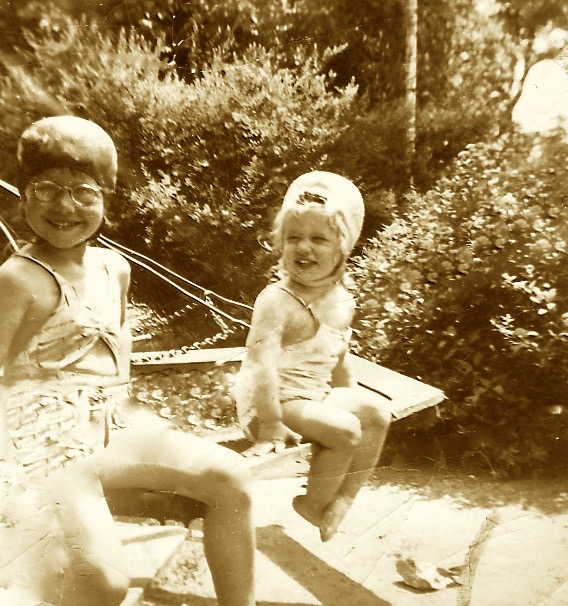
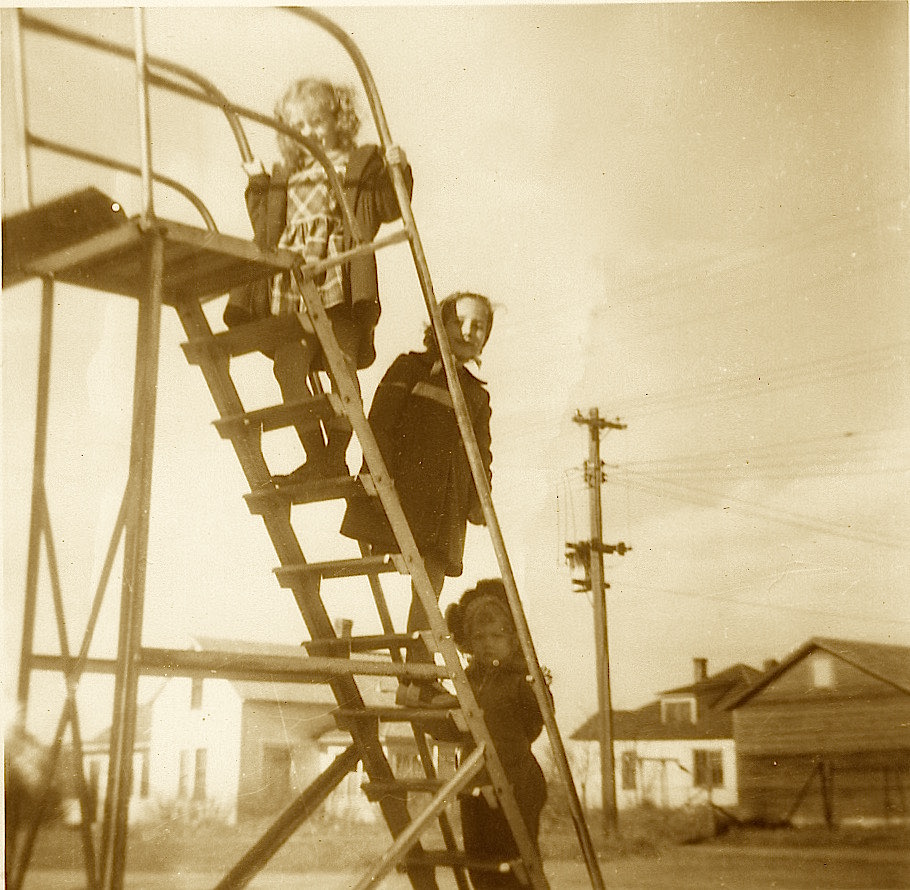
My sister and I at a park near my grandma’s house in Kansas on a merry-go-round similar to the one in the school playground across from our house in South Dakota.

                                                                   Merry-Go-Round

Their creaks were my alarm that kids were on the elementary school playground across the street and if my biggest sister was downstairs or away from home or even sleeping as soundly as she always did after coming home late the night before, I’d sneak into her room to look out onto the playground from above and see who was there. I knew the difference in the sound between the merry-go-round and each set of swings—the little swings next to the little slide, or one of the three big sets directly across from the block my house was on. Higher, with longer and more flexible chains, these swings could be made to loop de loop—pass up so high that you actually went over the top of the frame the swings were suspended from and wound the chain once around the pipe.

Some of the boys could repeat this three or four times until the swing got so high that none of the little kids could get up to it. Then the janitors would have to get their tallest ladder and go up to push the seat over and over the cross pole with one of their big push brooms to straighten it out again and bring the seat down closer to earth.

There were rules forbidding loop de looping, but the boys would come after school when all the teachers had gone home and even our janitors, Mr. and Mrs. Polachek, who lived kitty-corner across from the south end of the playground, were at home in their backroom away from the sounds of kids they had to deal with every day.

The creak I was listening for was the creak of the merry-go-round. Teepee shaped, it had a wooden runner all the way around it a foot up from the ground. There was a handrail about thirty inches above it, so you could stand on the wooden runner, facing the center pole, hold onto the hand rail and enjoy the ride as the big kids ran around in circles around the merry-go-round, pulling it with them to go faster and faster, then stood on four sides of it, grabbing the handrail pipe and pushing it off to make it go faster still. One by one, more onlookers would enroll  in the joint effort to get it going fast enough. Then they’d jump on and everyone would pump up and down, sticking their bottoms out into space as they bent their knees to keep up the momentum.

There were other ways to use the Merry-go-round. The bigger girls like Marie Holstedt who lived on the street that faced the opposite side of the playground from the one my house faced, would sit on the foot board with her boyfriend Robert. Their feet side by side on the ground, they would sway to and fro in a kind of two-step movement—two to the right, then one to the left––their knees touching with their swing to the right, their hips touching when they swung to the left. When they did this, the sound of the merry-go-round reminded me of the strange rhythmic creaking I’d hear sometimes late at night in my house.

It was probably the TV antenna on the roof, my mother had said. Or maybe the furnace trying to pump out heat, she had speculated when I pointed out that it had been a windless night.
Life was simple and I believed her. Only now do I make sense of it and of my father’s late night short trips down the hall to the bathroom—the washcloth always draped over the tub faucet the next morning.

It was an innocent age where it was entirely possible to be eleven years old and to never have had the least idea that anything like sex existed in the world. Yet a good deal of what eventually led up to it went on in the playground across from my house. Older girls would sit in the swings, swaying back and forth without ever taking their feet from the ground. Or, take fast running steps forward and backward without really letting go and allowing the lift off. To their side or in front of them would be their crush of the day or the week or the hour. If he was not the boy of choice, sometimes the girls would switch swings. If the boy switched again, too, and the other boy let him, then it was a sign language of sorts that indicated which boy favored which girl, and if the girls went home, a clear message that things had not matched up correctly to their satisfaction.

But at other times—usually during games of ditch ‘em played in the twilight and darkness of summer—courtships could progress toward hunkering down in the ditches around the playground, close up to some culvert where the ditches were their deepest, the girl in front, the boy with his arms around her waist, holding her back from running to try to get to home base when one of the littler kids who was “it” ran past without seeing them. In these junior high years just past childhood, the objects of the games started to shift until finally in high school, the rituals of the old games were left behind entirely and ditch ‘em became merely a starting place––as did the swinging back and forth, the pumping, the dance.

Today, with merry-go-rounds a thing of the past, they are still an appropriate metaphor for what life pushes us toward from our birth. It begins with our rocking in the arms of our mothers, the rocking chairs of our grandmothers, the wild swings through the air locked hand-to-hand with our fathers. It is what slippery slides and swings and merry-go-rounds and dancing move us towards. Everything going around and around and in doing so really going back and forth from generation to generation. Passing the world on and fading away. Now and then doing a loop de loop just because we can.

daily life color087 (1) daily life color088 (1)


This is a rewrite of a piece from three years ago. The prompt today is enroll.
The Persistent Suitor

IMG_2115

The Persistent Suitor

He has no right to loiter here, has no permit to tarry.
He looks no more familiar than  Tom or Dick or Harry.
And yet he is persistent, as though it’s his profession.
He gives no apology and renders no confession.

One day he carries chocolates, another a bouquet,
yet they do not grant him access. They do not pave the way.
Then one day he’s missing.  He doesn’t grace her door.
She hears no insistent knocking. There are no offerings more.

All day, she thinks of him and where he might have chosen to wander.
It seems perhaps that once again, absence has led to fonder
reflections on the part of one who’s playing hard-to-get.
(She is noted for her skill at it among the party set.)

One more day he’s absent. She claims she doesn’t care.
It’s easier to leave her house without a suitor there.
Yet when he finally comes again, she opens up her door
flushed with her power to attract. Victorious to the core!

“Yes?” she says, one eyebrow lifted in disdain,
as though another suitor is an aggravating pain.
And the confidence of her suitor seems never to have swerved.
As he handed her an envelope and said, “Ma’am, you’ve been served!”


The prompt today was permit.

Creatures under Rain


Creatures under Rain

All day long, the rain came down
to soak the mountain, drench the town.
Each dog stayed in to curl into
his protective curlicue.
I took their lead and kept inside
as the world around me cried and cried.

Though I won’t say that I’m feeling down,
I do not choose to paint the town
and marks on paper have turned into
other than a curlicue.
I painted what I felt inside
with words that folded in and cried.

Their pigments bled and rivered down
joining currents from the town,
and tears from other creatures, too,
joined this watery curlicue.
This whirlpool that we’d kept inside
joined us together as we cried.

The sun comes up and moon goes down
over country, lake and town.
Illumination cycles, too,
through nature’s dizzying curlicue.
When we share these truths we’ve found inside,
others hear what we’ve decried.

The whole world may be feeling down
dreading contact with the town.
The words we free may catch them, too,
in their discursive curlicue,
loosening pain they’ve kept inside—
dispelling tears they might have cried.


I was intrigued by the self-set challenge of composing a five stanza poem where each stanza made use of the same six rhyming words in the same order. I think it isn’t terribly noticeable except for the unusual world “curlicue” that eventually tips the reader off as to what is happening.  Still, it was an engaging challenge to make it work six times.What should I name this form? Six-Step? Any other ideas? The prompt today is creature.

Hard Transit

DSC08775

Hard Transit

My grandfather and his two teenaged daughters
drove a wagon to Dakota to claim a homestead.
I never asked how many weeks they traveled, or the hardships that they faced.
The young don’t know what answers they will wish for until it’s too late;
so only imagination serves to describe the heat,
day after day with no water except for what they carried,
coyotes, gray wolves and the glaring sun of the treeless prairie.
My aunts were just young girls dealing with the difficulties young girls face
in the sparsest of conditions. No mother. No outhouses.
The jarring ride—grasshoppers so thick the wagons skidded off the tracks,
and that loneliness of riding into
the emptiness of a strange world.

Now, I stand impatiently at the immigration window,
then the ticket line and the security line.
I empty pockets, discard water bottle,
remove computers from their cases, take off shoes,
raise my arms for the check,
struggle up the escalator with bag and purse,
find the right gate,
negotiate the walkway to the plane,
lift the heavy carry-on and lower myself into the too-small seat.
“Plane travel isn’t what it used to be,” my neighbor says,
and we console each other about how hard it is.
“Nine hours from Guadalajara to St. Louis—
a plane change and a three-hour layover in Atlanta,”
I grumble, and he sympathizes.


This is a rewrite of a poem I wrote so long ago that even I don’t remember it! The prompt today is sympathize. 

Wallpaper

DSC09880


Wallpaper

Clinging to the wall
like an old wallpaper scrap
are the words
I want you, I want you, I want you, I want you.

Their refrain slides up and down
the musical scale—
an old country tune,
plaintive and clear.

Why do I want you?

The first time I met you,
there was something about the curl of your hair.
Your eyes, so familiar­—puzzled, as though
you, too, were trying to remember.

After that, it was
the set of your shoulders—
the arm stretched between your seat and mine
with your hand on the back of my seat.

All of your restraint an aphrodesiac.

The truth is
that I pined
for two days after I left,
then went on with my life.

Still, that scrap
of wanting
comes up early in the morning
as I waken

and my mind walks,
looking for someone to pin it to,
and every time
it stops at you.

The prompt today is puzzled.

Profuse Praise


Profuse Praise

She was not the sort of miss that flattery could turn.
Excessive admiration just made her stomach churn.
She had no use for sweet talk or raves that were prolific.
Compliments just bored her. Praise she found horrific.

She set out to tell him that his raves were quite absurd
and his fawning words profusive, but could not recall the word,

so she just said nothing as his copious adulation
stirred her to a level of nervous agitation.

She found his fulsome words to be shockingly unstinting
with his gushing adjectives, his adverbs unrelenting.
He said that she was perfect, her end result most lavish,
while she just found his flattery ridiculously slavish.

“Rich, sweet, slightly juicy, and never sour or tough,
with just a little crustiness.” He couldn’t get enough.
So finally she just gave in and with a little sigh,
picked up the knife and cut him—
another piece of pie!


The prompt today was profuse.


The Conveyor of the Moon

The moon, a rabbit, a bottle of tequila and a simple Mayan figure of a woman convey to us many of  the legends of Mexico as well as one theory about her naming.  Eight years ago I created a retablo that conveyed this message, both visually and in a story that resides in a chamber within the box the retablo sits upon.  I sold that retablo years ago, but luckily I have this photo and these words that describe it. In case you missed it last time, here it is again: https://judydykstrabrown.com/2015/07/11/the-rabbits-navel/


The prompt today was conveyor.