Tag Archives: Daily Prompt

China Bulldog

China Bulldog

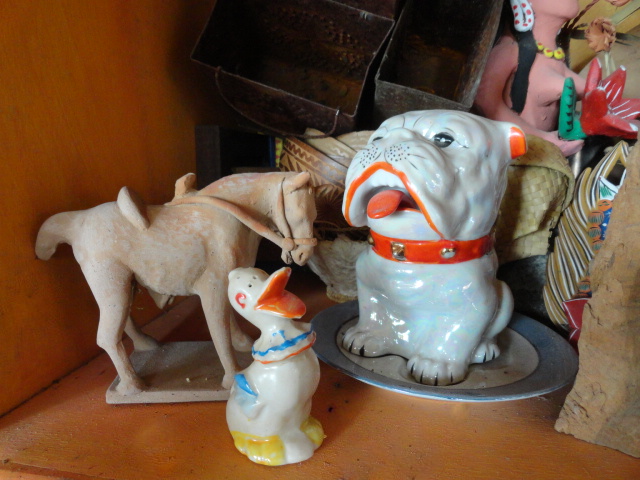
I dreamed last night that we were clearing out my mother’s house.  The front doors of all the kitchen cabinets had been removed and I was puzzled about this.  On the mantelpiece, I found China bulldog after China bulldog that was a replica of one I one my mother had told me to take home with me when I cleared out the house after my father’s death.  “Judy asked for this. You can fight over the rest.” said a note taped to the bottom.  A mayonnaise jar, it was of white glazed ceramic that had a rainbow sheen.  Its head came off as a lid and its bright orange tongue was the handle of a spoon.  The body fit into a depression in its saucer that had the outline of the bulldog’s feet and bottom so it nested a bit.

One of my first memories was seeing it sitting on the small triangular shelf in our kitchen.  My mother never used it and later, in newer houses where it didn’t suit the decor, it always sat within a cupboard.  My mother was too modern for China cabinets or knickknacks that didn’t match the color scheme.  When I was small, her taste went to magenta and chartreuse.  Beige and pink and turquoise marked the seventies, the turquoise and pink traded in for avocado and burnt orange in the eighties and back to a more understated green and beige in the nineties.

Whatever the color scheme, the bulldog never quite fit in, but it was the one object asked about by both of my sisters after the Loma Prieta earthquake.  I I was living in a house near its epicenter, and the bulldog had worked its way from the back of my kitchen cupboard to sit teetering on the edge, but it had not fallen.  It was one of the few things in a house packed full of art and artful objects that I chose to bring with me to Mexico.

I’d like to say that it has assumed a position of importance in my house in Mexico, but sadly, the China bulldog just never quite seems to fit in to the mainstream.  It has sat on a shelf in my studio for the past twelve years, somewhere near the back where it is safe but unseen.  But for some reason, if I were to be able to take one more object from my house, the China bulldog is what my mind falls upon. Perhaps it is time to think about why.

I often dream about a subject that ends up being my blog topic for the next day.  For some reason that topic fits into the prompt and so it is never very difficult for me to begin the day’s writing.  In this case, once I’d settled on the bulldog as my topic, I immediately remembered that in my dream I had found five or six bulldogs on my mother’s mantel.  Some were without bodies, all without their dishes.  Some were smaller than others and lacked the brilliant sheen or bright colors.  One seemed to be almost crumbling, as though it had been under water for a long period.  All were missing their tongues.

In the dream, I imagined my mother combing second hand stores and never being able to resist whenever she found a bulldog in the same shape as the one her older sister had given her when she was a child.  It’s been at least 100 years since she received that strange gift that was the only remaining thing that seemed to have been brought with her when she moved first from Missouri, then to Kansas and then to South Dakota, to marry my father.

She told me no stories about it and as I think about that, I realize she told me few stories at all.  Not about her wedding or my birth.  The stories in my family all centered around my father while her stories seemed safely tucked away on a shelf like the China Bulldog.  Perhaps that is why that one piece of all the pieces of my mother has assumed a center place in our memories. I know that my middle sister, who lived in the same town as my mother for the last six years of her life, has mourned her loss the most over the years.  My oldest sister, who was estranged from Mom for the last twenty years of her life, is in the throes of Alzheimer’s and so never mentions her at all.

It has been fourteen years since her death and I don’t think of her daily or even weekly, but every so often, something happens and the thought comes in a flash that I have to be sure to tell Mother about it; and for the past year, most of my poetry has been written in her joking, rhythmic cadence and rhyme.  Perhaps some essence of her that has been steeping in me for over sixty years has suddenly reached its saturation point and must come out.

And the China bulldog?  The dream? It is as though for all these years she has been trying to get it back, never quite replacing it but nonetheless not giving up the search.  And I can’t overlook the irony that it is these less perfect incomplete bulldogs that she chose to put on her mantel.  Is she trying to tell me something about beauty or the adherence to a dream or about giving up perfection to enter back into the quest?

My mind ricochets without finding an answer, but I continue to feel the prompt.  Perhaps there is reason in the name “wordpress.”  I feel that press to find meaning through words as I feel my mother’s gentle prod and communication through genes or memory or dreams, to leave perfect things behind and to get on with my life.
DSC09684

The Prompt: Burnt—Remember the prompt where your home was on fire and you got to save five items? That means you left a lot of stuff behind. What are the things you wish you could have taken, but had to leave behind?
The Sticky Fingers of Things

The Sticky Fingers of Things

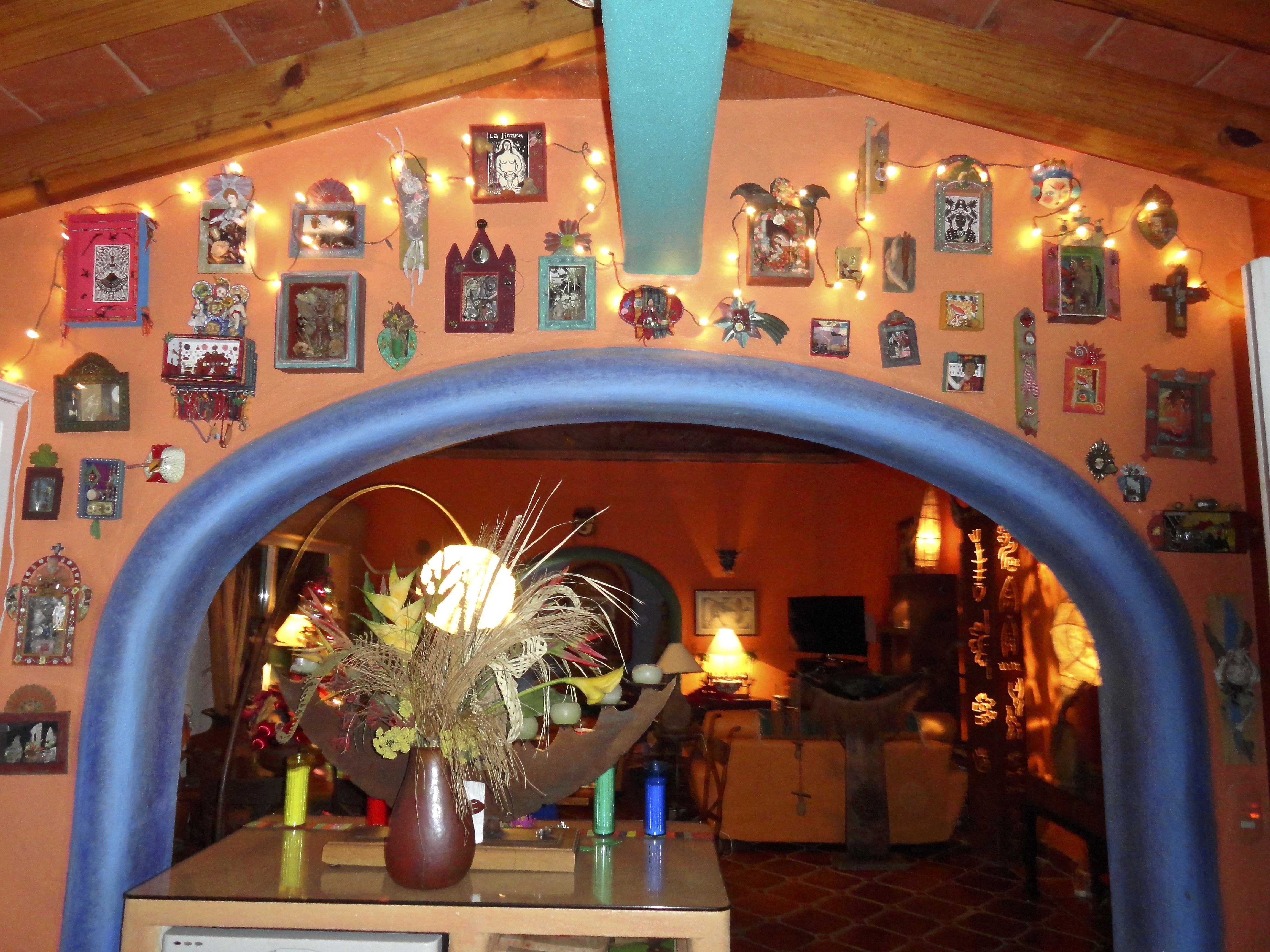
Over the past year, I have started to feel so encumbered by things that I feel like they are choking me.  Even my art-filled and carefully arranged house, which I love, has started to make me feel like I’m trapped in one of my own collages.

I once wrote that I like to do assemblage because it is an arrangement that is glued down so other people can’t rearrange it, but recently I’ve begun to feel like one of those objects.  I just can’t get myself unpinned from my present life.  It is not that there is anything terribly wrong about it.  Just that I no longer have a feeling of freedom..

Recently, I was asked what I would save if my house were on fire and I could only save five things.  My answer would be an album of childhood pictures, an album of pictures from Africa and Australia, my computer and two backup drives.  Then I’d put them in storage, buy a new computer and go on another trip around the world with no planned itinerary and no planned start or stop dates.

Why can’t I do this on my own?  Who knows why we let ourselves be controlled by things? Maybe it is because we know we can’t take them with us and so we strive to get as much pleasure out of them as possible while we can.  Perhaps it is because we fear that without things, we ourselves are nothing.  Perhaps it is because we cannot see that the beauty is within ourselves.  Perhaps it is because we fear that others give us value simply because of the things around us.

I once heard my eleven-year-older sister tell someone that she liked to visit her younger sisters because they both had such interesting lives and friends.  I felt so sad that she hadn’t said that she loved to visit me because I, myself, was interesting and loved.  I think this has influenced my feeling for her ever since.

My sister is now in the stages of dementia where pretty much everything has been taken from her.  She no longer knows what most common objects are for, but my niece recently told me that she had been given a life-sized baby doll that she holds and rocks and talks to and that the other day she called it Judy. I guess she waited too long to express any feelings of love she might have felt for me. Now, she is seemingly expressing that love toward an object when all these years she could have been expressing it to the person who could have returned it.  Is this what I’m doing by refusing to surrender the objects that fill my life?  Maybe it is time to find out.

DSC09458
The Prompt:  What five objects would you \save from your burning house?

New Word for the Day: Chronopromptophobia

New Word for the Day: Chronopromptophobia

Chronopromptophobia is the fear that your prompt will not be posted in time for you to write it before you need to get on with the day.

Etymology:  from the Latin roots chron: having to do with time;  prompt: to urge forward (ironically, this also designates  timeliness, as in “on time”); and phobia: fear.

The original term was coined in 2014/2015 when a major world blogging site experienced a series of breakdowns wherein prompts were either not published or were published so late in the day that the world economy suffered from the number of bloggers who called in sick to work to enable them to sit home and check every few minutes to see if the prompt was posted.

The Prompt: Play Lexicographer–Create a new word and explain its meaning and etymology.In response to The Daily Post’s writing prompt: “Play Lexicographer.”

Fresh Worms for Sale

Fresh Worms for Sale

Many have not come to terms
with the benefits of worms.
They find them repulsive and squishy.
Revolting, creepy, crawly, ishy.

But these folks tend to just react
without examining each fact
of all that folks could find to do
with worms if they’d just buy a few.

Granted, worms that wad and mingle
lack the charm of just a single
worm that can be used for bait
on a hook and with a weight,

but every person knows this use,
which always calls for worm abuse.
Worms, however, also toil
to break up and aerate the soil.

In jars with holes poked in the lids,
worms make good pets for little kids.
Good for hours of watching, they need
little care and little feed.

Worms don’t need collars, leashes, dishes,
never go against your wishes.
They are not barkers nor run-arounds.
None of the nastiness of hounds.

They have no hair to grow and shed.
You do not have to pat their head.
They have no other nasty habits
like gerbils, hamsters, cats or rabbits.

You don’t have to change their litter.
When traveling, you don’t need a sitter.
No vet bills when your pets are worms–
no fleas nor ticks nor mites nor germs.

Worms take up very little space
and may be trained to run a race.
And if you make a well-placed bet,
they just might get you out of debt.

The benefit of worms now told,
May I consider this worm sold?
Surely you’ll find much to do
with one or two that leave with you.

If you’re not a  fisherman
and if a pet’s not in your plan,
If you are a sadistic sickie,
just put one down your girlfriend’s dickie!*

*for the youth among us, a dickey is a turtle neck or collared inset
that may be worn under a vee-necked sweater or jacket to create the illusion that one is wearing a sweater or blouse under it.

The Prompt: Embrace the Ick–Think of something that truly repulses you.  Hold that thought until your skin squirms.  Now, write a glowing puff piece about its amazing merits.

South Dakota Gumbo

South Dakota Gumbo

When the rains came in hot summer,  wheat farmers cursed their harvest luck, for grain sodden by rain just days before cutting was not a good thing; but we children, freed from the worry of our own maintenance (not to mention taxes, next year’s seed fees and the long caravans of combines already making their slow crawl from Kansas in our direction) ran into the streets to glory in it.

We were children of the dry prairie who swam in rivers once or twice a year at church picnics or school picnics and otherwise would swing in playground swings, wedging our heels in the dry dust to push us higher. Snow was the form of precipitation we were most accustomed to–waddling as we tried to execute the Xs and Os of Fox and Geese bundled into two pairs of socks and rubber boots snapped tighter at the top around our thick padded snowsuits, our identities almost obscured under hoods and scarves tied bandit-like over our lower faces.

But in hot July, we streamed unfettered out into the rain.  Bare-footed, bare-legged, we raised naked arms up to greet  rivers pouring down like a waterfall from the sky.  Rain soaked into the gravel of the small prairie town streets, down to the rich black gumbo that filtered out to be washed down the gutters and through the culverts under roads, rushing with such force that it rose back into the air in a liquid rainbow with pressure enough to wash the black from beneath our toes.

We lay under this rainbow as it arced over us, stood at its end like pots of gold ourselves, made more valuable by this precipitation that precipitated in us schemes of trumpet vine boats with soda straw and leaf sails, races and boat near-fatalities as they wedged in too-low culvert underpasses.  Boats “disappeared” for minutes finally gushed out sideways on the other side of the road to rejoin the race down to its finale at that point beyond which we could not follow: Highway 16–that major two-lane route east to west and the southernmost boundary of our free-roaming playground of the entire town.

Forbidden to venture onto this one danger in our otherwise carefree lives, we imagined our boats plummeting out on the other side, arcing high in the plume of water as it dropped to the lower field below the highway.  It must have been a graveyard of vine pod boats, stripped of sails or lying sideways, pinned by them.  We imagined mind soldiers crawling out of them and ascending from the barrow pits along the road to venture back to us through the dangers of the wheels of trucks and cars.  Hiding out in mid-track and on the yellow lines, running with great bursts of speed before the next car came, our imaginary heroes made their ways back to our minds where tomorrow they would play cowboys or supermen or bandits or thieves.

But we were also our own heroes.  Thick black South Dakota gumbo squished between our toes as we waded down ditches in water mid-calf.  Kicking and wiggling, splashing, we craved more immersion in this all-too-rare miracle of summer rain.  We sat down, working our way down ditch rivers on our bottoms, our progress unimpeded by rocks.  We lived on the stoneless western side of the Missouri River, sixty miles away. The glacier somehow having been contained to the eastern side of the river, the western side of the state was relatively free of stones–which made for excellent farm land, easy on the plow.

Gravel, however, was a dear commodity.  Fortunes had been made when veins of it were found–a crop more valuable than wheat or corn or oats or alfalfa. The college educations of
my sisters and me we were probably paid for by the discovery of a vast supply of it on my father’s land and the fact that its discovery coincided with the decision to build first Highway 16 and then Interstate 90.  Trucks of that gravel were hauled  to build first the old road and then  the new Interstate that, built further south of town, would remove some of the dangers of Highway 16, which would be transformed into just a local road–the only paved one in town except for the much older former highway that had cut through the town three blocks to the north.

So it was that future generations of children, perhaps, could follow their dreams to their end.  Find their shattered boats.  Carry their shipwrecked heroes back home with them.  Which perhaps led to less hardy heroes with fewer tests or children who divided themselves from rain, sitting on couches watching television as the rain merely rivered their windows and puddled under the cracks of front doors, trying to get to them and failing.

But in those years before television and interstates and all the things that would have kept us from rain and adventures fueled only by our our imaginations, oh, the richness of gumbo between our toes and the fast rushing wet adventure of rain!

Writer’s note:  I know my sister Patti is going to read this and cry, and so I want to present you with this mental picture of her, college age, Levi cuffs rolled up above her knees, surrounded by five-year-old neighbor kids, enjoying her last big adventure out into the ditches of Murdo, South Dakota, during a July rain.

But wait!  A mere two hours of digging and another hour of editing has produced this proof of my former statement, so to augment your mental image, here is the real one:

Patty in mud 001-001

Not quite the gusher depicted in the childhood vignette, but nonetheless, Patti’s final puddle adventure. She had taken my visiting niece out. The next day the neighborhood kids rang our doorbell and asked my mom if Patti could come back outside to play! Ha.

The Prompt: Free Association–Write down the first words that come to mind when we say . . . home. . . soil . . . rain. Use those words in the title of your post.

Daily Duty

The Prompt: What are the things you need to do within 30 minutes of waking up to ensure your day gets off on the right foot? What happened the last time you didn’t do one of these things?

Daily Duty

When I wake up—early or late,
each day I feel I have a date.
The thing I need to do the most
is to check The Daily Post;
then, to write until I’m done—
sometimes drudgery, sometimes fun.

Today it’s just a little ditty.
This waste of time is such a pity,
but superstition drives me to it,
for I feel if I don’t do it,
that I’ve committed a major sin,
and that I’ll never write again.

Home from the Sea

The Prompt: Re-springing Your Step–Tell us about the last experience you had that left you feeling fresh, energized, and rejuvenated. What was it that had such a positive effect on you?

The Answer: Two months living on the beach in La Manzanilla really did leave me feeling energized, relaxed and a bit nostalgic. I posted some words and photos earlier here and here and here. Below is the rest of the story:

Home from the Sea

That good old salty sea air combined with grainy sand
defined my beach vacation and went great with being tanned.
Felt great under my bare feet and squished between each toe.
And left footprints behind me, wherever I chose to go.
It crusted up my toenails and powdered all my floors.
Seeped into my keyboard and creaked up all my doors.
It told the upstairs neighbors when I’d gone and got back home.
It sneaked into my ear canals and caked up brush and comb.
In spite of all the nuisance of the sand within my bed,
those memories of beach life still swirl within my head.
Yet I needn’t wax nostalgic, for I find behind each knee,
in pockets, luggage and the floor—the beach came home with me!

Rocky Balboa and Uriah Heep Meet on Rodeo Drive

The Prompt: Write a post in which the protagonists of two different books or movies meet for the first time. How do  they react to each other? Do they get along?

I was a witness as Uriah Heep just happened to stumble upon Sylvester Stallone gazing at his reflection in the front window of a chichi little shop on Rodeo Drive.  I admit that I loitered nearby, eavesdropping. I knew this was going to be good!

Rocky Balboa and Uriah Heep Meet on Rodeo Drive

Uriah sidled closer to get an autograph,
but he was intercepted by a member of Sly’s staff.
“Please do not loiter here, sir,”  the officious flunky said.
Her expression was most haughty. Her eyes just cut him dead.

Uriah’s voice was cloying as he said, “My esteemed sir,
I’m just an ‘umble man. I didn’t want to cause a stir.
But it would be so gratifying for a worm like me
to get to touch the pants hem of a real live star like thee!”

Sylvester spun upon his heel, surveyed the quivering mess.
“It won’t hurt to please the little man one time, I guess,”
Sly thought as he bestowed a smile meant to relieve the tension,
at the same time, putting out his hand with condescension,

thinking he might kiss it, but instead that low man’s knee
was brought up to make contact with Sylvester’s fabled vee,
causing his pitch forward ’til in the street he lay.
And this is what Uriah said as he walked away:

“I may be sly and unctuous–a real pain in the ass,
but even a lowlife like me still has a little sass.
My humble’s spilling over ’til it doesn’t seem quite real,
and so I thought I’d show Stallone some of what I feel.”

How the great man is brought down to eating humble pie.
For once Uriah can look down to meet him in the eye.
As he writhed in agony, the star made not a peep.
Now Uriah is the Sly one while Stallone’s become a heap.

Note: Okay, I’m sorry. For the poem. For the sick pun. Everyone has an off day now and then.

Answered

The prompt: Open your nearest book to page 82. Take the third full sentence on the page, and work it into a post somehow. (The book nearest to me and its quote is given below:)

What happens to someone like her as she gets older?
–from Luck, by Joan Barfoot

Answered

She loses her balance, starts to fall.
Once in the kitchen, three times in the hall.
Finds it harder to remember, spends more time alone.
Speaks her mind more freely, less likely to atone.
She starts attracting cats that come inside and do not leave.
Wears frays in her clothing–hemline, neckline, sleeve.
Starts forgetting passwords–sometimes the names of friends.
Her search for keys and glasses never really ends.
Starts waking in the nighttime to contemplate her death.
At midnight, has to go outside to try to catch her breath.
Counts the years before her instead of those behind.
She could live to one hundred if fate is being kind.

Will she live her last years with sister, lover, friend;
or will animal companions help her meet her end?
Will anybody mourn her? Does she want them to?
Will she be remembered by a poem or two?
Will anybody read her after she is dead?
Will all her future poetry die here in her head?
Will her blog named “lifelessons” finally cease to be?
Will they give the name away for a modest fee?
Will they erase her blog spot, burn her files of poems?
Cause a glut on EBay of her leftover tomes?
If she sells a book or two every other year
where will Amazon send the money when she isn’t here?

One day in the future in three thousand two
will Zee, (some bored teenager, with nothing else to do)
go onto the internet connected to her head,
close her eyes and throw herself backwards on her bed
and stumble on an errant line that floats through cyberspace,
and Google it to try to find its author, time and place?
“What happens to someone . . . ?” are the words that Zee has found.
Her fingers start to twitch as she is driven to expound.
The printer prints the words she says without her further action.
Tied into her speech and thought–spontaneous reaction.
” . . . like her as she gets older?” is printed on the wall.
For there’s no paper in the world. No paper left at all!
Her face is flushed, her eyes dilate, her eyes first squint, then blink.
This random line floating in space has provoked her to think.
First she’ll finish cyber school, then link her living pod
with a blowout sort of guy with a gorgeous bod.
They’ll make links with other blogs and party with their friends
for a couple hundred years before they meet their ends.
She thinks back on the interbrain to look for thoughts and links.
Lets her mind go soft as into cybermind she sinks.
Looking for her future job. She knows it’s there to see.
Time being just a concept to wander through for free.
She plops onto a webpage from two thousand fifteen,
all the information still there and easily seen.
The line Zee thought jumps out at her. She sees it’s not her own.
It’s been used two times before and now it seems it’s flown
into her thoughts to sort her out and give her a direction.
As she reads on, she catches on to this writer’s inflection
in every word she writes and when she gets to the post’s end,
she goes on reading through her life and starts to make a friend.
After two days of reading, she winds up at the start
knowing every detail in this blogger’s heart.
Then she goes back to where she started and sees her doubts and fears.
It’s then that she fast-forwards to the blogger’s final years
and sees the truth of everything that’s going to transpire.
The failing health, the hopeful mood, the ad, “Wanted to Hire
an interesting friend to talk to while I fall asleep.
One capable of caring and thoughts that wander deep.
Someone to be there some nights when it seems that I might leave
for one last time this life that’s loosening its warp and weave.
No heavy lifting needed–a weighted thought or two
is all that I find necessary. Weighing thoughts will do.”

Zee zoomed back to the entry that had drawn her thoughts at first.
The very sentence that had caused her gloomy thoughts to burst.
January was the month and 14 was the day
The year 2015, when she’d been second to say
those fateful words and now Zee, too, was thinking just the same–
moving to the comments to add her words and name.
“Dear Lifelessons,” she’d say to her, and then add her assurance
that everafter she would be her safety and insurance.
That she would never die alone or be bereft of friend
for Zee was vowing here and now she’d be there at the end.
She’d looked ahead and so she knew that she would keep this pledge.
She’d known the center of this life and now she knew its edge.
She knew the dates that she’d be needed in the years ahead.
She made a list and filed it in a clear spot in her head.
And then she went on thinking what those words meant in her life.
Would she be a scholar, an actress and a wife?
Would she produce children and would they be there for her?
That sentence found in cyberspace created quite a stir.
But all her dreams it prompted came true enough, what’s more
she kept her date with Lifelessons in 2054.

                                                                            –Judy Dykstra-Brown, Lifelessons, 2015

DSC08693

In response to The Daily Post’s writing prompt: “Connect the Dots.”

Leavings

OLYMPUS DIGITAL CAMERA

Photo by Judy Dykstra-Brown

Leavings

Do I walk the long kilometers of beach
to look for the next shell
or stand stable, like that woman
casting and recasting her hook,
patiently waiting to pull her world
in to her?

I’m gathering things
that I’ll collect into stories–pinning them down
to use like words.
Nothing wrong in finding meaning
through a piece of driftwood, a stone or shell.
Objects are only things
we cast our minds against
like images against a screen–
a shadow glimpsed crossing a window shade.

My shadow cast in front of me
is such a different thing
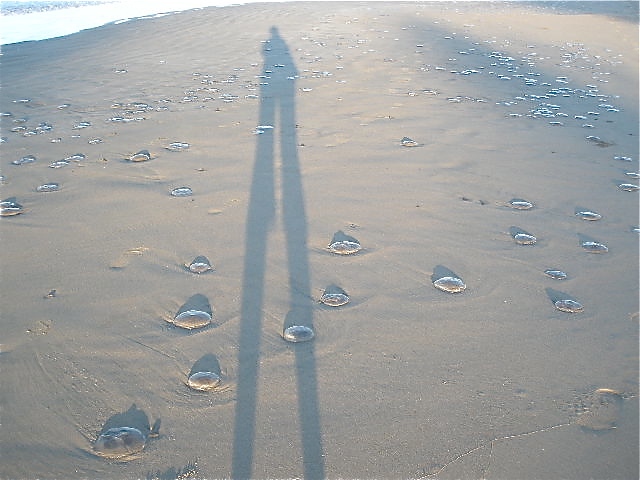
from one I cast behind.
In the first, I am constantly hurrying
to catch up to what I’ll never catch up to.
In the other, I am leaving behind
what I can only keep by walking away from it.

I take this place along with me
in clear images–
not as they were,
but as my mind has cast them;
so every picture
taken of the same moment
is different,
each of us seeing it through our unique lens.

We cast these things in bronze or silver-gelatin,
stone, clay
or poetry.

A grandma
holds out pictures of her children
and her grandchildren.
See? Her life’s work.
And then this and this,
without further effort on her part.

I share stories of children I don’t know
who gently unwind fishing line from a struggling gull,
hearts found on the beach
or other treasures
nestled in a pile of kelp.
I find my world in both these findings and departings;
the leaving each morning to go in search of them
the part I find most exhilarating–
perhaps teaching this
woman of the death-themed night-terrors
not to worry.
That longer leaving is just a new adventure.

People who do not remember
let me slip away
when I would have held on,
given any encouragement.
Yet fingers, letting go, flex
for that next adventure.

Life is
all of us letting go
constantly–
taking that next step
away from
and to.

A white shell.
I have left it there
turned over
to the brown side,
so someone else
can discover it, too.

Today’s WordPress Daily Prompt: Image Search—Pick a random word and do Google image search on it. Check out the eleventh picture it brings up. Write about whatever that image brings to mind. (Although the eleventh image was of a shadow on a beach, I’ve elected to reproduce my own photo here.)