Tag Archives: family memories

Early Bird

Early Bird

The party got much better right after you walked out.
You would have really liked it, I can say without a doubt.
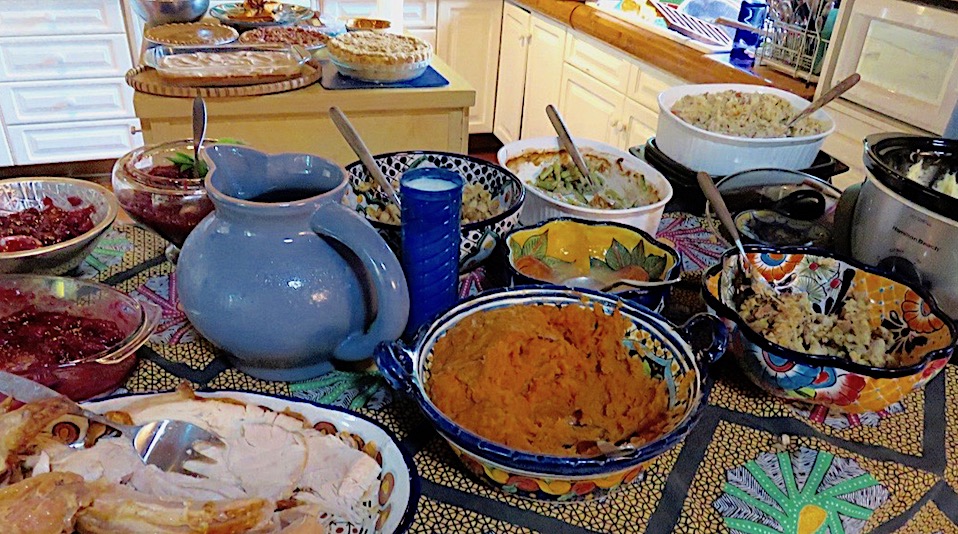
The cornucopia of desserts you brought was a definite hit,
but as we enjoyed its bounty, we wished you hadn’t split.

The baby took his first step and Grandma came alive
as though for this Thanksgiving, her memory she’d revive.
Cousin Shirley was a panic and the kids performed a play—
the whole family there to see it (if you had chosen to stay.)

So, the freeway was in gridlock from five o’clock to eight?
Negotiating lane changes was hurry up and wait?
By the time the party ended, traffic was flowing freely.
Uncle Arthur breezed right by us in his classic Austin Healey!

Everyone got home okay. We were in bed by nine—
about the same time you got home from waiting in that line.
Hearing old family stories may not be your favorite thing,
but versus overheated engines, they have a certain zing.

Splitting out on family may not be a  crime,
but did leaving three hours early save you any time?
When you’re in the biggest hurry, you’re  most frequently delayed.

You might have gotten home faster if only you had stayed!


Word prompts today are cornucopia, hurry, negotiate and delayed. Here are the links:
https://ragtagcommunity.wordpress.com/2019/04/25/rdp-thursday-cornucopia/
https://fivedotoh.com/2019/04/25/fowc-with-fandango-hurry/
https://onedailyprompt.wordpress.com/2019/04/25/your-daily-word-prompt-negotiate-april-25-2019/
https://wordofthedaychallenge.wordpress.com/2019/04/24/delayed/
 

Down in Grandma’s Cellar: NaPoWriMo Apr 13, 2019

Down in Grandma’s Cellar

Sleeping over at Grandma’s, her rooms all stuffed with treasure
there for my explorations, their pillaging my pleasure.
The barn so full and shadowed with pigeons, mice and more,
I did not venture farther than to peek in through the door.
But the basement was forbidden, so I overcame my fear.
To test my new maturity, I had to venture near.

Down in Grandma’s cellar, I could not see the stars.
There weren’t any planets like Jupiter or Mars.
But still it was as dark as night. The light from one mere candle
seemed the only light the ghosts who lived down there could handle.
As I creaked down the ladder rungs, glass rattled on the shelves
as though the time-dulled canning jars told stories on themselves.

Rhubarb on the nearest shelves, peaches in the back.
Watermelon pickles seemed poised for the attack,
swaying on the upper shelves, dusted by the years.
I gathered up my courage, pushing down my fears.
So many eyes caught in the dark. Glassy gleaming sprites
waiting there to satisfy the family’s appetites.

But no one came to gather them and spread them on a plate.
The waste of it was senseless—their empty, useless fate.
How many hours she’d labored to gather nature’s fruit.
How many other hours used up in the pursuit
of washing, peeling, cutting, and packing them in glass,
packing them in cauldrons and boiling them en masse.

Where did the hungry mouths go? Why did they go untasted?
What happened all those years ago that their richness was wasted?
Accustomed to the secrets kept hidden behind blinds,
we kids retained the questions that stirred our tiny minds.
So many of these mysteries lie hidden in my past.
Remarkable how long their spreading shadows seem to last.

I still have some of Grandma’s old canning jars, now relegated to a decorative use.
(Click on photos to enlarge.)

NaPoWriMo prompt: Today, we’d like to challenge you to write a poem about something mysterious and spooky! 


Memento: NaPoWriMo 2019, Day 12

Memento

The ring is dull with tarnish that I will not wash away
for half of its life stories are wrapped up in the gray.
The silver was the fairytale­­––the fantasies they dreamed
before they discovered life was much more than it seemed.

Thousands of daily scrubbings of tablecloth and shirt.
Another thousand cuppings of fingers through the dirt
retrieving carrots, beets and potatoes for the table.
She wouldn’t have removed the ring, even if she were able.

Through my whole long childhood, I saw it on her hand,
wondering at the beauty of that simple silver band.
Worn thin with age along with fingers sinewy and spare,
the silver gleam lost to the ring wound up in her hair.

It’s pattern now worn down with age, it nestles in a box
with other family memories: jewelry and rocks,
a tiny woven figure and a buttonhook and key––
each one rich with happenings still held in memory.

All worn and rusted, tarnished with the lives that they were part of,
I don’t know all their endings and I do not know the start of
many of these objects that now are all that’s left
of the family members of which we are bereft.

Their lives rest in these objects in their depleted beauty.
They’re here to provide evidence, as though it is their duty
to tell entire stories, both the pleasures and the pain,
so the lives they’ve touched upon have not been lived in vain.

And though I do not wear the ring, I cherish all its beauty––
all its former silver gleam obscured by toil and duty.
For the years since she first left us, I have kept it tucked away,
like so many of her virtues, hidden to the light of day.


Here is the NaPoWriMo prompt: Today, we’d like to challenge you to write a poem about a dull thing that you own, and why (and how) you love it. Alternatively, what would it mean to you to give away or destroy a significant object?

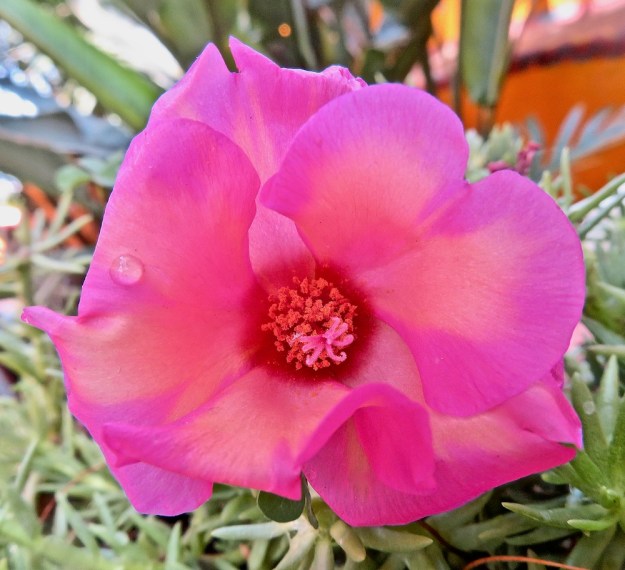
Moss Rose, FOTD Apr 6, 2019

IMG_1357

 I planted this plant in the broken off lower part of a huge sculpture Bob and I bought the day we bought our house. There were two of the three-foot high precolumbian sculptures, one a seated woman and one a seated man. I put them on the pedestals inside the front gate–one on either side–one representing me and one Bob, who as you know, did not live long enough to actually move into our house. The “kittens” knocked one off its pedestal a year or more ago, the other a few months ago.  Since they were in too many pieces to possibly mend, I saved the one, intact from the waist down, and the other, only intact from the hips down, and planted ferns in them and put them back into their old positions.  Unfortunately, there wasn’t enough soil to support the one, so I replaced the fern with this moss rose, which seems to find its new home to be sufficient to thrive. Here is the newest member of its family.

Family Vacation


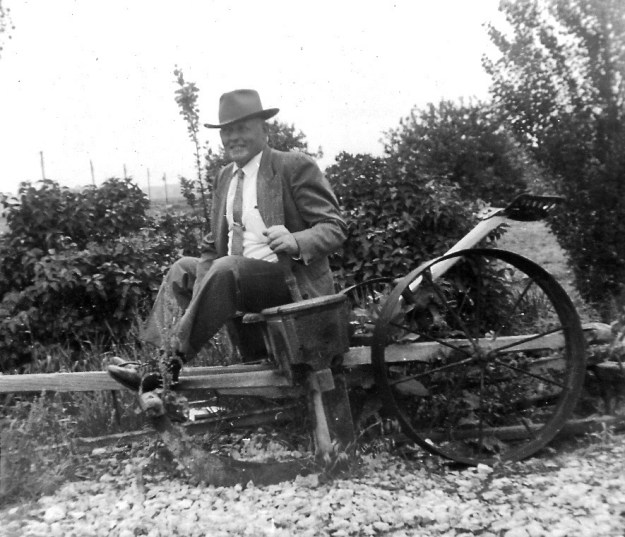
Version 6My dad in a slower mode of conveyance.

Family Vacation

My father on vacation was robotic in his thrust.
His modus operandi was to get there or to bust—
another hundred miles or so before we stopped to sup,
and we rarely got a room before the moon was up!

When he hit the highway, he became another man.

No mere roadside attraction could deflect his driving plan.
In those days of two-lane traffic and a speed limit of fifty,
he thought five hundred miles a day sounded rather nifty.

Fathers prone to threaten, who hit and rage and cuss

are, I fear, too often too ubiquitous.
But this was not my father. Rage was not his style.
He simply had addictions to mile after mile!

My dad was generous and fun. He told a story well,
but to take a trip with him was nothing short of Hell.
 His proclivity to “get there,” I fear was never curable,
and so family vacations were just barely endurable!


Version 2
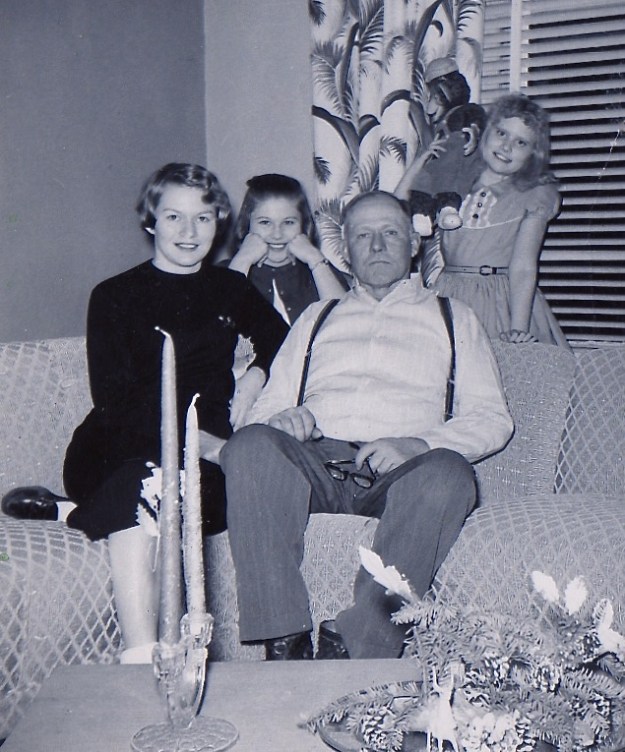
My sisters and I with my dad.  He didn’t usually look this grim!

The prompt words today are highway, durable, robot and ubiquitous. Here are the links:

https://fivedotoh.com/2018/09/01/fowc-with-fandango-highway/

https://dailyaddictions542855004.wordpress.com/2018/08/26/daily-addictions-2018-week-34/durable

https://ragtagcommunity.wordpress.com/2018/09/01/rdp-saturday-robot/

https://wordofthedaychallenge.wordpress.com/2018/09/01/ubiquitous/

When My Sister Plays the Piano


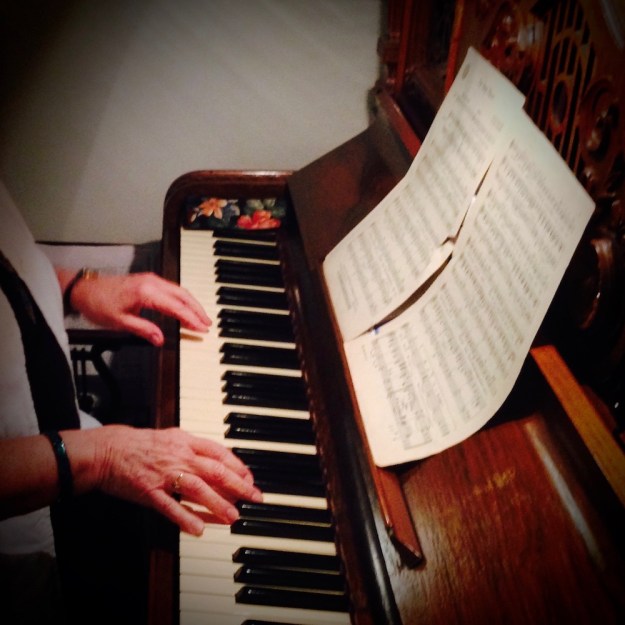
jdb photo

This is  a poem written when I visited my sister in the first stages of memory loss. it is a bittersweet memory that I shared with only a few of you five years ago when I first started my blog but which very few people read, judging from the number of views and “likes.” This memory, as most are, is bittersweet.

When My Sister Plays the Piano

The first notes, beautiful and true, float like a memory up the stairs.
In the week I’ve been here in her house with her, she has not played the piano
and so I thought her music was gone like her memory of what day it is
or whether I am her sister, her daughter or an unknown visitor.

Yet on this morning after her 76th birthday celebration,
music slips like magic from the keys: song after song
from “Fur Elise” to a sweet ballad I don’t know the name of—
sure and correct at first,
then with a heartfelt emotion we had both forgotten.

“Midnight Concerto,”
“Sunrise, Sunset”—
song after song
expressed
in an unfaltering language—
some synchronicity of mind and hand
her brain has opened the door to.

While I listen, time stands still for me
as it has for her so often in the past few years
as yesterday and today shuffle together to
crowd out all consideration of future fears.

For ten minutes or more, she segues
from melody to melody
with no wrong note.
Then “Deep Velvet,”
a song she has played from memory
so many times,
dies after twenty-four notes.
Like a gift held out and snatched away,
I yearn for it, pray she’ll remember.

After an uncharted caesura, her music streams out again,
sweet and sure, for a staff or two—
the sheet music giving her a guide her brain so often can’t.
But after a longer pause, I know it is lost
like the thread of so many conversations.
A hiccup of memory, folding itself away.

“Come And Worship” chimes out
like the tolling of a bell.
The wisp of the old hymn, two phrases only—
before it, too, fades.

That sudden muffled sound.
Is it a songbook displaced from its stand as she searches for another;
or the lid of the piano, quietly closing on yet another partial memory?


The Ragtag prompt today was memories.

Endangered Species: NaPoWriMo 2018, Day 8

I always thought that at some point I would have children, but by the time I finally found the man I wanted have them with, I was thirty-eight, and he already had eight living children. Four of these children were under the age of eight when we met. When I married their dad, I married them, too. This poem was written at a time when, as inept as I was at entertaining small children in an L.A. condo, I still believed in a sort of magic wherein stepfamilies could become real families.

ENDANGERED SPECIES

“When a woman is cut out of the process of creation, she becomes crazed.” –author unknown

Your daughter breaks her arm and something breaks with it.
She becomes manageable.
Her laugh, softer now sometimes.
She loves writing with her other hand.
Her broken one grows fingernails for the first time

which we manicure once a week.

Sometimes, I drive home slower
on the nights I know we’re going to have the kids,
hoarding a few more minutes alone.

My key in the lock brings them, wanting games at once.
You, exhausted, irritable on the sofa,

wanting them yet wanting them gone.

In a movie, Mary Tyler Moore saying
she can’t love the son who needs her love too much.

Can’t love on demand?
Dirty fingernails, torn knees on Levis—
the kids always looking like something your ex-wife dragged in—
driven down to our city life where they demand the mall.

Our rag-a-muffins.
 Not the way I pictured it.

They call me Mom immediately after the wedding.
I scrub their fingernails,
put medicine on cold sores,
tell Jodie not to wear those torn-out pants to school anymore.
The other kids, I say, will talk—

what my mother would have said to me.

When I tell them at the office
about the homemade Easter decorations
hung on our refrigerator,

about the one that reads “to Mom,”
Jim says he prefers Elliott’s stories.
When I tell them that the littlest grabbed my knees
and hugged and said, “I just love you,”

the clever crowd around the copier groans.
I’m not a mother, they all understand,
and once a week, I barely get good practice in.

But when your daughter breaks her arm,
I try to find a spell to stick us all together—
paper, scissors, colored pens.

I say, “Try to keep the glue off the dining room table.”
I say, “Try not to drop the magic markers on the floor.”
“Take off your shoes when walking on the white sofa.”

The NaPoWriMo Day 8 prompt: write poems in which mysterious and magical things occur. Your poem could take the form of a spell, for example, or simply describe an event that can’t be understood literally. 

Oops.. More Share Your World of Hospitals!!!

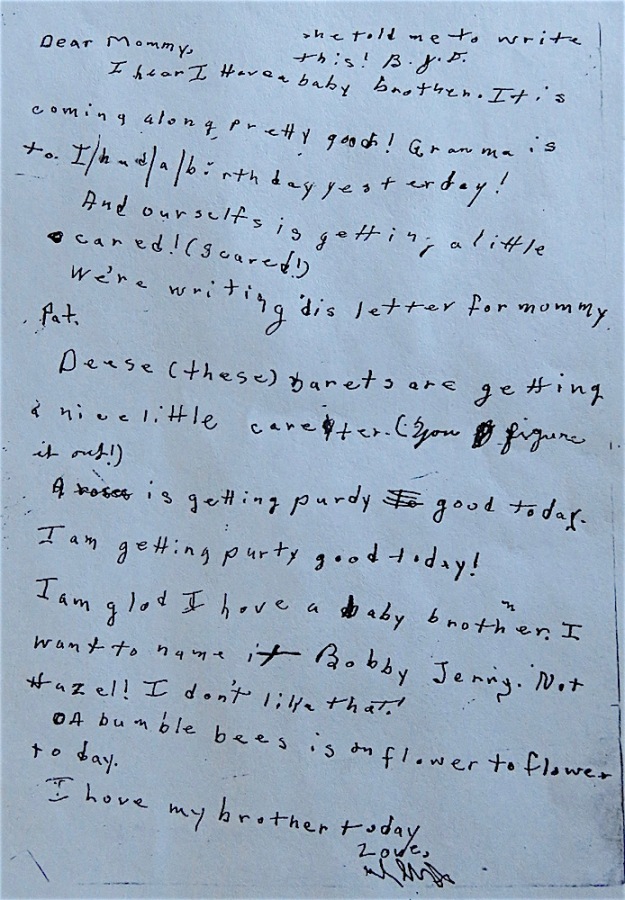
I almost forgot the most important photo in my hospital theme for today’s “Share Your World.”  When we were going through some papers, my sister Patti shared with me this copy of a letter she dictated to my sister Betty and sent to the hospital with my dad the day I was born.  She was 4. My other sister who wrote the letter for her was 11. Patti insisted that I was a boy.  (My dad had teasingly said they were going to name me Hazel.) Thanks, Dad, for not following through.  Here is the letter as dictated by Patti and written down by Betty Jo:

IMG_2955

And, if you want to see a continuation of this story, look HERE!!!

https://ceenphotography.com/2017/10/23/share-your-world-october-23-2017/

Dental Retaliation


daily life  color108 (1)

Dental Retaliation

Do you remember toothbrushes lined up on a rack
in the medicine cabinet, at the mirror’s back?
Your father’s brush was ocean blue, your mother’s brush was green,
your sister’s brush the reddest red that you had ever seen,
whereas your brush’s handle had no color at all—
as though it was the ugliest sister at the ball.

How you yearned for color, reaching for your brush
as the first summer’s meadowlark called to break the hush
of the early morning while you were sneaking out
to be the first one out-of-doors to see what was about.
Making that fast decision, your hand fell on the red,
thinking your sister wouldn’t know, for she was still abed.

You put toothpaste upon it, wet it at the tap
and ran the brush over each tooth as well as every gap.
Each toothbrush flavor was different, your older sis had said,
so you thought it would be different brushing your teeth with red.

Your father’s brush was blueberry, your mother’s brush was mint.
Your sister’s luscious cherry—its flavor heaven-sent.

“But because you are adopted,” your sister had the gall
to tell you, “they gave you the brush with no flavor at all.”
You waited to taste cherries, but that taste never came.
That red brush tasted like toothpaste. It tasted just the same
as every other morning when you brushed with yours.
You heard your sister stir upstairs, the squeaking of the floors.

You toweled off her toothbrush and hung it in the rack
and started to run out the door. Then something brought you back.
You opened up the mirror and grabbed her brush again.
A big smile spread across your face—a retaliatory grin.
The dread cod liver oil stood on the tallest shelf.
You were barely big enough to reach it for yourself.

You dipped her toothbrush in it, then quickly blew it dry.
Replaced it, shut the cabinet, and when you chanced to spy
your own reflection in the glass, each of you winked an eye.
Then you ran out to cherry trees to catch the first sunbeam
and brush your teeth with cherries while you listened for her scream.

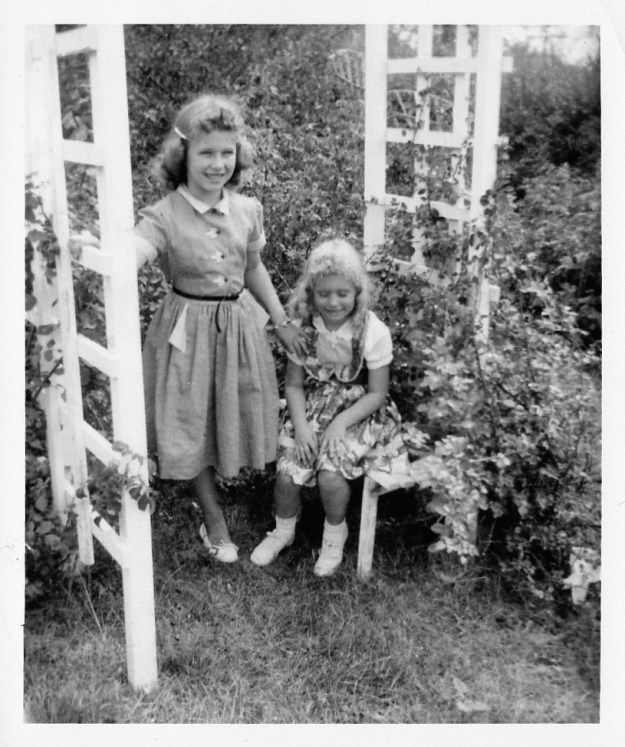
Yes, we really did have a cherry orchard behind our house. You can see the trees peeking up behind the wild rose bushes directly behind the trellis in the picture above. This is my older sister Patti and I.  Yes, she really did tell me I was adopted. (I wasn’t.) No, I never did smear her toothbrush with cod liver oil. The retaliation part is just a mental one, sixty-some years too late, I’m afraid. She has since redeemed herself.

The prompt today is toothbrush.

Following: NaPoWriMo 2017, Day 13

The NaPoWriMo prompt today was to write a ghazal. A ghazal is formed of couplets, each of which is its own complete statement. Both lines of the first couplet end with the same end-word, and that end-word is also repeated at the end of each couplet.

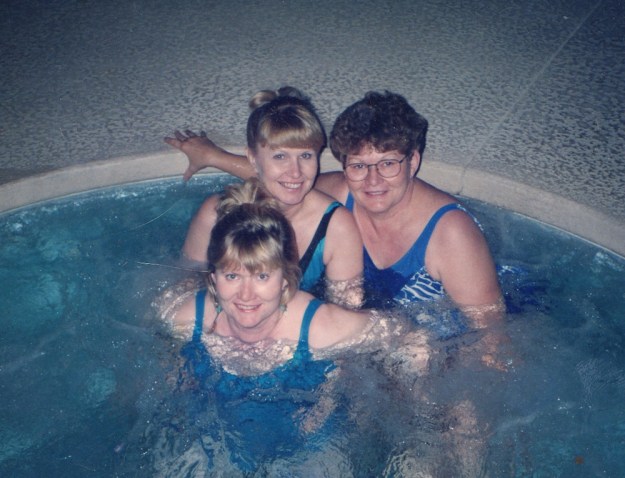
daily life color242My sisters and I. Strangely enough, there is not one photo of my mother and father and the three of us girls together. The only family photo ever taken was before I was born.


Following

 The youngest of three, every day down unpaved roads, I tracked my sisters’ footprints.
Nancy Drew wannabe, who needed  fingerprints when I could read their footprints?

My mother’s closet a treasure trove, hidden wonders lay obscured on the tallest shelves.
I fanned her dresses with my fingers, slipped into red high-heels that bore her footprints.

Careful where you walk, my father warned, parting tall grass near the homestead ruins.
Fearful of snakes, I fit my own feet to matted grass that marked my father’s footprints.

That frightening choice of colleges facing me, I knew no other way to decide
than to go where she’d gone, and follow in my sister’s footprints.

The obligation of college over with no more paths worn by other feet to follow,
I chose  Australia, Indonesia and then Africa––following imagination’s footprints.

My niece’s teeth clamped to the old saxophone as its mouthpiece snapped in two,
worn by each of the girls in our family and then by her, as she followed in our footprints.