Tag Archives: remembrance

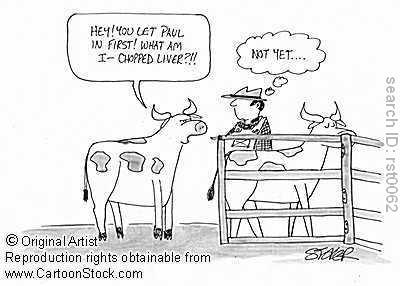
So What Am I, Chopped Liver?

chopped-liver-2

So What Am I, Chopped Liver?

The first time I can remember feeling unequal was in college, in Modern American Literature class. I remember the teacher (male) asking questions and I would usually raise my hand and answer first. I would make a point about whatever we had been reading and there would be a moderate reaction on the part of the teacher and the mainly male members of the class.

Half an hour later, after much discussion, invariably, one of the male members of the class would repeat what I had said as his own opinion and everyone would laud what he had to say as insightful and brilliant and everyone would agree!

This happened time after time. It was as though none of them really listened to what I said, or perhaps that their minds weren’t ready to accept it unless they went through a period of inductive reasoning first and they needed all the accumulated comments of the class to bring them to acknowledge what I had known from the beginning.

What it felt like, however, was that they put no credence in the ideas of a woman. This is not the only time I have noticed this. It happens now and then in the small poetry workshop I am a member of. I am really curious about whether any other woman has ever noticed this same phenomena.

The Prompt: Unequal Terms—Did you know today is Blog Action Day? Join bloggers from around the world and write a post about what inequality means to you. Have you ever encountered it in your daily life?

Bali-Bound


daily life color017 daily life color016

Bali-Bound

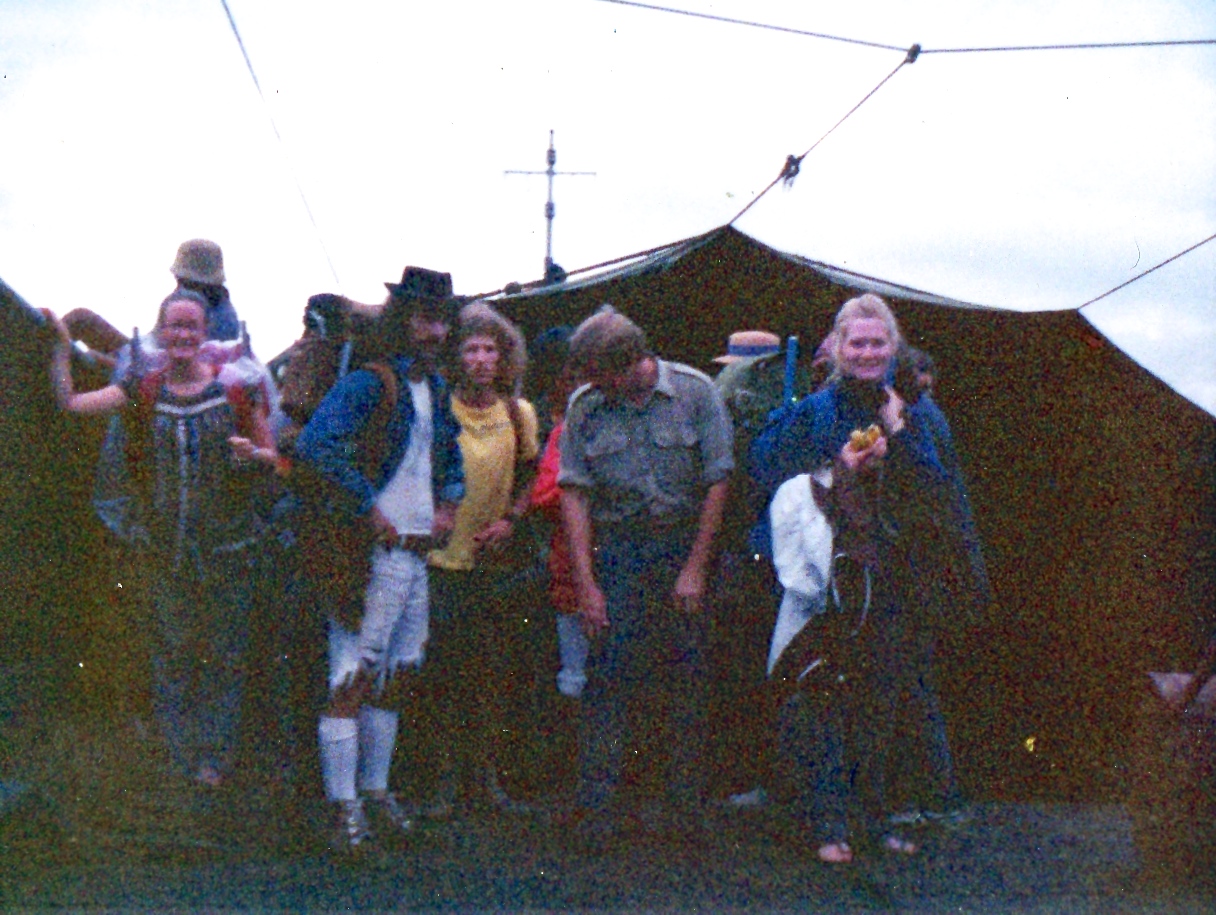
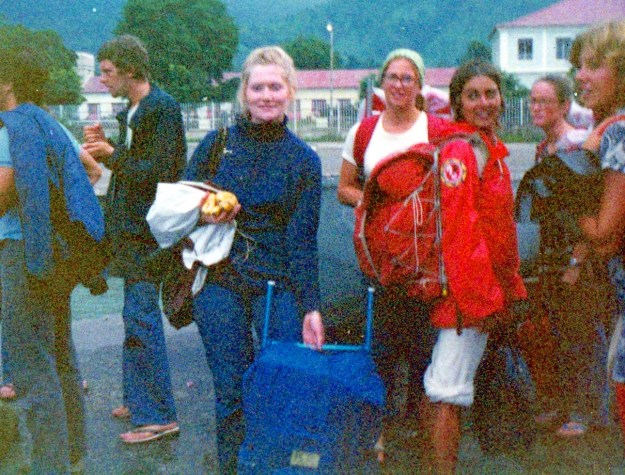
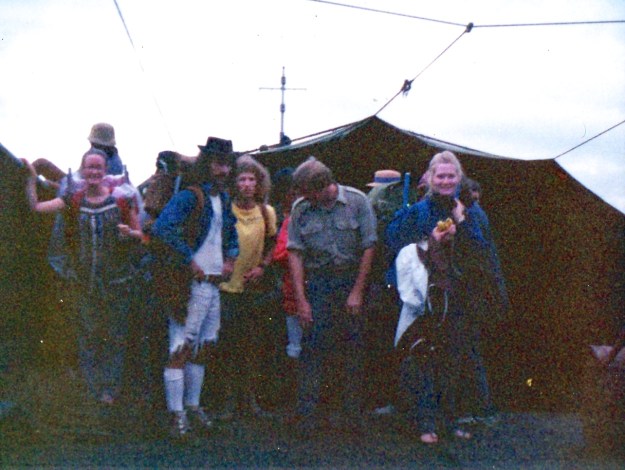
Germans, Aussies, Kiwi, Brit, Dutch, Canadians, Swiss.
I was the lone American who was pulled into this
adventure—just thirteen of us, including them and me
in a tank barge left from WWII, across the Timor Sea.
We did not know that Bugis pirates still set sail out there,
for we were young and reckless, and we didn’t care.
We still felt invulnerable. We would never die.
We all sought our giant chunk of the adventure pie.
We sailed all day and through the night and part of a new day.
Most of the cash that we had left was what we had to pay
to reach the west shore of an Island lashed by monsoon rain.
All bridges and all roads washed out, we searched for rides in vain.
A lonely store stocked not with much—some cans of cheese, two Cokes.
Not adequate provender for such starving, thirsty folks.
We crossed from Portugese Timor onto Indonesian ground.
Although we all had traveler’s checks, there was not much cash found
within our empty pockets, yet to Bali we were bound.
Still an unspoiled paradise—a haven with few cars
or partying Australians or honeymooning stars.

We stopped at one last little hut where I took off my sandals
to ease my feet, and thus were they made off with by some vandals.
And so it was that we set out through jungles vined and rooted,
fording rivers filled with leeches. I, alas, barefooted!
But chivalry was still in vogue and one or two or three
of my fellow travelers shared their boots with me
taking turns at walking barefooted for awhile
as we walked through the jungle, mile after mile.
Till late in the afternoon we came across an inn
(By then my resolution grown dangerously thin!)
Alas, we had no money for dinners and our room,
and here was where the two Swiss guys dispelled our sense of gloom.
They traded the two ten-speed bikes they’d carried or they’d ridden
most of their way around world—and they did it unbidden
by any of us, for we knew those bikes were like their kin;
and yet they gave up both of them for one night in this inn
for all of us, plus dinner—a repast full and rich,
and furthermore, our breakfast and the promise of a hitch
on a truck loaded with grain bags that was headed out tomorrow.
They did this for all of us and did not show their sorrow.
After showers poured from pails, (I noticed, I’d grown thinner)
some of us had a little nap and then a welcome dinner.
And when the Germans both pulled out their guitars for a song,
the sons of our innkeeper brought out theirs and sang along!
We all chipped in to teach the lyrics to Bobby McGee.
Our beds and food cost dearly, but the music was all free.

Next morning, we climbed high upon the grain bags for our ride
while Indonesians hung onto the rear and either side.
That truck looked like a peddler with his wagon piled high,
not with the usual notions, but with humans far and nigh.
We rode along uncomfortably, hour after hour.
No songs for us this long, long day, our mood was turning dour.
When it was nearing dusk, that truck gave one tremendous lurch
that very nearly threw us all from our precarious perch.
The Indonesians climbed on down and vanished all but one,
while the drivers told to us this next stage in our fun.
The axle cleanly broken, they would start out to get aid.
They’d come for us tomorrow—but they wanted to be paid!
We waved them off with promises—just one more awful bungle
and looked around for sleeping spots in this dense, darkening jungle.

We settled on a little hillock clear of trees and vine.
Rolled out all our sleeping bags. On what were we to dine?
One tiny little can of cheese and sardines in a tin
and those two Cokes we’d purchased—our provisions were most thin.
Hans had pellets with him meant for purifying water.
Guys headed out in search of it like lambs led to the slaughter.
The sky was darkening, but I knew I had to go to pee.
I headed down to where the trees afforded privacy,
pulled down my pants and put my hand, to balance, on a tree
when a sudden piercing pain shot from my hand through all of me!
I screamed and all my traveling friends came running down the hill.
I think of all my crises they were soon to have their fill.
I felt as though a burning dart had pierced through my right hand.
Toppled and now hobbled, I was unable to stand.

They helped me pull my pants up, sadly with a still-full bladder
as I heard the Timorese man say that it had been an adder.
I’d die within the hour, there was nothing we could do.
They emptied all their pills out and decided I’d take two
of everything we carried in our pockets and our packs,
for all of us were traveling with a drugstore on our backs.
To wash them down they offered up the ultimate in gifts:
the Cokes that we were hoarding, then they sat with me in shifts.

My finger swelled to such a size that the one ring I wore
cut off circulation until Peter cussed and swore,
“We’ll have to cut it off, so Trevor come here with your knife.
We have to cut if off of her to try to save her life.”
They put my hand upon a rock, I was delirious.
Trevor was looking rather green. Could they be serious?
He brought the knife down to my finger, but his wrist went limp.
The Germans gave a severe look, as though he were a wimp.
They told him to get on with it, but still he chose to linger.
“I just can’t do it,” Trevor said, “I can’t cut off her finger!”
“Not the finger, fool,” they said, “Just cut the ring away!”
And Trevor used the saw blade, for he had no more to say.
All night they held my arm aloft and manned the tourniquet,
It’s clear to me that I will be forever in their debt.
When I hadn’t died after an hour, the old man rubbed his eyes
and said it was another snake and I’d be paralyzed
on my right side but wouldn’t die—somewhat of a relief,
and still, I must admit I viewed paralysis with grief.

Eight hours later, still awake, I heard a distinct pop
and the swelling went down, but the throbbing did not stop.
Years later when I read “The Pearl” by Steinbeck just for fun,
when the baby nearly died, stung by the scorpion,
in just eight hours the swelling went down. That’s how I came to see
that it was probably a scorpion that had stung me.
They came with a new axle and we were on our way
and made it to our destination later that next day.
We caught a plane to Bali, but I got there in a haze,
to fall in bed where I was passed out cold for three more days.
Covered with red rashes from the rivers that we’d forded,
we were treated by the women in the houses were we boarded,
who tended to our wounds from leeches and our dysentery.
Yes, Bali then was paradise, but entrance wasn’t free.

Still, we’d paid the price and we were there right at the start,
before the rush of travelers destroyed some of its heart.
We rented bikes and rode the island, town to town to town
without meeting any traffic to try to mow us down.
A quarter for our rooms each night, a quarter for our lunch.
A lobster dinner for fifty cents—we were a happy bunch.
Processions down the streets at night, where gamelans abounded.
and temple ceremonies—all-in-all, we were astounded.
Magic mushrooms by the grocery bag cooked into omelets for us,
everywhere we went, the people just seemed to adore us.
Kuta beach was lazy then, and as we strolled along,
the most commercial thing we faced to buy was a sarong.
No beggars and no hawkers and no motorbikes to meet.
No half-an-hour to stand and wait to try to cross the street.
You might have guessed from hints I’ve given that there’s been a change.
Everything has altered now and become very strange.
Poppies restaurant—a tiny place in ‘73,
has grown into a restaurant chain with dishes gluten-free.
Hotels abound and hawkers flog their watches on each street.
Young Australians in each bar must drink to beat the heat.
We lived on just one dollar a day, in homes on Kuta Beach,
for there were no hotels yet anywhere within our reach.
There are more stories I could tell, and might, another day.
This tale has gone on for too long, so I must fade away.
But first I must apologize for this long-winded view
and say if you’re in Bali, we were there ahead of you!

The Prompt: Avant Garde—From your musical tastes to your political views, were you ever way ahead of the rest of us, adopting the new and the emerging before everyone else?


Back and Forth

Back and Forth

If I should find a time machine, I might or might not buy it.
And even once I bought it, I might or might not try it.
To think about the future always makes me sweat,
for I am trepidatious about how bad it might get.
I foresee live-in bubbles for one or two or three
who merely turn on YouTube for whomever else they see.
Pollution would be too advanced to venture far outside—
the world turned way too violent for most folks to abide.

If I visited the future, chances are I’d see
the death of friends and loved ones—perhaps the death of me!
See our country crumble due to earthquakes or to slaughter.
See Monsanto poison food crops after ruining our water.
Our seasons turned to drought, tornado, hurricane and flood—
by turn made dry or spinning or blown away or mud.
I know there are alternatives, but I can’t help but doubt
that current politicians will let it all work out.

But if I went into the past, perhaps I’d also rue it.
I might just be happier if I chose to eschew it
I might see as a toddler that I was just a brat—
a little squirming dervish—graceless, spoiled and fat.
I might hear that my singing voice was just a bit off-key
and see the looks the others gave as they were hearing me.
If I encountered me, we might just end up in a fight
like ones I had with sisters—and discover they were right!

Yet, this probably won’t happen and perhaps it might be fun
to have another look at what I’ve seen and what I’ve done.
And though to relive some things would leave me feeling queasier,
I know that it would certainly make memoir-writing easier.
What fun to relive Christmases from year to year to year,
To see my mom and dad again, what’s more, to get to hear
all the stories of my dad and this time to record them—
to spend time with my sisters and to show how I adored them.

What fun to watch me with my friends— Rita, Lynn and Billy—
to see when we were children if we were just as silly
as little kids I see today who just seem to be reeling
with energy and foolishness and excesses of feeling.
I’d drive on roads with fewer cars to spots no longer there.
Go roller skating in Draper gym. Fall on my derriére!
I’d have a Coke in Mack’s Café and then I’d shop at Gambles.
Buy love comics at Mowell’s Drug and then expand my rambles

down to the playground monkey bars, where I would do a flip.
Then to the Frosty Freeze where I would have another sip
of orange slush and then I’d have to buy a barbecue.
(I fear that in my tiny town, that’s all there was to do!)
I’d skip ahead, then, many years, to 1971,
and fly off to Australia for adventures in the sun.
Then Singapore and Bali, Ceylon and Africa.
See everything as it once was, when it was new and raw.

Regrets? Of course. I’m human, and so I’ve had a few,
but over precognition, I prefer déjà vu.

The Prompt: One-Way Street—Congrats! You’re the owner of a new time machine. The catch? It comes in two models, each traveling one way only: the past OR the future. Which do you choose, and why?

Leftovers


Leftovers

When my father died forty years ago, it was in Arizona, where my parents had been spending their winters for the past ten years.  They maintained houses in two places, returning to South Dakota for the summers. But after my father died, my mother never again entered that house in the town where I’d grown up.

Our family had scattered like fall leaves by then—my mother to Arizona, one sister to Iowa, another to Wyoming. Both the youngest and the only unmarried one, I had fallen the furthest from the family tree. I had just returned from Africa, and so it fell to me to drive to South Dakota to pack up the house and to decide which pieces of our old life I might choose to build my new life upon and to dispose of the rest.

My father’s accumulations were not ones to fill a house. There were whole barns and fields of him, but none that needed to be dealt with. All had been sold before and so what was to be sorted out was the house. In that house, the drapes and furniture and cushions and cupboards were mainly the remnants of my mother’s life: clothes and nicknacks, pots and pans, spice racks full of those limited flavors known to the family of my youth—salt and pepper and spices necessary for recipes no more exotic than pumpkin pies, sage dressings and beef stews.

Packing up my father was as easy as putting the few work clothes he’d left in South Dakota into boxes and driving them to the dump. It had been years since I had had the pleasure of throwing laden paper bags from the dirt road above over the heaps of garbage below to see how far down they would sail, but I resisted that impulse this one last run to the dump, instead placing the bags full of my father’s work clothes neatly at the top for scavengers to find—the Sioux, or the large families for whom the small-town dump was an open-air Goodwill Store.

It was ten years after my father’s death before my mother ever returned again to South Dakota. By then, that house, rented out for years, had blown away in a tornado. Only the basement, bulldozed over and filled with dirt, contained the leftovers of our lives: the dolls, books, school papers and trophies. I’d left those private things stacked away on shelves—things too valuable to throw away, yet not valuable enough to carry away to our new lives. I’ve been told that people from the town scavenged there, my friend from high school taking my books for her own children, my mother’s friend destroying the private papers. My brother-in-law had taken the safe away years before.

But last year, when I went to clear out my oldest sister’s attic in Minnesota, I found the dolls I thought had been buried long ago–their hair tangled and their dresses torn—as though they had been played with by generations of little girls. Not the neat perfection of how we’d kept them ourselves, lined up on the headboard bookcases of our beds —but hair braided, cheeks streaked with rouge, eyes loose in their sockets, dresses mismatched and torn. Cisette’s bride dress stetched to fit over Jan’s curves. My sister’s doll’s bridesmaid dress on my doll.

It felt a blasphemy to me. First, that my oldest sister would take her younger sisters’ dolls without telling us. Her own dolls neatly preserved on shelves in her attic guest bedroom, ours had been jammed into boxes with their legs sticking out the top. And in her garbage can were the metal sides of my childhood dollhouse, imprinted with curtains and rugs and windows, pried apart like a perfect symbol of my childhood.

Being cast aside as leftovers twice is enough for even inanimate objects. Saved from my sister’s garbage and cut in half, the walls of my childhood fit exactly into an extra suitcase borrowed from a friend for the long trip back to Mexico, where I now live. I’ll figure out a new life for them as room décor or the backgrounds of colossal collages that will include the dolls I’m also taking back with me.

Mexico is the place where lots of us have come to reclaim ourselves and live again. So it is with objects, too. Leftovers and hand-me-downs have a value beyond their price tags. It is all those lives and memories that have soaked up into them. In a way, we are all hand-me-downs. It’s up to us to decide our value, depending upon the meaning that we choose to impart both to our new lives and these old objects. Leftovers make the most delicious meals, sometimes, and in Mexico, we know just how to spice them up.

The prompt: Hand-Me-Downs—Clothes and toys, recipes and jokes, advice and prejudice: we all have to handle all sorts of hand-me-downs every day. Tell us about some of the meaningful hand-me-downs in your life.


Waiting for the Bell

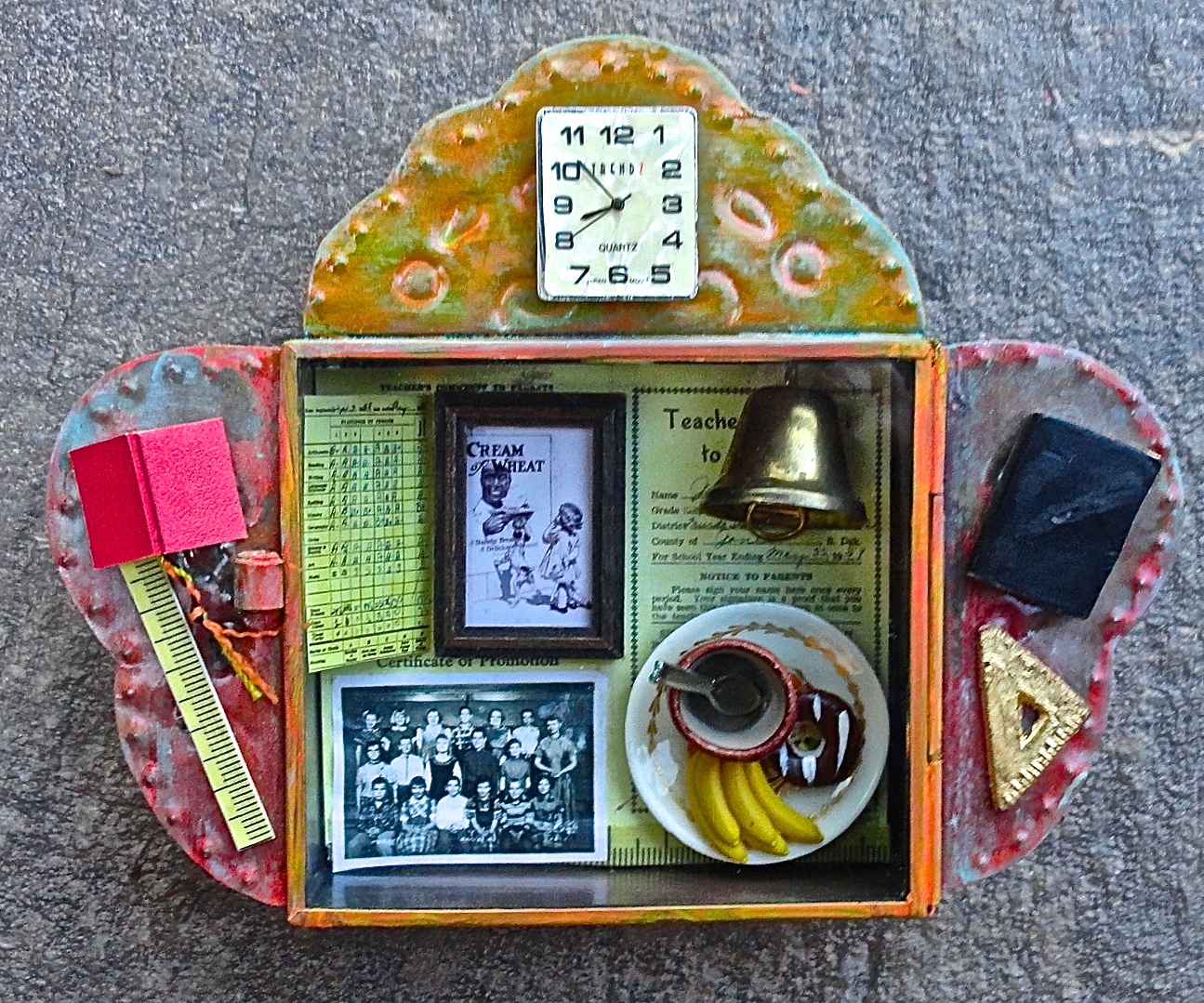
DSC07814Nine Minutes to Nine–Retablo by Judy Dykstra-Brown ( 5.5 X 7 X 1.25 inches)

Waiting for the Bell

From my upstairs bedroom window, I could see it all:
who got to school early to be first for tether ball,
the teachers driving up the street, avoiding children running
some children in the sandbox, and other children sunning
stretched out on the teeter-totters, waiting for a ride—
their friend the perfect size to balance, still locked up inside
cleaning off the chalkboards and dusting the erasers
with others who’d been tardy, or perhaps desktop-defacers.

We could hear the school bell toll the warning for
just one more bite of Cream of Wheat—no time for any more.
I stood and watched as sisters sprinted out the door.
Going on without me, for I was only four.
I waited then for recess, spread out on the grass
waiting for the hours and minutes just to pass.
Through open windows, I could hear all the teacher voices
quizzing all the children and listening to their choices.

The teacher on piano, the class singing along—
long before my school days, I’d memorized each song.
At 10:15, the bell was rung and big doors thrown out wide—
one hundred children, all at once, released to the outside.
Some ran to claim the swings and slides, or lined up for the games:
choosing sides for “Send ‘Em” by calling out their names.
But the creaking of the swing chains and whoops up on the slide
could not reveal the mysteries of what was sealed inside.

Year after year I watched and listened, storing up the clues
for the day that I could put on my new school shoes.
I’d have my school bag at my side while mother curled my curls
and keep it with me as I ate my breakfast with the girls,
spooning up my Cream of Wheat but listening for the bell
that warned the time was getting short for me to run pell-mell
across the street and up the stairs in brand new skirt and blouse.
I knew which room to look for.  I could see it from my house.

And then perhaps my mom would stand under our big elm tree
and the singing that she listened for would finally include me!

 The Prompt: August Blues—As a kid, were you happy or anxious about going back to school?

Woodstock Redux Redux : The Watchers

To understand the below poem, which was written to a prompt from okcfogottenman (who wanted me to address the subject of the broken tree limb) you need first to read my Woodstock Poem

Woodstock Redux Redux : The Watchers

Jimi and Janice sitting in a tree.
K-I-S-S-I-N-G.
Janice got so carried away
that the limb began to sway.
And though spirits don’t weigh much,
not so the limb that they both they clutch.
So as they vanished into vapors,
I felt the aftermath of their capers.
When the branch came crashing down,
It barely missed my fragile crown.
Lucky these greats of rock and roll
Didn’t have me as their goal.
If I’d been better at voice or guit,
that tree limb might have scored a hit,
and I’d be playing at the pearly gate
with other greats who’ve met their fate.
With tie-die halos above our hair,
We’d stage a heavenly Woodstock there!

No Fear

No Fear

We know within our hearts that personality
often cancels out what we can clearly see.
We all have known the men who, homely to the eye,
still have personalities sweet as cherry pie,
who win the ladies with their charm and humor that is wry,
causing them to line up for chances with this guy.

And the girl who’s plain until she starts to talk—
her face just so enlivened, you have to stand and gawk.
Made lovely by expression, intelligence and wit,
“beautiful” and “lovely” become the words that fit
when trying to describe this attractive little lass
who simply doesn’t bother with a looking glass.

Both have learned to conquer all their crippling fear—
to find the other side of doubt and kick it in the rear.
To face the world on their own terms and face it unafraid.
To take their rightful placement at the front of the parade.
But though we see what they have done, we do not always take
the road that for another seems to be a piece of cake.

You may find this poem to be most adolescent,
yet the feelings of our past most usually are present
throughout our lifetimes, though we seem to hide what we must feel,
leaving it to novelists and poets to reveal
the truths of all our agonies, the facts of all our fears—
all those things we’ve meant to face but yet hold in arrears.

I long ago discovered that writing must be true.
The only worthwhile topics are the things that bother you.
The lacks you find in others and the lacks within yourself
are what divide the poems in hand from poems on the shelf.
And so I must admit that fear’s my greatest hidden vice.
And since we all could do with taking our own sage advice:

I’ll say that with no fear, I would burn candles at both ends—
be as free with lovers as I am with friends.
I would have burned fingers, but an unbound heart.
All those lovely men, disregarded from the start
because I was too zaftig or not smart enough?
I’d face them nose-to-nose, and then I would call their bluff.

Today’s Prompt: Fearless Fantasies—How would your life be different if you were incapable of feeling fear? Would your life be better or worse than it is now?

Unwrapped Packages

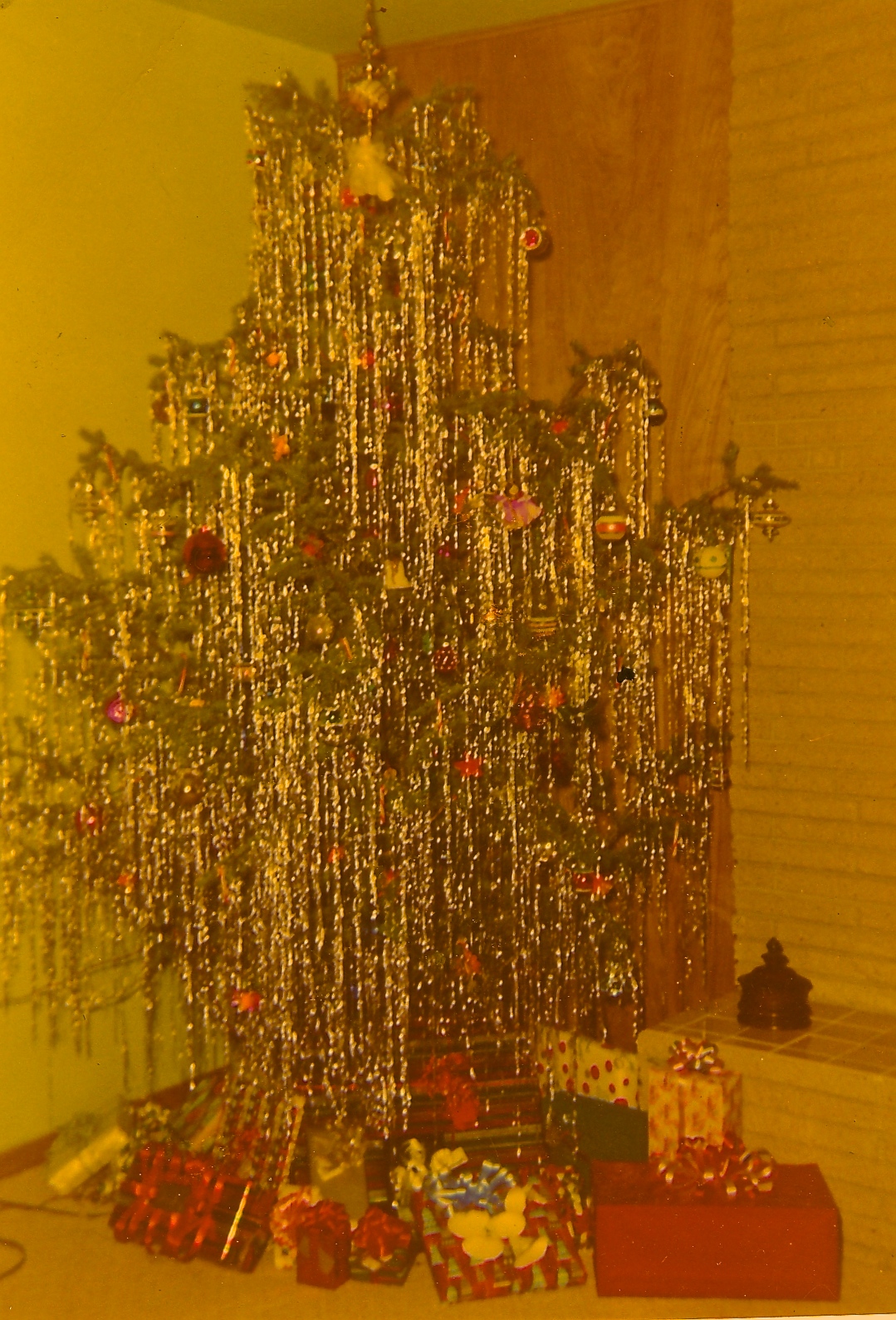
daily life  color008

Unwrapped Packages

It is the difference between that present handed to you
by a person who says, “It’s only a tie,”
and a package under the tree
squeezed and prodded at—perhaps a corner loosened
or a hole poked in through supposed accidental handling,
pondered like a good detective show.

Who wants these mysteries revealed before their time?
What value in the present whose contents you already know for sure?
The magic of Christmas for some is that faith that the girl,
untouched by human lover, gave birth—and it is that sort of faith
that “saved” the world. If we knew the whole truth of that story
would all it prompted fall into the hole covered all these years by mystery?
The whole world seems to be standing more on what we don’t know
than on what we absolutely know empirically—what we can prove.

And so I look at the picture of my young mother
in her cotton housedress and saddle shoes
holding her baby in front of her in her stroller,
whole contraption, child and carrier,
a foot or two above the ground,
and there is mystery in the reveal.
I do not hear what transpired to cause this pose.
I do not know if my father caught her carrying me
from the porch to sidewalk and said,
“Here, Tootie, turn around,” and snapped the picture,
or whether my older sister planned the pose.
Or whether some movie star was snapped in a similar scene
and my mother and sister, like two conspiring fans,
planned the shot to steal the glamor formerly reserved
for “Photoplay” or “Look” or “Life.”

There would be no reel-to-reel
in any normal person’s life for years.
No movie camera to tell me exactly what my mother was like
or my sister or me before my memory took hold and even then,
my mind’s remembrance
more like reflections in a lake that color and change
depending on the clouds or rain,
distorting the light like moods.
My Aunt Peggy’s house,
always remembered as feeling like
the color chartreuse,
and I will never know why.
That smell of a friend’s house that became associated
with her memory more than any concrete proof of reel-to-reel
or spinning film of movie camera.

I do not know my mother’s voice at thirty.
I did not witness myself since birth
by either sound or sight.
There is a different mystery
to a past caught
in boxes of Kodacolor prints
curling and yellowing in a closet
than one documented like a science experiment
with every event taped and filmed.

Where does the mystery of you reside when you see yourself
so clearly, as others have seen you all along?
What does it leave for you to try to discover?
No tapes.
No film.
No Internet.
No Skype.
No YouTube.
No home movies.
All of our pasts were once wrapped up forever.
Only our fingers poking in the edges.
Only our voices asking,
“What was it like the day when I was born?”
What do you remember about the day when. . . .?

The Prompt: Can’t Stand Me—What do you find more unbearable: watching a video of yourself, or listening to a recording of your voice? Why?

Laughter Schmafter

Laughter Schmafter

I used to roll with laughter most every day or so.
My parties were all riotous. No one would ever go
back home again till two or three or four or five or six.
And some would stay for breakfast, prerhaps hoping that I ‘d fix
my special chocolate waffles or orange berry strudels
or curried eggs or cheesy pie or strata made with noodles.
We’d story-tell and play charades and I admit, we’d drink
and stage our paper yacht races within the kitchen sink.
The guests might come in costume and some might bring a friend
for I had grown notorious for parties with no end.
When I was a teacher, I’d invite the whole darn staff.
Away from school, our hearts were gay. We dearly loved to laugh!
But this was years ago, my friend. Our hearts were young and gay.
Now that we’ve lived past sixty, we live a shorter day.
When I have my friends over to play a game or dine,
some find the spices don’t agree and others shun the wine.
Some have little dogs at home they have to feed by five.
Others have eye problems and find they cannot drive
after dark at all and so they have to leave by seven.
I guess our laughter’s done on earth. Perhaps we’ll laugh in heaven.

Daily Prompt: Roaring Laughter—What was the last thing that gave you a real, authentic, tearful, hearty belly laugh? Why was it so funny?

Lost in Iowa

Lost in Iowa

We are lost in Iowa,
pulled off the highway onto a gravel road.
Not content to give himself totally over to the control of GPS,
he checked its suggested route last night and instead devised his own.
But now, lost, without a clue as to where we are,
we have pulled over
to contemplate our situation.

I open the door to catch a breeze.
The yellow blooms of sweet clover and purple alfalfa
line the little road.
Wild anise and tall marsh grass
complete a scene
of perfect rural quiet and suddenly,
I am no longer lost.
I am back on the running board of my dad’s beat-up red pickup,
waiting for him to finish mowing the lower field.
I’ve eaten one chokecherry
from a nearby bush
and my mouth is puckered
by it’s astringent sting.
I go back sixty years
as I drink icy spring water
from my dad’s metal water can
wrapped in wet canvas
to keep it cool,
then jump back fifty years more
to my dad’s youth,
to try to imagine how he felt
with the prairie stretching hundreds of miles
in every direction.
My dad, his parents and two sisters in a two-room house.
There was privacy in the barn,
a dog for company.

Their closest neighbor
an ancient Hunkpapa Sioux named Charley
in his dugout house
half a mile up the draw,
town an hour’s ride away or more by horse or wagon.
With no diversion of cell tower or satellite dish—
there was only his family,
the land and his imagination.

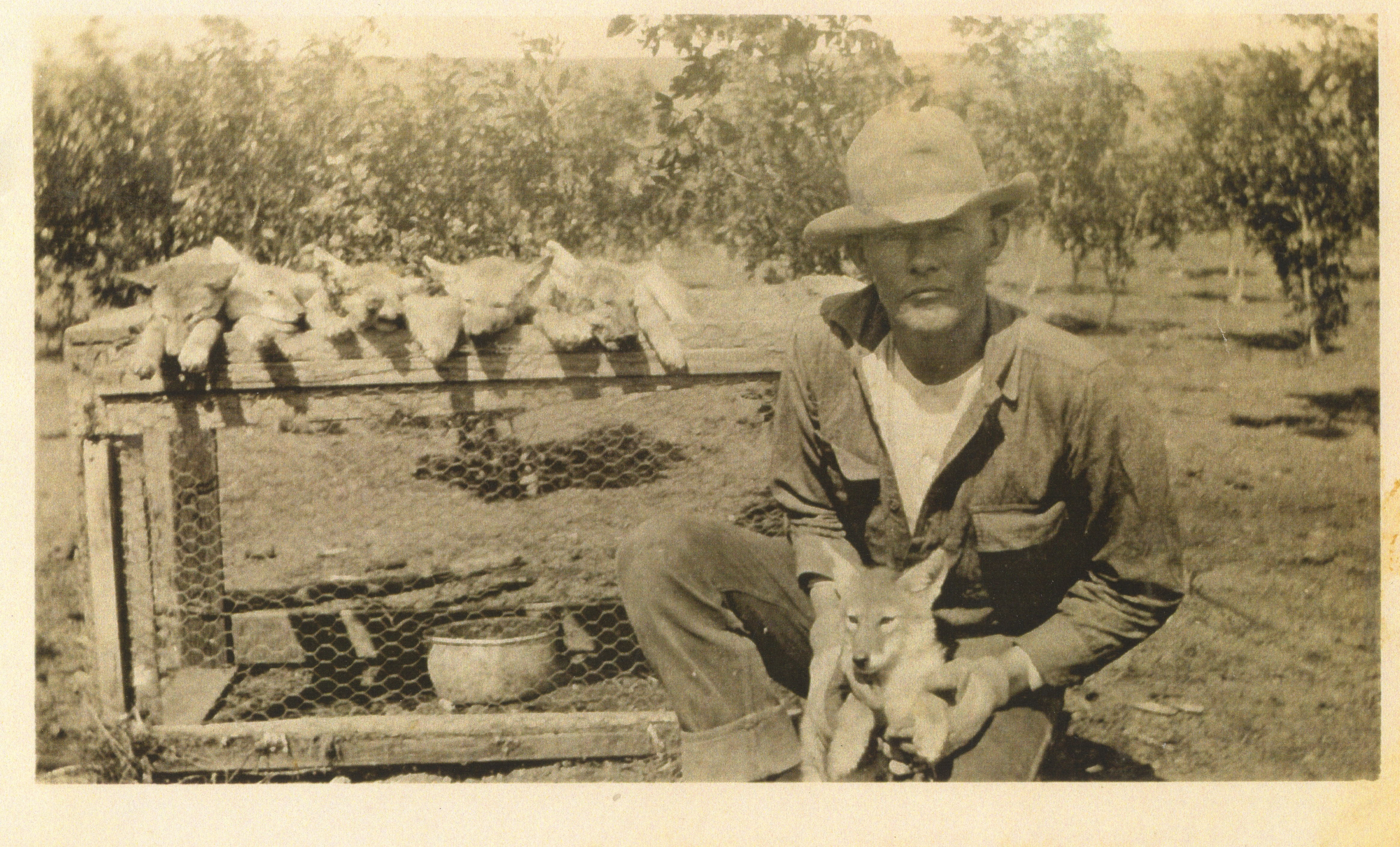
My dad killing the coyote,
then finding her pups and bringing them home.
What would his dilemma have been?
Did he raise them,
then turn in their pelts for bounty?
Did he release them,
and then never know when he killed a coyote
if it was merely a pest or a former pet as well?

What did he think when he lay in a patch of clover?
Did he smell the wild anise and imagine
the sweet stickiness of licorice?
Did he pick the wild asparagus
for his ma to poach?
Did he have the idle moments
with which my childhood was filled?

What child now lies in the grass,
looking for something for his mind to rest against?
What other traveler,
lost on a gravel road in the scorching sun,
opens her door to a breeze
that flows like water down an empty creek channel,
looks up from the GPS screen
that promises to restore them
to civilization’s knowing?
Will she, as I have, relieve her lost present
by losing herself in the past?

That girl who sat on her dad’s running board
who would journey so far to unimagined places,
still travels the mind back to pleasures
of a world it was possible to be lost in,
sweet clover and wild anise
giving a taste of precious emptiness.

In this age of machines that can guide us
so surely into a  future,
where we are often so found
that we are lost in it—
savor those mistakes
that bring us back
to flounder in ourselves.

We, too, know the way.

daily life  color006

Dad with sleepy coyote pups on South Dakota farm, 1924

The Prompt: Wrong Turns—When was the last time you got lost? Was it an enjoyable experience, or a stressful one? Tell us all about it.

I am cheating and publishing here a poem I wrote on a trip two years ago.