
Because it conjured up a wonderful afternoon in the San Miguel Botanical Desert Gardens with my dear departed friend Joe and my long-unseen friend Dale.
San Miguel Desert Botanical Gardens (Click on Photos to Enlarge)
Innocents in Mexico
Chapter 21
For the next three days, we packed as many explorations of San Miguel into our days as possible. We took another tour of the botanical gardens, this time taking a longer path which wound down to the bottom and to the furthest edges of the ravine. We explored ancient ruins, watched goats grazing near the water far below, watched boys diving into the water from the muddy banks. Men stuccoing bovedas on rooftops across the ravine caught sight of us and waved. We ended up on the path that wound right up to the huge mansion which clung to the cliffside at the furthest edge of the botanical gardens. Its inhabitants were the owners of the most popular restaurant in San Miguel. When other restaurants were empty, theirs was always full. When the city had prevailed upon him to give the land for the botanical gardens, the owner had complied, but when they had asked for the house, he had refused. “You don’t give away your dreams,” he said. Politicians had put on pressure, denied him access to city water for years, but he had held out. Now the pathways of the desert gardens came within feet of his house, but he was still there. His view was the best in San Miguel: The city in the distance, the ravine and aqueduct and ruins below him, around him the beautiful virgin desert, much of it still blooming as we walked its various paths.
A huge bird circled overhead. Lizards and a brightly striped snake crossed our path. Hummingbirds, bees, millions of giant red ants. The ubiquitous black grackles, moving their widely fanned tails like rudders, swifts gliding and darting, and those voluminous white clouds in the vivid blue sky. The neighborhood we had narrowed our wishes down to adjoined the botanical gardens land, but when we inquired about the price of lots, they were as much as we’d planned on spending for an entire house with lot. What Bob had decided he’d like to spend, that is. He had settled on $80,000—the price that the stabbed woman had put on her house, lowering it because, after all, who wants to live in the same neighborhood with a man with a knife and a proclivity to use it? I was humoring him, sure that we’d never find anything for that price that we would want to buy. He loved looking at houses, and so did I. I just didn’t want to buy another one before we sold ours!
A few days later, when Jim offered to rent or sell us his house for a figure within our budget, we switched our focus back again to reality. We could finish the compound wall, build a studio, finish tiling the house, but when we asked a builder for estimates of what this would cost, we figured that it would end up costing about what any of the places closer to the jardin would cost. In Jim’s house, we’d have privacy, a larger lot, a bigger studio, but in a neighborhood where it would be harder to sell in the future. If we didn’t want to buy, he offered us the option to rent for a year or two so he could go to South America with his girlfriend, and if we couldn’t find another house to rent for a year and a half, this was the option I preferred
On the plus side, it would get Bob’s mind off wanting to buy a house. On the minus side, our next door neighbors on one side were rowdy, the street in front of their house a gathering place every weekend for men with beer bottles and loud voices. The neighbors to our rear and other side were both metalsmiths, who often worked into the evening. One of their sons was a drummer who practiced daily on a large oil drum. The other was a whistler. True, so far, we had not been bothered by these sounds of activity, but, who knew how we would feel months or a year from now?
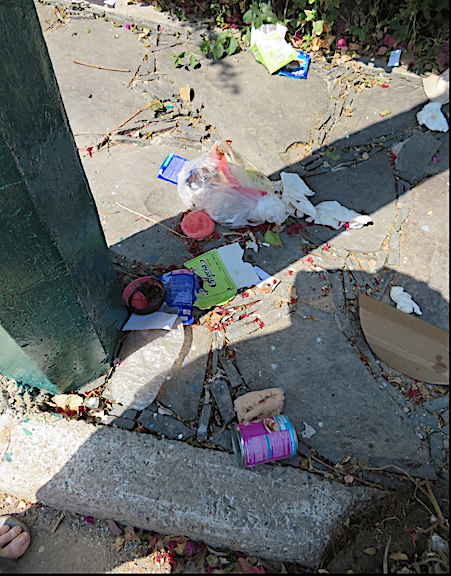
We loved the sounds of children playing on the huge empty field across from us. We loved watching people crisscross the field to and from Gigante. However, trucks and jeeps also used it for four-wheeling, and it was strewn with garbage: Coke bottles, water bottles, plastic bags, old tires, mounds of broken bricks, stone and cement dumped after building projects, tangles of barbed wire, tin cans, burned logs.
Every unoccupied lot in San Miguel became a repository for the rubbish of the neighborhood. Everyone drank Cokes and bottled water, and when the plastic bottles were emptied, they were tossed: out of car windows, into window grids, onto spare lots, onto city streets, into ravines and lakes and rivers. There was garbage collection and women faithfully walked to the curbs to hand over their household garbage, but when walking or driving or riding, the custom was to toss it. Highways nationwide––or for as far as we had seen––were rimmed with garbage. Coca Cola had done more to ruin the scenic beauty of Mexico than any single force. If it wasn’t their huge billboards or graffiti-like paintings on brick buildings city wide and country wide, it was the solid expanse of empty plastic bottles which paved the desert, the grass or the shoreline which bordered every road.
San Miguel was a beautifully preserved colonial town with strictly regulated ancient buildings, churches, monasteries and cobblestones. Its central zocalo––known as the jardin––was the place where lovers met and musicians played and children frolicked. Here benches lined the square and people sat to watch children, lovers, tourists, toy venders, beggars, neighbors, students, ice-cream eaters, scooter riders, ball bouncers, survey takers, shoe polishers, Spanish practicers and fruit sellers. Overhead was the dense foliage of trees. Around the outside of the square were the buildings hundreds of years old.
Within the jardin, sidewalks formed a square within a square with intersecting crisscrosses. Every twenty feet or so there arose a bronze stake. Antique, curlicued, topped with a rubbish container shaped vaguely like a mailbox, but patinaed, ornamented, lovely until you saw it from the front. There, emblazoned over the slot where the rubbish went in, in six inch high letters, was that ubiquitous script. “Coca Cola “it said, on each rubbish bin. Dozens of them marched the jardin like town criers, reminding us, “Never forget.”
The most constant presence in Mexico was Coca Cola. On one expanse of road, I spotted eight building-sized signs for Coca Cola and two for Pepsi Cola within a one block area. And in the ditches country-wide lay discarded bottles, like stepping stones between the few blades of grass that poked between them.
True, there seemed to be some awareness of litter as a problem. Here and there, you see a sign “No tire basura” (Don’t throw trash) on a spare lot or along the roadway, but few heeded them. They had become invisible. City dumps, more often than not, were located right next to major roadways. Handier that way, I guess.
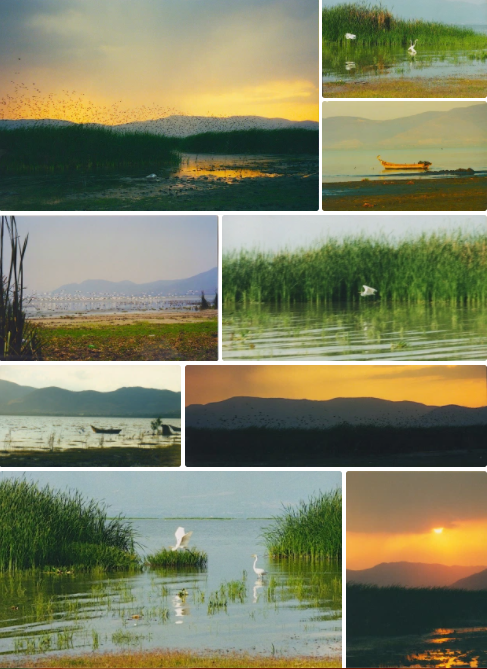
As we were discussing the possibility of visiting Mexico and then moving there for a year or more, Bob had started reading what material was available in that pre-internet age. In addition to San Migel de Allende, he had been attracted to two areas, mainly because they were situated by very large lakes. He had often told me that he had always wanted to live by a lake, and now he suggested that in the couple of weeks we had left before we had to be back for my mother’s memorial, that perhaps we should take a weekend off and investigate both of them: Lake Patzcuaro and then the largest lake in Mexico, Lake Chapala, Then, coincidentally, at a restaurant with tables placed too close to each other to avoid becoming conversational with one’s neighbors, we entered into a discussion with a couple from Ajijic who I had heard discussing the fact that public outcry had caused local politicians to decide to move the dump from a much-used cut-off road between two of the most popular towns on the lake to a more hidden location. They said, in fact, that along the whole expanse of the lake, rubbish seemed to be less of a problem than usual. As the lake shrank away from its banks, hundreds of yards of lake bottom were exposed. Here cattle grazed, four-wheel-drive vehicles turned wheelies in the dried dirt, boats lay earthbound, blocks from the nearest water. On weekends, locals thronged to makeshift palapas constructed on the former lake bottom to drink beer or Cokes or Fanta. Yet there was very little rubbish.
In one subdivision, double oil barrels were placed on each block along the road to serve as trash receptacles, but elsewhere, even where there were no rubbish bins, there seemed to be vastly less littering. Construction crews still piled their leftover stones, dirt, concrete, bricks and rebar on spare lots, to be dealt with by the next building crew, but piles of stone and brick and wood seemed less intrusive than thousands of plastic corpses of drink containers and shopping bags. Also in this area, as in the area around Lake Patzcuaro, there seemed to be more people out along the road searching for recyclable bottles. Why, in this era when so many items––from clothing to deck materials––are made out of recycled plastic, can some program not be started in Mexico, which could make it profitable for people to collect this unsightly litter and turn it from a liability into an asset?
It seemed a sign. Bob used this conversation as a springboard and once again suggested that we at least quickly investigate the other two towns that had intrigued him in his reading about Mexico. So it was that we decided to head off for a short sortie into the wilds of Mexico. First Patzcuaro, then Chapala, before signing the year-and-a-half lease for the San Miguel house. We still had a few weeks before we needed to be back in the states for my mom’s memorial in South Dakota. Why not spend them making sure that San Miguel was really the place for us?
For Chapter 22, go HERE.




 lifelessons - a blog by Judy Dykstra-Brown