I’ve given a few segments of the story of my time traveling and living in Ethiopia. Some people have requested more of this story, so here is an expanded prose version of yesterday’s poem. The year is 1972. This is long so you might want to read part of it and come back later.
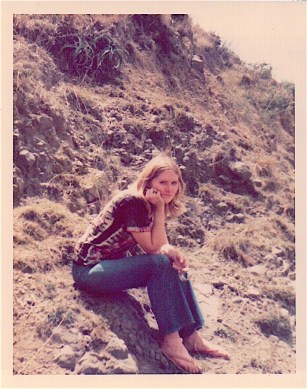
This is the picture Andu Alem took of me during our first walk in Lalibela.
Romance Underground
I was 24, just out of college, headed for whatever foreign country would hire me with no experience. The winner was Australia, and I headed out on my big life’s adventure. Setting out alone to somewhere where I knew no one, I was not scared. I was elated. I had no idea what people were like in this new environment. Perhaps they were more like me. I think I already knew that I was someone who enjoyed being the stranger. If I was the stranger, it meant all new territory for me. No one knew my family or anything about me. A youngest child, I could be judged for once completely on my own merits.
Australia was exciting, but after a year and a half of recruiting teachers from elsewhere, they decided they were overstocked and offered any of us willing to leave a payout equal to the amount of income taxes we’d been paid during the time we were in Australia. I cashed in and made $600! Wow! I thought this was enough to travel to London. My Australian roommate, Deirdre, decided to go with me. We planned to work enroute if we could and bought bus tickets from Sydney to Darwin and airline tickets from Darwin to Timor to Bali to Singapore to Sri Lanka.
Unfortunatey, once we got to Timor, we discovered that the airline we’d booked our flights on all the way to Sri Lanka had gone bankrupt, so we were a bit stranded. We made our way by World War II Troop barge, which we “rented” from some Indonesian fishermen, then by foot through the jungles. This was the second biggest adventure story of my life and one told in an earlier posting, but that is not the story I am telling today. Suffice it to say that eventually, after about 4 months, we made it to Africa.
Deirdre was our planner, researching each country before we got there. I careened through the trip from experience to experience. She was rather refined and a bit cautious, but out for a good time as well. I was a small town South Dakota girl who had read a lot and seen a lot of movies and so knew how to act. Well, perhaps I did.
When we had first been making our plans, looking at a map and tracing a path between Sydney and London, I had remarked that I definitely wanted to go back to Kenya, where I had been in 1967. Dee, who had no interest in game parks, agreed to go there if we could also go to Ethiopia to see the 13 undergound stone churches of Lalibela. I had never heard of these churches and had little interest in Ethiopia, but was game and willing to compromise. We would travel to Tanzania, Kenya, and eventually make our way to Addis Ababa, the capital of Ethiopia.
At the time we visited, Ethiopia was the last purely medieval country on earth. Its political system was headed by the king, who was believed to be divinely appointed and therefore, next in divinity only to God. Then came 12 “noble” families, who owned almost all of the land in Ethiopia…They were the Dejazmatches–next in power to the king, Haile Selassie. After the Dejazmatches came those who carried the title of “Ras.” The most famous Ras that you might know was Ras Tefari Mekonnen, beloved of the Rastefarians of Jamaica and elsewhere, who became Haile Selassie when he ascended to the Ethiopian throne. In line with this medieval theme, the national drink was “tej” which was a honey wine similar to mead. Lay singers would go from town to town making up songs about the people there, spreading the rumors from other towns. And the language was a poetic amalgam called “Wax and Gold” in which words took on a triple meaning. There was the literal sense, then a sort of humorous sense, and finally an allegorical sense.
In the courtroom and elsewhere, wordsmiths vied with each other to think up soliloquies that would stun listeners by their triple entendre and clever reparte. This was to prove to be a fascinating culture that I was given plenty of time to appreciate, prompted by circumstances beyond my control.
This was the year when the world finally discovered the horrible famine in Ethiopia. We encountered it first hand as people formed human chains across the road to stop our bus and beg for food. Very quickly, we had thrown all the food we had brought along out the windows to the starving people along the roadside, then our water, money—whatever we could. It was unbelievable that the government was doing nothing. Even the goods that the U.S. had sent over in famine aid were being stolen by the government ministers and being sold, instead, in the markets. ( We would see huge piles of bags of wheat labeled “Gift of the People of the United States of America” for sale. )
We traveled for two days on local last-class buses, which stopped at every village. As the bus filled up, we were given baskets, chickens, even babies to hold. The scorching heat was alleviated a bit by occasional spreading wet stains on my slacks as yet another bare-bottomed baby answered the calls of nature unencumbered by a diaper. We made our way to Dessi, in the middle of nowhere, visited an area called Bate market, where the lowland nomads leading their camel stings met the highland farmers in a huge market that covered three hillsides. Here camel dung fuel was traded for meager food goods…small hard red onions, tomatoes, berbere (a blend of spices for making the hot watt everyone fancied.) Then we got on a small plane and headed out for Lalibela–the famous isolated village which was home to the 13 stone churches which were said to be carved out of the living rock by angels–overnight, to boot.
At first , below us we saw only the usual dry flat expanses, but soon the terrain became more mountainous. Then, the land fell away…as though we had come to the edge of the earth…one sheer huge cliff spread for as far as we could see in each direction to the side of us, but in front of us…there was nothing! The ground fell away and below us was empty space.. Our airplane flew lower and eventually we saw tall mountains jutting up below us once again…Almost continuous mountains. It was hard to imagine where we would land. Finally, we could make out a small strip of level land far below. It was a grass and dirt landing strip. Here we landed. We could see a small wooden building a half block away from us…grass, dirt, and a narrow unpaved road heading straight up a mountainside.
One thing about traveling last class is that you meet lots of other last class travelers who tell you everything to expect in the next place you are headed for. Going north, there are always those going south. You have each been where the other is going, so you swap information. And so we had heard that there would be guides from the National Travel and Tourist Agency who would come and offer us a ride to town for $12. This was a princely sum for us, and we knew that after they left, boys on burros would come and offer to let us ride them to town for only a few coins. So when we were met at the bottom of the plane stairs by two handsome African men offering us a ride to the Seven Olives Lodge, we waved them away. They fell into step beside us. One was tall and gorgeous with a foot-wide Afro. In his camouflage safari jacket and wonderful polished bush boots, he was like a Marlborough man, Africa style, like a heart throb movie star cast in the perfect role. The other man was shorter and stockier with a smaller Afro. He was a John Belushi type, clever and masculine and always laughing and cracking a joke. And his jokes were funny!
We told them that we were “on to” them and that we didn’t have the money to pay for a ride in their Land Rover, but that we knew we could rent burros instead for less than a dollar.
No, there were no burros, they told us. Then we’d walk, we insisted.
It wasn’t that we didn’t think they were cute. My heart was thumping pretty fast in response to this gorgeous man who was pouring all of his charm into his sales pitch. There was something genuine about him, and friendly and flirty. He seemed pretty cool for an African twenty-something so far out in the sticks.
But if we walked, it would be too dangerous, they insisted. As we walked toward the hut that seemed to be the sum total of the airport buildings, other tourists were persuaded that they needed a ride and started to walk over to the Land Rover.
No, no, no, we repeated. We couldn’t afford the ride. We were traveling on a shoestring.
But it was too far to walk, they insisted, and too dangerous. If we walked, there were hyenas in the hills, and they would get us…
I’m sure I had to have made some comment on the Black Tigers at hand being, perhaps, as dangerous as hyenas awaiting us in the bush. Knowing me, I had to have done this, but at the very least, it occurred to me later.
Finally, we all reached the Land Rovers and the assorted tourists started to climb in. Dee and I walked on.
Then the tallest guide grabbed my arm. “Get in,” he demanded.
“But we can’t pay,” I said.
“Just get in the back,” he said. So we got into the back with them, riding last-class on the metal benches that ran front to back under the side windows.
We wound for miles up and down mountains before reaching the Seven Olives Hotel. When I started to open my mouth to say we couldn’t afford this hotel, the tallest man just waved a hand and said, “I know, just stay here while we get these people settled.”
After the “real” tourists were dropped off at the Seven Olives hotel and shown to their rooms, Andy and Tessie returned to the Land Rover. This time we rode in the front. As we drove higher and higher up the sinuous dirt roads that curled up the mountains, Andy and Tessie kept up a continual line of banter. Andy had a very deep voice like the Jamaican man who used to do the 7-Up commercials. Do you remember him? At the end of his “lines,” he would let out a rippling deep laugh…also like Andy’s.
They took us to a small motel owned by Andy’s aunt–one that catered to Ethiopian travelers. There were maybe 5 or 7 rooms at the most, and it was very cheap. I think about $3 a night. The porch/corridor that the rooms opened off of overlooked the entire town down below. From that perch, we could see the Seven Olives, the top of the one church that was in the shape of a cross, and the entire road as it wound down to the grass landing field of the airport. The entire landscape was comprised of dry dirt. In spite of the “River Jordan” which had been carved into the landscape at the same time that the churches had been carved out of the living rock, there was not one drop of water in either the “river” or the town. We were in the middle of the dry season. Water had to be carried for 3 miles in large clay jars on the backs of the women. Needless to say, not a drop was wasted. After arranging for a room for us, Andy and Tessie left to resume their tour guide obligations. Dee and I settled into our room, wondering if we’d see them again, but we needn’t have worried.
A few hours later, they returned to eat dinner with us–a spaghetti dinner cooked by his aunt. They were obviously interested in us, but I think both Dee and I were wondering which one of us Andy would choose. After dinner, the mystery was solved when he asked me to go for a walk and Tessie asked Dee. As we walked, he explained that his name, Andu Alem, meant “First World,” and that his last name, Tamirat, meant “miracle.” He was his father’s first male child, and so had been named “First World’s Miracle.” As far as I could see, he suited the name perfectly. He was a gorgeous young man–tall, handsome, well-dressed with a formidable Afro. He showed me the mark in his leg where he had been shot by the police during a University demonstration. They had then closed the University and so he had not been able to complete his degree. Instead, after a long bout in the hospital, he was given this job with NTTA. In a few months, just before the rainy season, they would drive the Land Rovers out over the mountains, back to Addis Ababa, for during the rainy season, no planes could fly and the dirt roads would become impassable.
He also told me that this province of Lalibela had been ruled by his ancestors and that his uncle was the Dejazmatch of this region. For this reason, everyone in the village knew him. His father, who was a Colonel in the Army, also had a large coffee plantation and two houses—one in the country and one in the town of Addis Ababa, which had been built so it could be used for the upcoming wedding of his sister.
He was knowledgeable about the history and legends of Ethiopia and told me story after story in his rich deep voice. I have a picture he took of me that first afternoon. I’m in Levis and an Indonesian T- shirt, Indian rope sandals. My hair is very long, blonde and straight and I’m very skinny from months of dysentery, poor food and lots of exercise. I sat perched on a rock. He was on a rock slightly below me.
I remember what I was looking at that caused that winsome look. Mile upon mile of mountains falling into valleys into other mountains and valleys…nonending. Eagles swooping, flocks calling out to each other, shepherds calling out to their flocks…the blue haze of sunset against the last brilliant rays of sun. It was a romantic Shangrila and I was at last living the life I was meant to live.
I remember the feeling so clearly. I can hear the sounds, feel the air, see the sinking sun, hear the bleating of the sheep and the calls of the shepherds; but I can’t remember how or when that first kiss happened. What I do remember is that it was a kiss I never thought I’d experience again, one of those kisses like the first kiss I’d ever had–a kiss you fell into and just kept falling. I was dizzy with it, and as we walked back to the room, I was glad for his arm around me, because without it I was afraid I would be staggering. Drunk on love. I was a cliché!
I could tell that Deirdre and Tessie had not fared so well. When they left and Andy pulled me in for another dizzy spell, Tessie made his move, but Dee turned away. Clearly, she was not enthralled. When they left, our two Black Tigers promised that after they’d taken the tourists on their morning tour of the underground churches, that they’d come take us for a private tour.
Dee and I were traveling light, with just one small cloth bag each—more like a shopping bag than a suitcase. So while we waited, we washed out our meager supply of extra clothing and hung it on the railing where it dried in minutes in the dry thin air. There were chairs and small tables in front of our room, and as we sat across from each other playing cards, a young boy, perhaps 12 years old, perched on the railing and watched us. He spoke a few words of English, and was able to convey to us his name: Sissae. During the course of the morning, we kept up a dialogue by pointing to objects and trading English words for Amharic. Finally, Andy and Tessie appeared. Had Sissae taken good care of us, Andy asked? Thus it was revealed that it was no mere coincidence that we had had a chaperone all morning long.
We had the VIP tour of the underground churches and passageways, heard the story of Tekla Hymanute, a priest who had martyred himself by standing in one of the niches in the underground passageways for 20 years—on one foot, until the leg fell off! Heard the story of the creation of the churches during the time when the route to the holy land had been cut off by the Arabs and so a new Jerusalem had had to be created for a new pilgrimage site. In the time of King Lalibela, the 13 churches had been carved from the solid mountain of stone which the town also stood on. Legend had it that Angels had accomplished the task overnight. Then the River Jordan had been carved out of the landscape as well. Granted, it held no water, but as a symbol it held significance.
Our plans had been to spend two days in Lalibela. On the second day, the day we were to fly back to Addis in the afternoon, we woke up very early to travel to the high cliff monasteries in the mountains above the town. This was accomplished on donkeys so small that our feet scraped the earth if we didn’t hold them up in the air at an angle. Slightly embarrassing, not to mention highly uncomfortable. Small boys ran alongside and offered crudely woven wool hats for sale. I bought one, not having any idea what I would do with it, but this action would be of importance later. For hours, we wound upwards until we arrived at a wall of sheer cliffs. Long ropes hung down from the tops of the cliffs and carved into their sides, nearly at the top, were the cliff monasteries. Only men were allowed to climb the ropes up to the monasteries. I must admit, it was a relief, since, not being the athletic type, I was positive I couldn’t have climbed the ropes anyway. I remember Dee voicing some worry that we might not get back to town in time for the flight, but I assured her that Andy had assured me that they wouldn’t leave without us.
Our trip back down the mountain was uneventful if somewhat uncomfortable, and as we drew closer to the town, the donkeys moved faster in anticipation of a handful of grain or a drink of water, no doubt. Our thoughts ran ahead of us. We needed to grab our bags from the hotel and be ready for the Land Rover to pick us up. I felt a bit heartsick, knowing that my big adventure would soon be over. I knew it was silly to fall so quickly. Some women could have these flings and chalk them up as an adventure only, but I knew that this wasn’t my style. I could pretend, and probably would, but there would be a good deal of hidden heartache in this for me.
As we neared the motel, we could see the Land Rover parked in front of the Seven Olives and could see Andy and Tessie going in to get the tourists, helping them with their bags, loading up the Rover, driving down the hill. Then they got to the fork that would lead up to our motel, but they didn’t take it! Instead, they turned onto the road that led down to the airport, many miles below.
Dee was sputtering. What were they doing? Had they forgotten us? They were probably going to let the tourists off and then come back for us, I assured her. We ran to the room, grabbed our bags, and went back to the porch to watch. What we saw was the plane landing, people boarding, and the plane taking off! Dee was livid, spouting invectives that had Sissae, who was again our chaperone, watching wide-eyed. What could they have been thinking, leaving us stranded this way? As she sputtered on, I saw the Land Rover turning onto the road again. This time, when it came to our turnoff, it entered it.
As he approached the porch, Andy broke into Dee’s tirade. “There were no seats left on the plane,” he explained. “I called in the morning after you left and was told that the plane had been filled in other locations before it reached Lalibela, and so there was only space for the tourists who had pre-booked their flights.” Secretly glad, I accepted Andy’s invitation to go to a tej house that night to hear the traveling lay singers. Dee grudgingly accepted Tessie’s offer as well. “You know, he’s married,” she confided to me later. Now I knew at least one reason why it had not gone so well between them.
We sat on wooden benches around the perimeter of the room. The musicians strolled from group to group, composing songs on the spot. The lyrics became more and more embarrassing until the object of the song presented money. Then they’d go on to the next person. The audience was exclusively men, except for Dee and me. As the singers got to us, Andy interpreted. We all drank the honey wine called tej, the national drink, out of long-necked pot-bellied little jars. It was delicious and, as we later discovered, lethal! The next morning, we slept in. When we awakened, Sissae was on the porch with our breakfast, ready for his next English lesson. Dee was packed and ready at the appointed time for Tessie and Andy to pick us up for the ride to the airport. We stood watching, and (dejavu?) exactly the same thing happened! Once again, we watched the plane land and depart without us.
By the time they had returned from the airport and come back to talk to us, Dee had worked up a storm. But what could they do, Andu Alem protested. Once again, the plane was fully booked! But there were only six tourists in the group, fumed Dee. Yes, but the plane had picked up passengers in Gondar and Bahar Dar as well, explained Andy. There was nothing they could do. Dee insisted on going to the airport herself to talk with the airline officials, so they graciously drove us down. The officials all agreed that the seats were all booked. Were there openings tomorrow, she asked? No, they were sorry. No openings. Well, there had better be an opening, Deirdre insisted, or she was making a complaint to Ethiopian Airlines. She fumed on, until the chief (and only) employee of the airport suddenly said, well, actually, there was one opening, but not two. “Fine, I’ll take it!” said Dee. “I’ll wait for you in Addis and you can come on the next plane available.” And that is what she did. She waited for 4 more days as plane after plane arrived with me not on it.
Every day, Sissae and I would sit on the porch as I waited for Andy to pick me up. And day after day we would see the Land Rover winding its way down to the airport without me. By now, we had become lovers, and the singers in the Tej house were singing songs of Andy and I leaving for the rainy season and then driving back after the rainy season to come live here and open up “Judy and Andy’s Souvenir Shop.” (I swear to God, this is true!) Finally, one day, I said to Sissae, “I know, Sissae, this is the day I will leave you.” And he answered, “Oh no, Miss, Andu Alem will never let you leave Lalibela without him.”
Light bulb!!!!! It was finally clear to me that Andy was telling the airline people, all of whom were his friends, to say there was no space on the plane! He didn’t want me to leave! I think I once said I was young and naïve, and this was a perfect example of my naïveté.
That night we had a talk about his dad, who hated Americans, and my dad, whose humor included calling Africans “jungle bunnies” or “stump-jumpers.” He had already had three heart attacks and would probably not survive the one he’d have if I returned with an African husband. Finally, at the end of a passionate, tear-stained, no-sleep night, we had made the decision. I was returning to Addis in the morning, then flying on to Asmara and beyond with Dee. Our love story was over.
The next morning the Land Rover did turn onto my road, picked me up and drove me with the other tourists to catch the plane. This time I rode in the place of honor between Tessie and Andy. I cried all the way. Tessie cried. Andy brought me flowers, but did not cry. He let me get on the plane and turned away–walked quickly to the Land Rover and drove away while we were still on the ground. I sat at a window seat and watched him drive away without a backward look. Then I cried, nonstop, for the next half hour.
I didn’t notice the man who sat a few aisles behind me, watching every detail of my departure. I didn’t see him watching me sobbing into my last soggy Kleenex. I didn’t see him move to the seat across the aisle. I had no idea of what was about to happen, and how it would change my life. I was as ignorant of the next chapter of this story as you are–caught up in the sad ending of my love story.
Eventually, I regained some composure and a young African man moved to the seat across the aisle from me. Since I was in a window seat, there was an empty seat between us. After a few moments, he asked if I was all right and if he could help me. I said no, that I’d rather just be alone, and he left me alone for a few more minutes.
Eventually, he started talking again and asking if there was something wrong. I said no, that I had just left a good friend and was very sad. He said that he was a student and asked if I would mind talking to him for a few minutes so he could practice his English. This was a common request as we traveled from country-to-country and as usual, I felt it was the least I could do, so we fell into a conversation and he eventually moved into the seat next to me. He was extremely good-looking and looked a bit old for a student, but he showed me an i.d. which did in fact identify him as a student. I knew that often students from the country could not afford to go to high school until they were in their twenties, so I was not too surprised that although he looked older that he was still in his last year of secondary school. He was pleasant and his English was good so we talked most of the way to Addis.
When we were about 15 minutes from landing, he asked a favor of me. He explained that he had been offered a scholarship to attend college in the U.S. but that his mother was unwilling to have him accept it as she feared racial prejudice in the U.S. and that she was afraid he would be mistreated or even killed. He asked if I would be willing to meet his mother to show her that all Americans were not prejudiced and unfriendly. I told him I was sorry, but that I really didn’t have the time as we were leaving the next day to fly to Khartoum. He pleaded with me, saying that this was something which could change his entire life if I would just do this one kind act. He said that if I would come for dinner at his mother’s house, that I could meet his family. He would send a taxi for me and we would be with his mother and sisters and nieces and nephews the entire time. Then I could take a taxi home to the motel where I knew Dee was at the moment, awaiting my arrival.
Feeling selfish and feeling the usual embarrassment that American travelers oftentimes feel over the imagined rudeness of many of their fellow countrymen, I eventually agreed. What could happen? And it could be a turning point in his life.
When we landed, Dee was at the airport waiting and we took a taxi home together. When I told her about my arrangement for that night and asked her to accompany me, she refused, saying it was just too dangerous. I didn’t know him. Anything could happen.
I insisted that it couldn’t be safer. We’d be in a taxi, then with his family, then I’d take a taxi alone back to the motel. What could go wrong?
Little did I know—
(If you haven’t already read it, the next part of the story may be read here.)




 lifelessons - a blog by Judy Dykstra-Brown