Category Archives: Daily Prompt

Anger (Anagram Poem)

With my Open Studio to set up today, I don’t have time to wait for the Daily prompt, so instead I’m using a prompt suggested by Sam Rappaz. The Prompt: ‘Anagram poem‘. These poems are adopted from the word games that we find in newspapers. The rules are: End words must be derived from four or more letters in the title. Words which acquire four letters by the addition of “s” are not used. Only one form of a verb is used. (Thanks, Sam Rappaz. You can see her Anagram poem here.)

Just for the fun of it, I’m going to try to use the words Anagram Poem for the challenge, but instead of using those words as the title of my poem, I’m using a word derived from them:

Anger

All through our lives it lingers near.
It hovers close over her infant’s pram,
where his mother’s soothing words manage
to calm his cries of distressed rage.
Yet what he sows is left to her to reap.
His distress squelched may turn in her to anger
as at midnight, with the seventh remop
of the day, the angst supressed all day is allowed to range
unfettered, growing from a silent pang
to a depression best escaped from with a rope.

Who imagined this, that wild night after prom
when he first held her breast, a glowing pear,
and she, at last, met his questing grope
not with a “No” expressed clean off the page
of the pamphlet given by her gram;
but rather by a passion that rang,
on that one night, truer with every groan.
His muscled back, her throat, her golden mane.
Her naked thigh pressed to the gear.
For once, her lover given no cause to mope.

And for a day, a week, a month, that golden night remained a poem.
Until the time-worn ending added one stanza more.
Telling her grandma and her gramp.
That long journey up the nuptial ramp.
That fast trip from teenager to ma’am.
With lightning speed, from car seat to manger
and the clock watched, and his absence, and this overpowering midnight rage.


Home Rule

Home Rule

The laws of society, made by such a complicated process, are ones that we seldom set about trying to change.  We follow some laws and break others. We pay our taxes and do not steal or litter, but we speed now and then, smoke a little pot in the wrong place, as decreed by state law, and sometimes stray onto private land.  These are small departures from the law which, not taken to excess, hurt no one including ourselves.

The bigger consideration for me is the rules I set for myself.  I often over-complicate my life by the intricacies of these rules.  Whether they are set up  because of the expectations of others or myself is something I’ve been examining at great length lately.  Why, when I entertain, is it so important to me to create a complicated meal worthy of company?  Why must I fuss over the table setting, the music, getting the house just right?  I know in the back of my mind that such things do not matter as much to those invited as they do to me, and yet I feel driven to stage the occasion, to create a memorable event–a happening of sorts.

This is a rule I somehow made for myself long ago and I can’t break the habit.  This is a need for me that over-complicates life and makes me less willing to entertain since to do so demands so much time.  Am I capable of slapping a pot of chili on the table along with a stack of bowls and some spoons and letting others help themselves?  Can I point at the fridge and ask them to choose their pleasure? Use paper napkins and mismatched glasses? Put a bottle of salad dressing or ketchup on the table rather than putting them into a bowl?  Would doing so detract from the pleasure of guests?  Would it even detract from my own?

I fuss and fuss with everything.  My art pieces are added to and subtracted from for weeks or months before I finally make a decision, choosing from thousands of objects stowed away in compartmentalized drawers.  Perhaps this is why I love traveling and making art with what I find around me.  Given fewer choices, I fuss less.  I long for a simpler life, yet seem unable to break the rules I set for myself long ago.

My newest fantasy is to stage a huge garage sale and to sell off jewelry, clothes, excess art objects stowed under beds and in closets and even, I admit, behind a painting in my seldom-used fireplace. Then I could stow the rest of my personal objects in my studio and take off for a year, living simply from a suitcase with a few clothes and a few tools and art supplies and my computer.

Where would I go and in these new places, would it be easier to break the rules, to stay simple and to concentrate on what is most important?  I’ve actually done this five times in my life, and every time I’ve ended up filling my life up fuller:  more things, more obligations, more expectations of doing it all.  Will I ever accomplish my goal of breaking these rules or will it have to be that final move that accomplishes what I’ve never managed to maintain in life–taking away all my distractions, until there remains only me?  And then, inevitably, taking away even me.

The Prompt: Breaking the Rules–Think about the last time you broke a rule (a big one, not just ripping the tags off your pillows). Were you burned, or did things turn out for the best?


Offers

Offers

When he asked me to marry him
and when we had to bury him–
these times inevitably set
wherein we find that we must let
nature have its way with us.
It does no good to rant and fuss.
Life’s made to reward, then abuse.
Its vagaries we can’t refuse.

All is part and parcel to
the next thing that we’re meant to do.
Good comes from bad and bad from good.
Birth, courtship, marriage, parenthood
fill our lives in marching order,
but every joy must have its border.
Birth leads to death. Love’s often lost.
To release life’s pleasures is the cost

of having and enjoying them.
Coal under pressure becomes a gem.
Remembering this must get you through
the next trial that’s set up for you.
Every day’s  an offer  you can’t refuse–
another pleasure to gain, then lose.
Life’s losses are also its seeds.
We lose our wants to gain our needs.

The Prompt: Set the timer for ten minutes and then tell us about an offer you couldn’t refuse.

Citing or Writing

Citing or Writing

Two little Internetters sitting on a log.
One is a writer. The other reads a blog.
The one who reads it learns a bit,
but I’d rather be the one who’s writ;
for there are parts of me inside
that like to run away and hide

and the only way I get to be them
is if I take the time to see them.
But they are canny, reclusive, meek;
and so unless I prod and seek,
they stay hidden, sealed away–
never seen in the light of day.

Somehow, blogging brings them out.
The Daily Prompt, without a doubt,
seems to catch them by surprise
and lures them from behind my eyes
to meet the screen–to shine and glow
and tell me what I need to know.

So if I want to follow others,
or entertainment is my “druthers,”
I’d go on reading other blogs–
other writers on other logs.
But since my need is to know myself–
to lure the rest of me from the shelf,

I’ll make the choice that’s most exciting.
If I had to choose, I’d keep on writing.
For if blogging is a game,
sitting on the bench is lame.
Those who write just keep on fighting
while those who read are just reciting.


The Prompt: If you had to choose between either writing a blog or being able to read the blogs of others, which would you choose?

“I” Tunes (My week in song)

“I” Tunes

Tuesday: I met old friends Jim and Ellen (who moved away a year ago) at Adelita’s for ribs and a year’s worth of talk.

Wednesday: I finally met up with the Mac computer repair guy who comes from Guadalajara to pick up sick Macs for repair.  I have my fingers crossed  that they’ll be able to save the Mac Air I spilled a full Coke on.  Later, I made it to my “Not Yet Dead Poets” meeting.

Thursday: It was a “gas” when my stove broke and I couldn’t get the pilot light clicker to go off.  The repairman had just been here, but I couldn’t find his number and panicked until eventually it just wore itself out. Still, please don’t use that back left burner.  Now it sets off the clicker on the burner in front of it!!  I certainly hope nothing bad happens.

An additional thrill for the day that many of you made your own was  The Thing that appeared on my garden wall.

Friday: I met my friends Betty, Liz and Larry at Viva Mexico for one of their enchiladas and a naughty tiramisu and one of their killer margaritas.  Later, I felt . . .

Saturday: It’s been so long since I’ve seen my friend Audrey,  but we spent a few hours at the new quirky cafe named Chillin’ and talked about planning a summer camp for kids in San Juan Cosala and Chapala.

The highlight of the week, of course, was the revelation of just exactly what “The Thing” was.  Laura M. beat out a few close contenders for the prize by naming my newest addition to my home the “Lurkin’ Merkin.”  This is what it really was.

And that, my friends, concludes my week in song.  Please hit the links to hear the music.  —Judy

The Prompt:  Describe your past week by compiling a playlist of five songs.

The Sticky Fingers of Things

The Sticky Fingers of Things

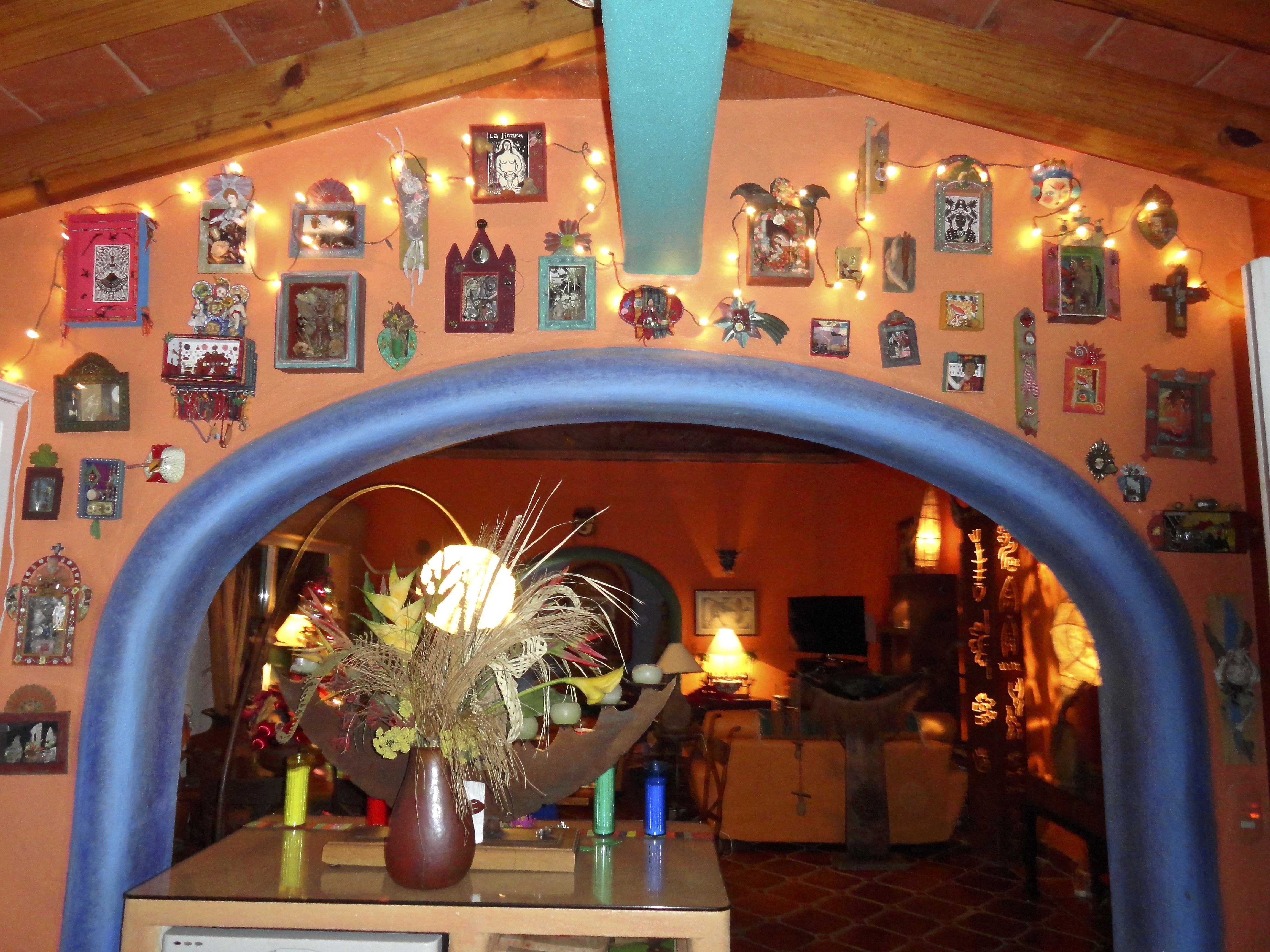
Over the past year, I have started to feel so encumbered by things that I feel like they are choking me.  Even my art-filled and carefully arranged house, which I love, has started to make me feel like I’m trapped in one of my own collages.

I once wrote that I like to do assemblage because it is an arrangement that is glued down so other people can’t rearrange it, but recently I’ve begun to feel like one of those objects.  I just can’t get myself unpinned from my present life.  It is not that there is anything terribly wrong about it.  Just that I no longer have a feeling of freedom..

Recently, I was asked what I would save if my house were on fire and I could only save five things.  My answer would be an album of childhood pictures, an album of pictures from Africa and Australia, my computer and two backup drives.  Then I’d put them in storage, buy a new computer and go on another trip around the world with no planned itinerary and no planned start or stop dates.

Why can’t I do this on my own?  Who knows why we let ourselves be controlled by things? Maybe it is because we know we can’t take them with us and so we strive to get as much pleasure out of them as possible while we can.  Perhaps it is because we fear that without things, we ourselves are nothing.  Perhaps it is because we cannot see that the beauty is within ourselves.  Perhaps it is because we fear that others give us value simply because of the things around us.

I once heard my eleven-year-older sister tell someone that she liked to visit her younger sisters because they both had such interesting lives and friends.  I felt so sad that she hadn’t said that she loved to visit me because I, myself, was interesting and loved.  I think this has influenced my feeling for her ever since.

My sister is now in the stages of dementia where pretty much everything has been taken from her.  She no longer knows what most common objects are for, but my niece recently told me that she had been given a life-sized baby doll that she holds and rocks and talks to and that the other day she called it Judy. I guess she waited too long to express any feelings of love she might have felt for me. Now, she is seemingly expressing that love toward an object when all these years she could have been expressing it to the person who could have returned it.  Is this what I’m doing by refusing to surrender the objects that fill my life?  Maybe it is time to find out.

DSC09458
The Prompt:  What five objects would you \save from your burning house?

New Word for the Day: Chronopromptophobia

New Word for the Day: Chronopromptophobia

Chronopromptophobia is the fear that your prompt will not be posted in time for you to write it before you need to get on with the day.

Etymology:  from the Latin roots chron: having to do with time;  prompt: to urge forward (ironically, this also designates  timeliness, as in “on time”); and phobia: fear.

The original term was coined in 2014/2015 when a major world blogging site experienced a series of breakdowns wherein prompts were either not published or were published so late in the day that the world economy suffered from the number of bloggers who called in sick to work to enable them to sit home and check every few minutes to see if the prompt was posted.

The Prompt: Play Lexicographer–Create a new word and explain its meaning and etymology.In response to The Daily Post’s writing prompt: “Play Lexicographer.”

South Dakota Gumbo

South Dakota Gumbo

When the rains came in hot summer,  wheat farmers cursed their harvest luck, for grain sodden by rain just days before cutting was not a good thing; but we children, freed from the worry of our own maintenance (not to mention taxes, next year’s seed fees and the long caravans of combines already making their slow crawl from Kansas in our direction) ran into the streets to glory in it.

We were children of the dry prairie who swam in rivers once or twice a year at church picnics or school picnics and otherwise would swing in playground swings, wedging our heels in the dry dust to push us higher. Snow was the form of precipitation we were most accustomed to–waddling as we tried to execute the Xs and Os of Fox and Geese bundled into two pairs of socks and rubber boots snapped tighter at the top around our thick padded snowsuits, our identities almost obscured under hoods and scarves tied bandit-like over our lower faces.

But in hot July, we streamed unfettered out into the rain.  Bare-footed, bare-legged, we raised naked arms up to greet  rivers pouring down like a waterfall from the sky.  Rain soaked into the gravel of the small prairie town streets, down to the rich black gumbo that filtered out to be washed down the gutters and through the culverts under roads, rushing with such force that it rose back into the air in a liquid rainbow with pressure enough to wash the black from beneath our toes.

We lay under this rainbow as it arced over us, stood at its end like pots of gold ourselves, made more valuable by this precipitation that precipitated in us schemes of trumpet vine boats with soda straw and leaf sails, races and boat near-fatalities as they wedged in too-low culvert underpasses.  Boats “disappeared” for minutes finally gushed out sideways on the other side of the road to rejoin the race down to its finale at that point beyond which we could not follow: Highway 16–that major two-lane route east to west and the southernmost boundary of our free-roaming playground of the entire town.

Forbidden to venture onto this one danger in our otherwise carefree lives, we imagined our boats plummeting out on the other side, arcing high in the plume of water as it dropped to the lower field below the highway.  It must have been a graveyard of vine pod boats, stripped of sails or lying sideways, pinned by them.  We imagined mind soldiers crawling out of them and ascending from the barrow pits along the road to venture back to us through the dangers of the wheels of trucks and cars.  Hiding out in mid-track and on the yellow lines, running with great bursts of speed before the next car came, our imaginary heroes made their ways back to our minds where tomorrow they would play cowboys or supermen or bandits or thieves.

But we were also our own heroes.  Thick black South Dakota gumbo squished between our toes as we waded down ditches in water mid-calf.  Kicking and wiggling, splashing, we craved more immersion in this all-too-rare miracle of summer rain.  We sat down, working our way down ditch rivers on our bottoms, our progress unimpeded by rocks.  We lived on the stoneless western side of the Missouri River, sixty miles away. The glacier somehow having been contained to the eastern side of the river, the western side of the state was relatively free of stones–which made for excellent farm land, easy on the plow.

Gravel, however, was a dear commodity.  Fortunes had been made when veins of it were found–a crop more valuable than wheat or corn or oats or alfalfa. The college educations of
my sisters and me we were probably paid for by the discovery of a vast supply of it on my father’s land and the fact that its discovery coincided with the decision to build first Highway 16 and then Interstate 90.  Trucks of that gravel were hauled  to build first the old road and then  the new Interstate that, built further south of town, would remove some of the dangers of Highway 16, which would be transformed into just a local road–the only paved one in town except for the much older former highway that had cut through the town three blocks to the north.

So it was that future generations of children, perhaps, could follow their dreams to their end.  Find their shattered boats.  Carry their shipwrecked heroes back home with them.  Which perhaps led to less hardy heroes with fewer tests or children who divided themselves from rain, sitting on couches watching television as the rain merely rivered their windows and puddled under the cracks of front doors, trying to get to them and failing.

But in those years before television and interstates and all the things that would have kept us from rain and adventures fueled only by our our imaginations, oh, the richness of gumbo between our toes and the fast rushing wet adventure of rain!

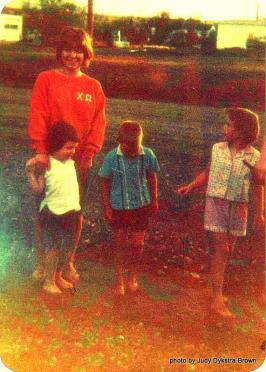
Writer’s note:  I know my sister Patti is going to read this and cry, and so I want to present you with this mental picture of her, college age, Levi cuffs rolled up above her knees, surrounded by five-year-old neighbor kids, enjoying her last big adventure out into the ditches of Murdo, South Dakota, during a July rain.

But wait!  A mere two hours of digging and another hour of editing has produced this proof of my former statement, so to augment your mental image, here is the real one:
Patty in mud 001-001

Not quite the gusher depicted in the childhood vignette, but nonetheless, Patti’s final puddle adventure. She had taken my visiting niece out. The next day the neighborhood kids rang our doorbell and asked my mom if Patti could come back outside to play! Ha.

The Prompt: Free Association–Write down the first words that come to mind when we say . . . home. . . soil . . . rain. Use those words in the title of your post.
Enough’s Too Much

Enough’s Too Much!!

Enough’s too much when it comes to fish
or any other smelly dish.
Too much for castor oil in spoons
or relatives on honeymoons.
Amoebas?  Any one’s too much,
and a date who wants you to go Dutch
clearly tells you he’s not “it.”
One mosquito, when you’re bit,
is not “enough,” but “one too many.”
when your preference is “not any!”

Kids with colds and snoopy neighbors,
tiresome chores and heavy labors,
bitter pills and jerked-off scabs,
rainy days with no free cabs,
diarrhea, scabies, gout?
Too much! Too much, without a doubt!
“Enough’s enough” is repetitious,
obvious and almost vicious.

So don’t go spouting it at me.
I hate cliches from A to Z.
I won’t have any said to me.
If you use them, you’re dead to me!
“It is sufficient” I will accept.
“I’ll have no more”  is most adept.
But don’t go muttering platitudes
at folks like me with attitudes,
or I promise we’ll be getting rough
enough to prompt, “Enough’s enough!”

In response to The Daily Post’s writing prompt: “Enough Is Enough.” Wow, this sounds so grouchy.  It is meant tongue-in-cheek.  I’ve probably used the phrase hundreds of times myself—usually directed at myself when I have lost my keys or glasses for the dozenth time that day!

Once Upon a Lime in Mexico

Once Upon a Lime in Mexico

I was just a small amoeba living on a lime,
and though Judy disinfects her fruit every single time,
I fear that the bartender doesn’t bother to
so that is how the tale occurred that I am telling you.
She squeezed her lime above the ice, then dropped it in the drink.
The Coca Cola fizzed up and the ice began to clink.
As she took her first big swallow, I lost hold of the lime
and slid down a soft pink chute into another clime.

I’d heard of other journeys and knew how this might end,
but I decided I’d enjoy every curve and bend.
I wound up in a reservoir where I gave in to sleeping,
but woke up to a million of me jumping, kicking, leaping.
It wasn’t half so pleasant as it had been before,
so I commenced to swim around, looking for the door.
Unfortunately, though I found it, it seemed to be blocked.
The wind was brisk, the waters churned, but the way out was locked.

When I heard the one who had consumed me groan and cry and cuss,
I rued the fate to which that Cuba Libre had doomed us!
For as distressed as she must be with headache and each cramp,
I was suffering equally from jostling and the damp.
For two days she lived on Electrolit, in bed and with no food.
And I held on for my dear life, listening to my brood
tell of what we could expect, flushed to a watery hell
down in the earth with all our kin—this legend they knew well.

Two days I lived like this, just holding on for my dear life,
listening to her pleas as spasms cut her like a knife—
too ill to go for help and unable to even sit.
I wondered how much worse this grisly tale was going to get.
Then suddenly, this morning, I felt the waters swirl.
I felt myself slip-sliding right out of the girl
into a clear container where I could see the world
from prison I’d once more escaped, or rather, I’d been hurled!

I felt the jostling and the engine of the moving car
which set up small vibrations in my little jar.
Yet still my progeny and I enjoyed the five mile ride.
It was so much better now that we were not inside
that dark and windswept place where we’d resided for two days.
Though I’ll admit none of our legends accounted for this phase.
No other amoebian Aesop had written any story
that took a turning such as this. Former endings had been gory!

I heard the car door open, footsteps and a creaking door.
Other footsteps, blinding light, and I was freed once more!
Spread onto a sheet of glass, surveyed by a big eye,
I breathed a sigh of pure relief. I’m such a lucky guy.
While they weren’t looking, I slipped off and landed on a shelf
where ever since I’ve been observing others like myself
who have escaped amoeba hell at least for a small time.
While I’m in amoeba heaven, and my dears?  It is sublime!!!

So clean, well-lit and active. Just like a picture show.
I sit here so languidly and just go with the flow,
calling out encouragement to visitors like myself.
And now and then, others come and join me on my shelf.
The girl who works here likes to put her sandwich very near,
where it serves as a good cushion for those of my kind, I fear.
The moral? Take care what winds up inside you, please, my friends;
for in spite of all my warnings, this story never ends.

In response to The Daily Post’s writing prompt: “Once Upon a Time”—tell us about something that happened to you in real life last week — but write it in the style of a fairy tale.

Sorry, friends, this one is another groaner!!!!