Category Archives: Poem

Swarm

Swarm
It’s the dance of the bees with drone after drone

leaving the hive and the queen on her throne.
Carlos the Bee guy seems most disconcerted,
and I wish that we had been sooner alerted.

The air’s raining bees. They are buzzing and winging
into my gazebo and soon might be stinging.
We leap from the hammock, Morrie and me.
He’s licking his nose and I’m slapping my knee.

We run for the house with one bee giving chase.
Its wings scrape my ear and my arm and my face.
We get to the house before it gets mean,
but again and again, it butts into the screen.

Honey is sweet and well worth its labors,
but creatures that make it do not make good neighbors.

When I tried to hire someone to clear off the empty lot I own next to my house, they ran into a problem—two hives of aggressive bees that made clearing the land impossible. Carlos the dreadlocked bee keeper is coming today to remove the combs of one hive that is reachable and to trap the bees to move to his own apiary, but when he came to check out the situation yesterday, the event described in the above poem occurred. He’s back today, and Morrie and I are going to stay inside!!!

Prompts today are dance, drone, raining and disconcert

This photo and all photos without attribution on this blog have been taken by me.

High School Commencement, 2020 Style

     muhammad-rizwan-VnydpKiCDaY-unsplash Used with permission

High School Commencement, 2020 Style

Here in Coyote Valley, we’ve had a small preview
of just what can happen when the world has gone askew.
High School Graduation might have gone without a hitch.
A certain senior’s choice of clothing was the only glitch.
When he approached the platform, parents nearly had a stroke.
His classmates simply had a laugh. They all enjoyed the joke.
His Hazmat suit was timely, though his mortarboard was tilted.
It beat the valedictory speech, which was a little stilted.
Thus Billy Jenkins pulled one over getting his diploma.
First the face mask and what with the principal’s glaucoma,
he missed the fact of who he had just handed an escape
from another year as senior without the dread red tape
of actually passing history, keyboarding or biology.
English, math or woodshop, PE or sociology.
Without opening a single book, Billy counted coup.
Add this to the statistics. COVID-19 got him through.

Prompts for today are coyote, valley, graduation, stroke and preview,

The Upstairs Room: NaPoWriMo 2020, Day 28


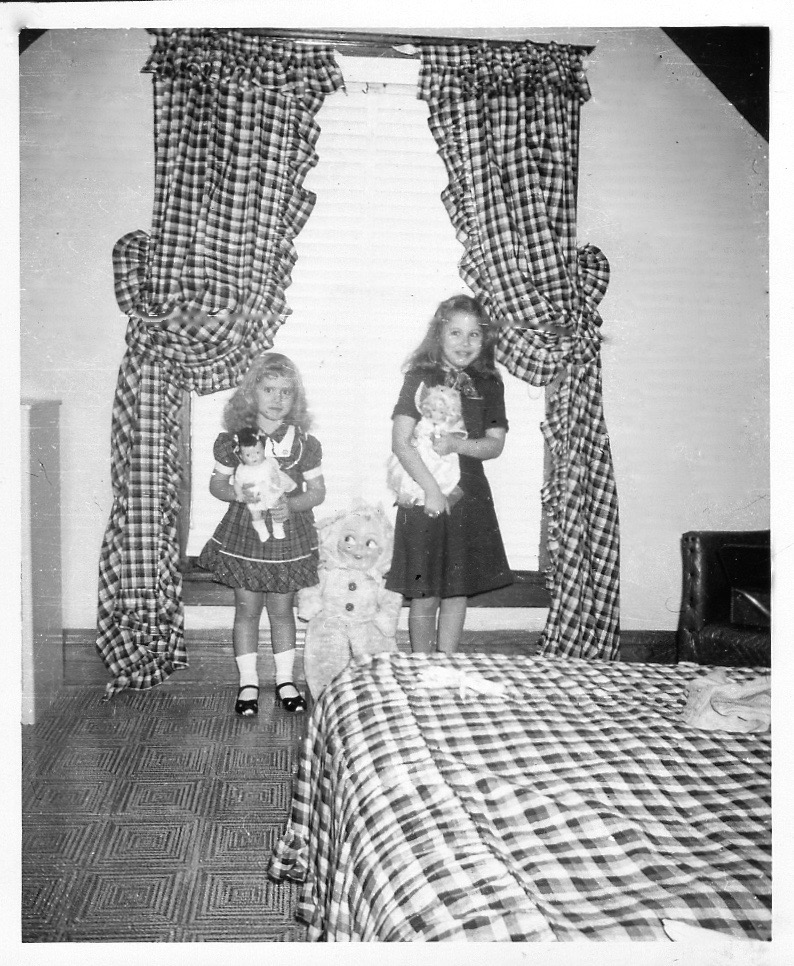
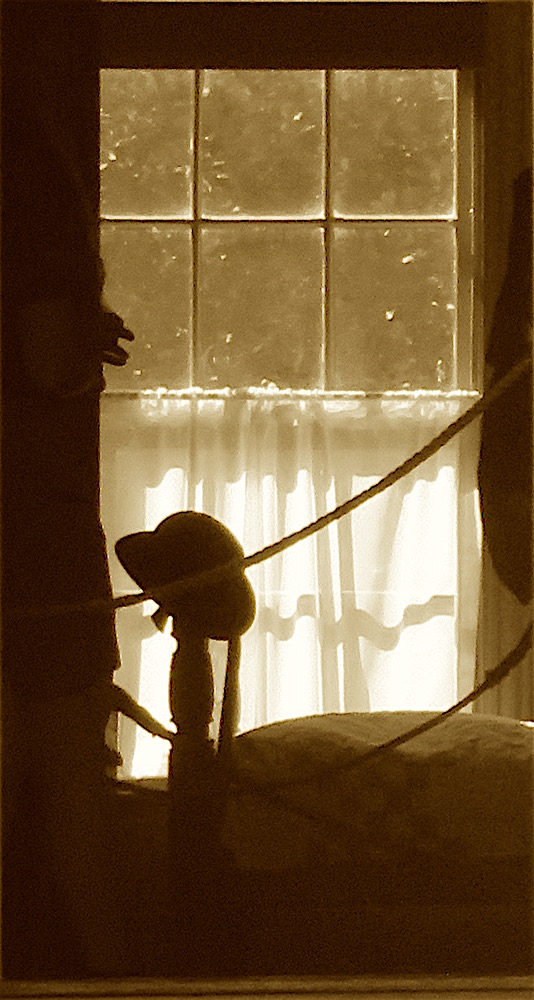
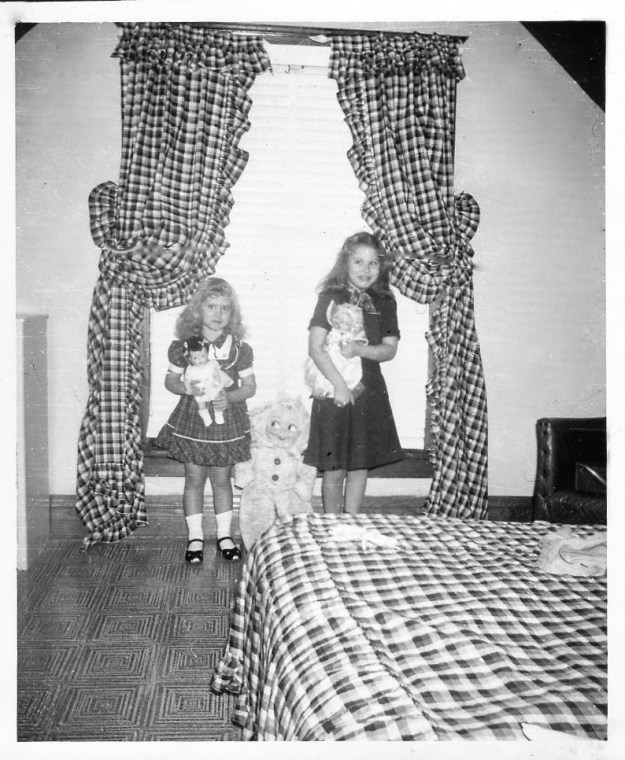
This is my older sister Patti and I in our oldest sister Betty’s room. Not the room next to it described below, but they both had dormers and the spread and curtains were the same–except mine had big yellow roses in place of checks. Her windows look out over the playground and elementary school across the street. Mine looked out on the road up to the high school.

The Upstairs Room

Through living room and dining room and kitchen to the mangle,
turn left and left again and then we’d have the stairs to wrangle.

The window in the upstairs hall streamed down shafts of light

sliced open by the balusters that overlooked the flight.

They created different angles at different times of day,
as though they were the playground where the sun had come to play.

Sometimes I climbed them slower at the end of day.

Sometimes I climbed them sleepily with toes feeling the way.

Often I went faster, avoiding Mom’s fly swatter
as she threatened more than swatted, this errant, sassing daughter.

Up the stairs and to the right—my dormered cheery room

with floor to ceiling windows that dispelled any gloom.

Between the angled dormers, meeting in a V,
was the room I always wanted, so that V spelled victory.

Linoleum I picked myself, bright green across the floor.

Soft yellow above it: ceiling, walls and door.

Flower-adorned bedspread—white with yellow roses.
Propped against its pillow shams, dolls in different poses.

A vanity with arms that spread to show the drawers inside

covered with a ruffled skirt that was my joy and pride.

It matched the tie-back curtains that matched the rose-decked bed.
It was the perfect dreamed-of room that danced inside my head.

Up there with my sisters, my nursery downstairs changed

into a brand new dining room with lots of chairs arranged

around a long wood table we used for holidays
beneath that upstairs window where I now sat and gazed

at high school boys returning from games of basketball

in the high school up the road, Doc Murphy out on call,

big kids playing ditch ’em or other kids on bikes,
teenagers with hot rods, toddlers pedaling trikes.

A sweet pea bush climbed up the wall and a trumpet vine,

trying to get up to share this room that I called mine.

Lonely sometimes upstairs in a night that never ends—
one sister still out at the dance, the other at her friend’s.

Robbers in the walls that daddy said were mice,

but they were robbers in my dreams, more than once or twice.

Scary noises in the street. Big boys walking by.
Wondering where folks really went when it came time to die.

Nice when my oldest sister finally came on home

and climbed in bed beside me so I was not alone.

“Scratch my back and I’ll scratch yours,” she promised every time,
then fell asleep before my turn—that sneaky sister’s crime.

Other houses, other rooms. So many in my life.

As a teen, in college, as a lover, as a wife.

Every room was special but none quite like the first—
that big girl room that quenched a youngest sister’s thirst.


For NaPoWriMo today, the prompt was to write about a room from our past.
Street Smarts: Flo Educates the Ivy League

Street Smarts: Flo Educates the Ivy League

Slip me a quarter, flip me a dime,
and you’ll still have your meal in the usual time.
When the diner is full due to inclement weather,
and your rowdy squad descends all together,
understand that you’ll just have to wait your fair turn
or the fries will be soggy and the hamburgers burn.

I  have a hunch you’re an ivy league boy—
a chip off the old block, your mom’s pride and joy,
but when you come slumming to this side of town,
it’s best that you play your fancy side down.
We don’t cotton to folks who think they’re our betters
or cater to jocks with their varsity letters.

Some day you’ll no doubt be someone of renown
with your designer suits or your medical gown,
but for now you’re a kid sitting there on a stool—
a self-declared prince with no country to rule.
So shut your damn mouth. Move to that empty table,
and you’ll have your burgers as soon as I’m able.


Prompts today are quarter, understand, squad, hunch and street.

Contemplating the Letter “C”


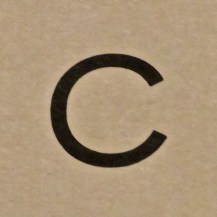
                                             The Letter “C”

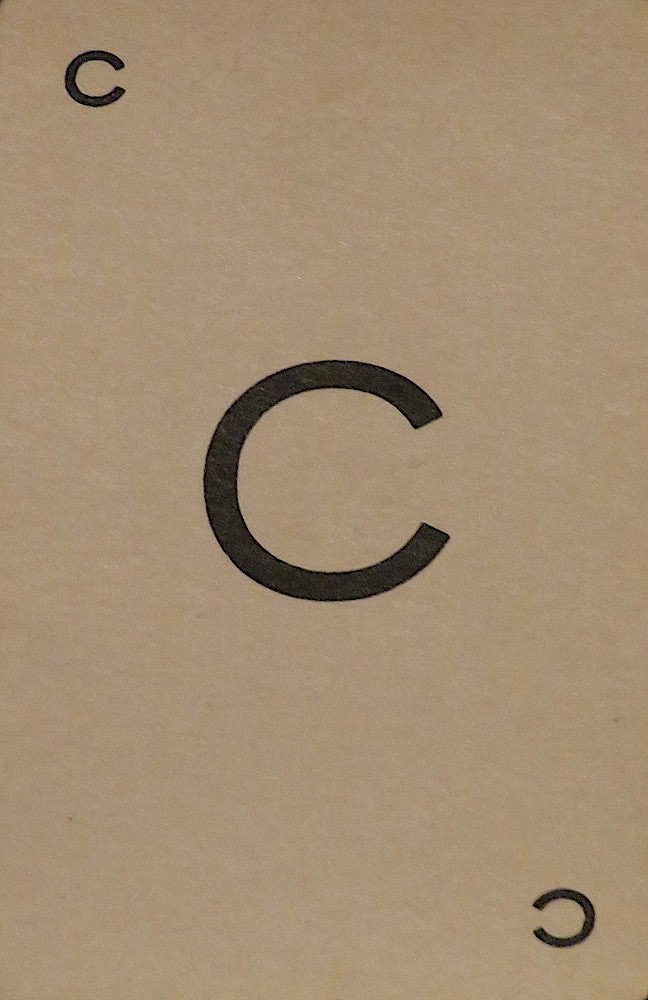
Here’s to the letter “C” that marks what is in the middle.
Somewhere between “A” and “F,” it has been known to fiddle.
While “A” studies most diligently, “C” is bound to shirk.
It has a certain phobia regarding too much work.
It’s head and shoulders above “F” and far better than “D.”
Nobody ever flunked a course by maintaining a “C.”

And yet it calls no sound its own. It’s either “K” or “S.”
At birthday time,  we’re given kake and winning brings suksess.
We’re stopped dead in our trases. When we’re kissed, it’s a karess.
Why “C” has no sound of its own, not one of us kan guess.
When the sirkus komes to town, it’s happened onse or twise
that the krokodiles eskape. It isn’t very nise.

Townfolks run and skurry—skared as they kan be,
for katastrophes kan happen when krokodiles run free.
It isn’t too konvenient, as you kan klearly see
to be a kurly letter the likes of letter “C”
that’s firmly in the middle, with no sound of its own.
Does “C” dream of being “S” when it’s fully grown?


For NaPoWriMo 2020, Day 23, the prompt was:

“to write a poem about a particular letter of the alphabet, or perhaps, the letters that form a short word. Think about the shape of the letter(s), and use that as the take-off point for your poem. ”

While I’m thinking of a new letter poem, I’m publishing this reblog of one I wrote that meets the prompt two years ago. As you ponder “C,” I’ll be Pondering the Possibilities of the Perfect other alPhabetic subject–maybe “P.”

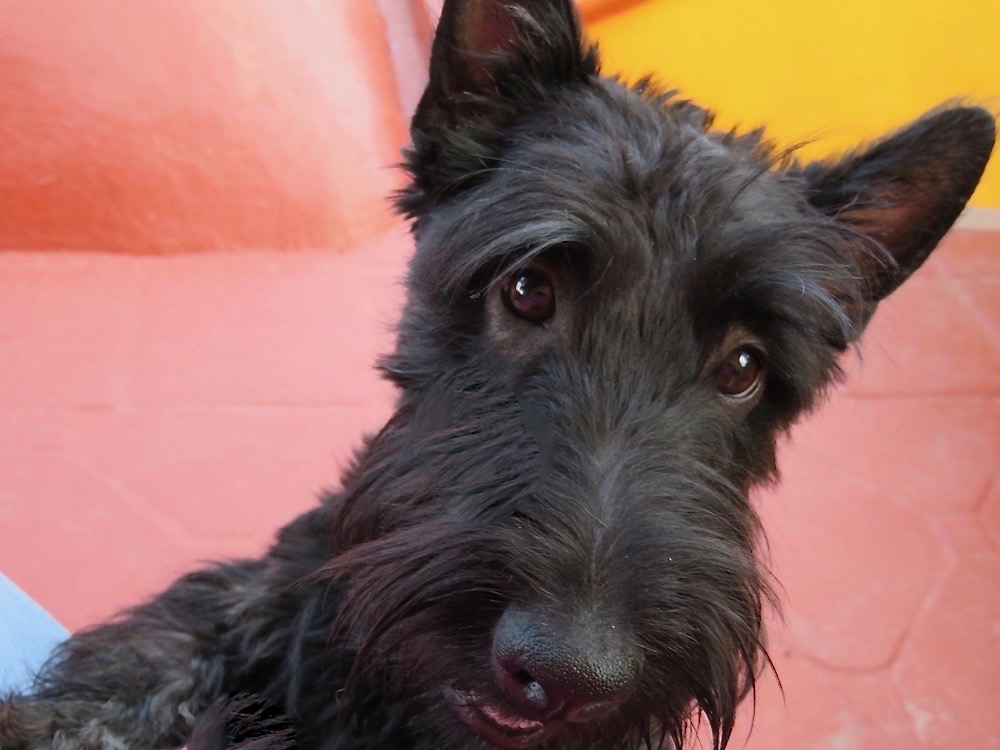
Morrie

Morrie

He displays such fierce bravado, barking at the man
who dares to try approach me. He’ll bite him if he can.
If he does not get his nuance, perhaps he’ll get his grasping.
If he can’t heed the exposed teeth, perhaps he’ll get their clasping.

If that human could but read the globes of Morrie’s widening eyes,
he’d need no communication in any other guise
from this dog that has decided he is his only rival
for his mistress’s affection. Every time, there’s a revival

of his barking and his lunging should this man dare approach me.
It’s as though he fears he’s coming with intentions to come poach me.
With everybody else, he is a charmer through-and-through.
He cannot wait to make a friend of anyone who’s new.

His emotions are a crazy-quilt of trying hard to please—
of greeting you with ball in mouth and jumping at your knees.
He cannot wait for you to sit to jump up on your lap
and insists on long ear rubbings before he takes a nap.

He’s every visitor’s best friend. Greets strangers on the beach,
and will bring a ball to anyone he finds who’s within reach.
Never will he wear out when chasing after balls.
He goes to bed when I demand and answers all my calls.

But why he feels my gardener of nineteen years duration
is a threat to me, and such a threatening aberration
that he flies to my defense whenever he is near,
is a mystery that I’ve not solved, and never will, I fear.


Prompt words today are bravado, globe, quilt, nuance and grasping.

Speaking in Tongues: NaPowWrimo 2020, Day 21

 
For the NaPoWriMo prompt today, we were to find a poem written in another language we do not know and to write a poem according to what we thought it meant. Here is my translation of a poem by a poet from the Netherlands. Her original and a true translation follow.

Messages in Bottles

Messages they send out to the world in bottles
(those they think up as they stir their morning cups of chocolate)
—beware their dangers.
These messengers have hands that can slap you awake,
then abandon you as they return to the problems of the privileged rich.These parasites, dosed with their vitamin B, ride roughshod over their hosts.

They linger in their beautiful dreams of percentages,
profit on the hunger of the poor.
They see not your skeletons when they look in the mirror.
They do not see the hearts they have broken.
Once, surrounded by the stricken, they put their fingers in their ears
and pretended they were evangelists to the poor.
Then, their illusions shattered by going door-to-door, they slammed doors shut again.

Their messages in bottles are swift to flow away.
The ocean has no doors to slam in their faces.
And their heads bent in prayer will not open those doors they have closed.
The ballast their bottles carry does no good.
The hunger of the world has no stake in the good books they carry.
The mood of their verses is malevolent. The vows they swear
are words in a wind that has come too late.
                                                                 –Judy Dykstra-Brown, April 21, 2020
Below is the poem in  Dutch, its original language—the language  my grandparents and father grew up speaking. I know about 5 words in it–and the alphabet!

GROUND CONTROL

Meisje van botten en pezen praat een wereld
aan elkaar van ’s avonds drop en chocola
de rijst voor straks bewaren, dagelijks
een handje noten voor het slapen en alleen
geen kaas vanwege mogelijke huidproblemen.

Heeft het over parasieten, vitamine B, genetisch
aangejaagde schommelingen in haar percentages
vet op water. De honger heeft het laatste vlees
van haar skelet gegeten en nu lukt het niet meer
om haar vast te pakken zonder haar te breken.
Onze enveloppen met de stokken, potten pindakaas

en preken neemt ze met een glimlach in ontvangst en
spoelt ze daarna ongeopend door haar lievelings-wc.Meisje van botten en pezen zweeft bij ons vandaanen wij, gebonden door de zwaartekracht, kunnen alleen
nog van beneden naar haar roepen dat ze haar verloren
ballast altijd terug omhoog mag hijsen, dat het nooit
te laat is om het hongeren te staken, een buik te kweken
om moed in te verzamelen, een vrouw van gewicht
te worden en de wind de wind te laten.
                                                         
                                                       —© 2018, Gerda Blees Uit: DwaallichtenUitgever:                                                                                    Uitgeverij Podium, Amsterdam, 2018.


And here is a translation into English of the above poem. I did not read this translation until after I had written mine. Obviously!! But, it is interesting that the idea of hunger did come across, somehow, although my poem is in an expanded world context whereas her poem about anorexia is very personal. I prefer hers!

The prompt for NaPoWriMo 2020 day 21 was to find a poem written in another language that you do not know and to write a poem about what you think it says.

Tableau

Tableau

She found him obnoxious, he found her inane.
Their thirty-day marriage, suddenly insane.
Both were fatigued by exhausting routine.
The breakfast, the paper, the washing machine.
A giant moth fluttered, beating the screen
and the window glass— imprisoned between.
The cryptic message it beat with its wings
sang of detachment and other sad things.
Both heard its struggles and both moved to free
anxious to end at least one tragedy.
Her hand touched the clasp and his moved the screen.
The moth vanished into the fresh morning green.
A brush of his knuckles on the hair of her arm,
his gentle reminder that he’d meant no harm.
Her turning toward him, a touch and a kiss.
Their world straightened out with nothing remiss.
A silent tableau—solution with no words.
A moth soaring free. A chorus of birds.


Word prompts today are flutter, screen, obnoxious, cryptic and routine.

Empty Spaces

mathew-schwartz-4GXtM_XR5zo-unsplash

Empty Spaces

The world has stilled its hectic pace, although its clocks tick on.
We stand at windows peering out, imagining what’s gone.
Rapid passings night and day, our reachings and attainings
have made way for the meantime to leave us our remainings.
There is a little secret the Swiss learned long ago
that has to do with leaving space—the worth of going slow.
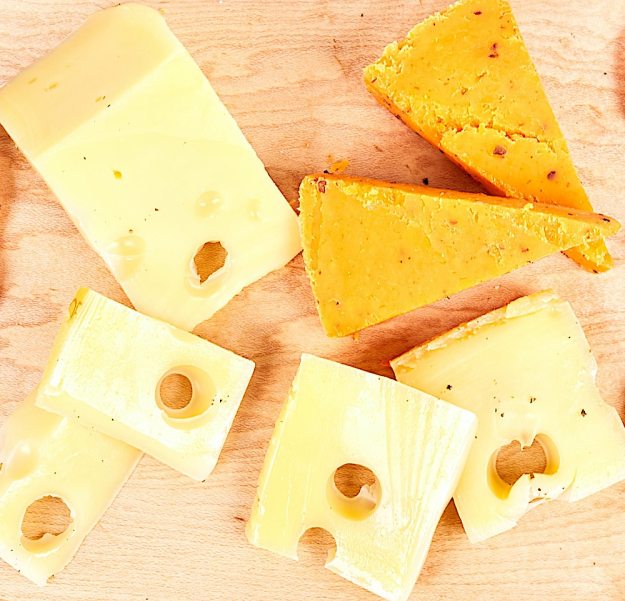
Their cheese that is the richest is full of empty spaces—
its flavor made the tangier by what nature erases.
The holes are not just emptiness, for factors that have made them
create a richer cheese than the cheeses that evade them.
The blocks with larger spaces have a better taste.
In short, the empty room they leave is anything but waste.
Perhaps it is the same with the new spaces in our lives.
Perhaps the empty spaces are where the meaning thrives.

Note: Holes in Swiss cheese are created by the bacteria which change milk to cheese. Propionibacterium uses the lactic acid which is produced by other bacteria, and produces carbon dioxide gas; the gas slowly forms bubbles which makes the holes. In general, Swiss cheeses with larger eyes have a better taste.

Prompts today are Swiss, hectic, attain, secret and clock. Image by Mathew Schwartz on Unsplash. Used with permission.

Leavings: NaPoWriMo 4/19 2020

OLYMPUS DIGITAL CAMERA

Leavings

Do I walk the long kilometers of beach
to look for the next shell
or stand stable, like that woman
casting and recasting her hook,
patiently waiting to pull her world in to her?

I’m gathering things
that I’ll collect into stories–
pinning them down to use like words.
Nothing wrong in finding meaning
through a piece of driftwood, a stone or shell.
Objects are only things
we cast our minds against
like images against a screen—
a shadow glimpsed crossing a window shade.

My shadow cast in front of me
is such a different thing
from one I cast behind.
In the first, I am constantly hurrying
to catch up to what I’ll never catch up to.
In the other, I am leaving behind
what I can only keep by walking away from it.

I take this place along with me in clear images–
not as they were, but as my mind has cast them;
so every picture taken of the same moment is different,
each of us seeing it through our unique lens.
We cast these things in bronze or silver-gelatin,
stone, clay or poetry.
A grandma holds out pictures of her children
and her grandchildren. See? Her life’s work.
And then this and this, without further effort on her part.

I share stories of children I don’t know
who gently unwind fishing line from a struggling gull,
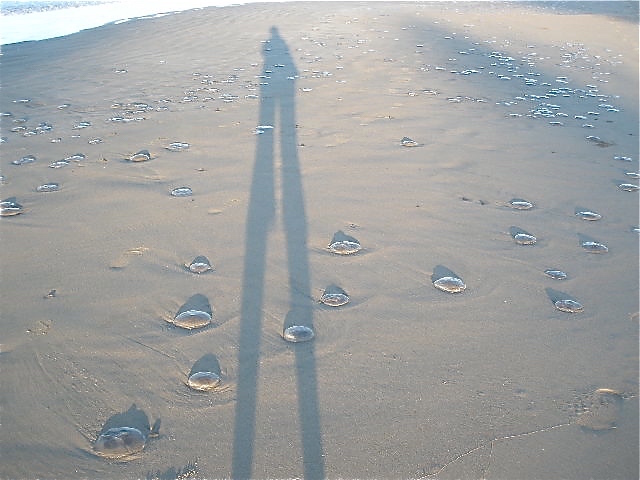
of a minefield of jellyfish found on the beach
or other treasures nestled in a pile of kelp.
I find my world in both these findings and departings—
the leaving each morning to go in search of them
the part I find most exhilarating,
perhaps teaching this woman
of the death-themed night-terrors
not to worry,
that leaving is just a new adventure.

People forget and let me slip away
when I would have held on, given any encouragement,
yet fingers, letting go,
flex for that next discovered treasure.

Life is all of us letting go constantly—
taking that next step away from and to.
A white shell. I have left it there
turned over to the brown side,
so someone else can discover it, too.


The NaPoWriMo prompt today was to take a walk and collect objects to turn into a poem.