Category Archives: Poem

Typical

Typical Day

Bark of dog,
Meow of cat.
Mama-san
takes care of that
with pop of can
and clink of dishes.
After solving
all these wishes,
back to bed.
Write my blogs.
Out of bed.
Put on togs.
Make a smoothie.
Read E-mail.
Into town
for writers’ meetings.
Lots of words
and lots of greetings.
Home again
to write some more.
Pepe’s ringing
at my door.
Once a week
a heavenly rub.
Body restored,
soak in the tub.
Pat the cats,
throw balls for Morrie.
Write some more,
the same old story.
Talk to Dux
many a time
throughout the day.
Sometimes  with rhyme.
Midnight finds me
in the pool
under stars
and Morrie’s rule.
Throw the ball
for him to fetch.
Exercise, then
reach and stretch
to retrieve the ball
he throws at me.
Then loft it over
bush and tree
to lower garden
for him to find.
This is our nightly
pool grind.
Go in to bed
to write some more.
Get up to check
I’ve locked the door.
Other events
often occur.
Trips to the vet
to trim or cure.
Coffee with friends,
or dinner out.
trips to the shore,
without a doubt.
Lives grow and change
often with time.
So this is just
the paradigm.

The prompt word today is typical.

Restart


IMG_7717

Restart

Every tortured ending, every tearful parting
may simply be the means to another soul’s restarting.
Freshening up our memory, clearing off the clutter.
Making our way simpler, like a warm knife cutting butter.
Why do we fuss and bother? Why do we tear our hair
when we’re suddenly a single after being a pair?
Another game has started—to find each other again
in another life or this one. How can we know when?
Life is an adventure, a continual seeking
full of little wrinkles in need of constant tweaking.
We’re blind to the whole of it, but often get a peek
to help us find the goal that we are meant to seek.
We are the markers in a game whose players we don’t know—
impetuously wishing the game were not so slow.
We want to know our endings and what we will be getting
when in truth each ending will just be a resetting.


IMG_8476


The prompt today is restart.

Jar of Hearts

IMG_8473

Jar of Hearts

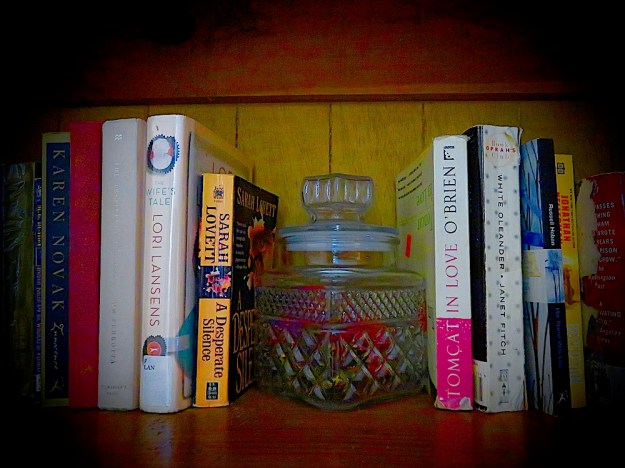
When I came into the room
the bookcase, too heavily laden by far,
had tipped and spilled our picture to the floor.

Its glass gathered with a broom,
the torn remains of us now saved here in a jar
I have neatly filed between fantasy and lore.


The “assignment” is to write a poem depicting a certain emotion or feeling without naming the emotion. And for the readers to say what emotion or feeling is being depicted in their comments. I have done my part, now you do yours!!! For dVerse poets pub

Burn


IMG_8175jdbphoto 2/18

The sun has burned the day away
and set the sea  on fire
turning a glowing pathway
into a funeral pyre.
She, too, has left her day behind,
shed like a soiled dress.
What tomorrow holds for her
She has no need to guess.

A quadrille on the prompt “burn” for dVerse Poets.

For Country School Children Perished in the Prairie Blizzard of ’52

For Country School Children Perished in the Prairie Blizzard of ’52

Cruel winds dispersed the swirling white
to cover up the prairie light.
They felt its cruel keening bite
clinging to them, clear and bright
as they, too, disappeared from sight.

By the time the storm had reached its height,
not one survived to tell her plight.
They found them on that snow-banked night—
arms raised aloft with hands held tight—
two sisters lost to nature’s might.

I had heard the story of the two little Judd girls who froze to death attempting to get home from their country school just North of my home town of Murdo, South Dakota, when a blizzard hit, but I had always thought it happened long before I was born.  In checking the facts, however, I discovered it was during the blizzard of ’52, when I was four years old—the same blizzard I’ve described twice on my blog. No electricity, my dad trying to get to his cattle to break the ice on their water tanks, all of use sleeping huddled around the fireplace in the living room, tunneling down main street to get into stores, stepping out of my second-story window onto a snowbank. My parents must have shielded me from the story of the two little girls—one three years older than I was, the other my sister’s  age—until I was older, although my sister Patti, who is four years older than me, has since told me she knew at the time and that she had played with the two little girls at the home of their cousins, who lived in town. Here their story is told briefly, in two five-line stanzas. The prompt from dVerse Poets was to write a five-line poem. So, I cheated a bit.

She Always Sleeps with the Radio On

My sister Betty, ages three to seventy three


She Always Sleeps with the Radio On

Each night,
      as I negotiate
              the squeaky stairs
                   from her attic guest room
           down to the bathroom
     one more time,
I hear the voices.

I imagine them as her companions,
    drowning out night sounds,
        freeing her mind from its hard task
of remembering.

Tonight, she sits on a lawn chair
on the grass. I sit on the front steps,
listening
   to a friend on the
     steps next to me, strumming, strumming,
as my sister and I sing along
in high school harmony.

The little girls across the street
       are the first to come,
       tiny lawn chairs in arms,
  to plop themselves in front of us
for the concert.

As they settle, my sister says,
“Now, back to the music.”

Moments later, their mother follows,
   bringing initial happy news
       of their upcoming trip
to a lake where last year
a teenage girl had been abducted,
         a segue to more disturbing news
of yesterday’s daylight intruder
flushed from a house a block away.

I’d noticed
    the police car
       circling, puzzled
           by his vigilance as we walked
      the neighborhood today.
 I’d smiled at the man on the bike who didn’t look
      a part of this neighborhood, wondering how he’d fare,

but now I feel the threat of him.

“House of the Rising Sun,” stops dog-walkers in their tracks
  as the litle ones
     sit on the sidewalk
         stringing beads I brought,
capturing this night
to hang around their necks:
gray plastic elephants,
            pink stars,
                   orange hearts,
                           green dolphins strung midleap
on sparkly purple cord.

This night strings us all together:
                  beads, words, music, the night sounds
of insects and frogs,

                                                 happy stories interspersed with fearful ones,
traffic from the busy street one block away.
             Hungry mosquitoes,
                    gathering suddenly,
are what break us apart.

     As we climb the stairs,
             her door
                        next
                            to the only
                                   bathroom
                     in the house
              closes.

For the first time 
    in the week I’ve been here,
          I hear no radio
                on my nightlong explorations
down the stairs.

At ten o’clock, 1:30 and 3,
          the hall outside her bedroom
                         stays silent,
          this evening’s full company
flooding over into the night.

We have exhausted her mind, filled it, worn her out.
           She stlll feels our presence.
                     
                                Four a.m.

A creaking door, and once again,
          silence becomes
        a cup for her to fill.
            Something is needed
to relieve worry—
to leave no room
    for either remembering
  or the lack of it.
I hear them then, insistent, down the stairs and in the hall.

                       Voices all night long.


The prompt word today is insist.

Deep Voice


DSC09534jdbphoto


Deep Voice

The stranger on an airplane in the seat next to me
never said a single word, and so I let her be
until our arrival, when I prepared to stand
and she produced a paperback—put it in my hand.

“It’s time for you to read this,” she said, then went away.
I didn’t say a word to her. Didn’t know what to say.
That book, however, changed my life and attitude and choices—
encouraged me to listen close to interior voices.

Buscaglia, Jampolsky and all of Carl Jung’s books
drew my mind away from appearances and looks
and into that finer world of instinct and of mind;
then drew me westward to the sea and others of my kind.

After a writer’s function, a stranger sent to me
“The Process of Intuition,” which I read from A to Z.
I read it twenty times or so, then sent it to a friend.
Then bought up every copy left to give as gifts and lend.

I don’t remember talking to the one who sent it to me,
but if I need a proof of faith, I guess that this will do me.
For I believe there is some force that draws the next thing through me
and if I follow instincts that hint and prod and clue me,

they are the truths that guide me on the path towards the new me.
The signs are there in all our lives if we choose to see.
No, I don’t believe a God guides our destinies.
I don’t believe in lifelines or spirits within trees.

I don’t believe in any faith that has a name or church.
I do believe, however, that I’m guided in my search
by something that unites us and sets our pathways right
so long as we listen to our own interior sight

that urges us to follow the right side of our brain
even though those choices are logically inane.
I know that it takes many types of brains to run the world,
but for me it’s intuition that when carefully unfurled

guides me best—towards art and words and unplanned days and oceans
and prompts me make a Bible of what others may call notions.
And so to simplify I’d say that I must have faith in
that voice we’re all a part of that speaks to us from within.


If you haven’t already viewed it, Word Press would not let me link to their Weekly Photo site yesterday, so please view also: https://judydykstrabrown.com/2018/02/08/tending-house/

This is a rewrite of a post from four years ago. The prompt today was simplify.

Bewildered: Gray Walls with Boxes


Gray Walls with Boxes

Once I knew words that fit together.
Now my mind still has the answers,
but rarely lets me in to find them.

People who seem to know me
bring pizza in a box
and we eat it in front of another box I’ve forgotten the name for––
a small world with other people moving in it that I don’t know.
Sometimes words appear in a ribbon on the bottom edge of that box
and I wonder if I understood them
if they ‘d tell me what I’m supposed to do.

On the walls are other flat boxes
with people frozen in them
and I think it is my fault.
There is something I am supposed to be doing.
“They are your pictures, Mother.
They’re there for decoration—
for you to enjoy,”
a woman tells me
when I ask her
if she’d like to take them
home with her.

I don’t belong here.
My high school boyfriend
must be wondering
where I’ve gone
and my daughter is as confused as I am,
claiming to be her own child;
and then one day my sister comes
and I have to laugh because they all
look so much alike—
my sister and her niece and her niece’s daughter
whom they try to convince me
are my daughter and my granddaughter––
so many layers of daughters
that it is too hard to keep them
all in mind.

But then that floats away
and I am trying to remember
when I am leaving this hotel
and I feel I’m not suited to run for president
although all those people
cheering at that big convention in that little box
want me to––
that little box they turn off and on each day,
sometimes before or after I’m ready
to have it turned off.

And they take me to that large room
where all those silent older people sit.
I do not want to go into this room,
but I am lucky, and we move through it.
Someone’s daughters have come to put me
into a box that moves us through the world
without walking. At first, I am so surprised by it,
then I remember what it is
but can’t remember the word for it.
As we sit in it, the world moves by
too fast, scaring me, and I try
to weep unnoticed.
But then they take me out of it,
give me popcorn
and lead me into a very large room
with many people sitting down
and an entire wall with larger people
moving on it, and it is so confusing, like déjá vu,
for I remember being in a room like this before,
but I don’t know if I’m supposed to
make them do something other
than what they are doing
or if I’m already controlling them with my thoughts
or if I’m supposed to be
up there on the wall with them.
I can’t remember whether these people
on either side of me are my sisters
or my children or strangers,
sitting chair after chair down the long aisle.

Most days, I am so sad all day long,
but sometimes my real self
comes to visit and I think,
how did I become a martyr like my grandmother
and why can’t I stop myself from crying, just like her?
One gray wall meets another at the corner
and I’m sure
that I am being punished
for things I did but can’t remember.

That blank face
in the mirror
has me in it,
but I can’t get out
and for a moment I know, then forget
that this is why I cry
and cry and cry
and cry.


I think the deep stage of bewilderment that Alzheimer’s brings us to is the biggest fear of many of us who are over the age of sixty.  I’ve written poems about earlier and later stages of this dread disease, but  this poem describes as closely as was possible for me the way my sister Betty seemed to be feeling at a couple of different stages of her dementia.  Her delusion that it was she who was running for president the year Obama was elected, her befuddlement over the television and later over the art on the walls, over the identity of family members, and finally her astonishment over being in a moving car and at the movies.  This may have marked the last time we took her out of the care facility where she still resides. I went to see her a few months ago and still plan to write about her present state. Anyone who has a loved one in some stage of this heartbreaking disease will know haw hard it is to imagine how they may be feeling and how equally hard it is to write about it.  That is why I keep putting it off. I’m running this poem again after five years because it seems to fit today’s prompt, which is bewildered.

Hard Transit

DSC08775

Hard Transit

My grandfather and his two teenaged daughters
drove a wagon to Dakota to claim a homestead.
I never asked how many weeks they traveled, or the hardships that they faced.
The young don’t know what answers they will wish for until it’s too late;
so only imagination serves to describe the heat,
day after day with no water except for what they carried,
coyotes, gray wolves and the glaring sun of the treeless prairie.
My aunts were just young girls dealing with the difficulties young girls face
in the sparsest of conditions. No mother. No outhouses.
The jarring ride—grasshoppers so thick the wagons skidded off the tracks,
and that loneliness of riding into
the emptiness of a strange world.

Now, I stand impatiently at the immigration window,
then the ticket line and the security line.
I empty pockets, discard water bottle,
remove computers from their cases, take off shoes,
raise my arms for the check,
struggle up the escalator with bag and purse,
find the right gate,
negotiate the walkway to the plane,
lift the heavy carry-on and lower myself into the too-small seat.
“Plane travel isn’t what it used to be,” my neighbor says,
and we console each other about how hard it is.
“Nine hours from Guadalajara to St. Louis—
a plane change and a three-hour layover in Atlanta,”
I grumble, and he sympathizes.


This is a rewrite of a poem I wrote so long ago that even I don’t remember it! The prompt today is sympathize. 

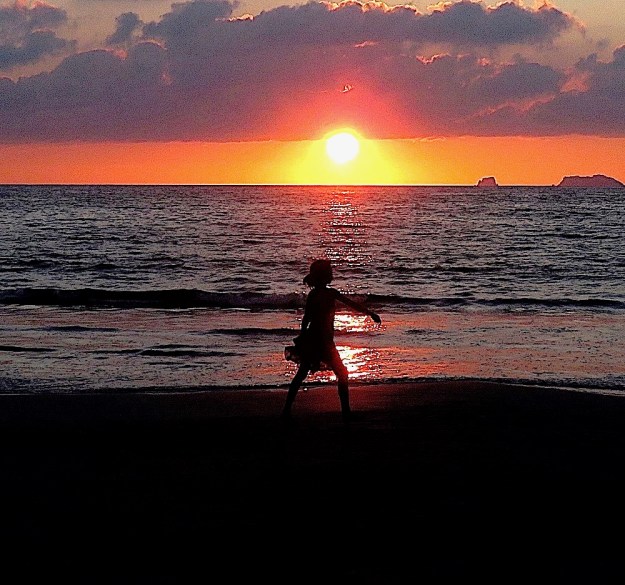
Dark Against Light


Dark Against Light

The universe’s fine maquette

is light on dark and dry on wet—
her quietness and stillness set
against the thrum of castanet.
It is a sort of etiquette:
opposite versus opposite.
Victory gauged against regret.
Sunrise followed by sunset.
Every lottery and bet
boundless riches as well as debt.
It does no good to fuss and fret.
This irony is all we get—
nature one pure brightness set
as backdrop to our silhouette.


Want more views of this sunset?  Go HERE.
The prompt today is one of the prettiest words in the English language: silhouette.