Category Archives: Writing

Let There Be Light


Let There Be Light


My mind is a growling dog.
While I stew and fuss,
fulfilling lists,
she jumps the screendoor,
beckoning.
Rude me, to turn my back
on the only playmate
who wants to play
the same games I do
every day, every hour,
because I fear that initial
plodding through silt
page after page
in search of the stream
of words.

Sometimes boredom
yawns so wide
that I have to enter it,
to wander its inner closet
where for decades
only cobwebs
have stirred.
In some dark corner
where I spank the dog
or search the bedside table drawers
of a lover called out at midnight,
I find the river’s source,
but then
the phone
rings and I’m off
gathering crumbs from a forest path,
leaving lost children
stranded in their own story.

Stray puppies—I collect every one,
wild orange funnel flowers
and guava
washed in an afternoon kitchen
just before the invasion
of five o’clock sunlight.
All of them I carry back
to hidden places
to rub against each other
and ignite
into the language of this place
where life goes in,
plays dress-up,
but emerges
nude,
like poetry.


The Prompt: Is there a cause — social, political, cultural, or other — you passionately believe in? Tell us how you got involved . The cause I most believe in is getting in touch with your authentic and true inner voice.  This is what I do when I write. Would that more people involved in making decisions that will alter our world would do so. This poem is really about the creative process where, when done right, there is only truth. It is also about all the things that get in the way of this process.

Lear’s Fool or Harlequin?

The Prompt today is “A Bookish Choice”—A literary-minded witch gives you a choice: with a flick of the wand, you can become either an obscure novelist whose work will be admired and studied by a select few for decades, or a popular paperback author whose books give pleasure to millions. Which do you choose?

Lear’s Fool or Harlequin?

Obscure or popular? That witch
creates a choice that is a bitch.

For, if at fame I had a chance
only if I wrote romance,

I’d prefer to be unknown,
in my corner, all alone,

writing words they’ll find profound
if in fact they’re ever found.

But wait. Have we two choices only?
Trite and read/genius and lonely?

Where is it written I must depend
upon a witch to plan my end?

Since when has either witch or fairy
determined what is literary?

Once I took a little breather,
I decided I’d choose neither!

Rebellious thoughts swirl through my head.
I’ll simply write my blog instead!!!

“Flutter” : The Surrogate

Surrogate w pic 6

The Prompt: Sounds Right—This is clearly subjective, but some words really sound like the thing they describe (personal favorites: puffin; bulbous; fidgeting). Do you have an example of such a word (or, alternatively, of a word that sounds like the exact opposite of what it refers to)? What do you think creates this effect?

I’ve always loved the word “’Flutter” as it applies to a butterfly or moth.  What better word could be used to describe the motion of their wings?  The moth described in my poem, however, was noticeable because of its lack of flutter.  It landed upon my computer screen like a magnetized object to metal and remained there for over two hours.  The moth pictured in the poem is the actual moth.  Tiny and green, it became part of my writing experience. Since it had chosen to remain in one position, directly on my screen, I was forced (by choice) to write around it, which could not help but influence the poem that resulted.


Unknowing


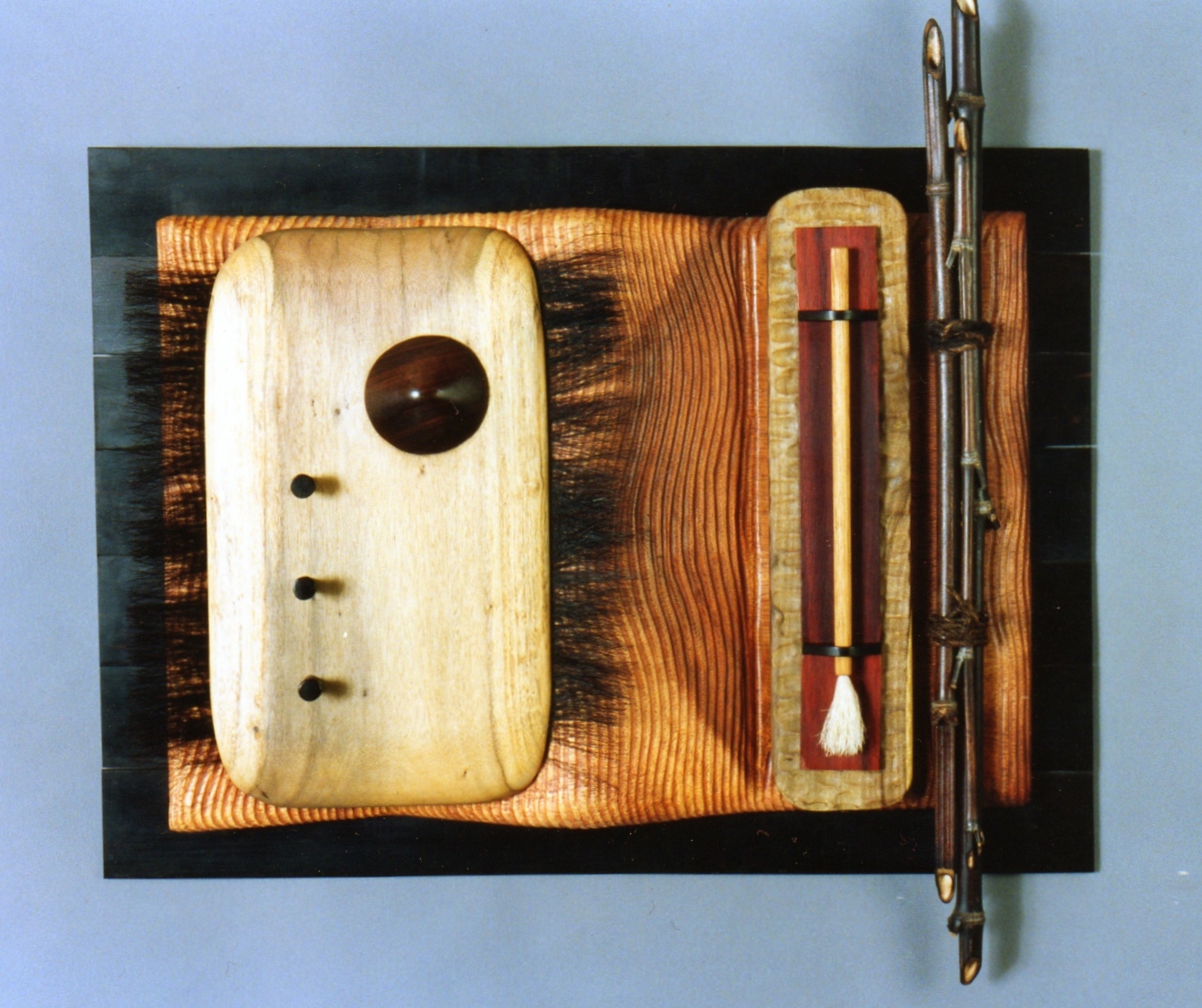
Wall piece

                       Wood, horsehair, bamboo, Wall Scupture  17″X23″, Judy Dykstra-Brown

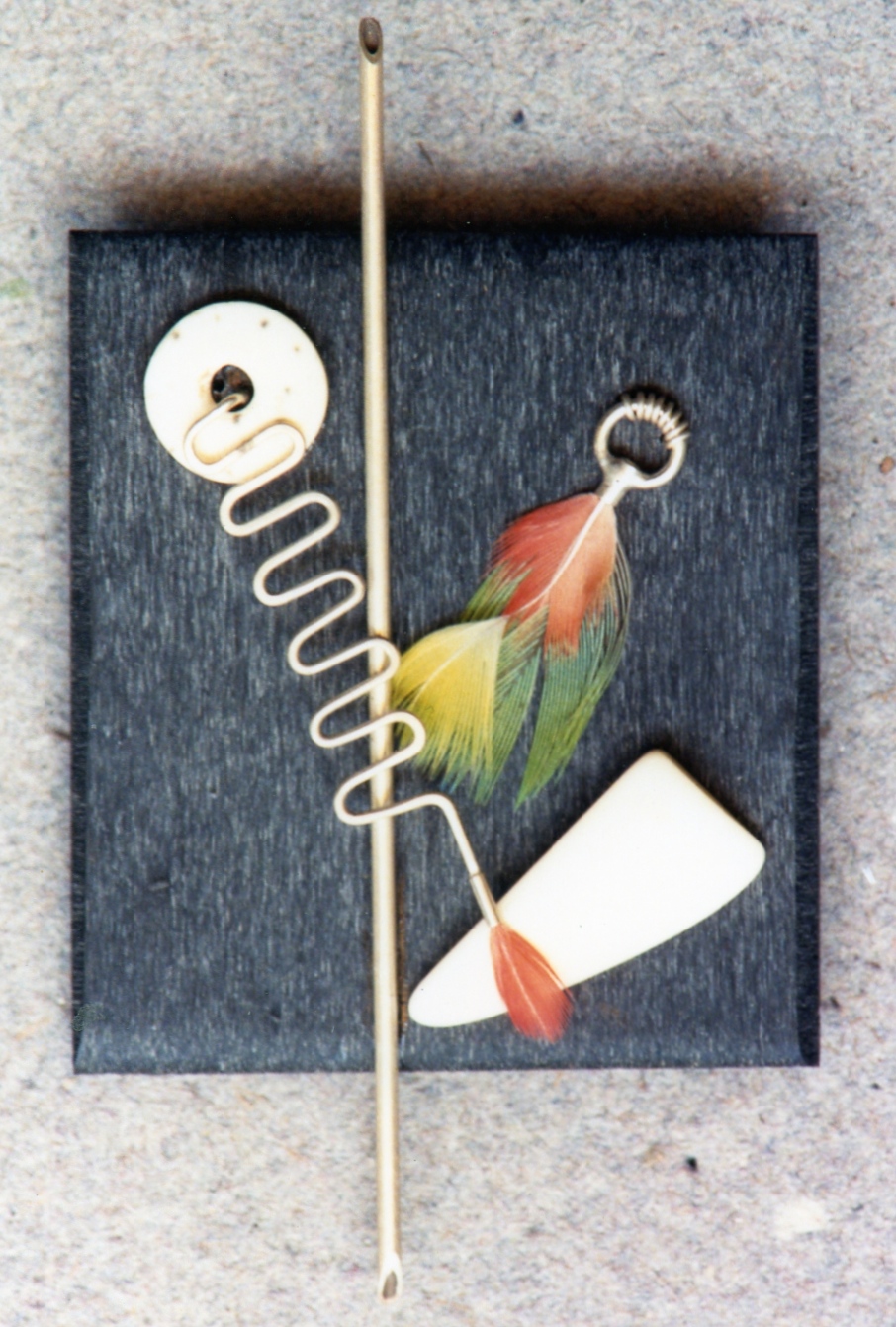
BroochBrooch by Judy Dykstra-Brown: Silver, Fossil Ivory,
Ostrich Eggshell and Feathers on Textured Acrylic

The Prompt: Writer’s Block Party—When was the last time you experienced writer’s block? What do you think brought it about — and how did you dig your way out of it?

                                                                   Unknowing

It was in 1986 and I was in a writer’s workshop in L.A. that was run by Jack Grapes. For the past five years, I had been writing daily, studying screenwriting and then poetry and working as a publicist and P.R. assistant for a TV production company. My whole world had become writing after I quit my job as an English teacher and move to CA to do what I had been teaching others to do for the past 10 years. Then, suddenly, I could not think of anything to write.

I had seen this happen before to others of Jack’s workshop participants and he seemed to have an uncanny knack of finding unusual solutions. For one talented writer who was pale and listless under her spiked hair and punk clothes, he prescribed a program of daily exercise and, miraculously, her poetry came alive as she did. But for me, Jack prescribed another remedy. “Do art!” he said. “I forbid you to do any writing at all. Instead, I want you to do art!”

But I wasn’t an artist, I protested. I didn’t know how to do art! Jack continued to insist. He told me to go to the dime store and to buy whatever interested me and to put it together as a collage. And so for a week, this is what I did. I bought a rubber mouse, a block of Morilla paper, acrylic paint, Popsicle sticks and confetti. I glued the mouse and confetti to the Morilla block, constructed a fence around them with the Popsicle sticks and cut out words to surround them that said, “Party mouse wants to come out and play but can’t!”

I broke Jack’s rule and wrote, filling sheets with words that had no logical connections with each other, then cut them up and made sculptures out of the strips of paper. I took the foil lids of empty individual plastic jam and butter containers brought back from a trip to Europe and cut them up, gluing them down along with other strips of words to form three-dimensional shapes, forming other object/word sculptures.

At the end of the week, I believe I had about seven works of what I didn’t think anyone would even loosely call “art.” Jack had told me to bring them in with me; but when I got to his walkup apartment in Hollywood, I left them in the car, embarrassed to show them. There were 25 others in the workshop. Perhaps he’d forget. I should have known better. When it came my turn to present, he asked me if I’d followed his “prescription.” When I admitted I had, he asked where my product was, and soon Bob (a man in the workshop who would in less than a year become my husband) and I were negotiating the stairs, carrying my “sculptures” up to face their first audience. I remember being so embarrassed to show them, but I was as accustomed as everyone else in the workshop to doing exactly what Jack said.

The reaction was the opposite of what I expected. Everyone loved my sculptures. One of the women in the group who had a gallery on Melrose asked if I’d like to have a show at her gallery. I was stunned. No way. I wasn’t an artist! But from that day on, for ten years I did no writing but did only art. I started out gluing found objects on stones, then when I married and moved to northern CA, I studied metalsmithing and papermaking and made my living for the next 13 years exhibiting in galleries and doing craft shows across the country

Ten years later, as the curator of an art center, I staged a show called “The Poet’s Eye/The Artist’s Tongue” that featured art that included words. This was when I started writing again, and I’ve been writing ever since. When I came back to writing, however, it was from an entirely different place—a place of “not knowing.” I wasn’t trying to write according to a preconceived idea of what writing should be, but rather from a place of intuition and what wanted to be written.

By forcing me to do something I knew nothing about, Jack taught me how to do something I knew how to do so well that it stopped me. My expectations were too high for myself. All of the things that happen naturally when one goes down deep in themselves and just writes got dammed up in me when I thought of what they should be instead of just letting them happen. By doing something that I knew nothing about, I learned how to better do something I knew too much about, and I’ve been writing ever since!

Sunday Morning Addendum

Sunday Morning Addendum

I used to go to church on Sunday, natural as breathin’,
but when the Daily Prompt is late, I turn into a heathen!
I wait and wait and look and look, refreshing up my browser.
So if you know our prompter, kindly call her up and rouse ‘er?
The end result of sleeping in is one I know too well.
Though she will get her beauty sleep, it’s I who’ll go to Hell!

Away

Away

Written in the morning, long before the day
sneaks in like an intruder, intent to have its say,
words born in the nighttime flower on their own,
bursting into bloom as soon as seeds are sown.

Truth is there behind us before it ever shows—
in words before they’re spoken, in wind before it blows.
Once recognized, I free these words to flow over the world—
off on their own to have a life wherever they’re unfurled.

Sent swiftly to their different spheres to live a life apart
from one who followed after, like a horse without its cart—
I like to set my words loose to canter on their own,
to feed upon wild grass that also roots where it has blown.

The Prompt: After an especially long and exhausting drive or flight, a grueling week at work, or a mind-numbing exam period — what’s the one thing you do to feel human again?

Do You Know Someone from Greenland?

400px-Coat_of_arms_of_Greenland.svg

Do You Know Someone from Greenland?

Do you know someone from Greenland? Please write them if you do
and tell them that I need someone from Greenland who will view
my blog for me so I can get it lit up on my map;
for on my statistics page it leaves a shocking gap.
Italy is lit up and the rest of Europe, too.
Mexico and Canada and Poland and Peru.
(But not, I fear, Afghanistan or Chad or Katmandu.)

I have fans in India, in England and in China.
Readers in the States from Oregon to Carolina.
Africa, The Emirates, in Russia and Japan,
and even in Australia, I have one loyal fan.
But no one from that Island has ever viewed my blog.
It seems that my well-oiled machine is missing that one cog.
I know that Greenland’s icy—that it’s Iceland that is green,
and perhaps that oxymoron may make Greenlanders mean.
Yet I’d think in winter, when there is so much snow
the Internet’s the sort of place that they would want to go!!!
My blog may not be noted for being really hot,
and if they want X-Rated, my blog is not the spot.
But if you’ve friends in Greenland, please tell them this for me:
my blog may not be steamy, but it’s guaranteed frost-free!

(And while you are at it, please have them stop by Shawn Bird’s blog at shawnbird.com/blog She’s missing Greenland as well!)

The Prompt: Road Tripping—‘Tis the season for road trips — if time and money were out of the equation, what car-based adventure would you go on? (If you don’t or can’t drive, any land-based journey counts.) . . . I interpreted the prompt loosely this time, more as a road trip of the mind. After almost 18 months of blogging, I keep noticing that very big block of the world called Greenland that still sits blankly staring at me, resisting my blog. When Shawn wrote to me after reading my blog about statistics, (read it here) saying that she was waiting for a viewer from Greenland, I knew that was my cue. So although I doubt anyone from outside has ever taken a road trip there, if you’ve journeyed there by some other means, please drop a clue to any friends you may have who live there to take a mind trip to our blogs and shut us up!!!!

First Friends

DSC07187

The Prompt: Do you — or did you ever — have a Best Friend? Do you believe in the idea of one person whose friendship matters the most? Tell us a story about your BFF (or lack thereof).

First Friends

I am three years old, lying in my Mom’s room taking a nap. I can hear voices in the front room. The world comes slowly back to me as I rouse myself from the deep sleep I swore I didn’t need. I hear my mom’s voice and the voice of a stranger. I slide my legs over the side of the chenille-covered bed, balancing for a moment like a teeter totter before giving in to gravity and letting my feet slide through space to the floor below. I creak open the door, which had been left ajar. My mom’s voice gets louder. I smell coffee brewing and hear the chink of china coffee cups in the living room.

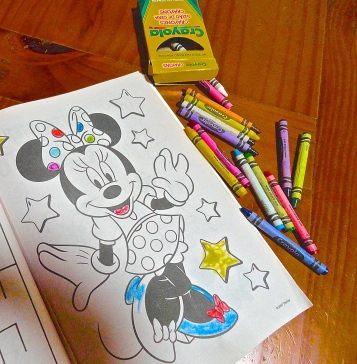
I hear a dull rubbing sound and move toward it—through the kitchen to the dinette, where a very small very skinny girl with brown braids is sitting at the table coloring in one of my coloring books. She is not staying in the lines very well, which is crucial—along with the fact that she is coloring the one last uncolored picture in the book which I’ve been saving for last because it is my favorite and BECAUSE I HAVE IT PLANNED SO THERE IS SOMEWHERE IN THAT PICTURE TO USE EVERY LAST COLOR IN MY BOX OF CRAYOLAS!

I sidle past her, unspeaking, aflame with indignation. Who could have—who would have—given her the authority to color in my book? I stand in the door of the living room. My mom is talking to a mousy gray-haired lady—tall, raw-boned, in a limp gray dress. My mom sees me, and tells me to come over and meet Mrs. Krauss. They are our new neighbors. They are going to live in Aunt Stella and Uncle Werner’s house two houses down. Did I meet their daughter Pressie in the kitchen? She’s just my age and Aunt Stella and Uncle Werner (who are not actually related to us, but just friends of my folks) are her real aunt and uncle.

The gray lady calls Pressie in to meet me. She is quiet and I am quiet. Then we go back to color at the table together. We drink orange juice and eat potato chips. We will be best friends for what seems like a lifetime but what is really only until we approach adolescence. I will have a love-hate relationship with her mother, who will continually set up competitions between Pressie and me to see who will win. She will try to coach Pressie first; but still, I will always win.

Pressie and I will play hollyhock dolls and dress-up. We play, sometimes, with Mary Boone; but her parents are too religious and don’t think we’re nice enough to play with her very much. I want to put on neighborhood plays and circuses, but none of the other kids want to perform. I want to play store and school, but Pressie eventually goes home to help her mother varnish the floors.

Pressie’s house is full of loud brothers and a sulky teenage sister. It is full of high school-aged cousins who tease us unmercifully and old ladies who come to play Scrabble with her mother. It is full of a missionary sister who comes back from South America and married brothers who come from Florida with babies that Pressie and I take charge of.

Pressie’s house is full of slivery floors that are always in the process of being varnished or de-varnished. There is one drawer in the kitchen full of everybody’s toothbrushes, combs, hairpins, hair cream, shampoo tubes, old pennies, crackerjack toys, rubber balls, lint, hairballs, rolled up handkerchiefs and an occasional spoon that falls in from the drain board above it. They have no bathroom—just the kitchen sink and a toilet and shower in the basement, across from the coal bin and the huge coal furnace. Their toilet has a curtain in front of it, but the shower is open to the world.

Sometimes when I am peeing, someone comes down to put coal in the furnace or to throw dirty clothes in the washtub next to the wringer washer. I pull the curtain tight with my arms and pray that they won’t pull it back and discover me, my panties down to the floor, pee dripping down my leg from my hurried spring from the toilet to secure the curtain. To this day, I have dreams about bathrooms that become public thoroughfares the minute I sit down. To this day, I get constipated every time I leave the security of my own locked bathroom.

Pressie babysits with the minister’s kids for money. I go along for free. She spanks them a lot and yells a lot. I think I can’t wait until I’m old enough to have kids so I can yell at them, but when Pressie is gone and the minister’s wife asks me to babysit, I don’t yell at them.

At Christmas I can’t wait to have Pressie come see my gifts: a Cinderella watch, a doll, a wastebasket painted like a little girl’s face, complete with yarn braids, books and toilet water from aunts, a toy plastic silverware set from my sister, stationery from my other aunt, playing cards, sewing cards, paint by numbers, a new dress. I run over through the snow to Pressie’s house to see her presents: a new pair of pajamas, a coloring book and new crayons, barrettes and a comb. In her family, they draw names. Quickly we run to my house, but she doesn’t pay much attention to my presents. She is funny sometimes, kind of crabby. The more excited I get, the more withdrawn she gets.

Later, I want to make snow angels in the yard and feed leftover cornmeal muffins to the chickadees, but Pressie wants to go home. Pressie always wants to go home. What she does there, I don’t know. She doesn’t like to read. None of us will have television for another five years. She doesn’t much like games or cards. I don’t know what Pressie does when she isn’t with me.

When she is with me, we take baths together and sing the theme music from “Back to the Bible Broadcast,” washing our sins away in the bathtub. We play ranch house in our basement. We pull the army cot against the wall and put old chairs on either side of it for end tables. We upend an old box in front of it for a coffee table. My grandma’s peeling ochre-painted rocking chair faces the army cot couch. We sneak into the hired man’s room and steal his Pall Mall cigarettes and sit talking and smoking. We rip the filters off first, which is what we think you’re supposed to do.

Pressie will always stay longer if we smoke. I blow out on the cigarette, but Pressie inhales. We smoke a whole pack over a few weeks’ time and then go searching for more. When the hired man starts hiding his cigarettes, we discover his hiding place and learn to take no more than four at a time so he doesn’t miss them. When he has a carton, we take a pack and hide it under the mattress on the army cot. My mother wonders where all the filters are coming from that she sweeps from the basement floor, but never guesses our secret.

Pressie spends more time with me than before, drops by almost every morning and always wants to go to the basement to play and smoke. Then the hired man finds another room and moves out and when Mrs. Church’s granddaughters come to visit, I will want to play with them but Pressie won’t. Then we will pair off—Pressie with Sue Anne, the girly one, me with Kate, the boyish one. We have a little war—mainly instigated by the sisters.

When the new farm agent moves in with two daughters—one a year younger than Pressie and me, the other a year younger than my sister Addie—I want to ask the girl our age to play with us, but Pressie won’t. I have a slumber party for everyone—all the girls we know. I invite the new girl, whose name is Molly, but no one talks to her much. She is shy and doesn’t push herself on us. No one else ever wants to include her. I go play with her anyway and spend the night at her house. Her mother is nervous, her dad cocky. Her older sister laughs nervously under her breath a lot, as does her mother.

Many years later, by the time we are in high school, everyone has accepted them. By then, all of those girls have parties where I’m not invited. They are always a little reserved when I come up to speak to them. Maybe they’re always reserved. How would I know how they are when I’m not around? Later, they all got to be pretty good friends. But in the beginning, I was everyone’s first friend.

Hail, Hail

                                                                        Hail, Hail 

My farmer/rancher father’s boots grew older with him, their wrinkles—like the back of his neck—born of weathering: rain, snow, mud and hot Dakota sun. They were so much a part of him that when he died, they were all my pre-teen nephew asked for, and he wore them out the rest of the way, until the soles peeled back and the leather with patina already long worn off, began to crack along the wrinkles and peel off.

Those boots reflected my father’s life, where things wore out. His clothes, his favorite chair—none were replaced for aesthetics or style alone—this practicality motivated neither by penury nor cheapness, but by growing up in a house where “making do” was a necessity.

But as in most things, there was one defining vain compulsion in my father’s life that broke him free from his mold. He loved new cars, as much for the pleasure of making the deal as for the smell of new leather and metal. The car dealers learned to call him when they got a car fully loaded, the way he liked it: automatic windows, power steering, power brakes, seats that tilted and slid back and forth and up and down by the touch of a switch. Whatever automatic feature was new that year, my father was up for it—big cars with fins, when they were in style, of every color.

The car salesmen would wait until the wheat crop had been harvested and then make the call, driving the car for sixty miles over the prairie to bring it to him for his perusal, like a new bride brought to a shah. They knew him well, and so when the bargaining began, they would accept his peccadillos. It was not the price he quibbled over, but rather the trade-in. “Well, I’ve got a combine that I need to trade in.” Once, three horses. And they learned this joy of trading was often what sealed the deal.

Later, when my sister married, her husband claimed my dad traded in his cars whenever they needed washing, but this was not true. Three years was a car’s usual shelf life, before he’d hand it down to whichever daughter of driving age needed a car the most. Packards and Cadillacs and Pontiacs were his choices of brands. For some reason, he reviled Fords. So that July of my thirteenth year, when the salesman brought the bright green Oldsmobile for my dad to view, we were sure this was the car he would turn down. My mother was not sure about the color and my dad was not sure about buying an Oldsmobile. He had no real reason. It was just a brand he’d never considered before, but it had all the bells and whistles. I think it was the first year that cruise control was offered, so it possessed that allure of new technology. And so it was that the car made it past any first inhibitions on both my mother’s and father’s parts and when the salesman drove away, it was in our “old” Cadillac and the shining green Oldsmobile became the new resident of our garage.

My oldest sister was married and gone, my middle sister seventeen—a year past legal driving age. Summer camp in the Black Hills was nearly 200 miles away, but over easily-navigated straight roads through bare prairie, the wheat having been cut early that year. So it was that my mom, worn pliable from 20 years of driving daughters hundreds of miles to doctor appointments and eye appointments and ball games and church rallies and singing contests and summer camps, decided my sister could drive me to camp that year.

My sister Patti and her best friend Patty Peck piled into the bench front seat. My best friend and I piled into the back. The trunk was full of two weeks worth of camping clothes. The pleasures of riding in a brand new car, just one week removed from its purchase, equaled the thrill of being off on our own. We rolled down the windows, stuck out our arms and let the hot July air stream through our fingers, stopped at Wall Drug for milkshakes, sang at the top of our lungs, and when our bare legs started sticking to the vinyl seats, closed the windows and enjoyed the air conditioning.

Three hours later, the black outlines of the hills that were our destination grew close enough to define the ponderosa pines that gave them their name. We cruised past Rockerville Ghost Town—a tourist trap where my oldest sister had worked a few years before—and turned off into Coon Hollow. My sister steered the car carefully over the dirt roads, fearing chipped paint or a chipped window from the occasional rock in our path. “Take Me Back to the Black Hills” we crooned, as we always did when we approached our favorite vacation spot. We rolled down windows once again to enjoy the scent of ponderosas and to hear the gurgling of the water as it rushed down the small river that paralleled the course of the dirt road that led back to the campsite.

“Black Hills Methodist Camp” read the sign. We stopped to take a picture before veering off onto the divided dirt road, and we had just caught site of the large log cabin that served as the mess hall when the first loud “Whump!” occurred. Then another and another and another. Terrified, my sister steered the car off into the trees as the hail grew larger and larger. We were facing the creek, which had grown wild with the churning of the hailstones hitting the water. They grew rapidly from quarter-sized to golf ball-sized to baseball-sized. The front window began to shatter. When one large hailstone seemed to pierce the roof of the car and land in my lap, I was out of my seat and over the back of the front seat onto the seat between the two Pattys before I could even think about it. As I remember it, I somehow managed this shift in position without ever removing my seat belt, but this, perhaps, is an exaggeration that occurred more in memory than in actuality. My friend, still in the back seat, held up the white ceiling light cover that had popped off when a huge hailstone had hit directly on top of it—showing that the rooftop was still unbreached

The entire hailstorm probably occurred over no more than a ten-minute period, but at the end of it, the stream in front of us was completely white with floating hailstones and the ground was covered. We climbed from the car, pushing through the hailstones in a shuffling motion to avoid slipping and falling on the huge balls of ice. The front windshield was completed marbled, every inch of our shining new car dimpled with deep depressions that equaled our own depression over what was going to happen when our mom and dad saw their brand new car! We were teenagers all and accustomed to that guilt that arose from a whole string of iniquities: dropping our mom’s favorite crystal bowl, staying out an hour past curfew, eating the last piece of pie. My sister backed the car out of the little turnoff she’d turned into hoping for some scant shelter from the hail and drove me and my friend the rest of the way to the registration in the mess hall, then she and her friend drove away. On the way home, they encountered a plague of grasshoppers that coated the windshield and they had to use bottles of Squirt to dissolve them from where they had become embedded into the marbled windshield; so this stickiness, dried in puddles on the hood of the car, added to the total devastation that greeted my dad’s eyes when his new “baby” was returned to him.

The feared recriminations never occurred. “Accidents happen. It wasn’t your fault,” said my dad. “I never really liked that color of green anyway,” said my mom. When my folks came to pick me up at camp, it was in a brand new rose-colored Pontiac Bonneville with a cream-colored top—the most beautiful car we ever owned. We met with no disasters on the way home, and four years later, it was the car I drove off to college six hundred miles away. My parents’ newest brand new car was a beige Buick that possessed none of the charm of the car now relegated to me, but did possess several new electronic features that I’m sure, for my dad, compensated completely.

The Prompt: You’re at the beach with some friends and/or family, enjoying the sun, nibbling on some watermelon. All of a sudden, within seconds, the weather shifts and hail starts descending form the sky. Write a post about what happens next.

BLOG HOP

I am so honored that I was asked to participate in this blog hop by Linda Crosfield, a poet whose work I admire greatly. Please see her blog to learn more about her and to read her wonderful poetry at Purple Mountain Poetry.

I met Linda in March in a writing group in La Manzanilla, Mexico—a beach community that most of us in the group visit for a month or two each year. It was a wonderful experience to meet so many excellent writers and I learned from every one. Hopefully, I’ll reconnect with some of them when I go back to the beach for a 2 month stint November-January of this year.

I would also like to introduce two excellent writers who are new acquaintances I’ve met through their blogs. Although their work presents opposite ends of the writing spectrum, they are similar in that neither takes the easy way out. I laud each of them because they both take such care in presenting original ideas and imagery. Please read their blogs to see what I mean.

Laura MacDonald has always dabbled in writing of many sorts. She is a very occasional contributor to the Bard Brawl blog (reviewing film adaptations of Shakespeare plays) and writes sketch comedy and wordy rants at Notes on a Napkin: What were they thinking? (though, much like herself, it was largely inactive throughout her pregnancy). She is currently channeling the ecstasy and delirium of motherhood into her poetry at Purple Toothed Grin and is pretty much making sleeplessness her bitch(/muse).

Robert Okaji lives in Texas with his wife and two dogs. He holds a degree in history but serves as a business officer in higher education and has at various times worked in a library, owned a bookstore and even sold cheese for a living. Much to his surprise and delight, three of his poems were featured in Boston Review’s National Poetry Month Celebration this past April. His work has also appeared in such publications as Clade Song, Prime Number Magazine, Middle Grey, Otoliths, Vayavya, Extract(s) and Lightning’d Press, among others. You may read his work at O at the Edges.

These are the questions I was asked to answer and that I hope Robert and Laura will each be answering on their own blogs.

What am I working on?

For the past two months, I’ve been posting a poem a day on my blog, following the prompts given by NaPoWriMo and WordPress Daily Post. I remember when I did NaPoWriMo last year that it seemed impossible that I’d make it through the month without quitting, but I loved it and missed it when it was over; so this year I decided to just keep going. I like having an excuse to make writing a priority each day and then wonder why I need an excuse. Sometimes I think I should be working on more serious work, but I love doing the blog and love writing the silly poems the most. Life is too short to do what you “think” you should do rather than what you want to do—especially at this stage of life.

How does my work differ from others of its genre?

Well, not many people have a daily blog that is 99 percent poetry, with most of it rhymed and metered. There is just something about having to write to a pattern that takes me to a different part of my brain. I never really know what the next line is going to be until I write it and I am continually surprised that it actually (for the most part) works out and comes to a conclusion. I never plan in advance. That takes away all the fun. Guess that is why I’ve never written (completed) a novel, although I’ve started a dozen or so.

Why do I write what I do?

I mainly write about things that I am still sorting out in my head. I discovered a long time ago that I don’t think unless I am writing or talking. A student once told me that my tongue sometimes got ahead of my brain and I realized that was true, and that wasn’t a bad thing (unless it was used for evil!) I try to slow down and think first when I’m mad, but just give my writing and my tongue free rein otherwise. It calls for understanding friends. (And kind of silly ones.) Why not just say what you think when you write? It’s safe because at this point, only you can see it lying there (actually, telling the truth there) on the page. You can always tone it down in the edit.

How does my writing practice work?

I love the computer, because it is the only way I can write fast enough to keep up with my thoughts. I write on the computer, always. (Well, almost always. At the beach, I carry a small notebook and pen in my pocket. I once tried a little digital recorder, but it doesn’t work for me. I don’t talk from the same part of the brain I write from.) I remember my first Brother electric typewriter that had a one-line memory. It was paradise, but really slowed me down as it was necessary to edit as I went. I love the freedom of the freight train mode of just writing as fast as possible without consciously thinking of what I am writing. The subconscious is a very interesting place to write from. It’s where we teach ourselves.

Find me online at grieflessons.wordpress.com or on Amazon here and here. (for some reason they can’t seem to get all my books in one location on Amazon.)