Tag Archives: dversepoets

Advice to a Poetry Critic

I wrote this for the figurative language prompt but missed the deadline for posting it by 30 minutes, so here it is in all its tardy glory!!!

IMG_1316

Advice to a Poetry Critic

Each poet worth her salt adores
well-appointed metaphors,
but when they step up to the mike,
similes they only like.
Before you discuss simile
consult an expert vis a vis
the difference between the two
so you will never have to rue
mislabeling your imagery.
Hyperbole is not allusion,
so don’t add to the confusion.
Synecdoche to oxymoron––
as you choose what to write more on––
get their names right for your reader.
There’s more to poems than rhyme and meter!

for dVerse Poets Open Link .

Uprooted

Uprooted

“Can you get even closer to the tree?” he said—so I went inches from the trunk of the tallest of the trees, crowding the fern that reached tentative tentacles from the tree’s shade into a ray of sun that escaped the fast-collecting clouds. “I’ll protect you,” he had said years ago, when we declared our union. But now, in this time of the approaching storm, I wondered about both tree and one who over the years had been in turn protector and threat. In times of gentle rain, a shield. In times more volatile, that sudden bolt that left bruised places easily hidden. I saw the tree’s scar, devoid of bark, burned at the edges––that place now easily overlooked in the shadows. And I moved away from the tree, walking with new confidence to the car. Uprooted, finally, after so many years.


Italicized line is from Sharon Olds’ poem, “Pine Tree Ode.” For the dVerse Poets Pub prompt–to develop a prose piece of 144 words making use of a line from another poet’s poem about a tree. Go HERE to read what other writers did with this prompt or to participate yourself.


Overpacking


IMG_4143

Overpacking

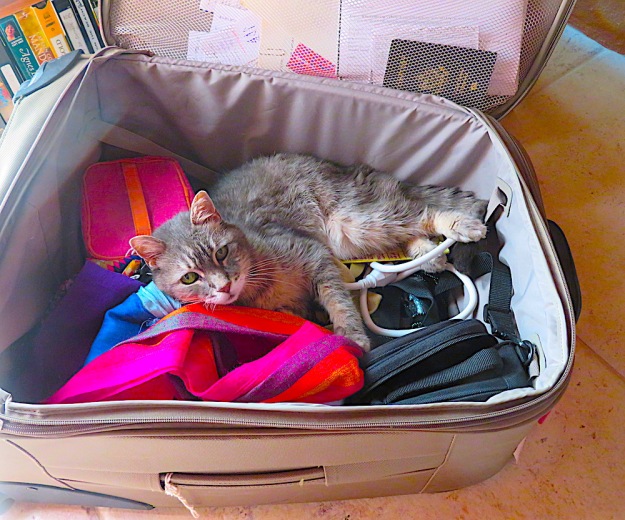
Where is it that a cat belongs? She’ll be the judge of that.
Wherever I am going, I am sure to need a cat.
She’ll help me with my packing and be my memory
so I don’t forget to take her when I set out to sea.

She can’t see how her company could go against my wishes.
A cat goes well with boats and anywhere where there are fishes.
Each morning she repacks herself and each night in the dark
she asks herself once more just when we’ll finally embark.

After a week of packing, my case is finally full.
I shut the lid, secure the lock, pick up the strap and pull.
I’m off to catch the red eye that will fly me off to Rome
to catch the boat that for one week will make do as my home.

I have packed so carefully, checking off my list
that I’m sure there’s nothing that I could have missed.
But I know that Annie, sleeping curled up on her mat,
when she wakes up and finds me gone, will not agree with that.

In spite of her best efforts, alas, she’s left behind.
It seems that human planning isn’t always kind
to cats who have spun fantasies of travel and romance.
Did human plans concur with hers? Poor Annie. Not a chance.

It’s a wonderful coincidence that the dVerse Poets prompt today is “Felines,” since just this morning I found this photo taken three weeks ago as I packed for my Mediterranean cruise with my sister. I meant to publish it back then but forgot and was wondering when it would be appropriate to use it as an illustration. I didn’t have to wait long to find out.


Slow Motion

img_7557


Slow Motion

After the fuss and bother, the acquiring and attaining,
somehow life seems better without the extra straining.
Now observing takes the place of doing and of showing.
Tranquility has won out over partying and going,
with “Hold your partner” filling in for former “do-si-doing.”


For the dVerse Poets Quadrille prompt, Tranquility

.

Sanctuary

IMG_2900

Sanctuary

What happened to dragons? What happened to fairies?
Banished by scientists and actuaries,
their truth of existence just can’t be computed.
The fact they exist is too soundly refuted.
Yet every child, awake in his bed,
knows they exist right there in his head!


The dVerse Poets prompt today was to write a quadrille (44 words) on the subject of dragons.

The Art Lesson

Version 2


The Art Lesson

I look at Carolyn.
The teacher hovers over her bright shoulder.
We are sisters, bright and dark.
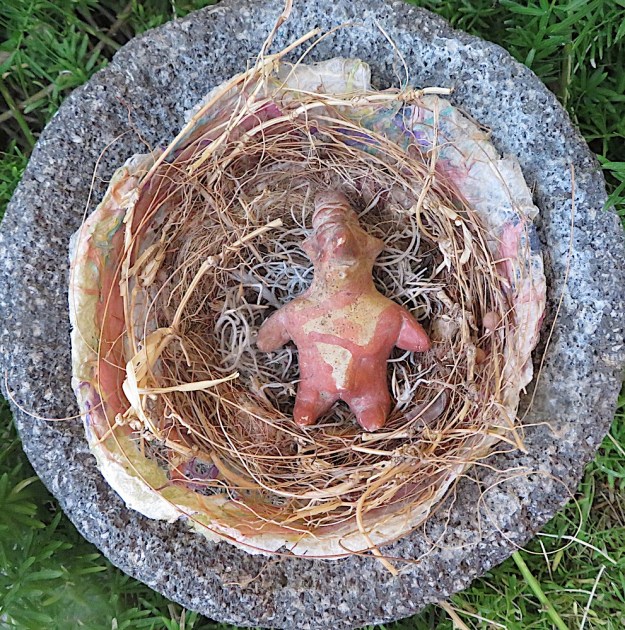
I stuff a bird’s nest into the hollow of the soft stone I have carved.
My mother will not like it.
She will only recognize the beauty
of the smooth hand
Carolyn has carved from alabaster,

That night, I stuff a snarl of Carolyn’s hair into
soft dung from the horse pasture.
I shape the Mimi spirit from the dung
and place it under the register in our room to dry.
When the cold snap hits,
the room takes on a feculent odor
and she wonders what is causing it.

For three days the Mimi spirit fills the room.
I reach under the register
and its outside surface crumbles in my hand.
I scrape its powder into a small pile.
The figure that is left I put in my pocket.
It is hard-baked.
The hand that held it smells like dead grass.
Some of the powder I sprinkle in a fine line
on the top of the frame around her vanity mirror.
The rest I save in my handkerchief.

The Mimi spirit I take back to class
to put in the nest.

My stone is a stone––
Hollowed,
grey.
with natural holes pockmarking it.
When no one is looking, I cut my finger with an Exacto knife
and collect my blood.
I unball my handkerchief.
I sprinkle the powder into my blood
to make a paste.
I take a fine brush from the cupboard,
paint the Mimi spirit.

They are all in front of me.
Carolyn. Andrew.
The teacher is in front of me.
No one notices.
I hear her laugh.
I pull a loose thread from my skirt
and wind it tight around my finger
until it turns white.

I take moss I’ve gathered from the oak trees
and I make hair.
I take the ankh-shaped clay tool
and scrape a hollow in the stomach of the Mimi doll.
I go to stand beside my sister,
taking the very small sharp paper-cutting scissors.
They are all watching her,
but no one watches the part of her closest to me.
She laughs, creating the diversion I need.
I quickly cut the very small piece
from inside a fold of her full skirt.
Later, she will blame it on moths.
I have told her about cotton-eating moths,
and she is a sister who always believes me.

I go back to my table at the back.
Still, not one has noticed me.
I trim material away from the part of the pattern I seek.
I cut out the very small figure of a child.
I roll the material I have cut away from around the child
into a tight wad
that I stuff into the new womb of the Mimi doll.
I roll the child into a ball
that I chew and chew
before swallowing.

I put the Mimi doll back into the nest in the stone.
Tomorrow I will pack it in a box.
Tomorrow I will wrap it in paper and ribbon.
Tomorrow I will give it as a gift to my mother.
Carolyn will give my mother the hand
and she will put it on her dresser
to display her bracelets and rings.
My stone will lie in its box
in my mother’s bottom drawer.

Next week I will steal into my mother’s room.
I will put the box under my sister’s bed for three nights.
I’ve already dug the hole beneath the willow tree—
in the soft soil where my father used to dig and dig.

Years from now, my mother will wonder where that box went.
Carolyn will have gone away before this, but not me.
I’ll say, “I don’t know, maybe Carolyn took it.”
My mother will slide her gold rings from the fingers
of the hand my sister carved for her.
She will love to stroke the cool hand.
But Carolyn will just keep going and never come back.

This is a poem I have written and rewritten over the past thirty years but which I’ve never published. It’s a dark poem and perhaps that is why I’ve never published it. I can’t remember what prompted it.  Certainly, nothing from my own life, but I recently found a folder of very old poems and decided to try to rework some of them. “The Art Lesson” is one of them. 

for dVerse Poets Pub Open Link Night.
Last Small Gift


scan112 2

Last Small Gift
for Zackie, 1982-1984

He always noticed high things––
airplanes, kites.
His long fingers
pointed to small things,
moving things, things that needed to be eaten,
people who should leave the room.

He gave second chances.
Even after I bit his finger
along with the cookie he offered as a token of friendship,
and even after the stout and lengthy 
cry of outrage in his mother’s arms,
in two or more additional meetings,
he was willing to start over again,
this time from the middle,
at becoming friends.

He never held out his arms to me.
He never cried when I left the room.
Yet he shared with me,
along with a glimpse of a heart that could still break,
all of the pleasures first experienced
which I had once felt,
and some long glances where neither looked away.

Usually,  I felt that in between his own needs
he knew everything there was to know about me,
this wise baby,
so that when he rejected me,
I knew it was for good reason.
And when he accepted me,
I felt I’d gained character.
Maybe I found it irresistible
that I had to earn his allegiance,
so that I felt flattered by it—
like the first girl chosen from the bench at a dance.

This baby
that I never knew well enough.
This baby who never noticed the toys I brought him.
This baby who reigned
from the corner of my sofa
under his pointed birthday hat,
never learned to say my name.

But he held something old for me in his eyes.
Promises, perhaps,
that some of the mysteries are left in a life
where most of the presents have been opened,
revealing objects less precious
than the surprises they came wrapped up in.


For dVerse Poets Open Link Night

Time Temporal


This sonnet I wrote six years ago is an extended antonym of Shakespeare’s “Sonnet18,”  written four hundred and ten years ago. I didn’t have many readers way back then at the beginning of my blog, so thought I’d repeat it here for the Sonnet challenge, along with Will’s original. Sorry, Will!!! And sorry.  Although I often use enjambment in my poetry, I fear there is none here.

Time Temporal

by Judy Dykstra-Brown

Shall I contrast thee to a winter’s night?
Thou art less lovely and more tempestuous.
The lack of wind doth still November’s empty stalks,
Oe’r which the winter hath too long a power.
Sometimes the too-cold moon hides ‘neath the clouds.
Then rarely doth it’s pitted face shine forth;
And dark from dark can sometimes rise,
Spurred on by fate or providence’s static plan.
But thy short winter shall soon pass away,
Restore to thee the homeliness of death.
Nor shall that birth that brought you forth to light
Still claim thee when temporal time shall stop thy growth.
As men lose breath and eyes lose sight,
So dies this poem, and draws thee with it to thy grave.

Sonnet 18

by William Shakespeare

Shall I compare thee to a summer’s day?
Thou art more lovely and more temperate.
Rough winds do shake the darling buds of May,
And summer’s lease hath all too short a date.
Sometime too hot the eye of heaven shines,
And often is his gold complexion dimmed;
And every fair from fair sometime declines,
By chance, or nature’s changing course, untrimmed;
But thy eternal summer shall not fade,
Nor lose possession of that fair thou ow’st,
Nor shall death brag thou wand’rest in his shade,
When in eternal lines to Time thou grow’st.
So long as men can breathe, or eyes can see,
So long lives this, and this gives life to thee.

For dverse poets.


The Perfectionist

The Perfectionist

Change not a hair of thy fair head if it be for me.
I like you just as you are now from pate to chin to knee.
Your shins, though, are too shinny. Your ankles too well-turned.
Your heels? Shockingly callused. Consider yourself spurned.

For the dVerse Poets Quadrille Challenge.

Aphorism

IMG_7992

Aphorism

The fire of camaraderie may warm the howling gale
or make our footsteps lighter while hiking a hard trail.
Although it is not mandatory, still it would avail
sailors to remember, laughter helps to swell the sail.


https://fivedotoh.com/2018/11/28/fowc-with-fandango-trail/
https://wordofthedaychallenge.wordpress.com/2018/11/28/camaraderie-2/
https://onedailyprompt.wordpress.com/2018/11/28/your-daily-word-prompt-mandatory-November-28-2018/
https://dversepoets.com/fire