Tag Archives: family stories

“Family Stories” For the Sunday Whirl Wordle 718, Aug 10, 2025

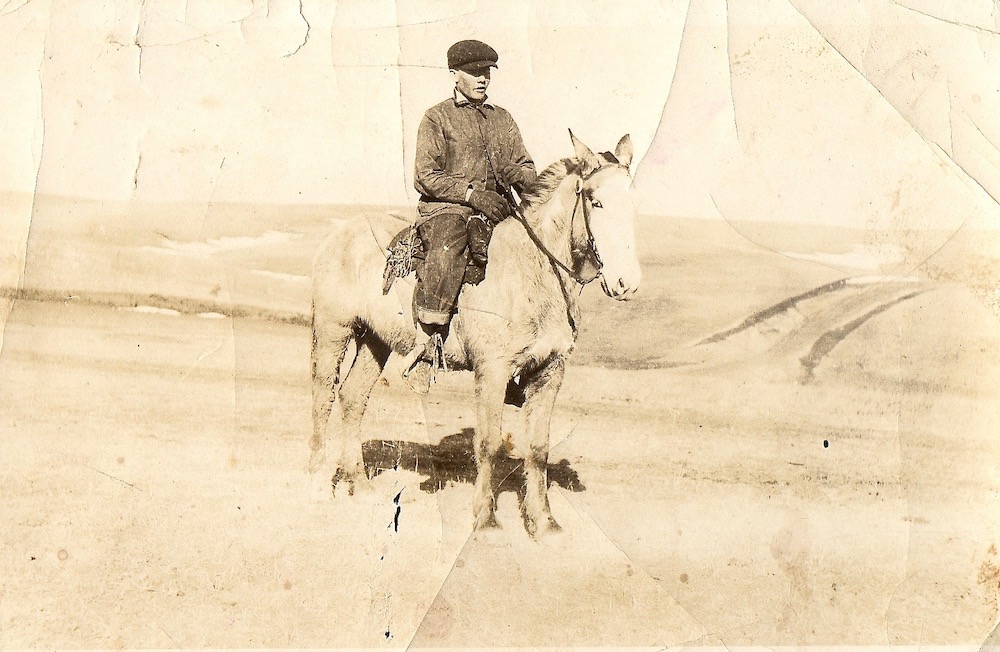
Ben Dykstra (My dad) age 13.

Family Stories

My father’s stories were not tales of moral principles or prophecy,
but rather reenactments of his roots—
tales of the open endless prairie
and the characters who peopled it.
Mirrors reflecting what seemed to me
to be a distant past:
forays to neighboring town dances
(told in the voice of  Deafie Sterner)
to “See the leetle women.”

Tales of Hank Jarneck, Cousin Louie
and Grandma’s liniment cake.
Accounts of gray wolves, prairie fires,
children lost in winter blizzards
and reenactments of the  voices of the wind
whistling through wall planks
and around the door during a winter blizzard.

In those days of my childhood before travel,
they presented a way to journey through time—
leading me back to my father’s roots—
allowing him to make those memories last
through another generation.
The debris of his life’s past
thus building the foundation
of mine.

For The Sunday Whirl Wordle 718 the words are: voices time story debris present
lead doors roots prophecy last mirror

Mama Milk My Goat, for Stream of Consciousness Saturday

Mama Milk My Goat

Whenever anyone in my family was feeling sorry for herself or himself and expressing it to a point where it was noticeable, another member of the family could be counted upon to use the family saying for such occasions, “Well, Mama milk my goat,” and if the person’s nose wasn’t too far out of joint, they might snap out of it.  Or, alternatively, stalk away to seclusion where they could fully feel the full extent of their misery without anyone trying to dissuade them from it. Why did we say this? Because my mother had told us all that it was what my grandmother, her mother-in-law, used to say.

My grandmother, a master at martyrdom, used to say it with a small uptake of breath, in a trembling voice.  I can remember hearing her do so, although it may be that sort of childhood memory that grows out of a family tale being told again and again.  Needless to say, I had no reason to question its frequent usage until I got to college and again and again was met by a blank look when I issued the rejoinder.  Finally, when I reported this strange fact to my folks over the dinner table during a trip home, my dad got a twinkle in his eye and confessed.

What my grandmother, who was Dutch, actually used to mutter when when she was feeling sorry for herself was, “Mama Miet mi Dote!” (Mama might be dead.) Only my mother (her daughter-in-law), who didn’t understand Dutch, thought she was saying “Mama Milk My Goat.”  My dad thought this was funny so never told us differently. So even now, “Mama milk my goat,” is occasionally what I say to anyone who is playing  the martyr, and if they have any curiosity at all and ask me why, I tell them this story.

Note: For those of you who speak Dutch, I know that “Mama miet mi dote” is not how “Mama might be dead” translates into Dutch.  Might might be “machen” and dead might be “dood,” but the whole phrase doesn’t translate into “Mama “machen mi dood,” either. Perhaps it was Frisian, which is where both my grandfather was from and where my grandmother’s family was from originally, or a local dialect or perhaps my ear heard the words differently, or perhaps it is just one of those family stories half legend, half fact.  At any rate, if you speak more Dutch that I do, I am more than willing to be informed about what it was my grandma really said. (I only know the alphabet, taught to me by my grandma, and “Mama miet mi dote!”)

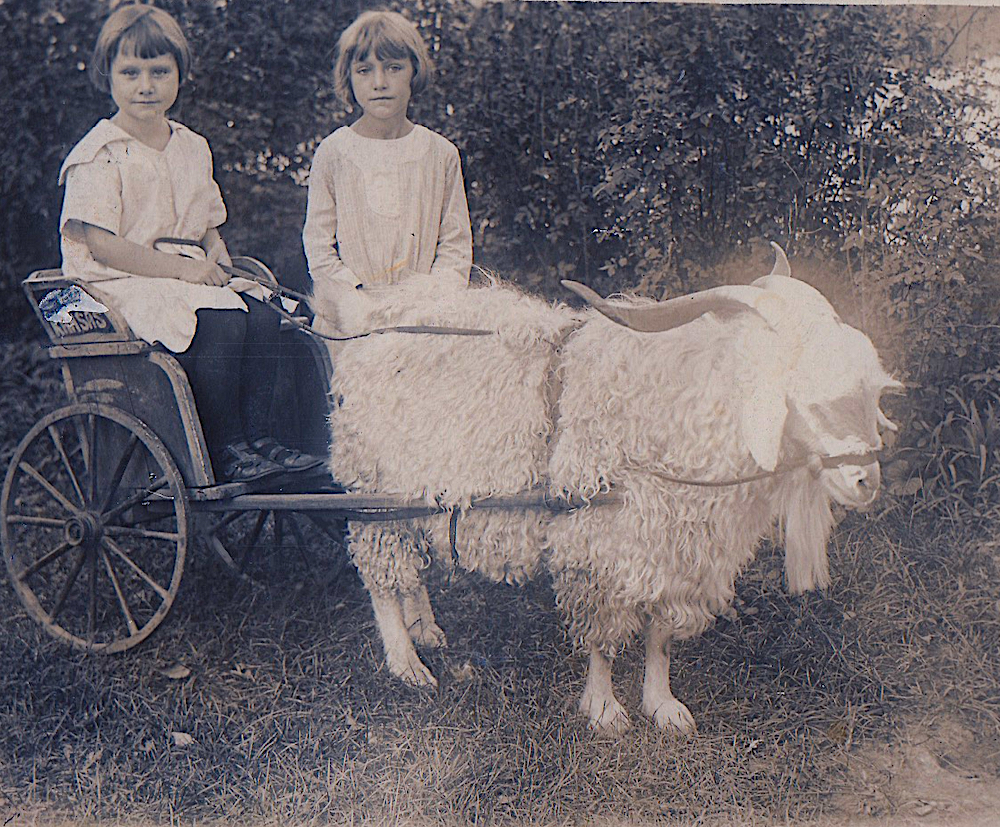
(The photo, by the way, is of my mother as a little girl with her sister Edith standing behind her. Just a coincidence that it includes a goat to illustrate my oft-told tale with!)


For Linda’s Friday Reminder prompt we were to tell an oft-repeated story.

Prescient

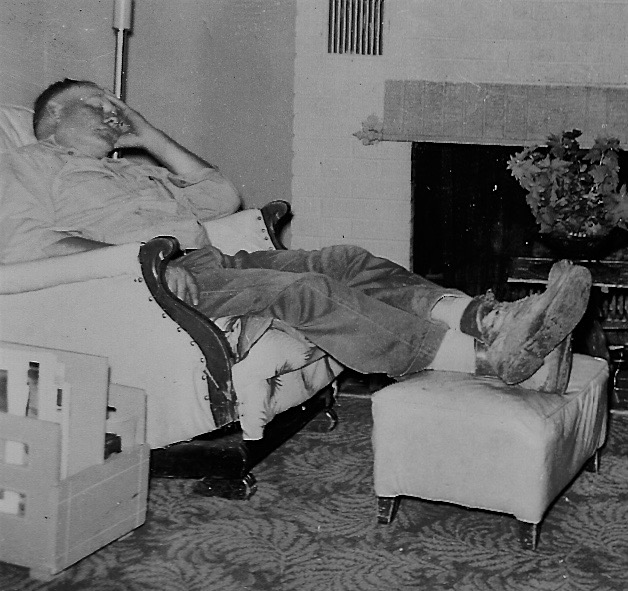
When he wasn’t ranching or farming or drinking coffee in Mack’s Cafe, this is where my father could normally be found, reading or napping. Here he is dreaming his own dream. Hopefully a happy one.

Prescient

My prescient experiences happened long ago,
shedding vivid spotlights on events I could not know.
Sporadic and unplanned-for, they came to me at night,
employing dreams to bring future happenings to light.

Once, thick in dreams, I woke to the ringing of the phone
and got up to answer its insistent tone.

“Miss Dykstra, this is Ludwig’s. You can come pick up your prints!”
Ready two days early? It didn’t make much sense.

 I said I’d be there shortly, but then went back to bed,
hoping to fall back to sleep, but, alas, instead,
the phone began to ring again, so I got out of bed,
“Miss Dykstra? We are calling to say your dad is dead!”

In shock, I dropped the receiver, and as it hit the floor,
it began to ring again. How could it have rung more?
Puzzled, I woke up in bed. The whole time I’d been sleeping!
So I got up in the real world to stem the phone’s loud beeping.

“Miss Dykstra? This is Ludwigs.”  The voice was calm and steady.
“We just called to say that your color prints are ready!” 
That summer morning, a cold chill rendered me unsteady.
Again, I though it should have been two days ’til they were ready!

I drove uptown to get my prints and when I got back home,
I could hear the ringing of my telephone.
I struggled then with key in lock, but the ringing died
before I even managed to get myself inside.

I couldn’t tell who called me, for I had no means
in those days before cellphones or answering machines.
I went into the bathroom to draw myself a bath.
It would take some soaking to dispel the aftermath

of these weird occurrences. A good half hour or more
had passed before I heard the opening of my kitchen door.
It was my Mom and Sister, both of them in tears.
My dad had had a heart attack, echoing my fears.

In time, it was the end of him, though he lived four more years—
a time in which he had to learn how to shift his gears.
A large man, hale and hearty, and active his whole life,
for those four years he had to depend upon his wife

to open doors and lift things heavier than a phone,
belligerently accepting help for things once done alone. 
“We tried to call you earlier, they said. Where did you go?
I’d had two calls to pick up photos, and so I told them so.”


This really did happen, exactly as described. Two sets of phone calls, the words exactly the same in the first set—one a dream, the other reality, although in the second set, I received only the first one in a dream  and when I missed the second phonecall, my sister had to deliver the message herself.

Word prompts today are thick, sporadic, prescient, employ, summer and bellligerent.

Family Reunion

Family Reunion

Thunder crashes, warning that her homecoming will not be ideal. These people know all her dirty little secrets and as is symptomatic of siblings, even those supposed to be mature, they are sure to reveal some of her past sins. She once wrote an award-winning satire based on her family,  but of course the irony was wasted on them. She came from a literal and humorless family. She had actually considered skipping this reunion, but then reconsidered. Once she has sold her newest story to the New Yorker, the trip will be tax-deductible, and where is she likely to find better material?

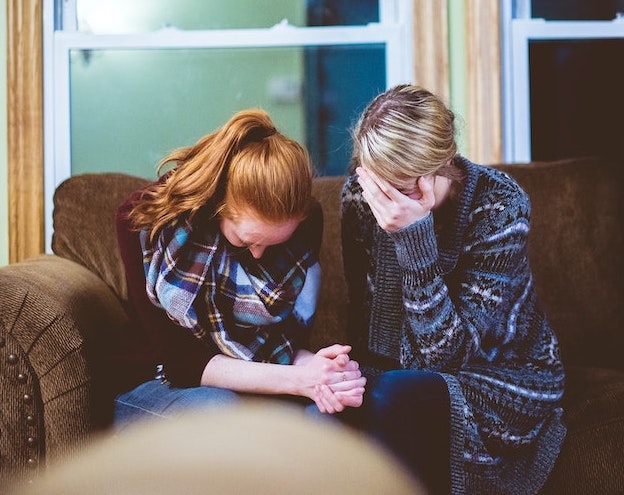
Prompts today are dirty, symptomatic, waste, satire, thunder and homecoming. Photo by Ben White on Unsplash.

Zoe Meets Cousin Kirk

Please click on photos to enlarge.

I was sleeping so well when Mom woke me up at 3 a.m. to put me outside so she could go pick her cousin Kirk up at the airport in Guad. She put me outside in my “safe” zone and finally got home around 5 or 6 a.m. She introduced us and of course he became “mine” immediately. He tastes pretty good! She fed him (but not me.) She and Kirk were still pretty peppy even after 24 hours with no sleep, but not as peppy as I was. The first ten minutes Kirk was here, I made off with one of his heavy sneakers and made it to Mom’s room with it in record time. Here I am resting easily with Ollie at 11 this morning. I’m still sleeping at 1:30. I think Mom got two hours sleep if she was lucky. She’s lying in bed writing this post, but chances are she’ll be having a catnap in the hammock later today. 

Spring Brakes


Spring Brakes

Her freshman year at college, my sis brought home a guest
that dad said was a nincompoop–rude and badly dressed.

His pants were tight, his buttons opened half way down his chest,
but my sister made excuses for the crudeness he expressed
by saying he was sensitive and recently depressed.

He strode into the kitchen and jerked open the door
of the refrigerator and began to pour
milk right from the carton, down his chin onto the floor.
What’s more, when he was finished, he asked if there was more!
Well, I could sense Dad’s anger before I heard his roar.

“He can’t help his behavior, he’s parched!” my sister cried,
pleading with our father as he threw the jerk outside.
Where, by his own volition, the kid sauntered to his ride,
put the keys in the ignition and, gathering his pride,
put the pedal to the metal, but then the engine died!

To inject a bit of humor would probably be rude,
but I simply can’t resist expounding on the dude.
My parents called his parents who came a bit unglued
and gave the kid a lecture on respect and rectitude,
imposing a Spring Break spell of solitude.

And that is why my sister spent her term vacation
in a state of martyrdom and excess perturbation.
I chalked it up to part of her farther education
and gloried just a little bit in her situation,
trying to abstain from another smug oration.

And that’s part of the story of when sister was a fool
and chose a dud as boyfriend, but to dwell on it is cruel.
That year she learned more lessons that weren’t taught in school.
When it came to spring vacation, it became her rule
that mixing  dads and boyfriends really wasn’t cool.


Photo by Mark Decile on Unsplash, used with permission. Prompts today are parched, nincompoop, inject, bide and guest.

Once Upon a Time

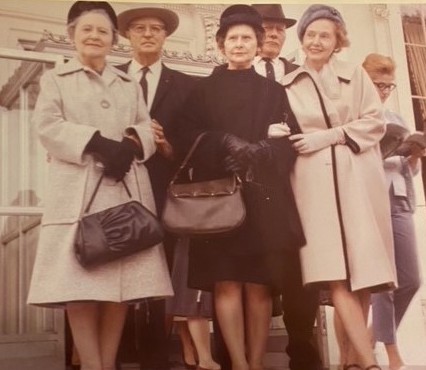
I’ve decided that my nieces and nephews need to hear some of the old family stories of relatives in their far distant past or ones they never met. This photo sent to me by my cousin Sara today gave rise to a story when Forgottenman asked me some question about it.

The members of the group are my mother, her two sisters and the husbands of two of them. Left to right, my Aunt Peggy, Uncle Rob, my mom Pat, My father Ben and my Aunt Betty. Uncle Ed, Aunt Betty’s husband, must have taken the photo, or perhaps he stayed home and a stranger took it. At any rate, I believe it is taken on the Capitol steps in D.C. where my glamorous Aunt Betty (of Filipino Lantern May Basket fame) lived. The three women are sisters–at that time the only remaining members of a family of six sisters and two brothers.  Rob and Peggy had driven from Wyoming, picked up my parents in South Dakota and driven to D.C. and points south, going through the states of Kansas and Missouri, where the ladies were born and raised.

One of the most memorable stories of that trip was told to us by my Uncle Rob, a sparkly-eyed gentleman who happened to be the State Superintendent of Schools for the state of Wyoming but who also had a rollicking sense of humor. I adored him.

The story as he told it was that he, Rob, was driving on the Interstate or whatever the equivalent of an Interstate was in the 60’s.  As I recall, they were now in Pennsylvania and for the past fifteen minutes or so, they had passed mile after mile of big fields of grapes. Dad, a rancher and farmer, was always interested in whatever was growing and so Rob was not too surprised when they came to a turn-off, that dad asked him to pull over and stop the car.

He was surprised, however, when dad opened the car door and bounded down the ditch up to the barbed wire fence that surrounded the field, reached over the fence and grabbed a vine, tugged at it and came streaking back to the car streaming a long vine of grapes behind him, jumped into the back seat and started handing the grapes around. My dad consistently astonished and delighted my uncle who had pulled a few hijinks himself in his past, some of which I’ve related in this blog.

I think this photo is an incredible contrast to recent events on those same steps. 

Too Busy to Remember

Too Busy to Remember

 If she gave herself time to think, she remembered,
and when she remembered, it was too often with regret.

     My Grandmother kept too busy to remember—every minute filled.  Walking to town, she trained her eyes to scan the ditches for buttons, dimes, Crackerjack prizes, a ball some dog had chewed, orphaned jacks pieces, Popsicle sticks and bottle caps. Into her deep apron pockets each went, joining her skinned black leather coin purse and a tatting-edge handkerchief. Back home again, her radio tuned to the Back to the Bible Broadcast, her curtains pulled wide for viewing whichever neighbors might walk by, she kept her fingers busy with tatting, beading sequined felt butterflies, knitting baby booties in bands of blue, pink, yellow and white. She crocheted the edges of embroidered sheets and pillow slips—one set for each grandchild. She was almost 90 by the time she got to my sheets. Barely able to see, she sewed stitches that got messier inch by inch.

     Now it’s me filling every minute of the day.  At midnight, I lie writing just one more line with heavy eyes. They close.  I open them.  They close again.  When I finally fold the paper and turn off the light, I give in to the agony of delayed pleasure–Sleep. Awakening, I dress and drive to the gym.  I read on the treadmill, read on the stationary bike and thigh machine, read on the leg lift.  Read until my hands are needed and holding the book is impossible.  Then I do one thing only–lift the weights, pull them down, let them bend me over, bend myself back up again.

     Over breakfast at the Mountain Inn, I switch to the paper: news, comics, crossword.  Back home, I cook, pound, dip, form, and couch paper.  I run down to the garden to cut bamboo, climb back uphill to the studio to strip leaves, bend branches, sew them to the dried paper.  In my ears, is the constant company of the radio–the blues or Uncle Jr., “Arden’s Garden” or “Talk of the Nation,” “Fresh Air” or “National Press Club,”  “Garrison Keillor” or “Click and Clack.”  From everywhere come the waves that fill my mind and fill my day. 

     I work until seven, then move into the house to cook the evening meal.  The radio in the kitchen leaks McNeil and Lehrer and  this time I  catch different details from the earlier report.  With dinner, there is a talk with my husband Bob, a video perhaps, or more time for the Sunday Crossword. After dinner, a good book.  In this way, I fill every second.  There is no precious time to waste. 

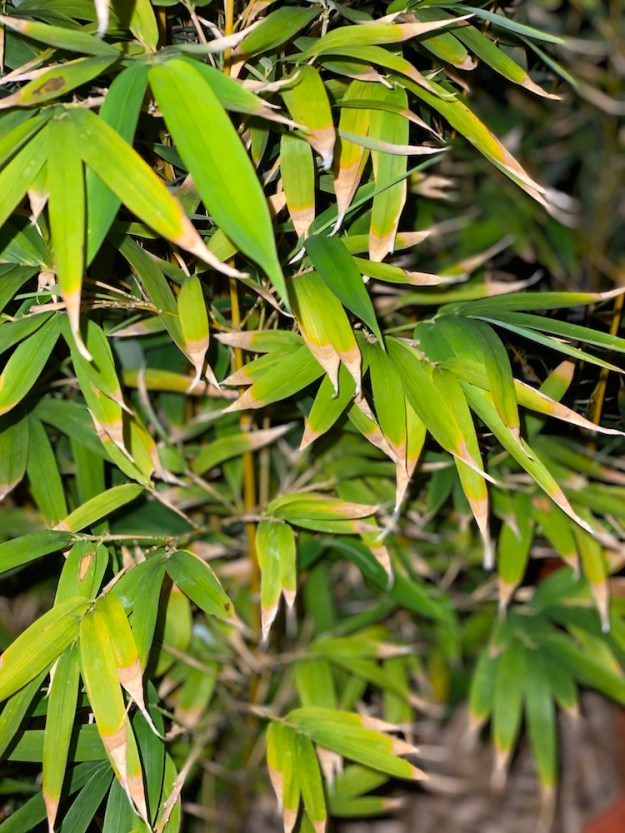
     Sitting on the garden bench, eyes closed, I listen to bamboo.  Eyes open, I watch it.  I walk to it.  Let bamboo brush my cheek.  Keep listening.  Watch the light filtered by bamboo.  Watch the redwood needles dry and  fall to catch in swaying bamboo.  Watch them settle more securely, their rust-red dryness brittle against the subtle green. The black trunks of mature plants, mottled stalks of one-year-olds, yellow blades of new growth. A scrub jay perches on the swayback crosspiece of a simple oriental arch.  Above the redwood path, a Stellar Jay scolds the gray cat who sleeps on the bench beside me. 

     The water skimmers skate the abbreviated lower pool of our wine keg fountain with its wooden spouts decayed and fallen to the ground, its three tiers silent, its pump long removed.  Papyrus bends and shivers to the sparse wind.  A bay tree shadows the remains of ferns turned red beside this summer’s green.  There is the gentle hammer of the acorn woodpecker against the gray ghost of the long dead tree.  The drone of yellow jackets in their nest below the tree house—their journeys out and journeys back again.  The loud whirring of the hummingbird.  Frantic fanning of his wings, the delicate dipping of the beak, smooth probing of the plastic petals of the sugar water feeder, then the dainty glide to ginger flower, to the pomegranate and the goldfish plant. 

     All the world is doing doing while I’m not doing anything. Not keeping myself from remembering, yet still not remembering.  I’m in my garden without doing anything.  Too busy to do anything until the phone rings, its brrrrrrrrr flooding downhill to fill the bamboo grove, its shrill voice splitting air, spilling jays from tree limbs over head.  Awake again, I push off from the garden bench,  run up the hill, reach the stairs, climb half way up, then stop.  I turn, go down again, walk slowly down the hill, sit on the bench beside the cat who has not stirred.  I hear the phone, but silence swells around it, pushing it farther into  the distance as I let it ring and ring and ring and ring and ring and ring and ring.

Ours is a society that fears most the waste of time, yet in spite of our best efforts,
we’re always running out of it. The secret to finding more time
is to give value to it precisely by wasting it.
 

Not a classic haibun, but close enough, I hope, For Open Link Night at dVerse Poets 
An Unknown Enemy

My mother, Eunice King, in goat cart with sister Edith, shortly before their father and sister died in the flu epidemic.

I had been told by my mother that the first deaths from that flu were in Ft. Riley, Kansas—brought home by soldiers to the fort where my maternal grandfather worked. I’d always been told that he died in that epidemic, as did his daughter Pearl, who was my mother’s sister, but looking through family records while looking for these photos, I have discovered that they seem to have died two years before the flu epidemic, so I am digging urther. The account of that period below is an excerpt from the family chronicle of the friend of a friend of my sister, who sent it  to her and she sent it on to me. I am sharing it here because  I think this account has some relevance to our present situation. My mother’s family lived in Junction City Kansas, near Ft. Riley. The story told below took place in Wyoming and describes what a different family went through during the time of the epidemic.

An Unknown Enemy

In 1873, Dr. William A. Hocker, was on his way to California to begin his career as a physician. During a stopover in the frontier town of Evanston, Wyoming he was beckoned to the bedside of a young woman with pneumonia fighting for her life. Unwilling to abandon a sick patient, Dr. Hocker let the train go on without him. So began his lifelong commitment to the development of medical care in Wyoming. He practiced in Evanston, Frontier and Kemmerer; served in the Wyoming Territorial Legislature; and was instrumental in founding the Wyoming State Hospital where he also served as the first superintendent.

Here, (as described by his daughter, Woods Hocker Manley) in 1918, Dr. Hocker faces the infamous Spanish Flu epidemic.

During the long winter that followed his operation Papa had little time to think about himself. He was city and county health officer, and a dreadful wave of influenza was sweeping the nation that fall and winter of 1918. However weak he might be physically, he was still in command of the community’s health regulations.

With the coming of the flu he established a general quarantine. He ordered that the town be closed, and he put out guards on all roads and at the railroad station. It was a drastic step, but he felt sure that it would save lives. He gave the order that no one was to enter the town.

The ways of influenza were mysterious, and no one knew for a certainty how it could be brought under control. But this was evident in Papa’s quarantined community: as long as the order was in force, about three weeks, no flu cases occurred. It was a well-known fact that people were dying daily in other towns. But in Papa’s town the quarantine was working.

Then the impatient merchants rebelled. Business was nearing a standstill, and they were greatly concerned. They demanded that he lift the order. Papa counseled with them. They were insistent. Then he called a public meeting so that the issue could be put to a vote. In his wheelchair, he sat with the other town officials on the platform. There was compassion in his voice as he spoke. His hands trembled a little, yet he fought his fight with a calmness and a strength that belied his real condition. But he was dealing with an unknown enemy, the flu itself. He could assert that he believed the quarantine was wise, but there were no scientific proofs. His whole argument was a plea for common-sense precautions, all manner of precautions, no matter

if the community erred on the side of safety. Business might suffer temporarily – yes; but who knew how many precious lives were in the balance?

In the end he was outvoted. The merchants had come to the meeting determined to break the quarantine, and they were backed by a solid majority of those present. The quarantine was lifted. Within a week or ten days the tragic death wave that had already swept through surrounding towns had come to Papa’s community as well; and before the winter had passed the results were appalling.

Manley, Woods Hocker. The Doctor’s Wyoming Children: A Family Chronicle. New York, NY: Exposition Press, 1953.


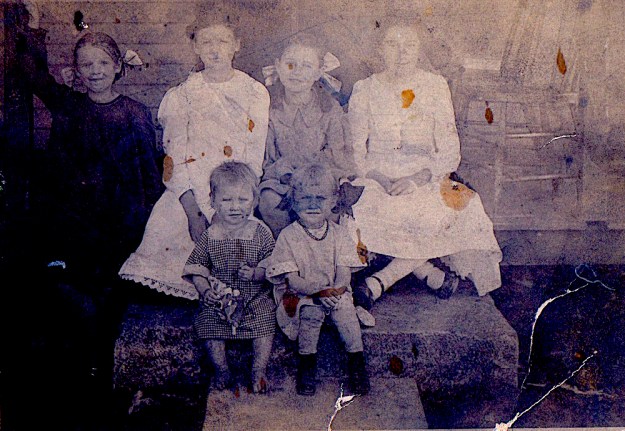
My mother Eunice (Pat), bottom left, with her sisters. Edith is next to her in the front row with the hair bow. Second row is Bessie (Betty),  Myrtle, Alpha (Peggy), and Pearl.. They had two brothers, Hiram and Wayne, who are not pictured. The traveling photographer just dropped by and asked if they wanted their photo taken. All the older girls ran up to fix themselves up in their finest, but didn’t bother to dress up mother, who is photographed in her little sack play dress with messed-up hair and  dirty bare feet, toes wiggling and holding her doll. 

Remembering Grandma at the Thirtieth School Reunion

Remembering Grandma at the Thirtieth School Reunion

When children guessed her age, I guess they might have guessed a million,
for her skin was fried and wrinkled and her manner most reptilian.

Her humor was peculiar—ribald, clever, sly.
Her whiskered chin was wobbly. She was rheumy in one eye.

When she talked about the old days and when people really listened,
her face seemed somehow younger and her eyes sparkled and glistened,

but she sputtered over S’s and dribbled when she talked.
She listed, lurched and wobbled. She zigzagged when she walked.
She loved her old blue tennis shoes with laces hanging down—
the only shoes she wore when she chose to go to town.
Still, her corns rubbed and her toes hurt. She preferred feet that were bare,
so she very rarely moved about once planted in her chair.

When her children brought her meals to her, they couldn’t linger long.
She couldn’t quite remember what it was that she’d done wrong.
Her grandkids liked her better and endured her bitter wit.
She taught them Chinese Checkers and some of them to knit,
but as they aged they visited less and less and less.
They didn’t like the odors. They didn’t like the mess.

And finally, as youngest, only I was able
to bear sitting with Grandma at her Chinese checkers table.
Only I could stand all the complaints and labored sighs—
all of the self-pity that shone out of her eyes.
But later, as a teen-ager, my visits, too, grew less.
Busy with my friends and school and other things, I guess.

And for all the years after she died, I thought about the years
when even I deserted her and I was brought to tears,
until my thirtieth class reunion, when a classmate I’d not seen
since we graduated, and for all the years between,
told a tale I’d never heard that made me realize
that there was more to life than what met my ears and eyes.

When television, new to town, kept Grandma company,
wild cats from her old henhouse came to sit upon her knee,
and the kids from the next corner also came to see,
for with ten kids in the family, they didn’t have TV.
It grew into a ritual. When they saw the sheen
emanating from the light of her TV screen,

they’d all drop in to see her and they’d stay until their pop
walked down from their house to bring their viewing to a stop.
Only the oldest daughter got to stay there until ten,
watching shows with Grandma—pretty ladies, handsome men,
cowboy shows and orchestras, adventure and romance.
They watched their favorite characters shoot and kiss and dance.

“We kids all called her Grandma,” my old classmate  confessed.
That she’d had this second family, our family hadn’t guessed.
So all those nights I thought that she’d been sitting all alone,
she’d been surrounded by her minions, like a queen upon her throne.
It seems the true facts of our past by memory can’t be gauged,
for sometimes history is rewritten and our consciences assuaged.

Prompt words today are reptilian, plant, ribald, peculiar and fried.