Tag Archives: memories

NaPoWriMo 2015, DAY 14: The Holy Apewoman of Mexico

th-8th-9th-6

The Prompt: Write a poem that takes the form of a dialogue. My dialogue takes place between my 7 year old self and my 67 year old self who, ironically, is writing this in Mexico.


Childhood Dreams

7
The mysteries
of Grandma’s barn
and basement–
whole lost worlds down there.
Our own attic–that door held down
by a gravity never challenged.

I wanted to see
the hanging gardens of Babylon,
Mexico and Africa–
all these places from books,
their pieces jumbled together
like puzzle pieces
in the deep recesses of my closet,
scattered,
but ready for assembly
some day
when I would
make my future memories
happen.

67
I crouch with myself at seven–
sharing imagined dangers
in deep closets,
trying to conjure the world.
So many small town stories
overlooked
while I dreamed of living
in those fairy tale places
of Bible stories
that stood on a shelf
sandwiched between
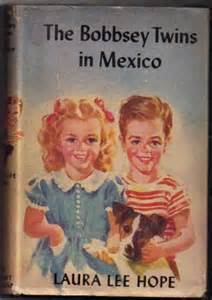
the Bobbsey Twins
and Tarzan.

Some of us spend our lives
trying to be like books,
then spend our old age
trying to remember childhood,
mainly remembering
childhood’s dreams.

*

NaPoWriMo 2015, Day 2: Stars

                                                                    Stars

Sometimes, on an Indian blanket spread on the night-dewed grass, I became aware of them.
They were always there waiting in the ever-clear South Dakota nights.
Anything could have happened on a night like that,
Reclining with no ceiling over us,
Silence split by crickets, frogs, the chipped barks of dogs.

S
ummertime freed us to the great outdoors.
Traitors to our beds, we chose the long-grass cushioned backyard.
Attacks by neighborhood boys an exciting possibility,
Rescues by my bellowing dad, in jockey shorts, standing on the back porch.
Sleep not on our agenda for hours afterwards.

Slumber parties meant for anything but slumber.
Taking a walk at midnight and crossing the path of no one.
Air in the night a different elixir
Returning to roll in the grass in shortie pajamas—that pre-sexual thrill.
Stars of our own summer, we strutted our stage until the wee hours.

Something in the night freeing something in us.
Taken by the stars to other selves, far above us.
Aware of the mysteries laid out like a path in front of us.
Returning reluctantly to our pre-teen lives,
Safe beneath the dangerous stars.

The WordPress prompt today was to write about texting, but Since I have never texted anyone in my life, thought I’d tell you what life was like in a pre-text world. And here’s a picture to go with both the subject of texting (old-time style) and the above poem:
https://grieflessons.wordpress.com/2015/04/02/a-photo-a-week-challenge-muted-colors/

https://dailypost.wordpress.com/dp_prompt/its-a-text-text-text-text-world/

John Wayne and I

DSC00169

When the Union Pacific Railroad was finally completed on May 10,1869, it was a cause for great celebration. A very good source describing the somewhat hilarious ceremony may be found here, but a segment from that source follows as a background for my own story:

A railroad linking America’s east and west coasts had been a dream almost since the steam locomotive made its first appearance in the early 1830s. The need for such a link was dramatized by the discovery of gold in California in 1848 that brought thousands to the West Coast. At that time only two routes to the West were available: by wagon across the plains or by ship around South America. Traveling either of these could take four months or more to complete.

Although everyone thought a transcontinental railroad was a good idea, deep disagreement arose over its path. The Northern states favored a northern route while the Southern states pushed for a southern route. This log jam was broken in 1861 with the secession of the Southern states from the Union that allowed Congress to select a route running through Nebraska to California.

Construction of the railroad presented a daunting task requiring the laying of over 2000 miles of track that stretched through some the most forbidding landscape on the continent. Tunnels would have to be blasted out of the mountains, rivers bridged and wilderness tamed. Two railroad companies took up the challenge. The Union Pacific began laying track from Omaha to the west while the Central Pacific headed east from Sacramento.

Progress was slow initially, but the pace quickened with the end of the Civil War. Finally the two sets of railroad tracks were joined and the continent united with elaborate ceremony at Promontory, Utah on May 10, 1869. The impact was immediate and dramatic. Travel time between America’s east and west coasts was reduced from months to less than a week.

The ceremony at Promontory culminated with Governor Stanford of California (representing the Central Pacific Railroad) and Thomas Durant (president of the Union Pacific Railroad) taking turns pounding a Golden Spike into the final tie that united the railroad’s east and west sections. As the spike was struck, telegraph signals simultaneously alerted San Francisco and New York City, igniting a celebratory cacophony of tolling bells and cannon fire in each city.
“It was a very hilarious occasion; everybody had all they wanted to drink…”
http://www.eyewitnesstohistory.com/goldenspike.htm

It will probably come as no surprise that in 1969 it was decided to have a huge ceremony honoring the 100th anniversary of the “Wedding of the Rails” in Utah. To that end, two trains set out—one from the easternmost point of the track and the other from the westernmost point. These trains were destined to meet at the original point of their joining, but since they were filled with dignitaries, they made numerous stops along the way with celebrations at each point where they stopped.

In 1969, I was attending university in Laramie, Wyoming. It was announced that John Wayne and Glen Campbell would be on one of the trains and that they would do a whistle stop where they would both say a few words before continuing on to the ceremony. Now it just so happened that this event coincided with Sigma Chi Derby Days—an annual event that consisted of a number of challenges whereby campus groups could assemble points. What the prize was I can’t remember, but I do remember that one of the contests was to gain the signature of the most famous person, and I happened to know that John Wayne himself had been a Sigma Chi. If I could somehow gain his signature, we would have it made in the shade for that particular challenge.

And so on the prescribed day, we were off, fully laden, with five of us filling the seats of my little red Ford Galaxy. How we would get close enough to the train to gain the autograph, I did not know, but nothing ventured, nothing gained.

There was, as may be expected, a huge crowd at the Laramie train station, and we waited in anticipation for the train. Finally, it came up, sounding its whistle, flags waving. Several men came out to a small stage that had been constructed just in front of the train. Finally, Glen Campbell came out, but no John Wayne. We were puzzled when the speeches started without him. What could have happened to John Wayne? Finally, I was hit with one of those instant inspirations often depicted by a light bulb going off over someone’s head in cartoon bubbles.

“I bet he got off the train to fly back to California!” No one disagreed and it was my car, so off we sped to the airport, which was several miles outside of town. We drove well over the speed limit down the two-lane nearly carless road. As we approached the airport, we could see no larger planes loading, but there was one smaller private plane. We went speeding up to the airport. “I’ll go see what’s going on with that small plane,” I told my friends, springing from the door almost as soon as the car had come to a screeching halt. I went running out onto the field—not hard to do in a small airport in those years before airport security­—and ran smack dab into a man who was walking toward the plane from the opposite direction. “Well, whoa, there, little lady. Where ya goin?” said the brick wall I’d just run into.

“I’m trying to find John Wayne. Do you know if he might be in that plane?” I asked.

“Nope, I’m pretty sure he’s not,” said the man, “because he’s standing right here!”

I looked up—way up—and sure enough. There he was with his hands still on my forearms where he had caught me just before I ran into him broadside!

Yes. It was a surreal experience. And it was even more surreal when I explained about the points and he said, “Well, would it give ya more points if instead of delivering my autograph you could deliver me?” I said it sure would, and we had reached my car and my somewhat astonished friends had piled four in the back for him to climb into the front seat with me when a harried looking man came running out from the landing field shouting, “John, John! What are you doing?”

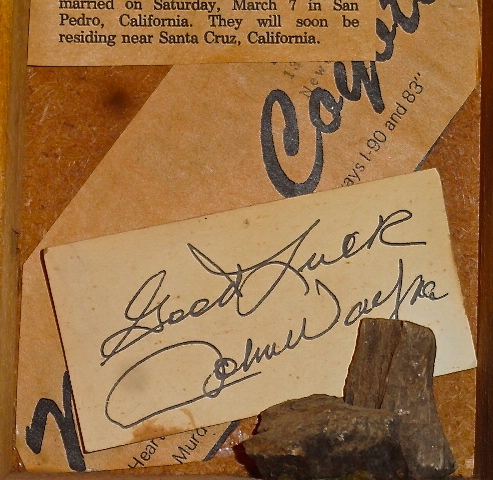
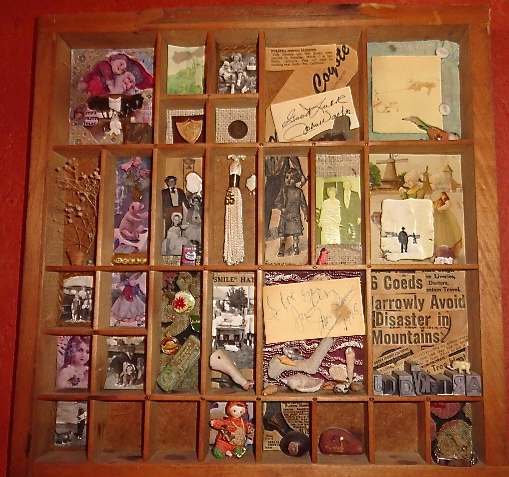
Long story short, John Wayne did not come back to campus with us. His manager managed to persuade him it was not in his best interests given that something in California was important enough to warrant his immediate return. But, I did get his signature and no, I did not turn it in for Sigma Chi Derby Days. To this day, it resides in a square of a memory box—one of the kind popular in the sixties and seventies that is made out of an old newspaper print box—and as proof, I include a picture below.

And yes, of course John Wayne was three sheets to the wind, for in keeping with the original rail-joining ceremony, “It was a very hilarious occasion; everybody had all they wanted to drink…”

https://dailypost.wordpress.com/dp_prompt/whoa/

DSC00166
For another great story about how Garry Armstrong met John Wayne, go here: http://teepee12.com/2016/01/08/the-duke-and-garry-a-pilgrims-tale-garry-armstrong/

The Prompt:  What’s the most surreal experience you’ve ever had?

My earlier post wouldn’t pingback to the Daily Prompt site, so I had to repost.  Here are comments from that earlier post:

lifelessons
grieflessons.wordpress.com
jubob2@hotmail.com
189.169.119.208

This seems to be a day for synchronicities. Did you read Mark Aldrich’s piece? Today is also my best friend’s birthday and I need to call her as well. Your mentioning your birthday reminded me of hers, so the chain goes on. Thanks for your kind words, Anton.

Mark Aldrich
thegadabouttown.wordpress.com
markaldrich68@hotmail.com
68.174.46.193

I wonder why that did not ping properly.

That is a treasure of a story.

Anton Wills-Eve
antonwillseve.com
willseve@aol.com
78.144.91.230

Judy you should have been a journalist! One of the best and most interesting posts I’ve ever read.Well done, but tell me, how did you know May 10 was my birthday? Seriously, it is. Anton. 🙂

Cees Black and White Photo Challenge: Things made out of plastic

DSC09337

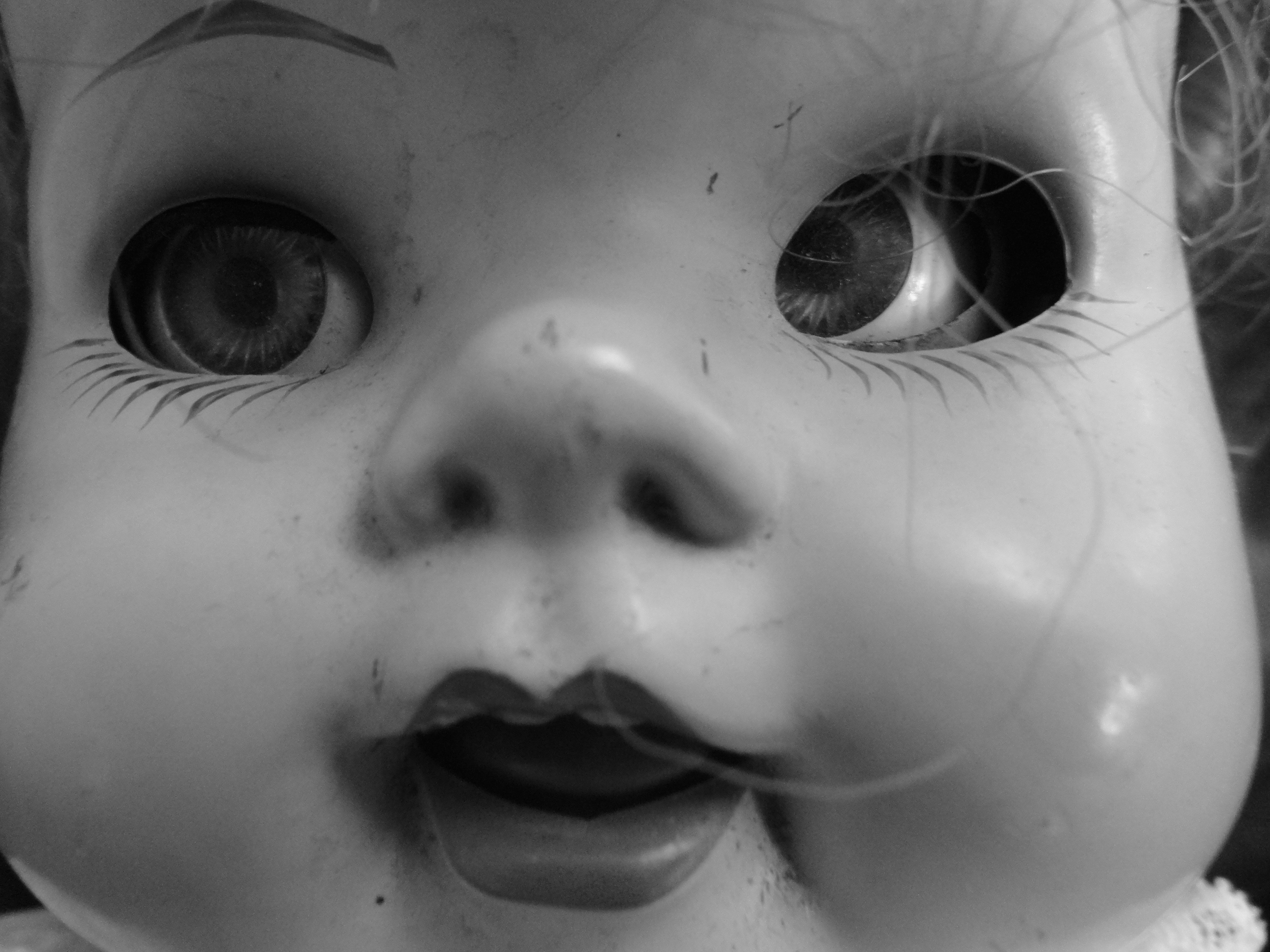
Every time my big sister’s friend Karen came to spend the night with her, she would bring her Bonnie Braids dolls to sleep with me. I recently visited both of them in Minneapolis! 60 years after they both moved away!!!

DSC06826 DSC06829 DSC06824


http://ceenphotography.com/2015/03/05/cees-black-white-photo-challenge-things-made-out-of-plastic/

Empty Cup

Empty Cup

You would think there would be some remnant left,
but death was simple.
You were there and then you weren’t.
After one deep ragged breath
you were so gone that even your body
seemed to miss you.  That stillness
so irrevocable. So not right.

Our friends all came
to see the place where you had been,
bringing offerings
to fill the void.
It was a full-packed house–
your sons, their wives, your daughter–
eight of us filling out every hollow corner.

I slept in the bed meant for two,
trying to convince myself I was enough–
trying to fill in the space you left.
That empty cup.

The Prompt:  Cut Off–When was the last time you felt completely, truly lonely?

Up Against the Wall

Up Against the Wall

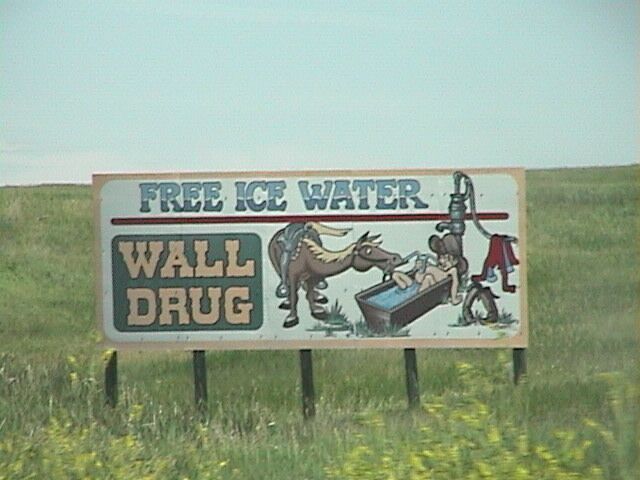
 Wall_Drug_Sign

If you haven’t heard of Wall Drug, you probably have never been to South Dakota.  Signs for one of the world’s oldest and best known tourist traps are spread out across the state and surrounding states as well as such far-flung locations as Antarctica, Afghanistan and Italy.  For me, it was an exciting stop along the only vacation route taken by my family for most of my young life, for Wall was stationed smack dab on Highway 16 between my even smaller town of Murdo, South Dakota and the Black Hills, where our summer vacation usually consisted of an overnight stay in “The Deer Huts” after taking one of my older sisters to the Methodist Youth Camp a few miles away.

The excitement of the Deer Huts consisted mainly of the fact that the bathrooms were all outside–little wooden enclosures marked by a half moon that my mother hated and I adored.  I loved the nighttime trip up the hill with a flashlight and the strangely reassuring sound of what had once been a part of my body making its dark descent down the long vertical tunnel–as though it was having an adventure of its own.  I loved the threat of animals watching me in the dark as I made my way back to the log cabin.  It was about as exotic as my life ever got before I finally left home for college at age eighteen and life really began. But I digress, for the true adventure that wound up at the Deer Huts always began when we got to the badlands–a series of sandstone hills and gullies that furnished the background for many a cowboy movie of the fifties.  Then, shortly after the badlands, came Wall Drug!.

You can read the full story of Wall Drug HERE.   If you are pressed for time, however, I will give you the shortened version. The whole phenomena of a drugstore in a small town of under 300 on a godforsaken prairie  in the middle of nowhere started in 1931 with a suggestion by the wife of the owner that they put up signs offering free water.  From there, the promotions grew into singing automated cowboy orchestras, stuffed longhorn cattle, a life-sized dinosaur, chapels, souvenir shops, other automated scenes, a restaurant offering such South Dakota fare as hot beef sandwiches complete with mashed potatoes and white bread swimming in brown gravy, homemade rolls, cherry pie and 5 cent cups of coffee with  free coffee and donuts offered to soldiers, ministers, and truck drivers.

I have pictures of me at age eight and age sixty-six, standing by a huge stuffed longhorn steer, bravely touching the horn.  The last picture was taken as my childhood friend Rita and I took our last long nostalgic trip across South Dakota. In the Wall Drug Cafe, we shared a hot beef sandwich, a cinnamon roll and a piece of cherry pie for old time’s sake, put a quarter in the slots to see the singing cowboys creak into action, still in tune after almost sixty years.

In this more sophisticated age, folks still stop at Wall Drug.  It’s possible their teenagers remain in the car, texting their friends or playing computer games with the air conditioning cranked up to dispel the scorching South Dakota summer sun, but I bet the little kids as well as the bigger kids who are their folks or grandfolks still wander the block-square expanses of Wall Drug, looking for thrills from another age and time. And somewhere within its cluster of rooms and passageways, Grandma can still buy an aspirin or get a prescription filled, then get a free glass of water to swallow it down with, Grandpa can still get a five cent cup of coffee and a little kid can taste his first delicious mouthful of South Dakota Black Angus beef, swimming in gravy and surrounded by reassuring slices of Sunbeam white bread and mashed potatoes.

The Prompt: Tourist Trap: What’s your dream tourist destination — either a place you’ve been and loved,https://dailypost.wordpress.com/dp_prompt/tourist-trap/ or a place you’d love to visit? What about it speaks to you?

Sweet Clover

Sweet Clover

Before our dad told us its real name,
we used to call it wild mustard.
What did we know about sweet clover except for its color
and that summer smell, cloying in its sugared perfume.
It filled the air and smothered the plains—
bright yellow and green where before
brown stubble had peeked through blown snow.

On these dry lands, what flowers there were
tended to be cash crops or cattle feed.
Sweet clover or alfalfa.
The twitching noses of baby rabbits brought home by my dad
as we proffered it to them by the handful.
Fragile chains we draped around our necks and wrists.
Bouquets for our mom
that wilted as fast as we could pick them.

Summers were sweet clover and sweet corn
and first sweethearts parked on country roads,
windows rolled down to the night air,
then quickly closed to the miller moths.
Heady kisses,
whispered confessions, declarations,
unkept promises.
What we found most in these first selfish loves
was ourselves.

The relief of being chosen
and assurance that all our parts worked.
Our lips accepting those pressures unacceptable
just the year before.
Regions we’d never had much congress with before
calling out for company.
That hard flutter
like a large moth determined to get out.
Finding to our surprise,
like the lyrics of a sixties song,
that our hearts could break, too.

Hot summer nights,
“U”ing Main,
cars full of boys honking
at cars full of girls.
Cokes at Mack’s cafe.
And over the whole town
that heavy ache of sweet clover.
Half promise, half memory.
A giant invisible hand
that covered summer.


The Prompt: The Transporter—Tell us about a sensation — a taste, a smell, a piece of music — that transports you back to childhood.

Mr. Cole

Mr. Cole

He lurked out in the hall as we all took our seats and came to order.  He took a drink from the water fountain, putting down what looked like a new briefcase as he did so.  He picked up the briefcase and made for the door, then turned and walked back to the fountain, putting his briefcase down as he took another drink.  He started for the door again.  Changed his mind and returned for another drink.  Then he squared his shoulders, picked up his case, re-rounded his shoulders and entered the room.

He was a little mole of a man—sniffy and hunched with scrunched-up eyes behind thick glasses.  When he entered the classroom, he looked straight down at the floor, as though he wasn’t sure one foot would follow the other without great attention.  He maneuvered his way to his desk and stood with his back to us.  He slammed his briefcase onto the desk, then removed it again, as though in indecision over whether he really wanted to stay at all.  Then he slammed it down again.  Removed it.  Slammed it down.

Finally, he moved around to face us and assumed a more teacherly demeanor.  He actually looked at someone in the front row for two seconds, before retreating back around to the back side of the desk, perhaps seeking some protection.

It was the first day of my freshman year in college. Next to me was a very new friend who not only lived in the same dorm but who also had just pledged the same sorority. We sported our bug-like black pledge pins on the fronts of our sweaters, a hand’s distance above the nipple, as we’d been instructed to wear them.  It was a bit like being in enemy territory, for we had already learned that the English department and the dormitories were not the best places to display our new status as Greeks so openly.  Our sitting together was a bit like circling the wagons on a westward journey.  We had each others’ backs.

“My name is Mr. Cole,” the dwarf said. “This is the honors section of Freshman English 101.”  He had facial ticks and a way of floating off into dreams.  Sometimes the end of a sentence just sort of wandered off, as though some other matter of greater importance had intruded upon his thoughts.  We did not disturb him in these reveries.  My new friend Linda and I would exchange looks and she would giggle the sexy little laugh that was her only laugh.  We both admitted, finally, to having a bit of a crush on him.

It was my first of many crushes on “different” men.  Men who had facial ticks or personality disorders that made others look on in horror or disgust just seemed to intrigue me, and my new friend was someone who gave validity to my strange behavior.  She, too, thought he was intriguing.  When we invited him to be a faculty chaperone for our pledge dance, he asked if he would be expected to function in the capacity of a bouncer and I assured him that no, it was more of an honorary position. To our surprise, he accepted, showing up with a tall willowy English department assistant who seemed herself to be of a literary bent.  I don’t remember if they danced, but I believe they dated for the rest of my college career.

You can see by my relation of these details how little I really knew about this man. On that first day in Freshman English, I remember being frightened and feeling inferior to the big town kids in the class.  If the truth were told, most of them were probably small town kids themselves, but coming from a town of 700, I thought of a town of 6,000 as a city , and I was sure that my own excellent academic record was more a result of comparison (there were 15 in my graduating class) than of true prowess.  Mr. Cole explained that instead of studying grammar, sentence and paragraph construction, that as honors students we would be expected to write an essay or story a week which would then be read in class and commented upon.

The night before our first writing assignment was due, my insecurity had kept me from committing a single mark to paper.  We had been given no topic and no direction.  This paper was to function as a sample of where we were on the continuum of writing skills.  This was to be my introduction to the strange gnomish man who had studied under Roethke.  Although I had no idea who Theodore Roethke was and no easy way of determining who he was in this pre-computer, pre-Google age, I had made one of my rare forays into the college library and found a whole section dedicated to his books in the poetry section.  So, I was about to be read by the student of a very important American poet.  And, I didn’t know what I was doing, really.  Our composition efforts in high school had been for the most part limited to essays and term papers.  I’d once written a humorous sonnet about Goldwater and Johnson and that was about it.  How did one go about writing a vignette, which as I recall was our assignment?  Midnight, one a.m., two a.m. ticked away on the smoking room wall as I sat looking at the blank page.

A fly, brought back to action by the hot light of my study lamp, worried my ear before buzzing off to pin itself to the wall. The smoke of my cigarette curled between us, and suddenly, in a sort of astral projection, I was that fly on the wall getting high on the fumes of a doobie that smoked in the ashtray beneath it.  The room was filled with the imaginary bodies of stoned kids splayed out on the floor or with headphones on their heads.  I started to write.  Forget that I had never smelled or seen marijuana, let alone smoked a joint. It was easier for me to imagine that fly getting high than to imagine myself doing so, but within a half hour, I’d completed the essay, set my alarm clock and had joined the fly in its herbally-induced sleep.

The next day, I placed my own sheet on the pile of papers on his desk.  Mr. Cole entered as usual, slamming the briefcase, removing it, slamming, slamming.  I had never been introduced to the term “Tourette’s Syndrome,” but many years later I wondered if perhaps this accounted for some of his oddness.  He would stand at the desk and crane his neck upwards, roll his eyes.  Sometimes he would look at one back corner of the room and then at the other, as though he were privy to some world and audience we had no access to. Seeing a film on Roethke, I wondered if he had patterned some of his odd behavior on his former teacher. This is just a scrap of a remembrance, so perhaps I dreamed it.  In this era of YouTube it would not be hard to check out.

Three days later, he was ready to discuss our vignettes.  There were many in this class, he revealed, who were able to put words down on paper but who were not writers.  There was one student, however, who had portrayed the truth in a way that the others had failed. This student had displayed courage in telling about a part of themselves that no one else had been willing to be vulnerable enough to display. He then read my essay as an example of superior writing to the entire class.

What I felt? Relief, certainly.  Pride?  Sorry, but yes.  I enjoyed being singled out.  After the class, other students came up to me saying they would not have had the courage to write the truth like that or to admit they’d smoked pot and applauded my success in exactly expressing what it was like to be stoned.  On the way back to the sorority house to do our pledge duties, my friend giggled and admitted she had never smoked pot.  “Neither have I,” I confessed, with a sideways grin at her.

I took three classes from Mr. Cole. In Honors Freshman English, I earned an A.  When I took creative writing from him a year later, he seemed to have me completely confused with another student who had taken a class from him the semester before.  He kept calling me Jenny and commenting on how my writing had improved.  The next semester, I took another class from him and in the margin of one of the first poems I wrote for him, he said, “Not quite up to the sudden fine standards you set for yourself last semester!”  I knew then that he was still thinking of me as Jenny and was disappointed that I’d returned to my former standards of mediocrity.  He’d given me a B+ on the poem.  I tried harder for the remainder of my last semester in his class, earned another A and would like to believe I lived up to his expectations. Of Jenny.

We do not always stand out in the memories of those we admire with the same clarity that they stand out in ours. What happened to Mr. Cole, I do not know.  As with many in our lives, when his importance in my own life ended, so did his existence.  I tried Googling his name once and found nothing, which may mean his own poetry books were published in a pre-computer era.  When I Google my own name, there are 209,000  entries listed, probably most having to do with some other combinations of my name, but most of the ones really referring to me have to do with writing. Probably all of those entries deserve a footnote of thanks to Mr. Cole, who was the first to find merit in my words and also the first to be deceived by them.

(You can see a 25-minutes YouTube video on Theodore Roethke here. Other than his reading style, he really doesn’t have much in common with Mr. Cole at all.)

The Prompt: Teacher’s Pet—Write about a teacher who influenced you.
China Bulldog

China Bulldog

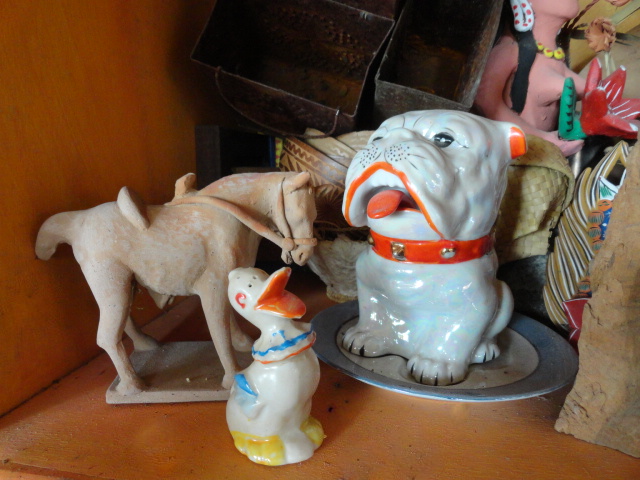
I dreamed last night that we were clearing out my mother’s house.  The front doors of all the kitchen cabinets had been removed and I was puzzled about this.  On the mantelpiece, I found China bulldog after China bulldog that was a replica of one I one my mother had told me to take home with me when I cleared out the house after my father’s death.  “Judy asked for this. You can fight over the rest.” said a note taped to the bottom.  A mayonnaise jar, it was of white glazed ceramic that had a rainbow sheen.  Its head came off as a lid and its bright orange tongue was the handle of a spoon.  The body fit into a depression in its saucer that had the outline of the bulldog’s feet and bottom so it nested a bit.

One of my first memories was seeing it sitting on the small triangular shelf in our kitchen.  My mother never used it and later, in newer houses where it didn’t suit the decor, it always sat within a cupboard.  My mother was too modern for China cabinets or knickknacks that didn’t match the color scheme.  When I was small, her taste went to magenta and chartreuse.  Beige and pink and turquoise marked the seventies, the turquoise and pink traded in for avocado and burnt orange in the eighties and back to a more understated green and beige in the nineties.

Whatever the color scheme, the bulldog never quite fit in, but it was the one object asked about by both of my sisters after the Loma Prieta earthquake.  I I was living in a house near its epicenter, and the bulldog had worked its way from the back of my kitchen cupboard to sit teetering on the edge, but it had not fallen.  It was one of the few things in a house packed full of art and artful objects that I chose to bring with me to Mexico.

I’d like to say that it has assumed a position of importance in my house in Mexico, but sadly, the China bulldog just never quite seems to fit in to the mainstream.  It has sat on a shelf in my studio for the past twelve years, somewhere near the back where it is safe but unseen.  But for some reason, if I were to be able to take one more object from my house, the China bulldog is what my mind falls upon. Perhaps it is time to think about why.

I often dream about a subject that ends up being my blog topic for the next day.  For some reason that topic fits into the prompt and so it is never very difficult for me to begin the day’s writing.  In this case, once I’d settled on the bulldog as my topic, I immediately remembered that in my dream I had found five or six bulldogs on my mother’s mantel.  Some were without bodies, all without their dishes.  Some were smaller than others and lacked the brilliant sheen or bright colors.  One seemed to be almost crumbling, as though it had been under water for a long period.  All were missing their tongues.

In the dream, I imagined my mother combing second hand stores and never being able to resist whenever she found a bulldog in the same shape as the one her older sister had given her when she was a child.  It’s been at least 100 years since she received that strange gift that was the only remaining thing that seemed to have been brought with her when she moved first from Missouri, then to Kansas and then to South Dakota, to marry my father.

She told me no stories about it and as I think about that, I realize she told me few stories at all.  Not about her wedding or my birth.  The stories in my family all centered around my father while her stories seemed safely tucked away on a shelf like the China Bulldog.  Perhaps that is why that one piece of all the pieces of my mother has assumed a center place in our memories. I know that my middle sister, who lived in the same town as my mother for the last six years of her life, has mourned her loss the most over the years.  My oldest sister, who was estranged from Mom for the last twenty years of her life, is in the throes of Alzheimer’s and so never mentions her at all.

It has been fourteen years since her death and I don’t think of her daily or even weekly, but every so often, something happens and the thought comes in a flash that I have to be sure to tell Mother about it; and for the past year, most of my poetry has been written in her joking, rhythmic cadence and rhyme.  Perhaps some essence of her that has been steeping in me for over sixty years has suddenly reached its saturation point and must come out.

And the China bulldog?  The dream? It is as though for all these years she has been trying to get it back, never quite replacing it but nonetheless not giving up the search.  And I can’t overlook the irony that it is these less perfect incomplete bulldogs that she chose to put on her mantel.  Is she trying to tell me something about beauty or the adherence to a dream or about giving up perfection to enter back into the quest?

My mind ricochets without finding an answer, but I continue to feel the prompt.  Perhaps there is reason in the name “wordpress.”  I feel that press to find meaning through words as I feel my mother’s gentle prod and communication through genes or memory or dreams, to leave perfect things behind and to get on with my life.

DSC09684

The Prompt: Burnt—Remember the prompt where your home was on fire and you got to save five items? That means you left a lot of stuff behind. What are the things you wish you could have taken, but had to leave behind?

South Dakota Gumbo

South Dakota Gumbo

When the rains came in hot summer,  wheat farmers cursed their harvest luck, for grain sodden by rain just days before cutting was not a good thing; but we children, freed from the worry of our own maintenance (not to mention taxes, next year’s seed fees and the long caravans of combines already making their slow crawl from Kansas in our direction) ran into the streets to glory in it.

We were children of the dry prairie who swam in rivers once or twice a year at church picnics or school picnics and otherwise would swing in playground swings, wedging our heels in the dry dust to push us higher. Snow was the form of precipitation we were most accustomed to–waddling as we tried to execute the Xs and Os of Fox and Geese bundled into two pairs of socks and rubber boots snapped tighter at the top around our thick padded snowsuits, our identities almost obscured under hoods and scarves tied bandit-like over our lower faces.

But in hot July, we streamed unfettered out into the rain.  Bare-footed, bare-legged, we raised naked arms up to greet  rivers pouring down like a waterfall from the sky.  Rain soaked into the gravel of the small prairie town streets, down to the rich black gumbo that filtered out to be washed down the gutters and through the culverts under roads, rushing with such force that it rose back into the air in a liquid rainbow with pressure enough to wash the black from beneath our toes.

We lay under this rainbow as it arced over us, stood at its end like pots of gold ourselves, made more valuable by this precipitation that precipitated in us schemes of trumpet vine boats with soda straw and leaf sails, races and boat near-fatalities as they wedged in too-low culvert underpasses.  Boats “disappeared” for minutes finally gushed out sideways on the other side of the road to rejoin the race down to its finale at that point beyond which we could not follow: Highway 16–that major two-lane route east to west and the southernmost boundary of our free-roaming playground of the entire town.

Forbidden to venture onto this one danger in our otherwise carefree lives, we imagined our boats plummeting out on the other side, arcing high in the plume of water as it dropped to the lower field below the highway.  It must have been a graveyard of vine pod boats, stripped of sails or lying sideways, pinned by them.  We imagined mind soldiers crawling out of them and ascending from the barrow pits along the road to venture back to us through the dangers of the wheels of trucks and cars.  Hiding out in mid-track and on the yellow lines, running with great bursts of speed before the next car came, our imaginary heroes made their ways back to our minds where tomorrow they would play cowboys or supermen or bandits or thieves.

But we were also our own heroes.  Thick black South Dakota gumbo squished between our toes as we waded down ditches in water mid-calf.  Kicking and wiggling, splashing, we craved more immersion in this all-too-rare miracle of summer rain.  We sat down, working our way down ditch rivers on our bottoms, our progress unimpeded by rocks.  We lived on the stoneless western side of the Missouri River, sixty miles away. The glacier somehow having been contained to the eastern side of the river, the western side of the state was relatively free of stones–which made for excellent farm land, easy on the plow.

Gravel, however, was a dear commodity.  Fortunes had been made when veins of it were found–a crop more valuable than wheat or corn or oats or alfalfa. The college educations of
my sisters and me we were probably paid for by the discovery of a vast supply of it on my father’s land and the fact that its discovery coincided with the decision to build first Highway 16 and then Interstate 90.  Trucks of that gravel were hauled  to build first the old road and then  the new Interstate that, built further south of town, would remove some of the dangers of Highway 16, which would be transformed into just a local road–the only paved one in town except for the much older former highway that had cut through the town three blocks to the north.

So it was that future generations of children, perhaps, could follow their dreams to their end.  Find their shattered boats.  Carry their shipwrecked heroes back home with them.  Which perhaps led to less hardy heroes with fewer tests or children who divided themselves from rain, sitting on couches watching television as the rain merely rivered their windows and puddled under the cracks of front doors, trying to get to them and failing.

But in those years before television and interstates and all the things that would have kept us from rain and adventures fueled only by our our imaginations, oh, the richness of gumbo between our toes and the fast rushing wet adventure of rain!

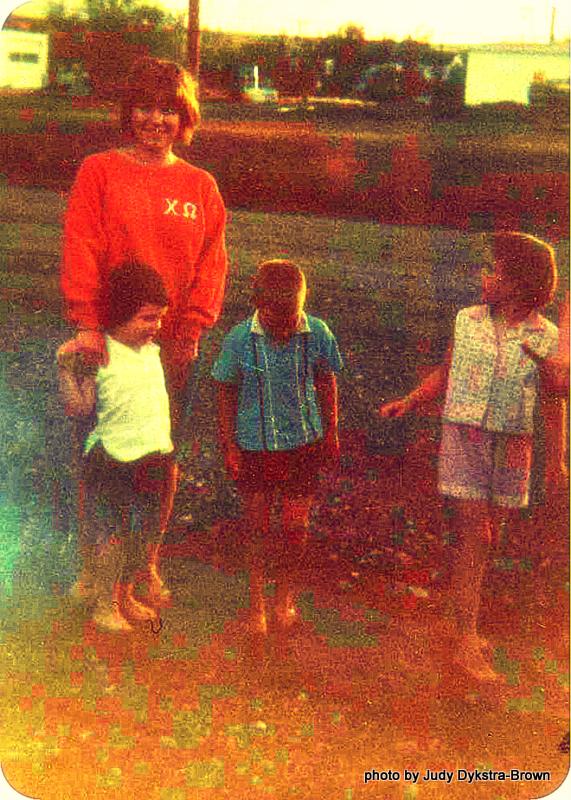
Writer’s note:  I know my sister Patti is going to read this and cry, and so I want to present you with this mental picture of her, college age, Levi cuffs rolled up above her knees, surrounded by five-year-old neighbor kids, enjoying her last big adventure out into the ditches of Murdo, South Dakota, during a July rain.

But wait!  A mere two hours of digging and another hour of editing has produced this proof of my former statement, so to augment your mental image, here is the real one:

Patty in mud 001-001

Not quite the gusher depicted in the childhood vignette, but nonetheless, Patti’s final puddle adventure. She had taken my visiting niece out. The next day the neighborhood kids rang our doorbell and asked my mom if Patti could come back outside to play! Ha.

The Prompt: Free Association–Write down the first words that come to mind when we say . . . home. . . soil . . . rain. Use those words in the title of your post.