Tag Archives: Mexico

Work Ethic / Canción de México: Two Poems

The Prompt: Gut Feeling—When’s the last time you followed your instinct despite not being sure it was the right thing to do? Did it end up being the right call?

Work Ethic

There’s something stirring in me. I do not know its name.
It whispered to go seawards, so that is why I came.
I do not know the object, though once I thought I did.
Once here the book I thought I’d write left my mind and hid.

I find that I am drifting like a seabird on the swell;
and so far that is fine with me, in fact I like it well.
Instead, I write these ditties that I finish every day,
forsaking what I think I should to just write what I may.

No need for all the boring things: research, footnotes, citing.
Whatever is in front of me is what I end up writing.
Some might say that it’s responsibility I’m shirking,
but I say that I’ve simply learned to go with what is working.


Canción de México
(Song of Mexico)

This small café sits on the square, or rather the rectangle.
The gas trucks pass by, blaring “Gaaaaas,” their grounding chains a-jangle.
Trucks and cycles lacking mufflers roar by every minute,
bass blaring from each car window without much music in it.

The guinea fowl make such a ruckus that they sound insane,
but to complain about the noise in Mexico’s inane.
The daily garbage trucks, the water truck and all the rest
all live by the assurance that what’s loudest is the best.

I drink my coffee, eat my muffin, try to grin and bear it;
but when she sets a napkin down, I grab at it and tear it.
And even though one part of me says that I shouldn’t dare it,
I use a bit to wipe my lips. The other part? I wear it!

I stuff a wad in either ear, and though I still hear all,
I go by the illusion that I hear it from afar.
Sometimes I feel the threat of age, so quickly it is nearing;
but if I lose one faculty, dear God, please make it hearing!

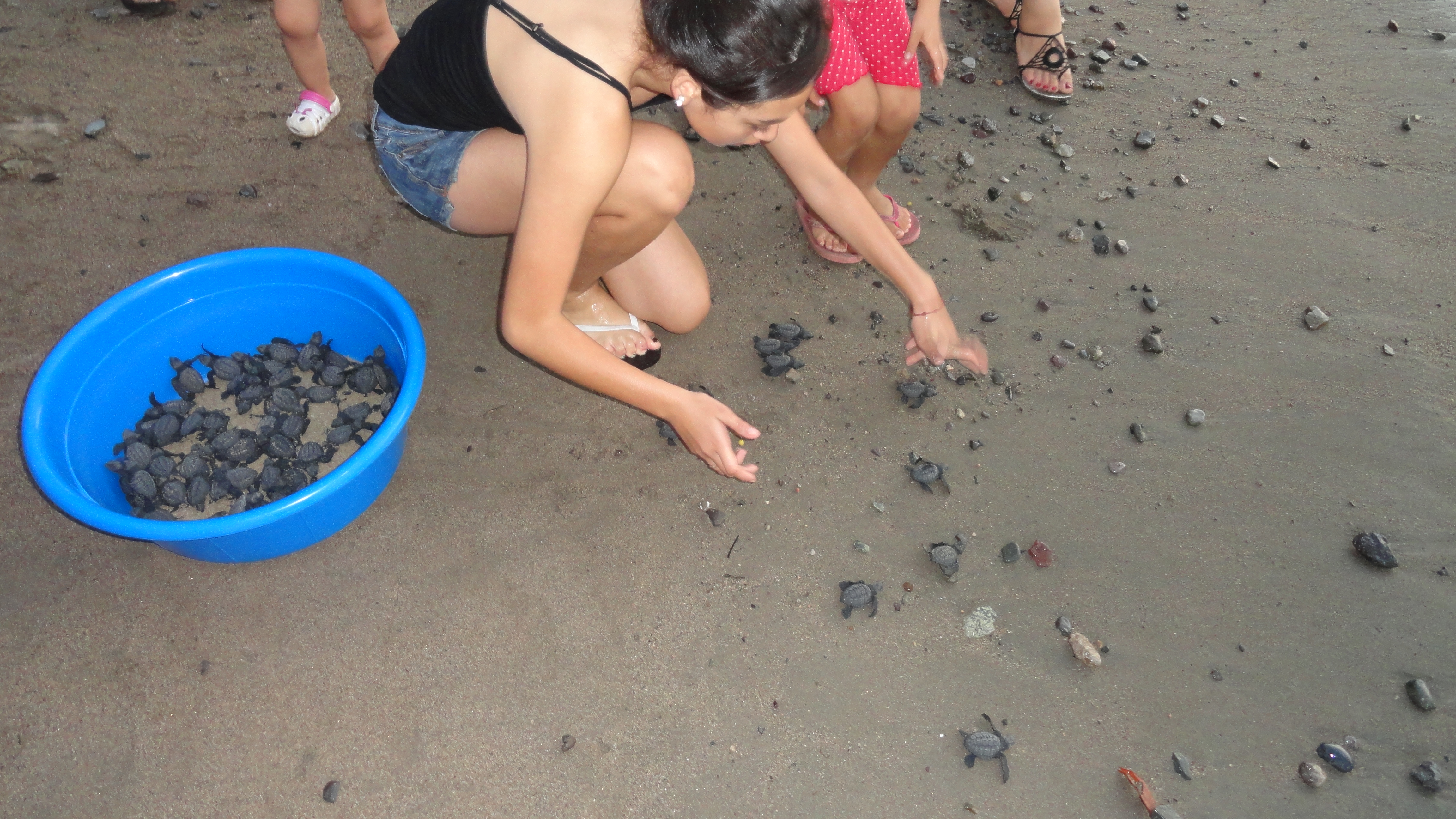
Putting the Tiny Sea Turtles into the Sea

DSC00181 DSC00184 DSC00188
DSC00195

Cruel Harvest

In this middle morning,
pelicans drop like hail on the surface of the water.
This is not their usual style,
for they do not dive headfirst
and squeeze bills to necks
and swallow as before,
but merely float and dip their beaks
and raise their heads and dip again.

I hope it is not the tiny sea turtles
that we put in the water last night
that they are feeding on like hors d’oeuvres,
greedily.
But surely those turtles,
placed in to swim away 15 hours ago
are elsewhere than this,
facing other dangers, no doubt,
but at least to one I don’t bear witness to.

 We had waited until sunset
when the birds had gone
to lift the tiny creatures
from their plastic world
and set them,
confused and stunned,
upon the sand
to turn in circles
until we placed them right again
and again,
sometimes patting their tails
to encourage their voyage
to a new life shocking in its largeness.

 “What is this
lifting up and putting down?”
they must think,
“and then this broad expanse
that lifts us, spins us,
submerges us?
We lift our heads and swim,
then tumble, in shock.
What more has life to surprise us with?
First bursting from the shell that had protected us
now this thrusting into a colder world.”

Children squeal with glee and are warned by elders
not to step back lest they step on turtles that surround us all.
All of us look backwards as we step.
Cameras clicking,
voices in English, Spanish, French—
all enchanted with these creatures perfectly formed
with black flippers and beautiful shells.
We see their tiny heads like periscopes above the waves—
swarms of them at first and then separate,
swimming off to their individual fates.
Fifteen minutes later, the rising action
features a solitary pelican that swoops for one
and then another and another
bedtime snack.
“No,” we scream.
One woman throws a rock.
These pelicans that have enchanted me for weeks
as I watched their graceful flight and sure plummetings,
now prompt a new story.
They are villains, stopping new life,
bringing back the theme I am so aware of here
for these weeks floating in the sea.

Every organism, every animal, every person on this earth
lives only by merit of the death of others.
When life ends in infancy, how sad, how sad, we say;
but also say seeing the full grown pelican on the beach,
bleached to bones,
its beak sealed shut with a plastic circle from a six pack
or the needlefish, stretched on the sand and picked by carrion.
Never so obvious as here, this feeding of life on life
and never so startling as when we place the baby turtles
on the sand, wanting to save one for ourselves,
but knowing this action has a larger purpose than that.

We surrender them to their life apart from us,
then moments later,
see the pelican feed on them
guiltlessly,
living his place in the world.
Oh that I, too, had acted more selfishly—
palming the tiny turtle,
putting it in my loose pocket,
keeping it safe
away from that broad sea
that has so many means
by which to claim it.

WordPress Weekly Photo Challenge: Converge

 Converge

I love prompts like this that force us to look at our photos in a different way.  I’ve just been waiting to use the first one below, which seems perfect for this challenge.  Thanks, WordPress, for pushing our minds as well as our eyes.

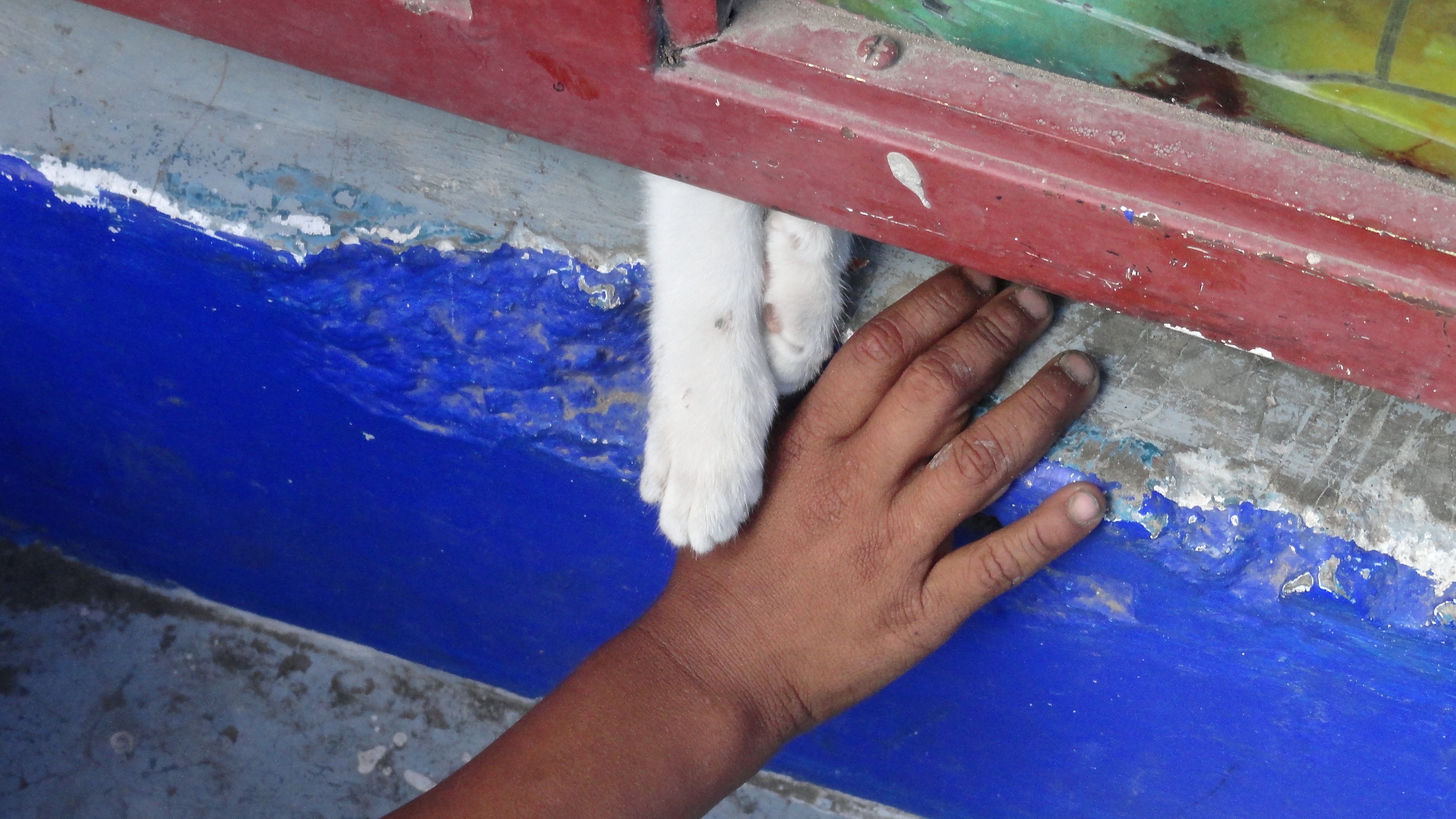
DSC08989

I arrived at a local coffee bar/gallery to find it closed. This didn’t deter two little boys outside or the inside kitten, from communing. Where there is a will, convergence will happen!

DSC09117

The woman, the children and each of the dogs each arrived separately to converge. There were three extra dogs as well, but I liked the composition of this cropping of the photo. The small dog jumping out from behind the umbrella pole is a picture by himself and seems to be gaining the attention of all except the children who are intent in their creative efforts in the sand.

DSC09044

This fish was alive and left upon the sand to die. I couldn’t help but identify with his efforts to draw air. This is the part of fishing that bothers me the most. The children saw little difference between the live fish and the dead one, wanting to touch every surface. When the bigger boy reached to touch the eye, I flinched, but luckily the fish was dead by then. Not my catch. Not my boys. If they were, all would have passed differently.

DSC09386 DSC09667

For more “Converge” photos, go here:
http://ceenphotography.com/2014/12/01/wp-weekly-photo-challenge-converge/

To The Island

The Prompt: We’ve all been asked what five objects we’d take with us to a desert island. Now it’s your best friend’s (or close relative’s) turn to be stranded: what five objects would you send him/her off with?

To the Island

If I sent you to an island, it would be for your own good.
It wouldn’t be unwillingly, with chains and ropes and hood.
I’d lure you off to be with me, surrounded by the sea.
You wouldn’t have to talk or walk or be in love with me.

The objects that I’d give you are a camera, notepad, pen
and a computer with no wifi to connect to where you’ve been.
You’d live in the present with the details of your life,
examining where you have been without the daily strife.

With no Internet distraction, no ringing of the phone,
sometimes you find a part of you that you have never known.
There’s something that is lacking in what’s crowded in one’s brain.
It’s hard to find ourselves when we must live the whole world’s pain.

In the morning, you would walk the beach, move inward with the tide,
examining what treasures the waves conceal inside.
A stone shaped like a check mark or a continent or heart–
it’s hard to suspend looking, once you’ve made a start.

You may take photos of them or collect them in your pocket—
something to make art from, or a picture for your locket.
Another way to get inside is what you write about them.
If you have secrets, it’s inevitable that you’ll out them.

The sea’s part of something larger and each treasure is a clue
connecting the whole universe to something within you.
This is why each object plucked up from the sand
is part of you that you’ve reclaimed—there within your hand.

What you see in what you find is what you have inside.
Perhaps it’s something you don’t know or that you know and hide.
The very fact that it is here revealed for you to see
may mean that you are ready to finally set it free.

The sea with all its treasures and its recurring tide
is also found within you—safely tucked inside.
So look into a mirror—a metaphor, more or less;
if you are wondering if you’ve changed, you won’t have to guess.

You’ll look for things within yourself as closely as the sea
and find out more of who you are and who you want to be.
You’ll see the changes on your face that say you’ve become wise.
Deep worry lines around your mouth and laugh lines by your eyes.

And once that you have found yourself, you’ll find yourself again;
for you are always changing—refining what you’ve been.
Tucked off on an island like a wallflower on a shelf,
perhaps you’ll find the whole wide world there within yourself.

And when you see the world within, you’ll want to live in it,
for it’s a world that you have power to change as you see fit.

DSC09967

Just a few of the more than 30 heart-shaped rocks I’ve found. I’ve photographed many more than that.

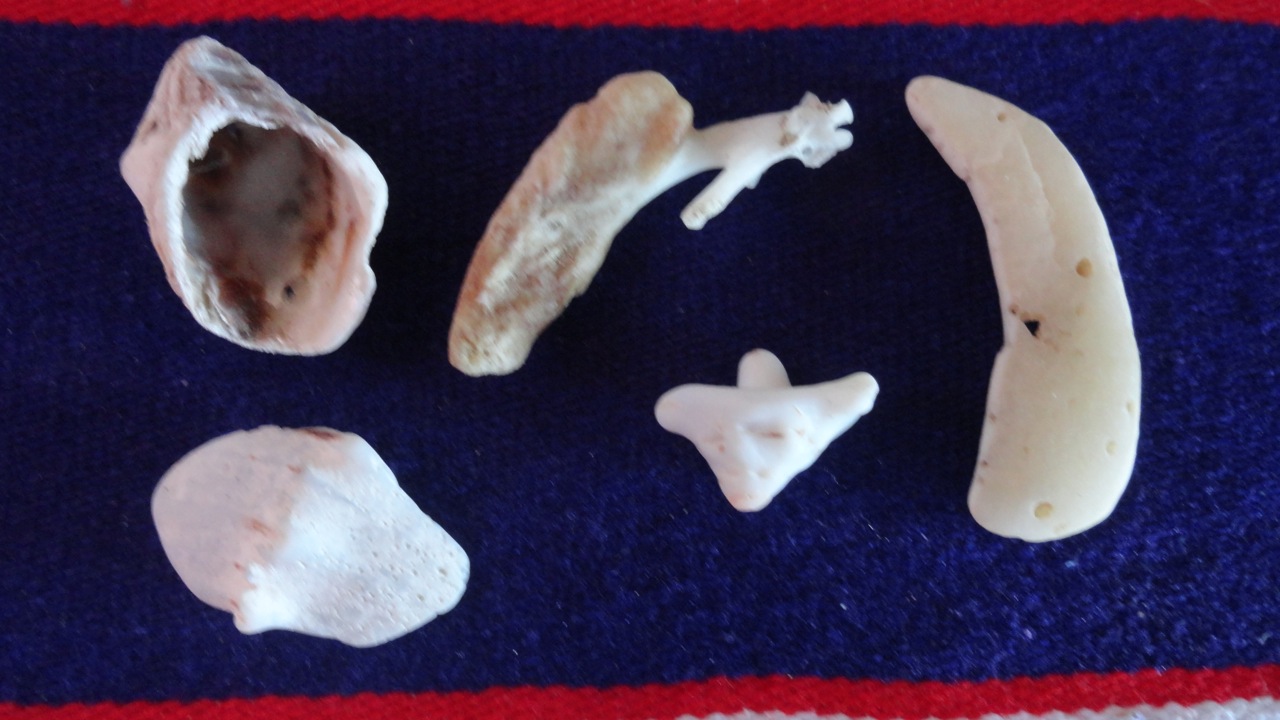
DSC09972

What do you see in these beach finds?

DSC09976

This check mark shaped stone was one of my favorites today. I also found one in the shape of Africa, which is alluded to in the poem, but didn’t take a photo.


Frozen

  OLYMPUS DIGITAL CAMERA That little peak you see peeking over the shoulder of the big mountain we all call Senor Garcia is the sister peak to Colima Volcano, who gifts us with the 120 degree steaming hot water that streams into our pools, hot tubs and cisterns in the neighborhood above San Juan Cosala, where I live.

Frozen

Lately, the mornings had grown crisp. Even here, below the tropic of Cancer, where they were rumored to have the second best climate in the world, they suffered a few weeks of weather where she regretted having neither heat nor air conditioning in her house. Its brick and concrete walls held-in the cool air. In the summer, this was a welcome fact. Now, in mid-November, it created the effect of the cold storage locker at the butcher shop in the small South Dakota town where she had grown up.

The butcher shop had a room-sized walk-in freezer that functioned as a meat safety-deposit vault. People in the town paid to rent private lockers. Ranchers could bring  a live cow to the butcher and he and his family would kill it, age the meat, wrap it in neat packages labeled hamburger, rib eye, chuck roast, rump roast or sirloin; and then stow it away in drawers big enough to hold an entire dismantled cow. When she was very small, she could remember going to the locker with her mother or father to get the week’s meat from the drawer that had their name scrawled on a piece of masking tape stuck on its front.

The locker also sold ice cream sandwiches by the carton of 50 or so, which they would take home and store in the freezer compartment of their refrigerator. They were square little bars—half the size of the bigger ones you could buy individually at the supermarket, and she grew chubby the year she turned nine—probably mainly due to her mother’s lack of rules about how many could be consumed daily. When the supply grew sparse, it was replenished by whoever went to the locker—her mom or dad or oldest sister.

It is early morning and she puts off getting out of bed to face the brisk air. Water is streaming into the pool. She can hear its hiss as the hot volcanic water hits the cooler water of the pool. Pasiano the gardener clears his throat. Later, when Yolanda arrives, the dogs will grow restless and bark to be fed. It is not the bright morning promised by the precognition of the weather channel. Even through the white scrim of the manta cloth drapes, She can tell that the sun is muted. The past two days have been marked by intermittent rain showers coming from a sky permanently cottoned-over by a layer of clouds that now and then the sun peeks through. As she lies in bed typing, she can see a light ray through the curtains, but it fades quickly away.

8:01. It is now legal for the noises of the day to begin. The neighbor’s spoiled son roars by in his ATV that is muffler-less. The harsh sound slashes a gash through the gentler sounds of the day: the whisk whisk whisk of Pasiano’s broom, the surge as a steadier supply of hot water streams into the pool from the pipe hidden within the concrete form of a plumed serpent that spews water from between the fangs of its open mouth.

She has fantasized about stringing a wire across the cobblestone road to spill that teenaged brat from his ugly machine. This is the violence prompted by an early morning slaughtered by his ear-splitting exit. On weekends, he is up the hill and down the hill with his friends. Once, when she went to protest, they steered their monster tricycles in her direction, veering off just as she jumped back onto the sidewalk. She couldn’t hear their laughs above the deafening din of three bikes, but the girls on the back of the vehicles  turned to look at her as they roared away, and their mouths were stretched in broad grins of amusement over this aged gringo who had come out with a frown to comment on the fun of youth.

They have gone. She can hear their mechanical beasts speeding down the road toward the carretera, their loud roars terrorizing neighborhood after neighborhood as they pass. She returns to the house to make the phone call to the office that will protest this noise and this small terrorist action.

“Yes, senora, we will look into it.”

“Will you call their father this time?”

“Yes, senora. The father is in Guadalajara now, but when he comes, we will call him.”

“They veered their bikes toward me so I had to jump back on the sidewalk!”

“Yes, senora. We will tell them.”

She hangs up knowing they will not tell the parents anything. They are important enough to have a huge house here in the tennis club where she lives— house they use on occasional weekends. A house which sits empty for most of the year. A house where they once brought their children and their cousins and friends to swim in the steaming hot water of the club pool or their own pools. A party house for their children, now that they have reached their teen years.
The father would be an important business man with connections, perhaps a judge or politician. It was rumored that one of the houses on her street, one further up the mountainside, was owned by a member of the cartel.

Whatever the truth of this, the complaint would not be made. In Mexico, so long as their misdeeds did not come too completely to the surface, the rich were invulnerable—cushioned by a layer of privilege augmented by mordida. No foreigner who chose to come up against a Mexican would ever win—no matter how large the misdeed. Murderers might be caught, but the case would then fade away in time so that they might never be tried, but again would be released on some technicality given birth to by mordida. Houses and land paid for in full by gringos could be reclaimed by entrepreneurs or ejidos powerful enough to know the right judge or the right politician.

Now the roar of the ATV’s is forgotten with the passing of the first truck hauling gravel and stone up to the construction site at the highest point presently reachable on the mountain. One day those mountains that rose so beautifully above her would be filled with houses to the very top; but for now, as the noise of the churning engine fades into the cold white sky, she contemplates what she will write about now that the demands of the prompt have been met. She will not write a funny rhyme today. Her mind has already been trapped by the mood prompted by the demands of this day’s topic.

She wonders how the parts of what she has written can be brought together. It is as though she has written a beginning and an end with no middle. Perhaps that was how a novel was begun in the mind of a novelist—to start out with meat in a cold storage locker and end up with a neighbor’s son terrorizing the neighborhood on an ATV. Was that how it went? Could she stuff those two vignettes with enough information to stretch them apart like a bota bag full of sweet wine? Did she have the capacity to grow those grapes, the skill to ferment them and siphon them into the bag she has created on this cloudy morning that only now was beginning to let the rays of sunlight through? That strong Mexican sun made more powerful by the high elevation of this place at the almost top of a mountain on a street set at such an angle that if there were ever snow here, she could step outside her house and sled in one straight line down to the lake that was a mile away, across its frozen surface, all the way to the other side.

The Prompt: Today you can write about anything, in whatever genre or form, but your post must include a speeding car, a phone call, and a crisp, bright morning. (Wildcard: you can swap any of the above for a good joke.)

Agustin’s Story

Update Dec. 14, 2017: I’m very curious about why, three years after I posted this story about Agustin on my blog, I’ve suddenly had over 200 viewings of it in one day. If you’re reading this, would you please add a comment to tell me how you came to do so? Thanks, and thanks for viewing it!

The Prompt: Second-Hand Stories—What’s the best story someone else has recently told you (in person, preferably)? Share it with us, and feel free to embellish — that’s how good stories become great, after all.

Agustin Vazquez Calvario: Renaissance Man and Good Samaritan of San Juan Cosalá

I have been told many stories by Agustin, and some day I will share them with you, but I think they’ll have more power if you know more about the man, so today I want to tell you about him.

                        DSCF7765_2

A number of years ago, a popular situation comedy in the U.S. was “Cheers,” a story about a Boston pub that became a home away from home for its regulars. Some of the lyrics from its enormously popular theme song were:

Making your way in the world today takes everything you’ve got.
Taking a break from all your worries, sure would help a lot. . . .
You wanna go where people know people are all the same,
You wanna go where everybody knows your name.

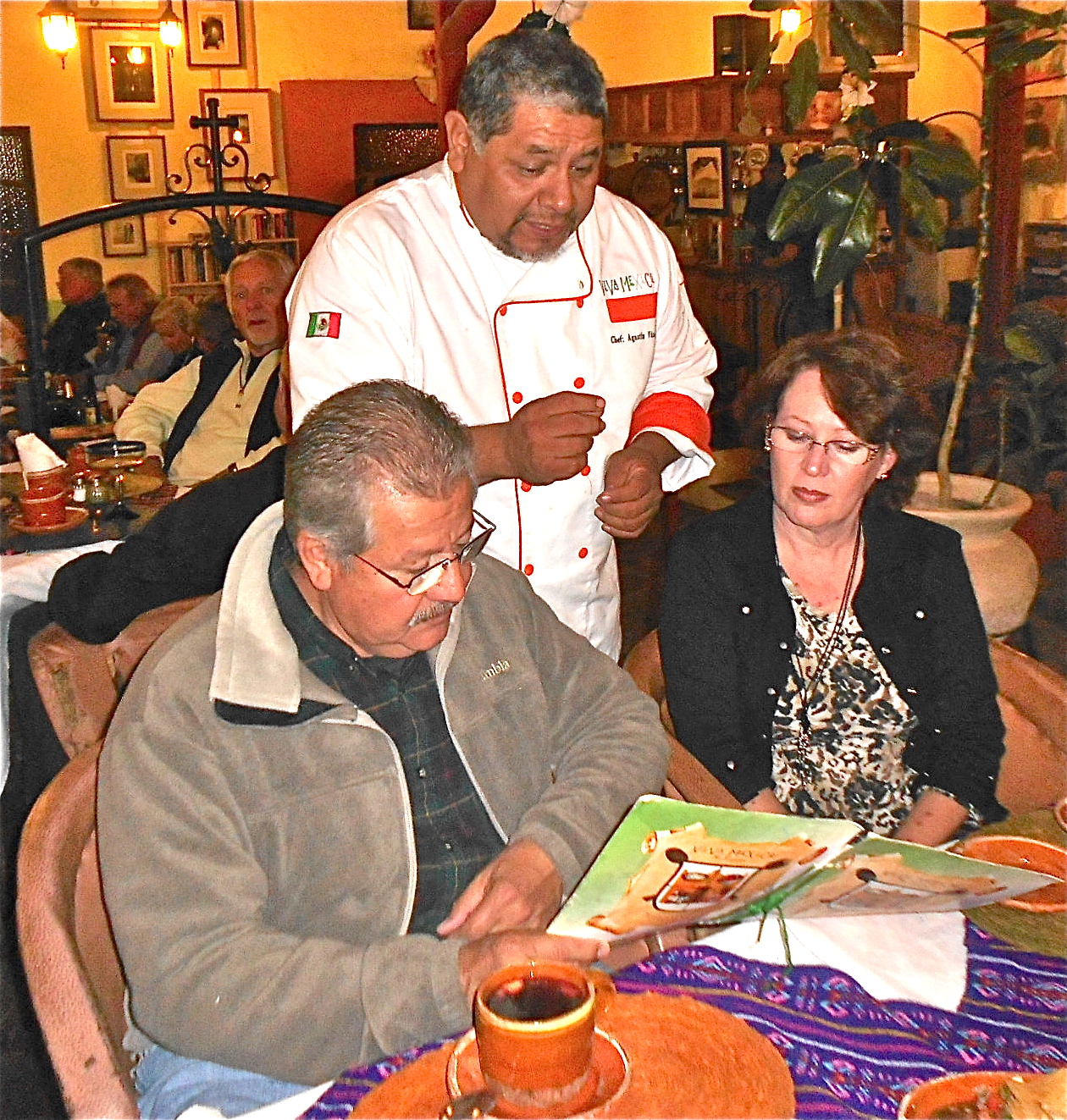
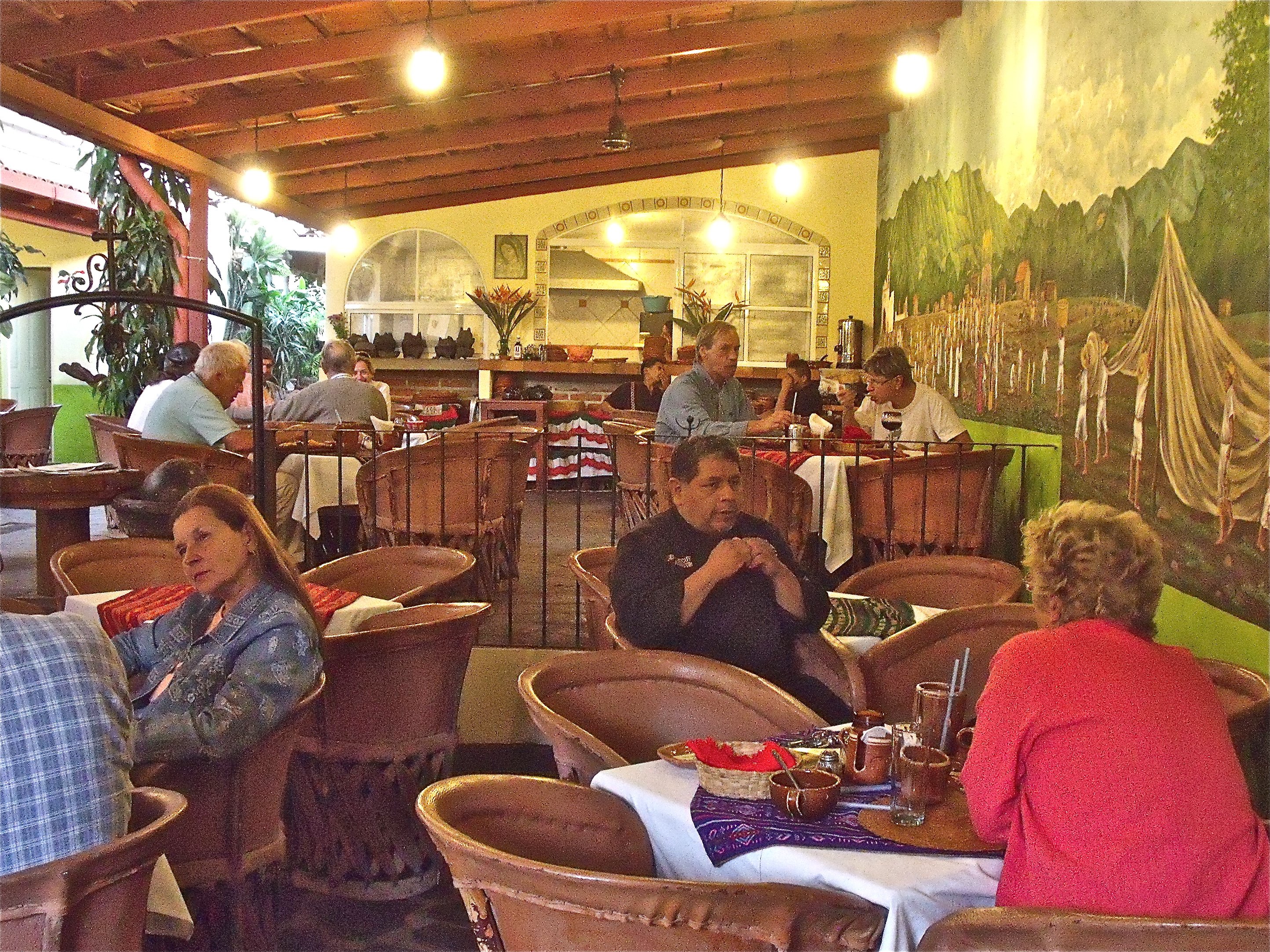
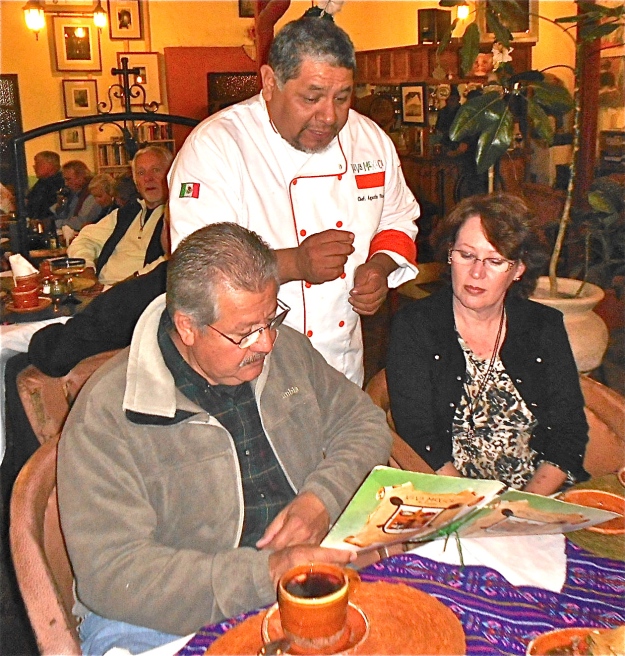
 In San Juan Cosalá, Mexico, a pueblo of 6,000 on Lake Chapala, about an hour’s drive away from Guadalajara, that place is Agustin Vazquez’s restaurant, Viva Mexico. It is a warm, art-filled social center for the community that in my opinion also happens to serve the best food lakeside. Here as in the rest of his life, Agustin functions as half scholar, half artist, surveying other restaurants, cookbooks, websites and even literature such as Like Water for Chocolate for recipes that will enable him to bring to life again Mexico’s rich culinary history.
DSCN1347

Quail in rose petal sauce is one such recipe which joins other special menu offerings such as fish fillets cooked in banana leaves with fresh herbs, chiles en nogada, pork shank, and ribs simmered in Agustin’s homemade sauce. Other traditional favorites are pozole (a rich pork and hominy stew) and molcajetes (beef, chicken or shrimp with sweet green peppers, onions, panela and other cheeses with a red or green sauce, cooked in a traditional stone receptacle). My favorite is a molcajete of chicken breast cooked in green sauce. Mmmmmmm. No one I’ve ever recommended it to has been disappointed, and I recommend it to everyone I see who is about to order.

More artistry is displayed in the presentation. Vegetables are fanned in flower shapes, organic lettuce supports the freshest tomato slices, and the entire plate becomes an artistic pleasure that makes one pause a moment to survey the plate before succumbing to the wonderful odors that presage delightful tastes and textures to be experienced.

DSCF8268Chiles en Nogada is a popular item on the menu.

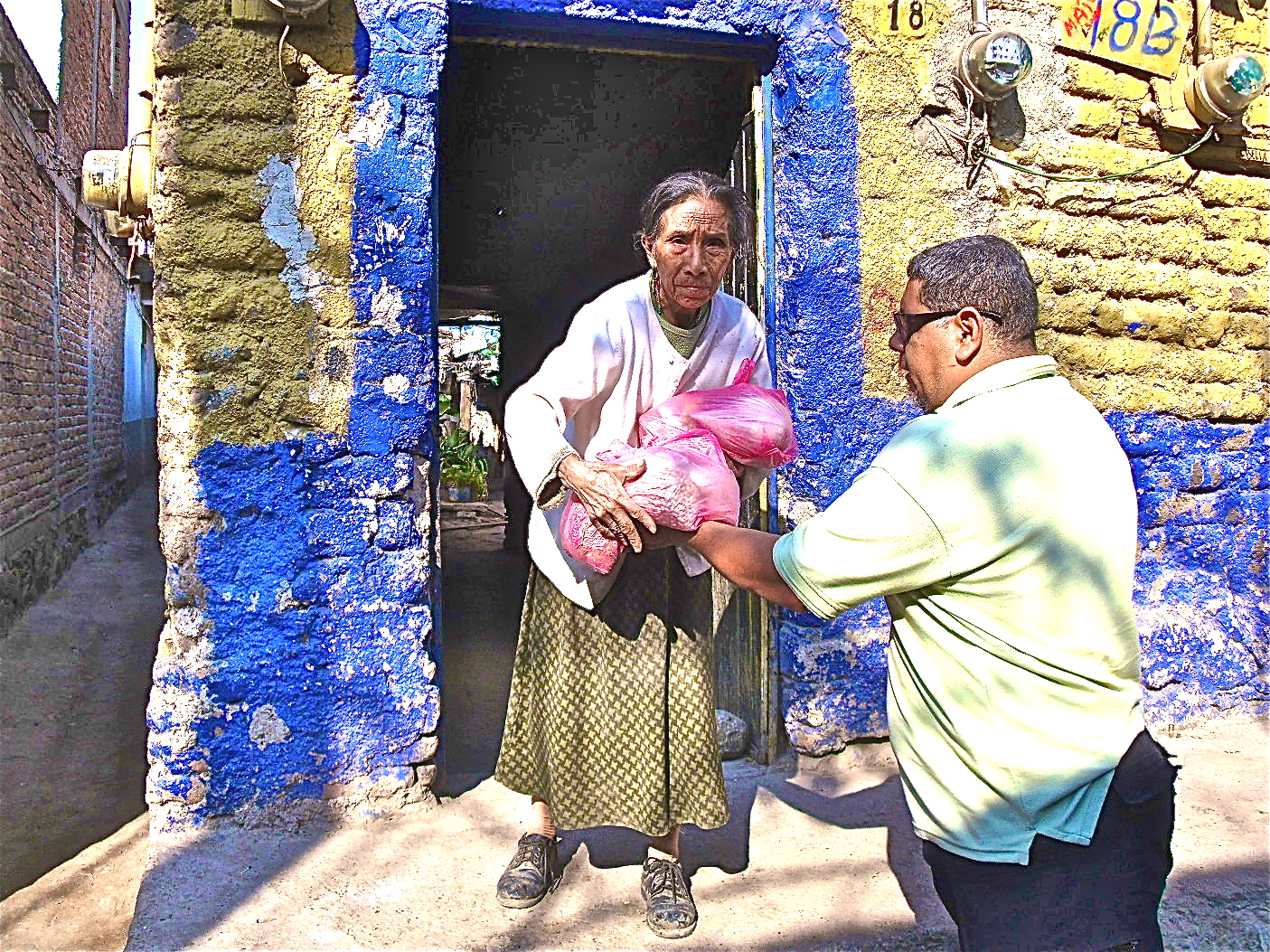
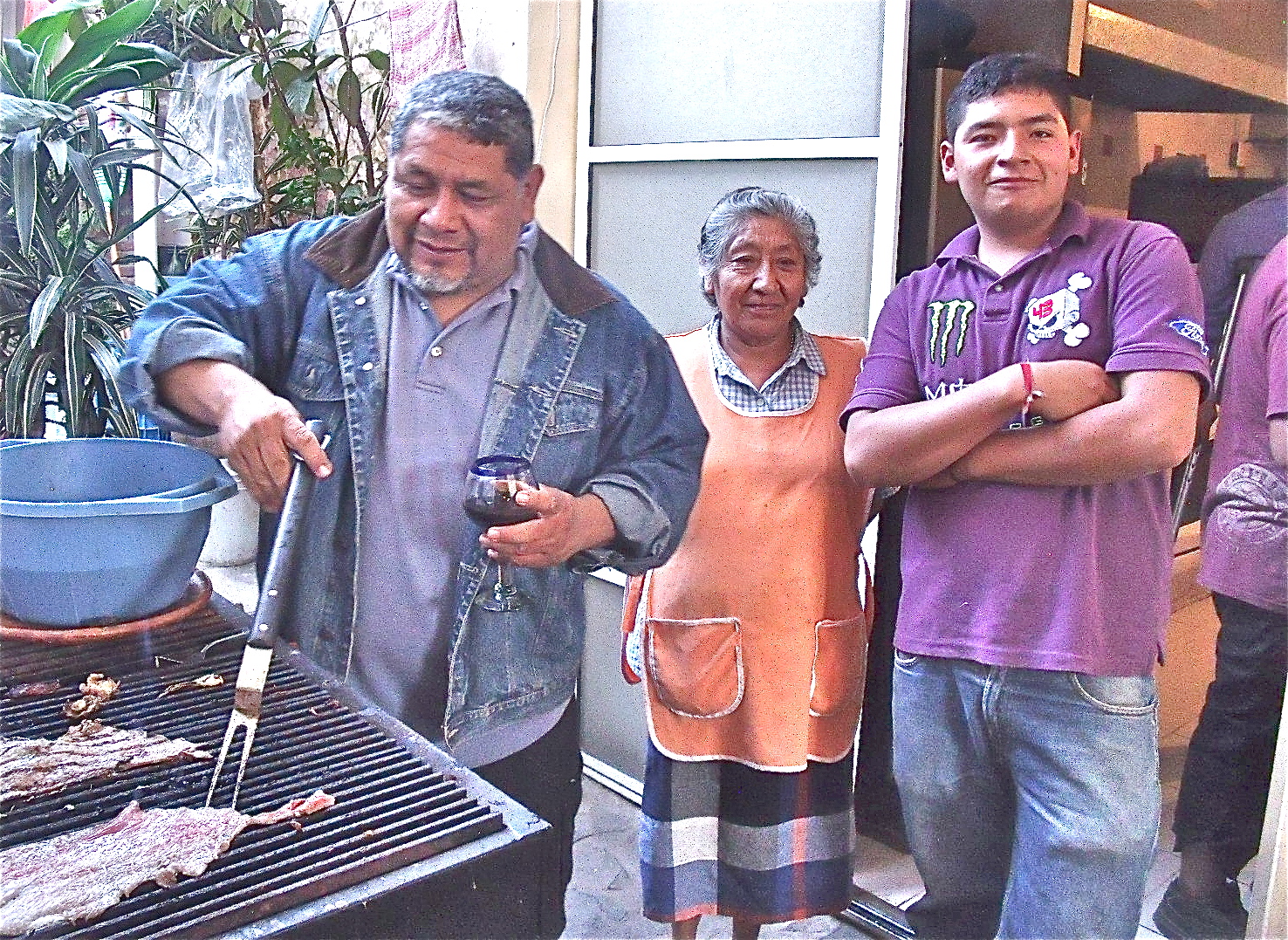
 A lifelong local resident who has his community and its people in his heart, Agustin is so busy that it is hard to imagine how he fits all of his obligations into one day, for his creation of one of the most popular restaurants in the area is just one small part of his life. He also helps to direct a charitable food operation that now feeds 100 families in his home village, personally purchasing the food and for years, delivering it to each family once a week. (Now the families come to receive their weekly ration from a new region of his restaurant  that serves as a storage space and dispensa for Operation Feed.) Since he joined the program a few years ago, his skill in bargaining has allowed them to double the number of families who are helped by the program. He does not allow them to reimburse him for his gas or his time.
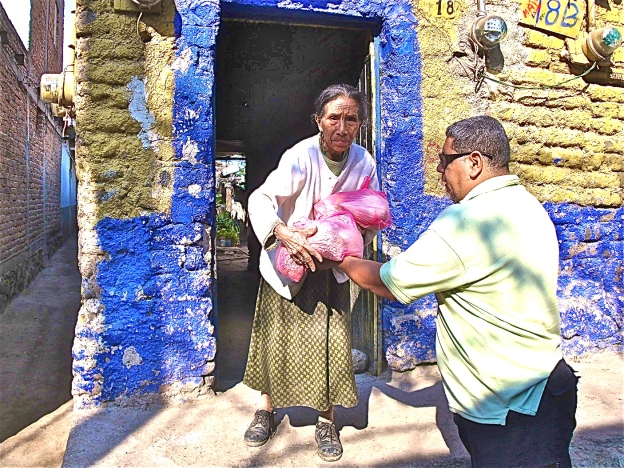
DSCF8675With his knowledge of the village, Agustin has cut the time for weekly food deliveries in half in the year since he has been doing the driving.

I first met Agustin in 2002  when I became involved with a group of local Mexican artists. Agustin, who at the time was working as a real estate agent and contractor, had long been their patrón (sponsor) and so when I approached them about helping to stage a children’s art experience where they would paint pictures on the theme of cleaning up the lakeside and their village, Agustin immediately became a major supporter of the project, helping to buy backpacks and school supplies for the prizes. When we staged a fundraising concert to send a young opera singer to the U.S., Agustin fed us all afterwards in what was then his Aunt Lupita’s pozole restaurant. At the time, it was dirt-floored, the simple kitchen was open to the air and parts of the restaurant were without a ceiling.
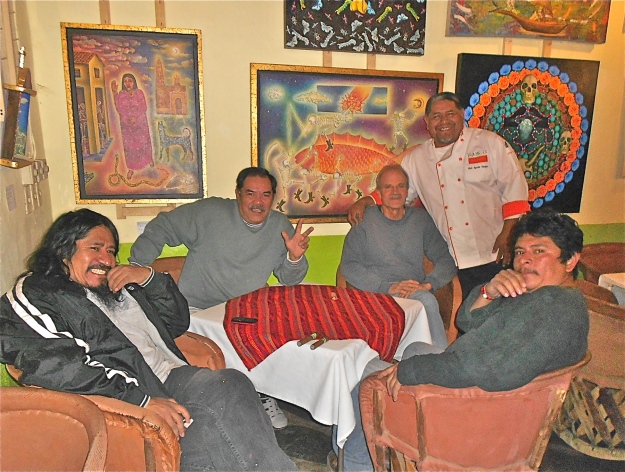
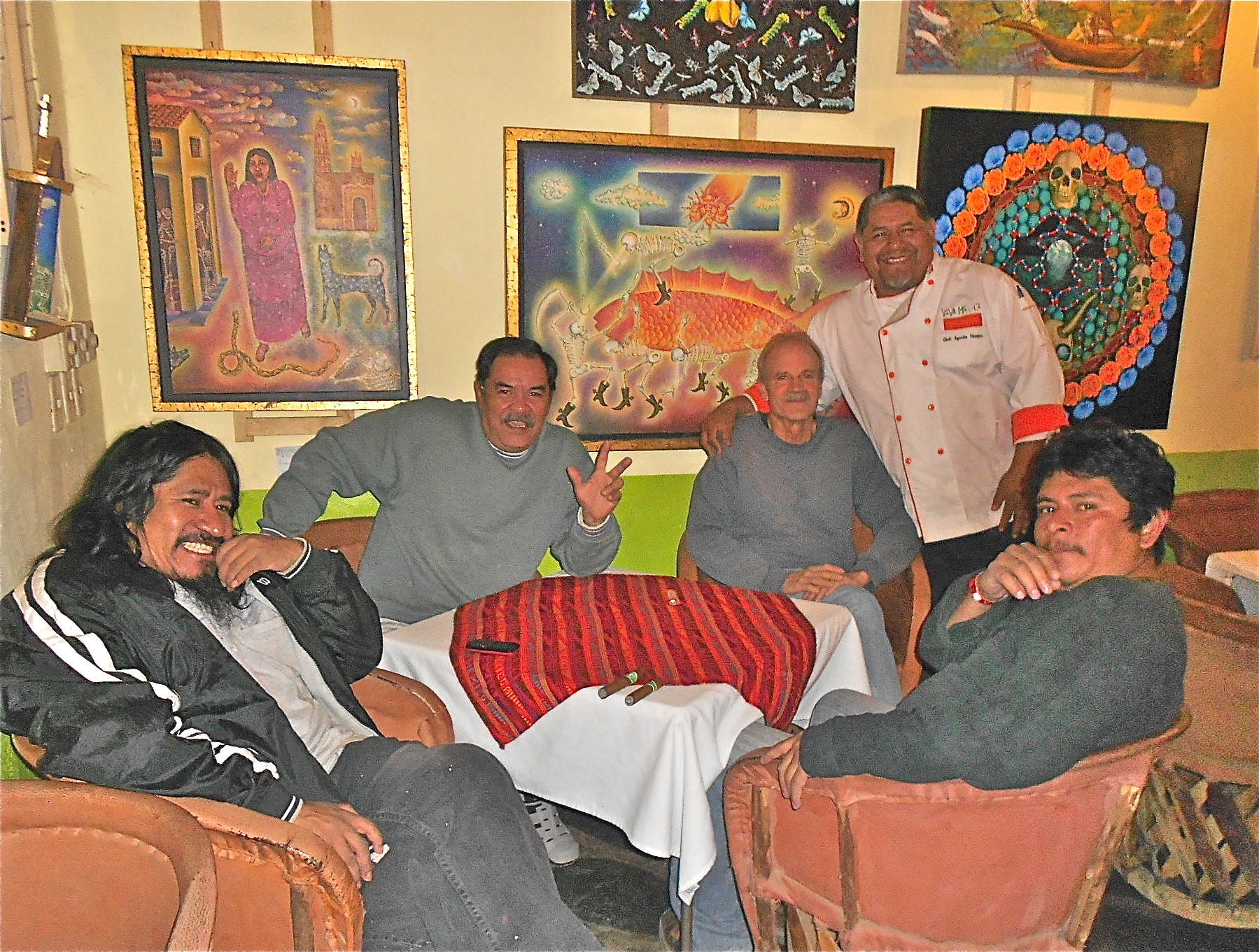
DSCN1336Agustin greets Isidro Xilonzochitl and other artists and friends who are regulars at Viva Mexico.

Now, ten years later, Agustin has added a beautiful stone floor, screened in the kitchen, added ceiling fans, colorful tablecloths and equipale chairs, purchased all new appliances and kitchen equipment, new bathrooms and a bar where local artists continue to meet most nights. If they are a bit short of money to pay for meals, it is fairly certain that they’ll be served a meal anyway. The walls reflect his support of local artists. Floor to ceiling on all sides, they are covered with their framed paintings, except for the east wall, which is entirely covered by a mural by Isidro Xilonzochitl. It depicts San Juan Cosalá as it was hundreds of years ago. “These guys—these artists and writers and musicians—have to be supported,” Agustin told me recently, “They are part of our community, as you, who live here also, are part of it.”

That statement forms the crux of the magic of a place like Agustin’s. It really is the place that binds us all—Mexican and expats—together. This first started to happen on September 12 of 2007, when weeks of rain were followed by a tromba (waterspout) that dumped water into the hills above the Raquet Club and the town, causing a tremendous downrush of water that brought boulders, dirt and everything in its path down the mountainside and into the town. Walls, buildings and roads gave way to the avalanche of water and rock, leaving much of the town devastated.

Agustin, who had recently purchased his aunt’s restaurant, stepped immediately into the fray, feeding the thousand or so displaced residents and relief workers three meals a day. Originally paying for the food out of his own pocket, he was eventually given food and aid by other residents, both Anglo and Mexican; and this is how the Mexican and Anglo communities were given a chance to mingle and get to know each other on a more intimate level. When I volunteered, Agustin first gave me a broom to sweep the dirt floor. By the end of the week, I was stirring huge pots of beef and waiting on tables as his restaurant filled three times a day.

The work was exhausting as Agustin and eventually, 25 volunteers, most of them family members, worked to provide three meals a day. By the end of ten days, this amounted to over 3,000 meals! By the time he had persuaded local politicians to take over this task, in addition to losing out on almost two weeks of income, Agustin was so in debt for supplies he had bought out of his own pocket that for two months, he questioned his ability to reopen the restaurant. Most of his knives, forks and salt and pepper shakers had been thoughtlessly carried away with carry-out meals. Teary-eyed, Agustin told me about local neighbors, poor themselves, who heard of his plight and offered him hands full of change to try to help, but in the end, he was still $75,000 pesos in debt.

With three sons and a wife to support, Agustin could not afford to take more of a break than was absolutely necessary, so mustering his courage, he somehow found the means to again open the restaurant which four years later has become the heart of the community.

Unknown
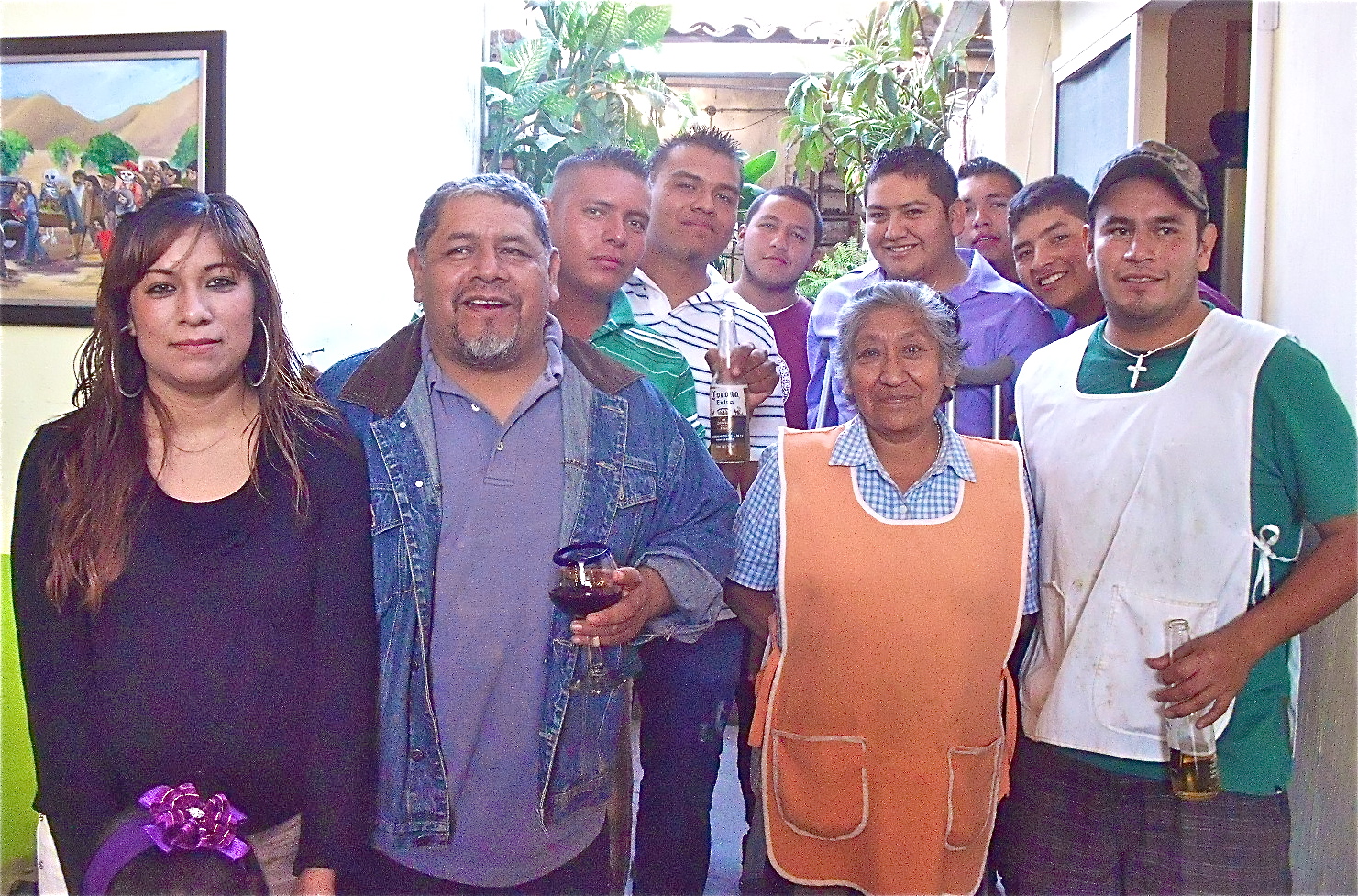
Any night of the week that you venture into Viva Mexico, you are likely to encounter one of these “regulars.”

What factors go together to create these great qualities of entrepreneurism, courage, generosity and artistic sensibility in a man? Knowing a bit more about Agustin’s history might give us a clue. When he was born in San Juan Cosalá in 1966, the midwife told Agustin’s mother that this child was different and special, that he would bring luck to his family and all around him. When I asked Agustin what quality the midwife had noticed, he did not know, but later when we talked again, I asked him if he had been born with a caul over his head, as this is the traditional sign world-wide that a child is destined to greater things.  When I described what this meant, Agustin nodded his head in agreement.  This is how the midwife had described it, but he had never known the term for it.

When Agustin was born, his father went to the United States to find work to support his family. At that time, Agustin was the fourth child but the first son born into a family that would eventually grow to five brothers, five sisters. Agustin himself began work at the age of six, cutting firewood or helping his grandpa with his fisherman’s nets after school. “My mother, she always pushed us to go to school,” said Agustin. “She could not read or write herself, but she was always encouraging me to look for another way to live. ‘I don’t want you to be like me,’ she said. Now I say the same thing to my sons.”

“I was a troublemaker in secondaria,” Agustin confessed to me, “because I always questioned the priest, wanting to know more.” Agustin credits Padre Adalberto Macias with changing the town through education. “He didn’t want me there, though, because all those questions were a disruption,” admits Agustin. Ironically, Agustin is now the man who drives to the Abastos (wholesale market) in Guadalajara each month to procure food and deliver it to Casa de Ninos y Jovenes, the residential school for disadvantaged youth run by Padre Adalberto.

In July of 1978, at the age of twelve, Agustin went north to the U.S. for the first time. His father put him in school in Lompoc, California for three or four months, but as one of only four Mexicans in the school, he was not treated well and he begged to be sent back to Mexico. Sadly, although he did manage to complete secondaria (tenth grade), there was no money to send him to preparatorio. Instead, at the age of 14, he quit school to blast rock at the Piedra Barrenada, the stone cliff north of the fish restaurants on the carretera (highway) east of San Juan Cosalá. “On Saturday and Sunday, I worked as a waiter,” Agustin told me.
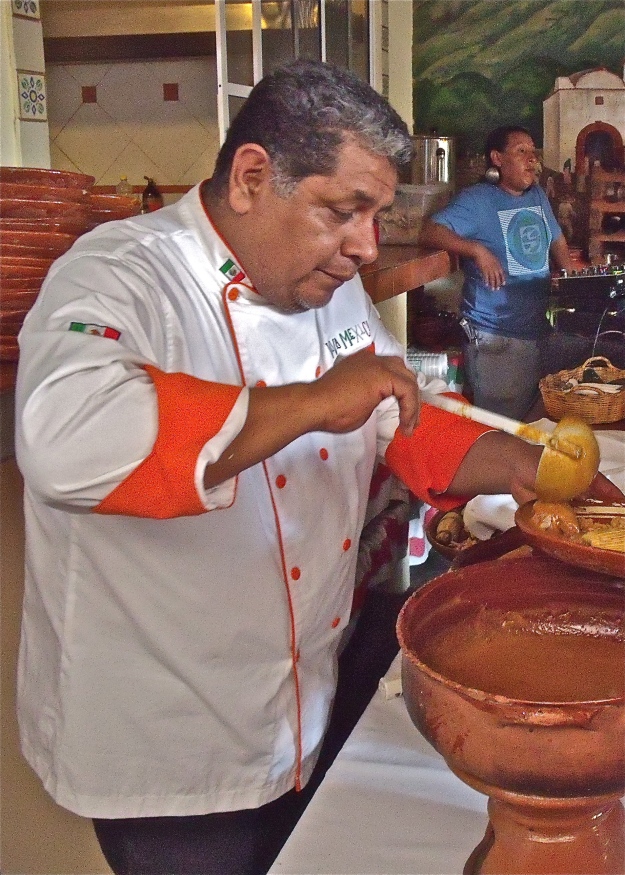
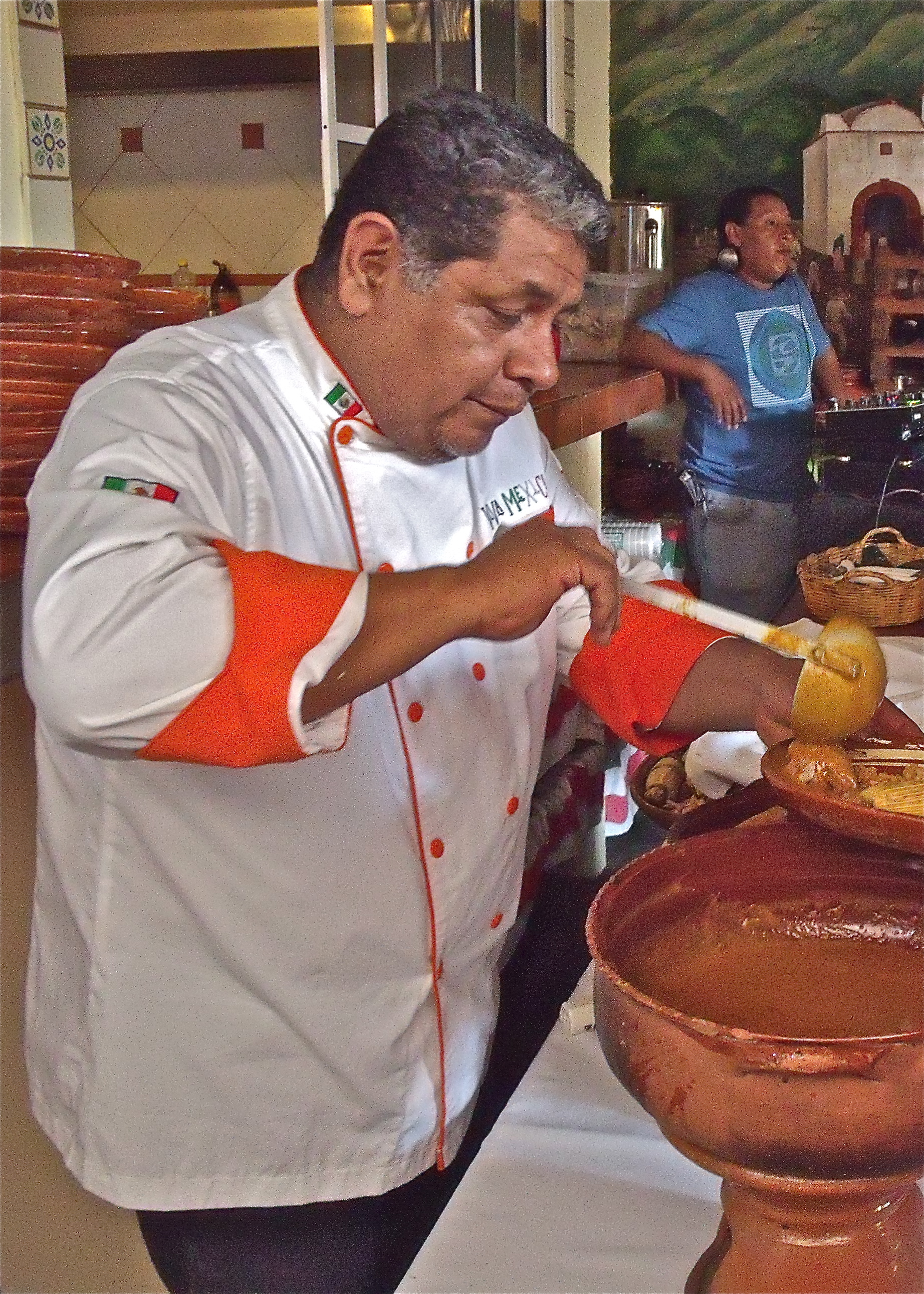
DSCF8508When Agustin accepted his first job as a waiter, did he ever dream that one day he would be serving customers in his own restaurant, wearing a designer chef’s coat that was the gift of a customer?

“I worked many jobs. I cut chayote plants and corn with my family. For one year I was a carpenter with my cousin. When a company came to export chayote to the United States, they made me manager at the age of 15, even though I was the youngest. I don’t know why. Next, I was a waiter at the balneario (hot mineral water spa) until I went to the states with my brother in 1984.”

It was his mother who had intended to go north to find his father, whom they had not seen for three years. She had heard rumors that he was very ill and living in Tijuana, but how could she leave with so many children to cook for, she asked, and begged him to go in her place. He lived for one month in the streets of Tijuana, looking for his father. When he found him, his father was in a hospital, having just undergone surgery. Once he recovered, they had no money to return home, so they went to the U.S. where this time, Agustin worked in the fields with his father for one year. “Cities on the borderline are horrible,” he told me. “They are so sad. Many people from different countries with no money to leave. So sad.” After one year of working in the states, he came back to Mexico to work in construction.

He went back one more time to the States, to get his ailing father so he could die in Mexico. When his father died in 1989, as the oldest son, Agustin inherited responsibility for the family he had been helping to support for most of his life. “My father was a generous man,” Agustin told me, “who would give his shirt if people liked it. When I was a young boy, my uncle, who remained in San Juan, had a pool hall. It was a long time before I knew that my father had given him the pool tables, and that the nets my grandfather used as a fisherman were actually my father’s nets. He was a nice man, my father, but he had to go to the states to support his family. He went to the states when I was born and worked there until I was twenty years old, when he came home to die.”

In 1990, Agustin married Antonia, a local beauty queen. “I saw her at a dance,” he said, and chuckled guiltily as he added, “She was with my friend, but when I saw her, I just had to ask her to dance, and so I took her away from him. My mother didn’t want me to get married, wanted me to wait. I was already feeding ten people in my family, but I wanted to get married, and so I did.

DSCF8364Twenty-two years later, Antonia and Agustin share cooking duties in their newly refurbished kitchen.

I was intrigued over how a young man with a wife and ten other dependents was ever able to become the self-educated, well-read community-minded restaurateur that Agustin is. “How did you ever manage to get where you are today?” I asked, and Agustin, a natural-born storyteller, pulled up a chair to the table where I sat over my molcajete and resumed his tale.

“I got a job at a restaurant in Ajijic that was run by a couple from San Francisco. They had three restaurants: in Los Cabos, Puerto Vallarta and here. The woman was very tough, but nice, and I learned a lot from her. For one thing, I learned to focus. Four people together couldn’t compare to her chopping. While I was there, they taught me how to cook and to flambé. They helped me to be in contact with people. First I replaced the chief of waiters when he was gone, and after that I was the replacement for the bartender, waiter and cook. At that place I learned everything, but after one year, I had to quit. The cold and hot probably hurt my hands, because I started to get their kind of bones–the kind that grow (arthritis.)”

“When I went to apply for a job at Mama Chuy (a resort hotel near San Juan Cosalá) my wife was pregnant with our first son. I had to have a job, so I feigned experience. When they asked me if I knew English, I said yes. When they asked me how old I was, I said 28 or 29, but I was really 23. Everything they asked me, I said I knew how to do—except for maintaining the pools. ‘No, I said, but I can learn.’ When they asked me how much I wanted to be paid, I said, ‘Whatever you want to pay me,’ and I was hired on probation.”

“I worked there for five years and learned to speak English. I learned a lot at Mama Chuy’s. My first day, a guy from Massachusetts who was a guest there asked me if I wanted to learn English. When I said okay, he told me to be there tomorrow at six. That first day, he gave me the book Aztec by Gary Jennings and told me to read 20 or 30 pages. It was in Spanish, and that night I told my wife that for me it was an insult for him to give me this kind of book. But my wife told me to do what he told me.”

“When I saw him the next day, he asked if I had read the book and I said yes, but when he questioned me, he knew I hadn’t. Then he explained why he gave me the book. ‘The first thing you have to know is who you are,’ he said, ‘This book will teach you your own history.’ That was when I learned that you should never say ‘can’t.’ What you want, you have to go for. From that man, I learned everyday English. All the people at Mama Chuy helped me. In the five years I was there, I learned so many things. That man was a snowbird who came back every year and he taught me so many things. We became good friends. He 88 years old now…and in the states with Alzheimer’s.”

“During this time and afterwards, I taught English to 400 to 500 people from San Juan: gardeners, maids, taxi drivers, and students. This made me feel okay. I taught them for free or for one peso per class to buy diapers for my sons. Afterwards, I went to one or two schools to teach as well.
DSCF8754Three generations work together at Viva Mexico: Agustin, his Tia Lupita and his sons.

In the years to come, Agustin expanded his already extensive resume. First he became a contractor. “The best guys in town work for me,” he told me. “Just 5 guys. I don’t need more. They have worked for me for 18 years, whenever I need them.” When I asked him how he obtained his contracting experience, he admitted that here, too, he was self-educated. “I knew it in my dreams how to do it,” he confided. I was reminded of my recent trip to see Frank Lloyd Wright’s home and studio near Scottsdale, Arizona, where I had discovered that the same was true of Wright, who never had any formal architectural training.

“Trains pass by on a regular basis and I jumped on every one to see where it would take me.” said Agustin, referring to his ability to seize any available chance to self-educate. “The train, it doesn’t stop. You have to jump, run a little bit and get into the train.”

Other years were spent as a real estate broker. When he first was hired to work at Laguna Real Estate, he had no car, so he bought one. It was very hard, he said, because most of the customers were American and Canadian, so they preferred to work with the American and Canadian agents. He took classes in English, which were hard—a different level of English than he had learned formerly. In the first week, he sold a house, but received no commission.

For the next six or seven months, he sold no other houses and was ready to quit. The owner of the agency persuaded him to finish out the week. He made many phone calls, and ended up selling $2 million dollars US in two weeks. He worked there for five years, then changed agencies to work with another Mexican broker. “We took the leftovers,” he said, “the houses that didn’t cost so much, that the other brokers didn’t want; and we ended up doing six to seven closings a month.”

“If someone comes and offers me something, I will learn. Life is simple. We complicate our lives by wanting to have our own way. Like a bull. If you let him go, you can follow where he wants to go and it is easy to hold onto the bull. But if you pull, it’s not easy.”

When I asked him what his goals are for his sons, he answered, “Goals. I know my son’s life is not my life. I know it is his life. My first son is almost finished with University and will be an agricultural engineer, the second is in technical school to be a pilot and will be safe. The third (who quit school last year to support his girlfriend and baby, but who intends to go back to school next year) needs a push. This restaurant is for me, not necessarily for them. They need to find their own way. The people who work for me, I always try to help them as well.”

DSCF8757Agustin, his Tia Lupita and other members of his staff display their usual smiles.

“What is left in life for you?” I ask him, and he answers, “Travel. If I had only myself to worry about, I would travel. People who travel live twice in their minds. Instead, I read, for people who read travel in their minds. Outside of his three trips to the U.S., what traveling he has done is in Mexico—every state except Chihuahua, Veracruz or Chiapas.

I know from an American friend who has had much advice from Agustin about what books to read, that Agustin is widely and well-read. When I ask him his favorite authors, he says, “I’d have many of those. Gabriel Garcia Marquez, Octavio Paz, Juan Rulfo? Why not?”

When Ninos y Jovenes asked him to take over the purchasing  of food and supplies for their residence school for disadvantaged children, his answer was yes, and he added this monthly task to his weekly trips to Guadalajara to buy food for Operation Feed. When Earl Smithburg, the former director of Operation Feed, died, Agustin provided the buses to transport people to his funeral.

When I asked him to drive me into some of the areas worst hit by the tromba for a follow-up story two years later, the answer was yes. When I asked his construction company to repair my roof, the answer was yes, and I don’t believe I ever received a final bill. I’ve asked about this countless times, and he never quite remembers what the amount is that I owe him.

He has amazing skills: carpenter, mason, real estate broker, resort manager, construction design, construction manager, restaurateur and chef. In addition to this, he is an outstanding family man, father, neighbor and friend. It came as no surprise to me at all that when I asked him if he’d ever had his IQ tested that he said yes. With prodding, I got him to confess that his IQ was 144—genius level.

In closing, I’d like to quote just a few of the statements that people made when I asked them their impressions of Agustin:

“Agustin consistently puts his personal needs behind the needs of others. He always thinks of others first when making decisions that will impact those around him.”

“Agustin recommended this incredible reading list for me. He is a self-taught scholar. He was a big reason why I stayed in Mexico. He has a heart that includes absolutely everyone.”

DSCF7754Agustin takes time out to talk with one of his regulars; and yes, they were talking about books.

“He is the most unselfish man you will ever meet. He will give of himself by whatever means he has without thinking about the personal sacrifices that giving will cause.”

“He is a very trusting individual. If you pledge trust in return, you will enjoy a level of personal friendship that is truly without borders.”

“He is probably one of the last breeds of good old Mexican folk who grabs on to the land and to the culture of a bleeding patria (native land).”

“Humble and slow like an old dog who has been left the hard task of looking out to all those who depend on him and think of him as the ultimate guardian.”

“An absolute perfect host. He greets each person in his restaurant. If he is cooking at the time, he will wait until you are eating or afterwards, and then come up to your table, stand and talk for awhile, or if it’s a slow night, pull up a chair and talk to you.

“Multi-talented, really smart, Renaissance man. Genuinely cares about people. No haughtiness or pretense.”

“He has gotten to where he is by being absolutely nonpolitical. Everything he does, he does out of the goodness of his own heart, without a thought of his own gain. The help he furnished during the landslide was not for political reasons or anything other than that’s the kind of guy he is.”

“Agustin is an artist at work. He goes to the food sellers and warehouses for the charities he buys food for and he beats them down so badly on the prices that they aren’t making a whole lot of money.”

Energetic, generous, personable, devoted father, teacher, philanthropist, self-taught pillar of his family and community, a man with a heart of gold who goes out of his way to help others, Agustin Vasquez Calvario is a living testament to the truth that one person can make a difference.

(Viva Mexico is located two blocks west of the San Juan Cosalá Plaza at Porfirio Diaz #92. Call 387-761-1058 for directions or reservations.)

Judy’s note: This article was written a few years ago for an online magazine that is no more.  In the years since then, Agustin has created a huge gourmet kitchen and  doubled the size of his restaurant. The same artist who painted the mural inside has covered the outside of the restaurant with a huge mural that depicts the inside of the restaurant with every table filled with Agustin’s regular customers depicted.  I’m at a table in the front row with my best friends around me.  Sadly, I am the only one who still lives in Mexico.

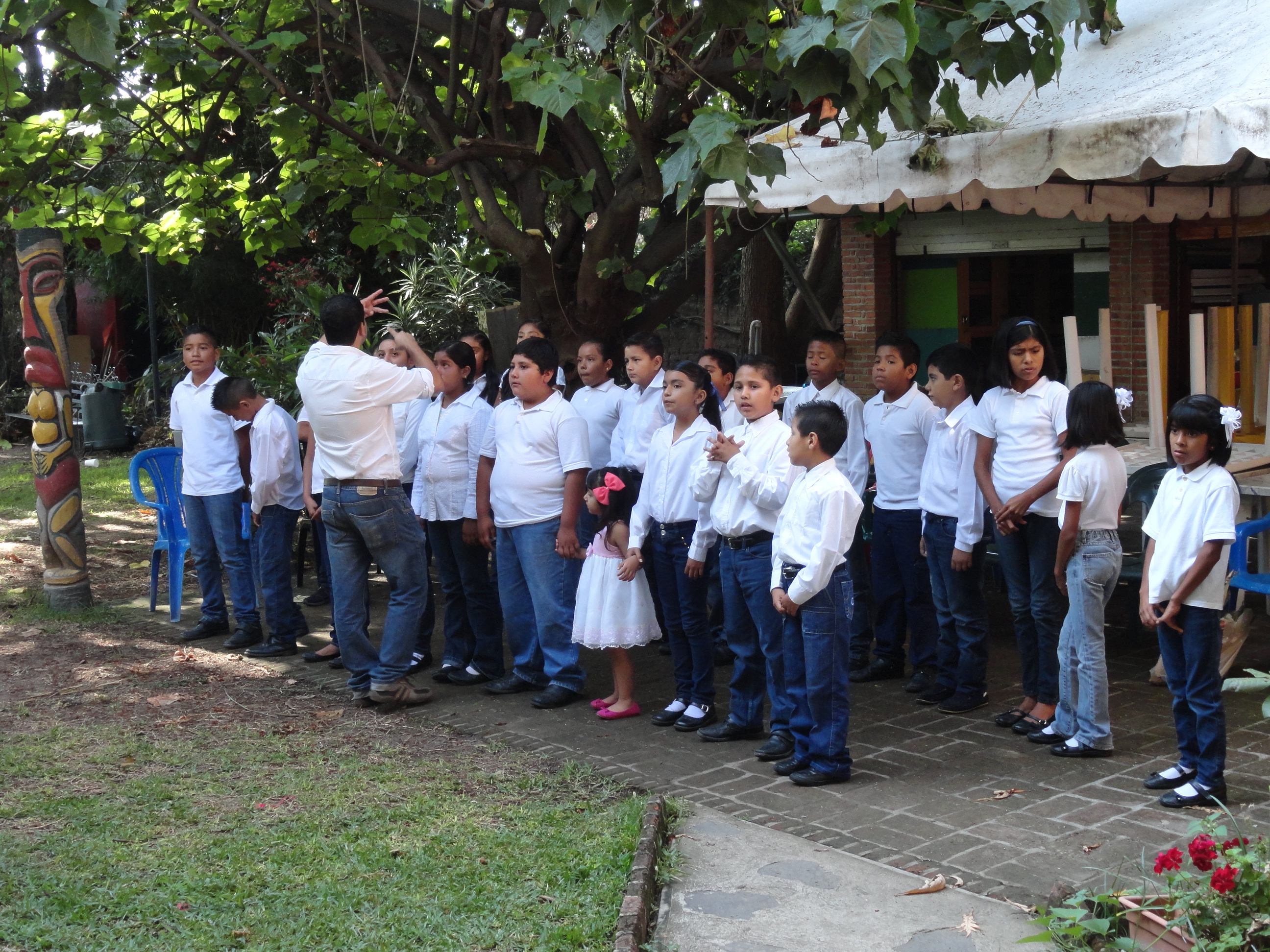
Agustin has had many health challenges that have forced him to slow down and allow others to share some of the responsibilities he has always assumed.  Although he has more helpers, new projects continue.  He teaches English to Mexican adults and children, a children’s chorus now meets in the new half of his restaurant that only opens on weekends. A children’s orchestra has been started with instruments provided by solicitation of locals supportive of Agustin’s continuing schemes to give the youth of San Juan Cosala something to do more interesting than drugs and alcohol.

DSC07577 San Juan Cosala Children’s Choir.  That’s Agustin’s granddaughter with the pink hair ribbon!

Twice a year, clothes are handed out here to the pueblo’s poorest and every week, food is dispensed to the 100 poorest families.  Meat, vegetables and fruit have been added to the rations which formerly included only dry foodstuffs and oil. Things change and change as things do, but one thing that never changes is that Viva Mexico remains the heart of the community:  both expat and Mexican.

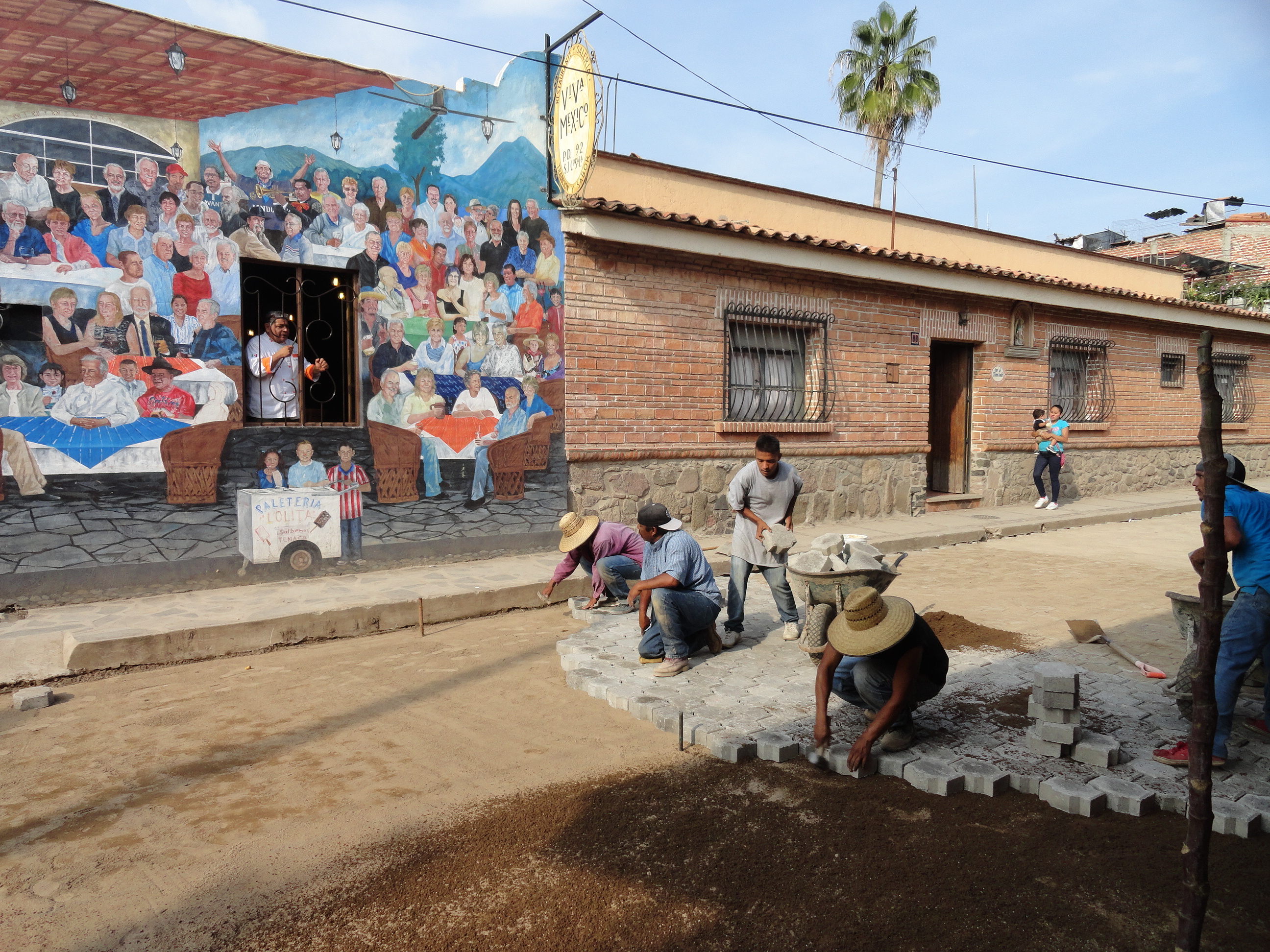
DSC08075 DSC08074Changes continue as the real Agustin, customers and friends  all seem to be supervising the installation of new pavers that replace the former cobblestones of the road leading from the plaza to Viva Mexico.

UPDATE NOV. 29, 2016: We celebrated Agustin’s 50th birthday at Viva Mexico last night. See the story and photos in a new post HERE.


HALLOW E’EN

1913688_1136038127859_5133796_n
The Prompt: Trick or Trick—It’s Halloween, & you just ran out of candy. If the neighborhood kids (or anyone else, really) were to truly scare you, what trick would they have to subject you to?

Hallow E’en

They pound upon my door and wait outside my wall.
One climbs a tree to peer within. I hope he doesn’t fall.
I cower here within my house. Perhaps they’ll go away.
Though I am not religious, eventually I pray.

Their little voices raise a pitch. They start to bay and howl.
There’s a flutter in my heart region, a clutching in my bowel.
I purchased Reese’s Pieces and miniature Kit Kats
just for all these masked and costumed little brats.

My motives were unselfish. The candy was for them,
for I don’t eat much candy in efforts to grow slim.
And yet that bag of Reese’s, those small Kit Kats and such
called to me from where they were sequestered in my hutch.

It started with a whisper, hissing out their wish:
“We would look so pretty laid out on a dish!”
I knew that they were evil. I knew it was a trap.
I tried hard to resist them, my hands clenched in my lap.

I turned up my computer, listening to “The Voice.”
Those candy bars would not be seen till Halloween—my choice!
My willpower was solid. No candy ruled me.
(If that were true, no kids would now be climbing up my tree.)

Yes, it is true I weakened. I listened to their nags.
I took the candy from the shelf and opened up the bags.
Their wrappers looked so pretty put out for display
in one big bowl so colorful, lying this-a-way

and that-a-way, all mixed and jumbled up together.
No danger of their melting in this cooler weather.
I put them on the table, then put them on a shelf,
so I would not be tempted to have one for myself.

When people came to visit, I put them by my bed.
Lest they misunderstand and eat them all instead.
Then when I was sleeping, one tumbled off the top.
I heard it landing with a rustle and a little “plop.”

I opened up one eye and saw it lying there
just one inch from where I lay, tangled in my hair.
Its wrapper was so pretty—foiled and multi-hued.
Some evil force took over as I opened it and chewed!

This started a small avalanche of wrappers on the floor
as I ripped & stuffed & chewed & swallowed more & more & more!
This story is not pretty but has to be confessed.
My only explanation is that I was possessed.

They pound upon my door and wait outside my wall,
but I have no candy for them. No treat for them at all.
Surrounded by the wrappers, bare bowl upon my lap,
I think I’ll just ignore them and take a little nap.

I hear them spilling o’er my wall and dropping down inside.
I try to think of what to do. Consider suicide.
They’re coming in to get me. Beating down my door.
They are intent on blood-letting—the Devil’s evil spore.

I guess it’s not the worst death a gal could ever get.
I’ve heard of much worse endings than death by chocolate!

1913688_1136038527869_395578_n1913688_1136038367865_7037617_n1913688_1136038287863_5588685_n1913688_1136038207861_6603987_n1913688_1136038167860_1696102_n1913688_1136038087858_6027993_n1913688_1136038007856_1648819_n1913688_1136037847852_2468748_n1913688_1136037767850_5683525_n1913688_1136037727849_5594428_n1913688_1136037567845_630735_n

There is Always Music


This is the young man who was absolutely world class but who can’t read a note of music!

There is Always Music

The music of Mexico is composed of a cacophony of sounds—all of them loud! Trumpets, drums, violins, guitars, tubas and trombones are backed up by fiesta revelers, insects, burros, cattle, roosters, fireworks, church bells, air brakes, stone drills and vendors driving the street with loudspeakers announcing gas, produce, knife-sharpening or bottled water for sale.

Living in Mexico is like living in a place where one or another of your neighbors celebrates a party every other day of the week. Patriotic holidays, weddings, saints days, baptisms, funerals, fifteenth birthdays—all are occasions for fiestas of often grand proportions; and although these parties do not always take place in your own neighborhood, the lake and mountains act as a sounding board which makes it sound as though they do.
Recently, it has become the style to set off fireworks from a boat positioned mid lake to celebrate nuptials. Then loud music and loudspeaker shouts proceed far into the night. Tonight as I got home a half hour before midnight, the music was so loud that it could have been coming from the house next door, but it was coming from a large hall on the carretera a half mile away. It was a wedding party I had seen the beginnings of earlier in the day, now grown into a full-scale bash.

The loudest celebrations are held on saints’ days or national holidays. These celebrations are frequent, as in addition to the usual holidays such as Dia de la Independencia and Aniversario del Revolución, each town has a ten-day celebration of the town’s patron saint. During one week-long celebration in the nearby town of Ajijic, it is rumored that 10,000 bottle rockets were set off, each of them launched into the air and exploding at the decibel level of a cherry bomb.

To demonstrate the frequency of such celebrations, take the six-day period of April 30 to May 5. The most famous Mexican holiday in the U.S. is Cinco del Mayo, but in Mexico, but in Mexico it is a celebration of minor importance. There are four other major holidays in the five days leading up to it, all of them more important. The week starts out on April 31 with El Dia del Nino, a celebration and parade for the day of the child, followed the next day by labor day—Dia del Trabajo—the day of the laborer. After a day’s vacation from holidays, there is Dia de Santa Cruz, followed two days later by Cinco de Mayo, the commemoration of the Battle of Pueblo. All of these celebrations bring with them the sounds of revelry: loud banda music, fireworks, guns fired into the air and the accompanying barks of protesting dogs and encouragement of human revelers.

In December, Christmas is preceded by the week-long commemoration of the Virgin of Guadalupe, which in my village is the occasion for hundreds of plant-decked altars to be set up along the streets in front of houses, garlands over the street and cobblestones strewn with fresh alfalfa. One day in early December, a neighbor came by to visit. Later, we went for a walk in the San Juan Cosala main plaza. The most beautiful feature of the square was a large faded portrait of the Virgin of Guadalupe that stood near the church. Flowers and lights surrounded it in preparation for her saint’s day. Unfortunately, one of the strings of colored lights that swathed the portrait was a musical strand. In the fifteen minutes we took to traverse the square, we heard nasal computer-like renditions of, “I Wish You a Merry Christmas,” “Santa Claus is Coming to Town,” and “Rudolph the Red Nosed Reindeer.”

There is always music. Now the steady hum of the pump which recycles water from the jacuzzi to water the plants stops and I hear the steady whisk whisk whisk of the gardener’s broom on the stone patio. Outside hundreds of bees hum around the Virginia creeper that blankets the awning over the patio.
Birds furnish a counterpoint harmony to these domestic arias. In the few months that I have been living here, I believe I’ve heard whippoorwills, Baltimore orioles, grackles, and tanagers. I have heard the mysterious night call of a bird with a voice disguised as an interloper whispering, “Pssssst. Pssssst.” (I have since learned that this is probably an insect.) I have never seen either this bird or the bird whose call sounds like a squeegee being scraped against a chalkboard, but I did eventually see the ubiquitous insect called a rainbird (local name for a cicada) whose voices (by the thousands) proceed from a few seconds of castanet sounds to the buzz saw melody that fills the hills and trees around my house with their mating music in May and June .

In my first six months living lakeside, my solitude has been broken by few people other than my housekeeper, gardener, workers and repairmen who make daily pilgrimages to my house to correct problems at about the same rate as they create them. When now and then they switch off the loud competing blarings of their individual radios, I hear music in the noises of their industry as they administer to the house and grounds like neophytes to a high priestess. It is the house that is the god here, not me. I sit in another part of it making my own music on the keys of my laptop.

This morning, I awoke to the chink chink chink of the gardener’s shovel as he dug concrete chunks from the flowerbed beside my pool. He used neither of the new shovels I bought him, but instead the flat edged old shovel with the handle broken in half. I have stopped demanding or even suggesting that anyone do things the easy way. The squeegee sits dry in the storeroom along with the dried out sponge mop. Nearby are the damp rags and buckets are are actually used to wash the windows; and in the living room, I can hear the rhythmic slosh of Lourdes moving the string mop that is used so frequently that it rarely dries out.

On Monday, as Lourdes ironed in the spare room, I asked if she wished to listen to my Spanish/English tapes. If it is true that she will soon go to join relatives in the States, she should know some English. She nodded yes enthusiastically, but after one cycle, she removed the tape and switched to the radio. I could hear her singing along even two rooms away through two closed doors. She sang slightly off key, in a happy voice, unaware that anyone listened. In the afternoon, she ironed 30 garments, even though I had asked her to iron only three. As she ironed, she sang.

Every day I learn more about Mexico. On this day I have learned this. The pool man may be missing, there may be no water in the aljibe (cistern), and you can be sure that if you need hardware, the hardware store will be closed for comida (the afternoon meal). If you want to go to the restaurant you have passed twenty times, on the day you go it will be closed. There is a page-long list of things my house needs that I cannot find. But on this day, I learned of one thing that you can always find. In Mexico, there is always music.
                                                                                                                   –by Judy Dykstra-Brown


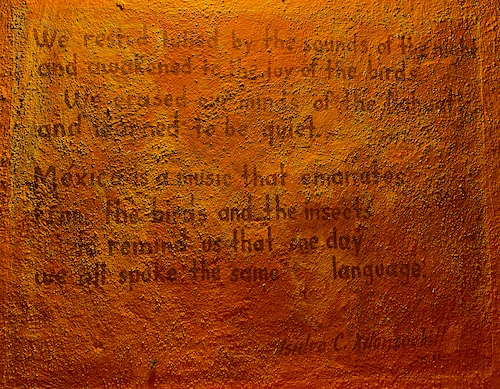
Twenty years ago when I moved to Mexico, I wrote the above piece for a local magazine and when the time came that I wanted a local artist, Isidro Xilonxochitl, to paint a mural on my outside wall, I asked him to use the themes from my essay.

He painted a wall covered by birds and insects, but also wrote a poem in Spanish that I translated into English.  Wall damage made it necessary to paint over the mural years ago, but the poem is still painted on my wall.  If you can’t make it out from the photo, I’ve rewritten it below. (Note: Nahuatl is a language of the Uto-Aztecan language family.)

We rested lulled by the sounds of the night
and awakened to the joy of the birds.
We erased our minds of the Nahuatl
and learned to be quiet.

Mexico is a music that emanates
from the birds and the insects
to remind us that one day
we all spoke the same language.

                                  — Isidro C. Xilonsochitl


This post is for Sam, because he asked.

Fire on the Mountain

Fire on the Mountain

The smell of burning leaves us only when we sleep,
the hills above us aflame for weeks as the wind
catches the upraised hands of a dozen fires
and hurries them here and there.

It is like this every year
at the end of summer,
with the dry grass ignited by
light reflected by a piece of glass
or careless farmers burning off their fields.

The lushness of the rainy season
long since turned to fodder by the sun,
the fires burn for weeks along the ridges
and the hollows of the Sierra Madre—
raising her skirts from where we humans
puddle at her ankles.

Imprisoned in their separate worlds,
the village dogs bark
as though if freed
they’d catch the flames
or give chase at least.

The distracting smell of roasting meat
hints at some neighborhood barbecue,
but only afterwards do we find
the cow caught by her horns in the fence
and roasted live.

Still, that smell of roasting meat
pushes fingers through the smoke of coyote brush
and piñon pines and sage,
driving the dogs to frenzy.

The new young gardener’s
ancient heap of rusting Honda
chugs up the hill like the rhythm section
of this neighborhood banda group
with its smoke machine gone crazy
and its light show far above.

The eerie woodwinds
of canine voices far below
circle like children
waiting for their birthday cake,
ringing ‘round the rosy,
ringing ‘round the rosy
as ashes, ashes,
it all falls down.

I discovered a new prompting site. The prompt for this poem was to write down the following, then to use all six in a poem that begins with “The smell of burning leaves….” (I had a different take on that first line.)

Something you buy in a bakery. (Birthday cake)
A smell in a diner. (Roast beef)
A make of automobile. (Honda)
Something people do to relieve stress. (Sleep)
An unusual musical instrument. (Quena flute. I felt the actual name of the instrument distracted from the poem, so I used the more generic “woodwind.”)
A child’s game. (Ring around the Rosy)

Here is the link for that site if you want to follow the prompt or see other poems written to this prompt.

Autumn Schmautumn

The Prompt: Autumn Leaves—Changing colors, dropping temperatures, pumpkin spice lattes: do these mainstays of Fall fill your heart with warmth — or with dread?

Autumn Schmautumn

The only colored leaves I see are going to be faux,
for autumn never visits in my part of Mexico.
In fact, those piles of autumn leaves are far back in my past.
Green on the leaves in Mexico just lasts and lasts and lasts.
It’s true that each leaf everywhere must one day be defeated,
but down here where I live, the only way leaves are unseated
is not by frigid temperatures. There’s no cold to unglue them.
Our only leaf-removal means is cutter ants that chew them!
The ones who cut them down are all the bravest and the best.
Their comrades wait below to carry them all to their nest.
Their robberies completed without the slightest peep,
their piles of leaves depleted in the nighttime while we sleep.
Our guard dogs doze on soundly as ants pass by in the dark,
letting all these thieveries go on without one bark.
And so I fear that this far south no autumn colors are viewed.
Our trees create no spectacle. They go from green to nude!
And though ants harvest all our leaves—just chew them off and take them,
at least they grant us favors in that we don’t have to rake them!

OSDED-00000927-001