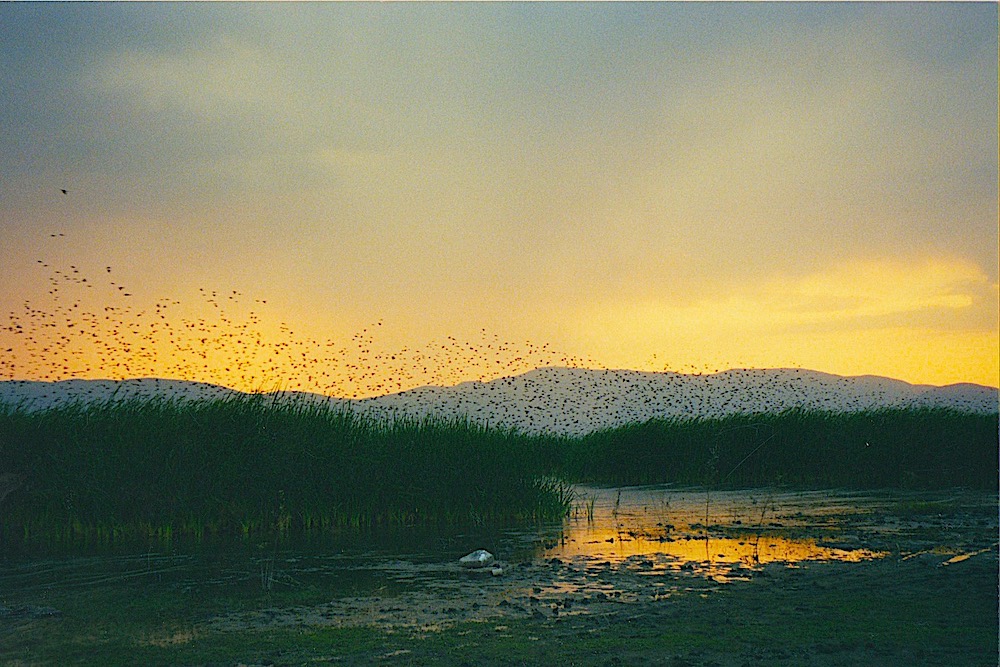
Night lifting of blackbirds from the cattails on Lake Chapala.
Blackbirds Over Lake Chapala
I no longer have to look away from the sunset
to know the birds are flying over.
I’ve come to recognize the sound,
like water rushing against the banks of a stream,
of thousands of wings pumping then gliding then pumping.
The ribbon of their combined mass
twists for miles like a giant ghost snake in the sky,
its molecules dividing, joining,
undulating from the green marsh grass
into eye blue sky.
Birds silhouette against
an edge of tangerine cloud
that is a scribble of glue in the sky.
Below them,
the smell of dirt, smoke from the burning mountain,
drum beats from the heart of the hazed city.
A canoe shaped like a Nile barge bumps against the reeds.
Sounds of a new flock flying over whip the air
above the night heron
who stands on short legs
on a post surrounded by low water.
The whole mass of birds is blown by the wind forth and back,
forth and back.
Some separate and circle back to marsh grass
where another mass lifts to fly east,
away from the setting sun.
The scene is ripped by
the rapid raucous staccato of two small boys
lofting rocks toward the soaring banks of birds,
violence feisty in their harsh raised voices.
Again and again they throw their stones,
a futile gesture,
as above them the sun turns angry orange
over the purple mountains,
then sinks to radiate like something sacred
from behind dark clouds.
Watching two egrets open the air with pencil points, then vanish into it,
I only hear the diving pelican cut the water behind the tall reeds.
And, like a sudden wind over my head,
a new rush of blackbirds.
In Defense of Poetry
“I like the sound of poetry, but I don’t get it.” “What does it mean?” “If it means more than it seems to say, why not come right out and say it clearly?” “It sounds phony. The language isn’t real.” “It sounds good but it isn’t about anything significant. Why don’t you turn your talents towards something significant?”
All of these statements have been made time and time again about poetry, some of them about my own poetry. It’s true that there is much bad poetry, as there is much bad prose, but there is also the wonderful poetry of Sharon Olds, Carolyn Kaiser, Carolyn Forche or Robert Frost. The poetry is not written in the stilted poetic style of centuries past that most people associate with poetry, but rather in clear, concise everyday language. For it is not the language of good poetry which divides it from good prose, but rather the language that is left out, the type of detail focused on, and even the part of the brain that instigates it. Poetry gives those of us with not much patience for the news another way to think about politics. And because it is more an activity of the right than the left brain, it gives us another slant on the matter. So, let me try to persuade you to give poetry one more chance. Read his essay, read the above poem one more time, and perhaps your tolerance for poetry might expand a bit.
First of all, poetry is always about something more than is stated. Take the first stanza of “Blackbirds Over Lake Chapala.” The poem starts out simply, talking about a giant flock of birds. The senses of sight, hearing and touch are appealed to as the poet describes standing under a flock of thousands of birds as they lift from the lake.
In the second stanza, the sense of smell is added to the sensory experience and the theme expands into more than a nature study. The edge of the cloud, caught by the light, becomes a “scribble of glue.” The image not only conveys information about the appearance of the cloud, but also brings in the new theme of technology–something functional and man made. The city is “hazed.” It is ironic that just as the natural beauty of the cloud edge is described in imagery that links it to a man-made accident (a scribble of glue) that the sunset is made more beautiful by the smog and smoke issuing from the town. What appears to be beauty is actually what is killing the lake. Man draws off more water than can be replaced and the lake shrinks. Pollution from irrigation runoff is killing the birds and fish.
But the beauty of the lake remains, as though nature continues to assert her dominance. In stanza three, a new flock flies over. A heron appears. The wind buffets the flock. It is both the wind of nature and the wind of change in society. For the language of poetry has levels. What is said, what is implied. The birds fly away, but more birds always emerge. Is this how it really is in nature? Will it always adapt and change to accommodate the horrors that we inflict upon it? In stanza three, it appears that this is so. But then, in stanza four,
The scene is ripped by
The rapid raucous staccato of two small boys
lofting rocks toward the soaring banks of birds……
Again and again they throw their stones. Senselessly, like shooters on a kangaroo hunt or like buffalo hunters, they seek to kill for the sport of it. Everything in their world is theirs to do with as they please. For the small boys, it is a futile effort as the birds soar away, but bigger boys (and nations) yield bigger weapons, and it is just possible––more possible within the past few years––hat they will finally win in their selfish efforts to bend the world to their needs.
The sun turns angry orange, personifying nature. Would that nature could protect itself. But sometimes its only defense is to destroy that which is destroying it. Some would say we are the hands of nature, destroying the infidel. Some might say that the infidel is the hand of nature, destroying us, who have wreaked so much havoc in the world. But what does the poem say?
In the last stanza of the poem,
…two egrets open the air with pencil points, then vanish into it.
I only hear the diving pelican cut the water behind the tall reeds.
And, like a sudden wind over my head,
a new rush of blackbirds.”
There is more to nature than we can ever understand. Our meddling with it has proven it to be true. The poet only hears the pelican. She cannot keep her eye on both the egrets and the pelican at the same time. So it is with us. We can never understand the total interconnectedness of nature. We are a part of it, as is the bomb, the oil tanker, and politicians. It is the way of nature that one thing dies to feed the other. We are not placing ourselves above nature in fulfilling this drive. But what we are doing is placing ourselves upon the chessboard of nature. Seeing ourselves to be the knight, we may find ourselves the pawn. We may find ourselves both the agents and the victims of the world as it seeks to rid itself of harmful elements. Most people, no matter what their religious or scientific beliefs, recognize that our world of animals, man, televisions, SUVs and rocket ships has evolved from something far different. . .from gas, dust, spirit. This world, so changed over the eons of its creation, will go on restoring itself, replacing one form of life with another. Is it our turn, like the great dinosaurs, to be replaced? Are Trump and Musk the twin comets who will bring about our demise?
And if so, what of the world? In the last stanza, after the sudden wind, there is a new rush of blackbirds, And so it is with the world. Nature, more innocent in scope if not in intention, will go on in one form or another. Whether we continue to be a part of it is, for the present, up to us.
Author’s note: This poem was written at a time when the lake was at an all-time low. Presently experts have declared the lake’s water to be 70 percent above U.S. minimum standards. The fish are not polluted and the lake is swimmable–in spite of what is often said. And although in the essay after the poem I mention the “poet,” as though it were someone else, the poem is, in fact, my own.


 lifelessons - a blog by Judy Dykstra-Brown