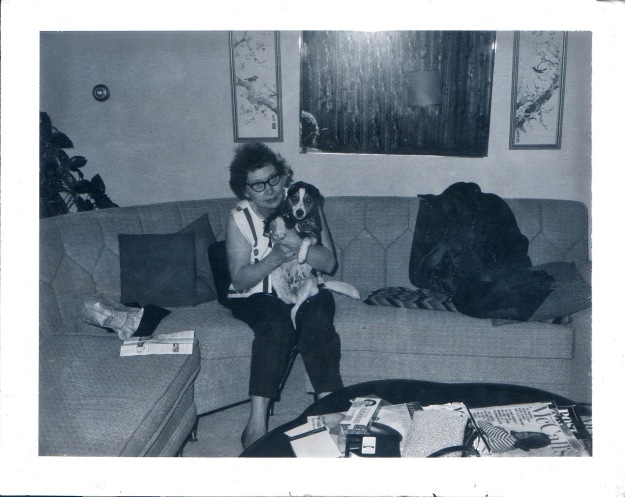
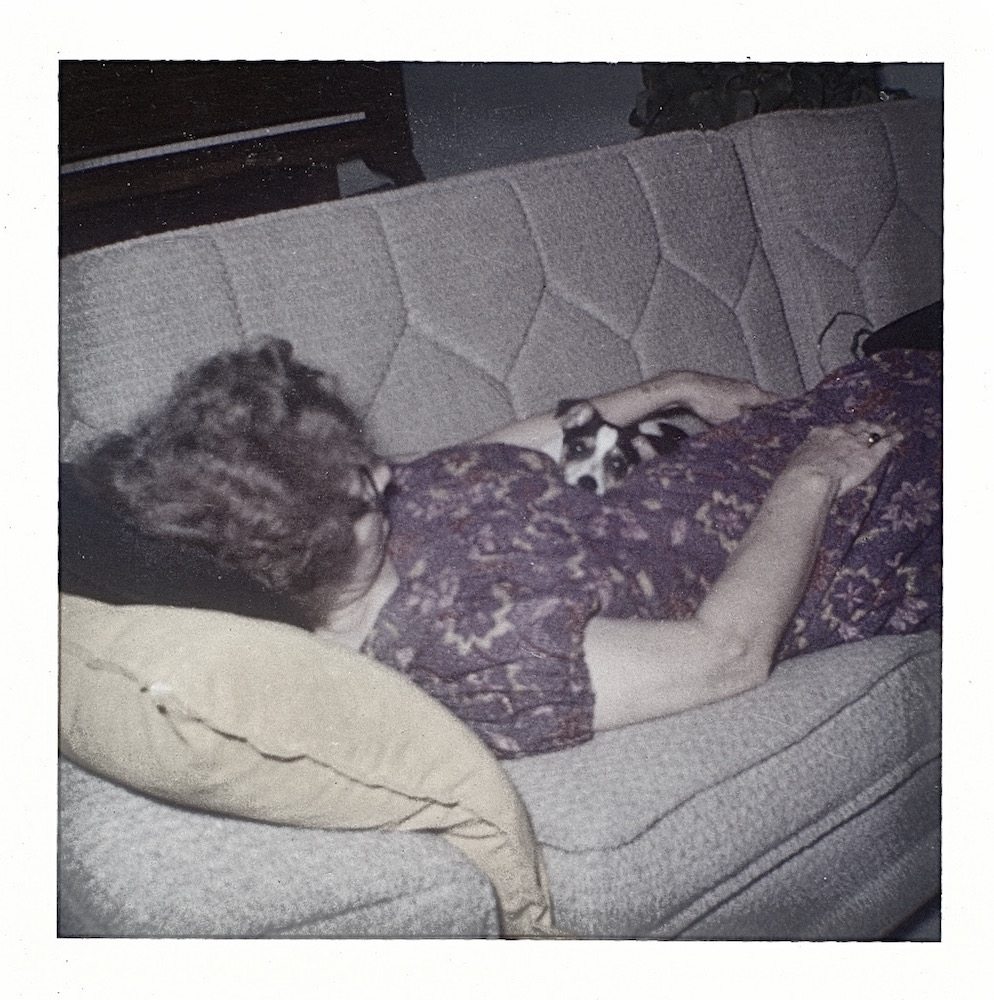
My mother and Scamp in an uncharacteristic upright position. Note reading material to their right.
Generational Drift
My mother would have been the first one to say that she was lazy. To be fair, this wasn’t true. I had seen her iron 32 white blouses at a sitting—her at our large mangle, running the fronts and the back of the garments, then the sleeves and collars through the large rollers, my sisters or I then taking our turns ironing the details near the seams and around the buttons. We had a regular assembly (or wrinkle de-assembly) line going every Saturday morning.
She cooked every meal and kept the house reasonably clean. But on weekends, she was the commander and we were the workers. One vacuumed while the others dusted. We were the window cleaners and the front walk sweepers, the table setters and dish washers when school or social activities allowed.
But there were times when a good book consumed each of our interests to a degree that weekend chores were lost in a blur of fantasy–each of us in thrall to a different book–my sisters in their rooms or on beach towels spread out in the sun of the back yard, me on on my back on the porch roof just outside my older sister’s bedroom window, and my mom flat on her back on the living room sofa.
Or sometimes it was the same book–taking turns reading 9-year-old Daisy Ashford’s memoir “The Young Visiter” [sic] as the rest of us howled–holding sore stomachs, tears running down cheeks. At times like this, a week’s clutter might sit untouched on surfaces, that morning’s dishes still in the sink, last night’s shoes still lying like rubble in front of the t.v. or half obscured beneath piano bench or assorted chairs around the room.
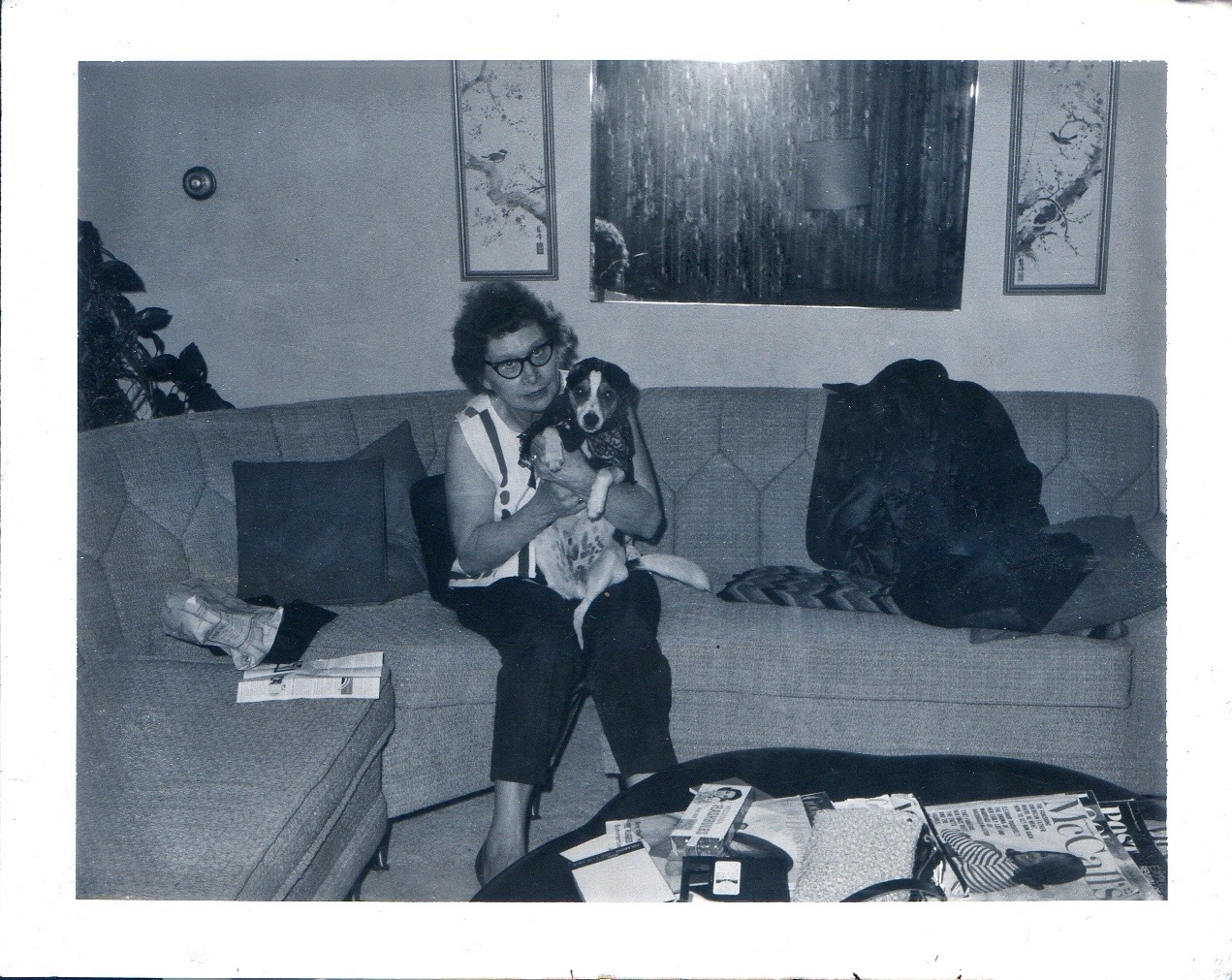
In short, housework, although generally done weekly, never got in the way of activities or a good book. We were a family of readers, and generally this reading was done on our backs. My mother’s spot was always the living room couch–some family pet (a tiny rabbit or raccoon, kitten, or the family terrier, Scamp) spread out between her side and the divan, my dad in “his” comfy rocking chair, feet up on the foot stool. I loved my bed or the floor or in the summer, outside under a tree. My older sisters’ bedrooms were sacrosanct. A closed door meant privacy. No one entered uninvited.
This was in an age before computers, cellphones, or other texting methods. The one telephone in our house was on the kitchen wall or counter. It was a party line in more ways than one. Not only were our conversations held within earshot of the entire family, but also could be “overheard” at will by the two neighborhood families who shared our party line. Today’s technological wheel had not yet been invented. With no TV possible until I was 11, I spent a youth devoted to two things: my immediate surroundings and the people or book readily within sight. If company was called for, it walked or drove to you or you drove or walked to it. The rest of life was family, homework, housework, play or books, and my mother, luckily, considered the play and books to be equal in importance to housework.
“I’m basically lazy,” she always said, but I must repeat again that this was not true. Our house usually assumed a state of more or less perfection at least once a week. It is unclear the degree to which this was motivated by my oldest sister, who was an excellent commander. “Mom, we’ll do the dishes. Patti, you wash and Judy you wipe,” she would instruct, while she herself disappeared into her room for an after dinner nap.
I do remember a certain Saturday when each of us lay on her back or sat sprawled in a different chair reading when a knock sounded at the front door. Impossible! No one in our small town ever dropped by uninvited. Even sorties to or from my best friend’s house just two houses away from me were always preceded by a phone call. We remained silent, but the insistent knocking continued. I peeked out at the front door through the living room drapes and the eyes of two girls and an older woman all shifted in unison towards the drapes. Caught!
Each of us grabbed a different pile of garments, books, shoes or ice cream dishes from a living room surface and stashed them in a closet, drawer or cupboard as my mother answered the front door to a woman and her two daughters from a neighboring little town, just 7 miles away. They had dropped by because they were building a new house and had been told by my dad that they should stop by to see our house, which had been built a year before by a builder they were considering.
My sisters and I stayed a room ahead as my mother s-l-o-w-l-y showed them the house. I cleared dirty dishes from the last meal into the stove as my sister hastily made beds and tossed dirty clothes into closets, sliding them closed to obscure reality as the visitors probably wondered what all the banging closets and drawers were about.
This was not the norm. All of Saturday morning was traditionally spent cleaning floors, dusting my mother’s salt and pepper collection, neatly piling stacks of comic books on the living room library shelves, washing windows, straightening kitchen shelves. We were not slovenly, but neither was my mother a cleaning Nazi. Life and literature often intervened.
Now, more than fifty years later, my mother has been gone for 14 years. One sister has been lost to Alzheimer’s, the other is the perfect house keeper my mother never was. But every morning, I lie in bed writing this blog until it is finished. My favorite location for reading is still flat on my back, and I do not need to compete with my mother for my favorite reading spot on the living room sofa. Sometimes Morrie, my smallest dog, spreads out beside me, and I can’t help but think of my mother–feeling as though I’ve taken her spot–stepped into the role set for me by the preceding generation.
Yes, the day’s dishes lie stacked in the kitchen sink. There are books piled on the dining room table from Oscar’s last English lesson. Papers are piled on the desk next to my computer, a pair of shoes under each of several pieces of furniture. Bags of beads and Xmas presents purchased during my trip to Guad a few days ago are still on the counter, ready to be whisked off to cupboards or the art studio below.
But my book is a good one and Yolanda will be here tomorrow, bright and early, looking for tasks to justify her three-times-a-week salary. With no kids of my own to boss around or delegate bossing authority to, and salaries cheap by comparison here in Mexico, I have hired myself a daughter/housekeeper/ironing companion. Sometimes we stand in the kitchen and talk, letting the dust remain undisturbed on surfaces for ten minutes to a half hour more, or go down to the garden to decide where to move the anthurium plant, to just admire a bloom I’ve noticed the day before or an orchid recently bloomed that she has noticed in the tree I rarely glance up at.
Every generation cannot help but be influenced by the last, and in spite of many differences, I am still my mother’s daughter. It is in my genes to place some priorities above housework, firmly believing that this is good for my soul as well as the souls of those around me.

My mother and Scamp in a more characteristic pose, resting up from reading.
In response to The Daily Post’s writing prompt: “I’ve Become My Parents.” Do you ever find yourself doing something your parents used to do when you were a kid?





 lifelessons - a blog by Judy Dykstra-Brown