Tag Archives: South Dakota

Follow the Lines: Cee’s Compose Yourself Challenge: Leading Lines

Follow the Lines
(Click to enlarge pictures)

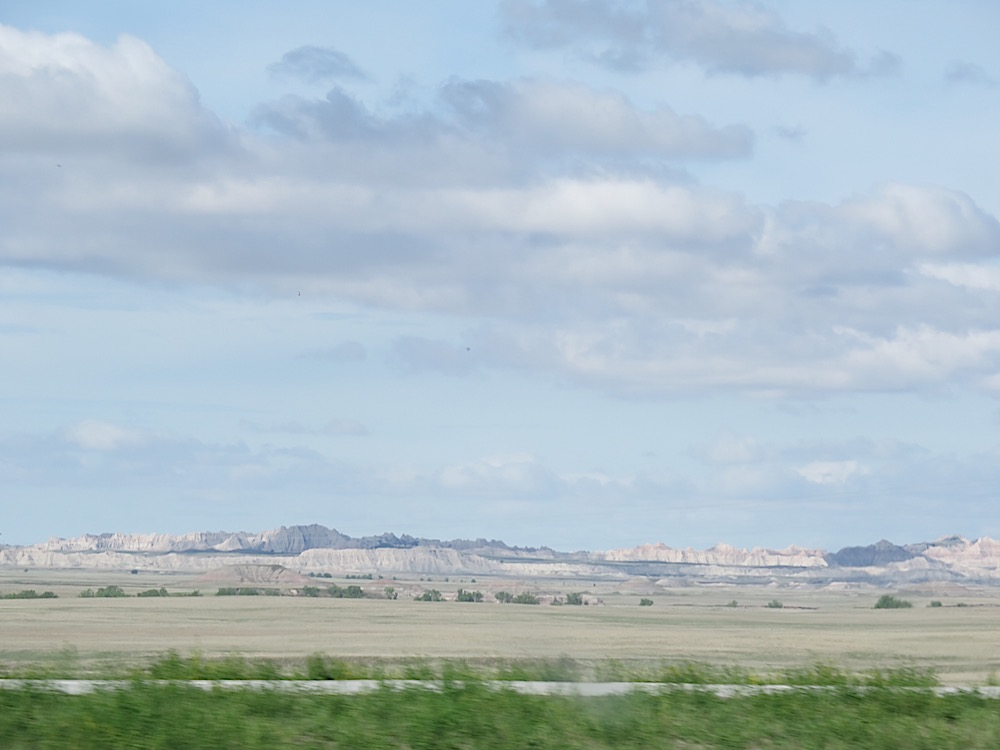
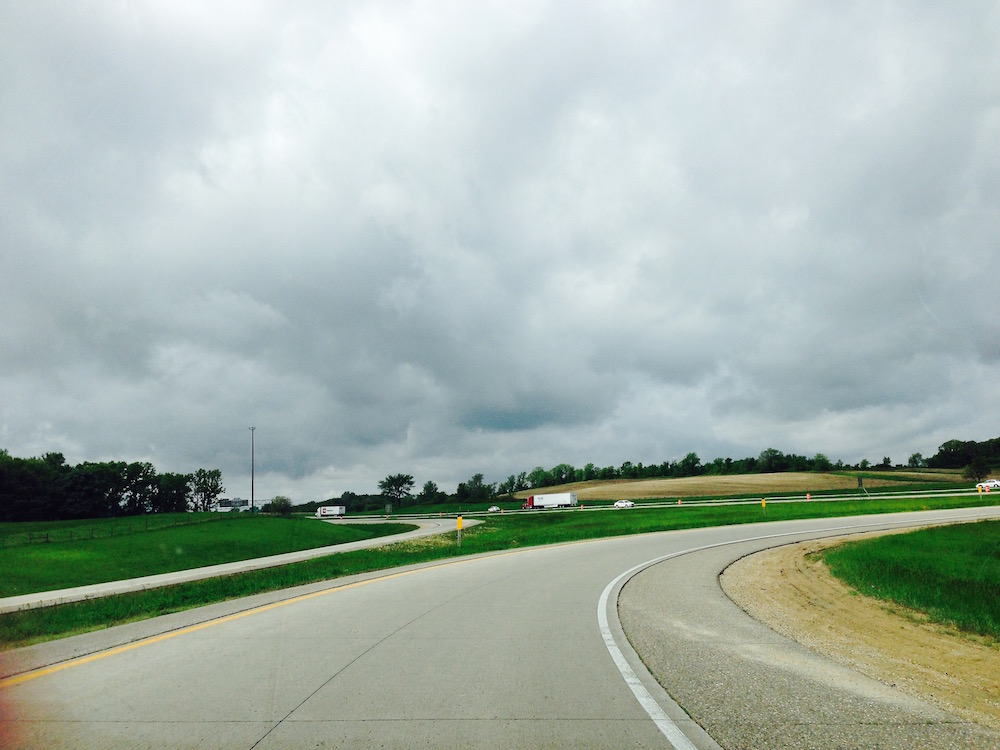
IMG_0105 Version 4You need to CLICK to expand this one. Although this looks like a panoramic shot, it is actually a cropped version of the photo below. I think the  horizontal imagery of the photo (in which every element is horizontal) is brought out with more effectiveness in the cropped version, perhaps because the canvas itself is more extremely horizontal. Unlike leading lines that demonstrate perspective by leading the eye back into the photo, these lines draw my eyes back and forth, so I wonder if they qualify as leading lines or if perspective is a requirement.

IMG_0174 (1)(This is the original of my cropped version favorite above it)

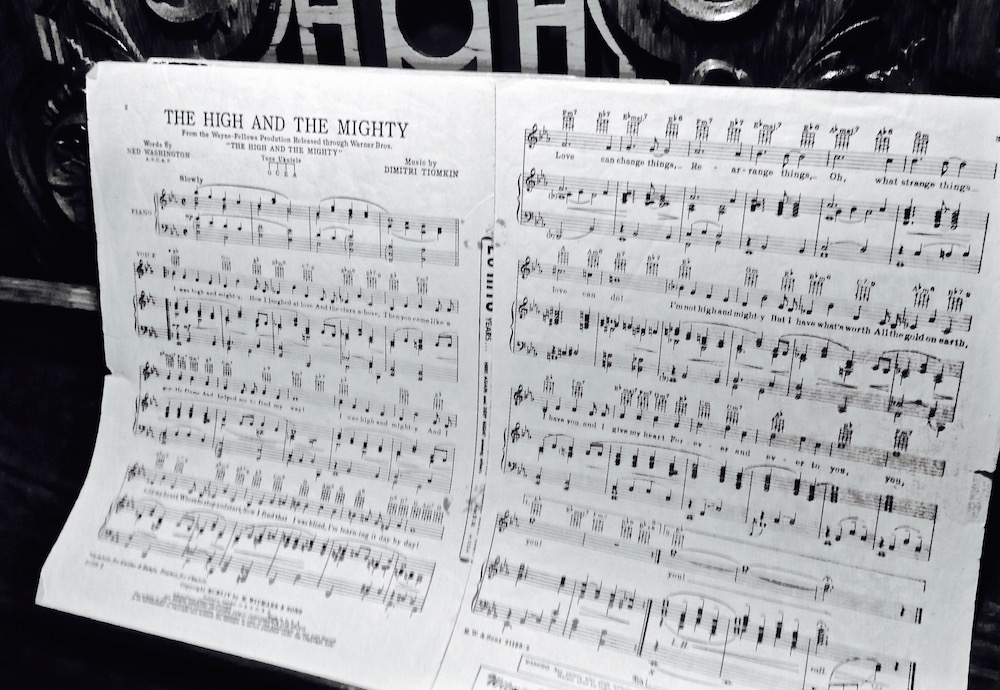
IMG_0563 (1)I almost didn’t use this photo because of all the contrasting round and curved shapes, yet I feel in spite of them the horizontals of the music draw the eyes back, especially because of the narrowing perspective.  I’m interested in what Cee has to say about this.

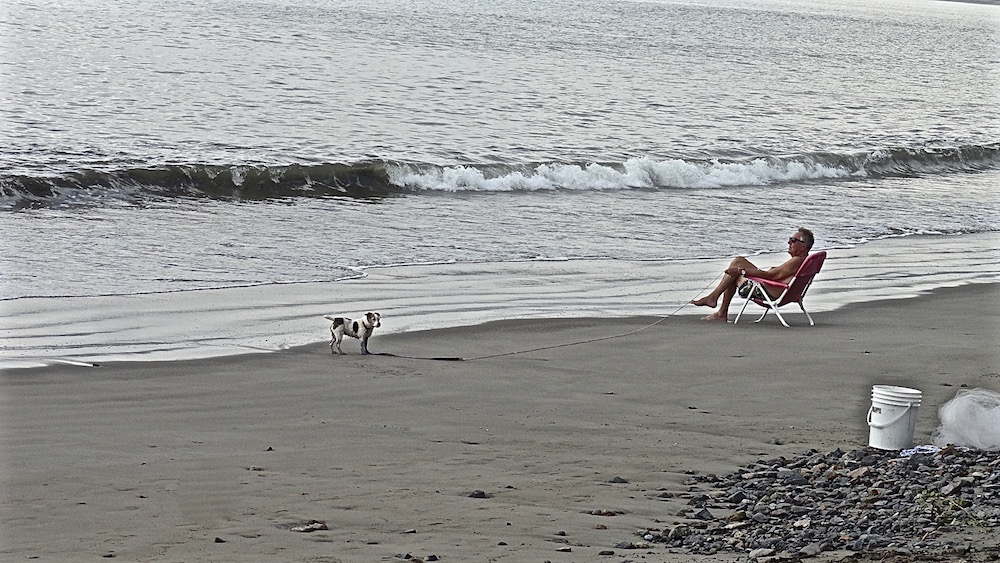
DSC00627 - Version 2I love this scene and took it from about 5 different perspectives and focal lengths, including a shot that reveals shoreline for miles up the beach.  There is something about the simplicity of the wave line in this shot echoed by the ripples on the sand that made me like it the best.  Showing this line extending for miles seemed like overkill.

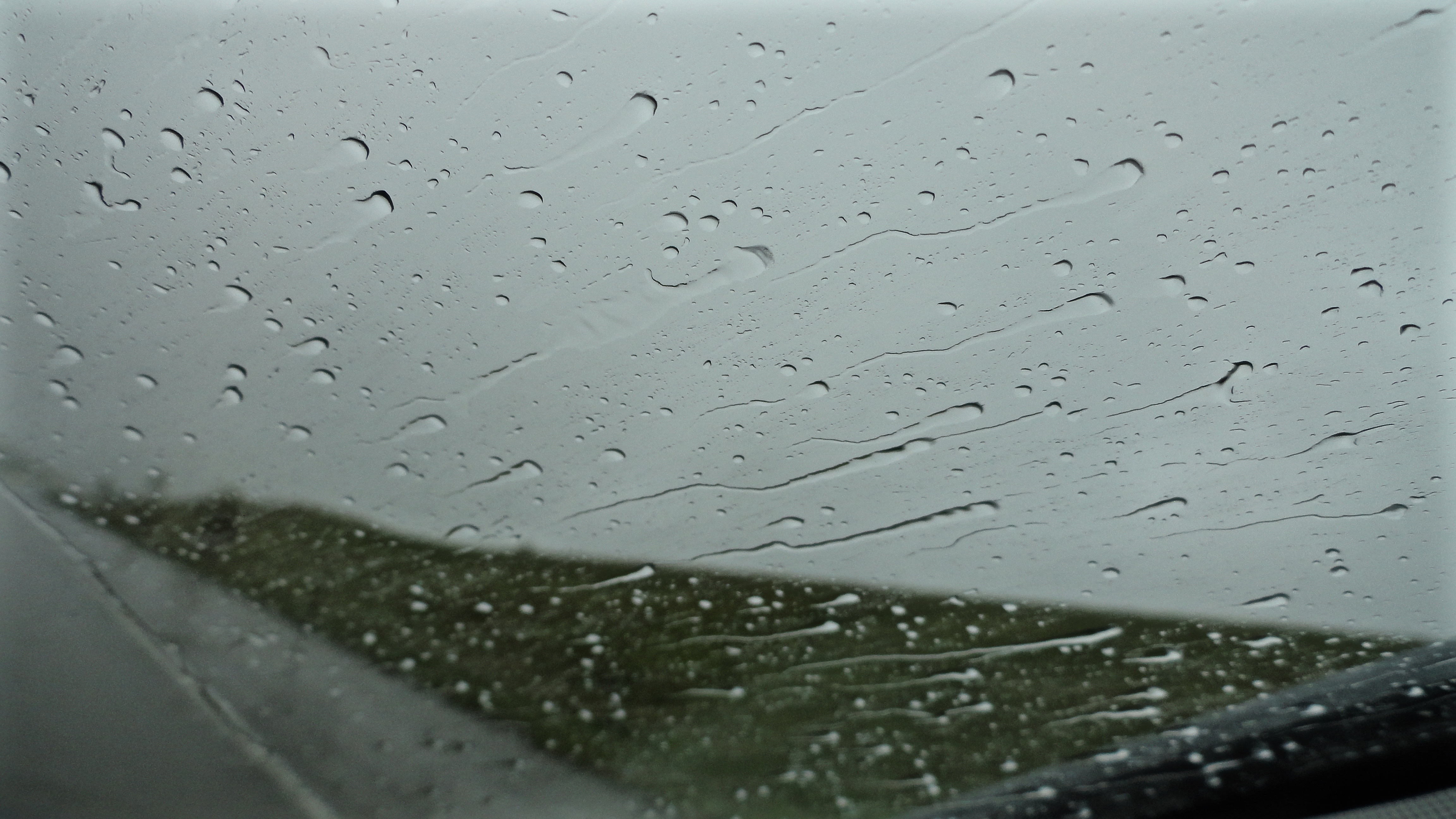
DSC01483Searching for leading lines in my current library of photos on my computer made me realize that I really do concentrate on curves and more rounded shapes.  What lines I found were almost always of roads or beaches, so it was fun to include these raindrops on the windshield of a speeding car.  They seem to fulfill the assignment to me, but still I’m interested in what Cee has to say about them.

Now, on to the additional assignment of including curves.  I think these photos fill the bill:

Version 2IMG_0261

http://ceenphotography.com/2015/10/28/cees-compose-yourself-photo-challenge-week-5-leading-lines/

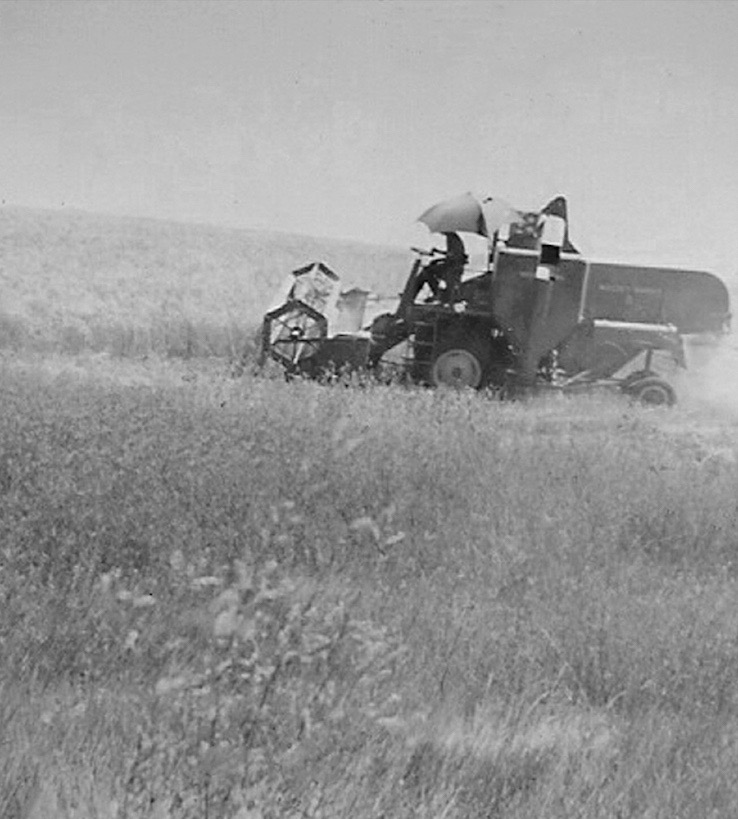
The Combiners (Entire Poem)

At Irene’s request, I am publishing the poem that I published the ending to yesterday in its entirety today.  Audrey and Betty–you may not want to read this one!

Combine (1)

The Combiners

They used to roll in mile-long parades
down the two-lane highway that led to our town–
big trucks carrying bigger combines,
like mothers still carrying their much-too-large sons.

Once we followed a string of twenty combines
for fifty miles—
Passing them all an impossibility,
as much for their sheer numbers
as for the almost constant tourist traffic
in the oncoming lane.
When the caravan pulled off the road at last,
sixty cars squealed by, accelerating.
From opened windows, fists were raised,
and not in solidarity.

They ringed the football field,
parking far out against the fence
like floats after a homecoming parade.
In an inner ring, camping trailers, cars and pickups
With license plates from Kansas or from Oklahoma,
drew into a not-much-smaller circle,
like wagons protecting themselves
from a too-easy invasion of natives.

The next morning, the combines
and most of the cars and trucks
pulled out,
leaving the trailers like war brides behind them
as men and machines moved out to the land
to bring in the harvest
before the hail or rain hit.

These machine monsters
Were not the air-conditioned luxury cruisers
of today, but the dusty, scratched, hot,
wheat chaff-blanketed, insect-filled,
open-to-the-one-hundred-degree air
combines of the fifties.

Each summer in July,
when these droves of men and boys
came northwest
from Kansas and Oklahoma,
we were told by our mothers to
stay away from the school football field
for the weeks of the harvest,
to stay away from the boys
in the downtown cafes
and the movie theaters
and the weekend dances.
Especially, to stay away from boys
in pickups or in cars
with out-of-state license plates
as they “U’d” main on Saturday night.
To stay away from their soft southern drawling voices
and their sun-baked work-hardened hands
and the tanned sinews of their arms.
Away from their breath
and their eyes,
their slow smiles
and their syrup voices.

These same boys we came to know
as shy farm boys
or college students
earning tuition with a summer job,
were dangerous in the minds of our mothers,
who either remembered
magnetic strangers of their own
or knew the dangers in the way of small towns:
by watching the lives of others.

Our fathers’ memories
of teenage yearnings
or present urges, fulfilled or unfulfilled,
swelled their minds with possibilities as well;
but fathers didn’t talk to daughters about such things.
The mothers were their buffers and their adjutants,
and so the fathers watched and mothers warned
the day the combiners came to town, plague or gift,
to camp in their Airstreams in the high school football field.

What better gift could be brought to a teenaged girl
In a prairie town of 700 people?
It was a treeless, riverless, lakeless town
sixty miles from nowhere.
A town where most of the boys went home
right after football practice
or basketball practice
or track.
Where on weekends they shot rats at the city dump.
Where in the summers, they worked
on their dads’ farms
And barely came to town at all.
A town where my particular age group of boys–
five of them in a class of fifteen–
were all late bloomers when it came to girls
and who even when they did bloom in their senior year,
didn’t date us,
but dated, instead,
freshman girls who made them feel secure.
What better gift, then, could be brought to us
than Oklahoma boys, soft-speaking, tanned and dangerous?

There were three restaurants in our town–
two for locals, one
for tourists and special occasions–
And in all three,
the majority of waitresses
were high school girls.
It was here that we came to know their
soft-drawl voices as they ordered,
sly-shy smiles when we filled their tea glasses,
the bump of their tanned knuckles against our wrists
as they took the ketchup bottle.
Here, our mothers could not insulate us from
the clean smell of their after-work showers
and the scent of wheat chaff lingering under it,
their tanned arms and their tanned faces,
their foreignness and their taboo charm.

The dances in Vivian, 40 miles away,
started at 10, when the shows let out,
and ended at 1:30.
There were kids from all the high schools
for 60 miles around.
The drinking dads of some of my school friends went there,
and college kids,
guys from Pierre–the biggest town we knew–
as well as from Presho and Kennebec and Chamberlain.
These dances in the town gym were famous.
Only sodapop or coffee were sold at the concession stand,
but drinking went on in cars
and in the bar down the street,
before, during and after.

The summer I was sixteen,
sneaking a smoke in the parking lot before the dance,
we noticed the pickups with the out-of-state license plates.
This was a first for us–
an extension of the neutral ground of restaurants.
Later, inside, we saw them dancing with the Vivian girls.
Each of us felt like we owned a particular combiner
that we’d noticed on the street or,
more likely, in some cafe,
so that their dancing with Vivian girls
seemed to us an infidelity
that we might or might not forgive them for.

I saw him first on the bleachers
on the other side of the floor.
As dancers came together and parted,
I saw him and then didn’t see him.
After the music stopped, I craned my neck
around the legs that stood in front of me,
trying to see him across the cleared dance floor.

Then the voice at the top of the legs
asked me to dance, and I looked up–at him.
Feeling uncertain, wicked and wild,
I answered yes.

I’d served him once or twice
at Restaurant 16–
that highway-fronting restaurant
as exotic as its name.
I knew he was working the Weston place
with an outfit my dad had never used.
He liked his steak well-done,
French dressing, no tomatoes.
Butterscotch sundaes made him cough.
Over the water pitcher and order pad,
we had traded a look or two.
I knew he wore Old Spice
and drank Cokes with breakfast,
but I didn’t know his name.

When we got to the dance floor,
he took my hand,
put his other hand on my damp waist.
It was a slow dance and the night was hot.
The dance was work.
I was awkward–too inhibited to get as intimate
as following in dancing requires.
Over the music, we tried to shout our names,
tried to find a mutual rhythm,
finally giving up both endeavors
to dance the slow song, untouching,
moving our arms in fast song 60’s style
to the slow song rhythms.

When the music stopped,
he walked me back again
to the bleacher
he had plucked me from,
reinserted me into the correct space in the line of girls,
smiled, and walked away.

My friends closed around me
like a sensitive plant
to hear the news.
I watched his back,
blue short-sleeved shirt,
his pressed Levis
and his cowboy boots.
I watched the Oklahoma swing of his hips–
danger on the hoof.
He wouldn’t ask me to dance again,
yet, his sun-blackened arms,so finely muscled,
had held me for a minute or two.
His bleached blue eyes
had seen something of worth in me.
He had asked my name, touched my waist,
and walked me off the dance floor.
And, since this was as spicy
as any of our stories would likely be
all summer long,
I turned to my friends to tell the tale.

I definitely think this suits today’s prompt:  https://dailypost.wordpress.com/dp_prompt/take-a-chance-on-me/

True West: Social Stereotypes in a Small South Dakota Town

Prompt: West End Girls. Every city and town contains people of different classes: rich, poor, and somewhere in between. What’s it like where you live? If it’s difficult for you to discern and describe the different types of classes in your locale, describe what it was like where you grew up — was it swimming pools and movie stars, industrial and working class, somewhere in between or something completely different?

IMG_0078

True West: Social Stereotypes in a Small South Dakota Town

I grew up in a very small town (population 700) on the prairies of South Dakota. I was not aware of a wide disparity of classes at the time; but looking back, I see that there really were classes based on economic and racial factors.  Since my town was situated quite near to several Indian reservations, there was often at least one native American in my class.  In the second grade, it was Clifford Leading   Cloud–14 years old and placed in the second grade.  Needless to say, he towered over the 7-year-olds. No doubt this was why he was constantly stoop-shouldered and his demeanor was apologetic and shy.  He was a wonderful artist, and I still have several of his drawings.  “Clifford drew this for me!” I proudly wrote beneath two colored-pencil sketches in my scrapbook, but when I took them home to show them to my mother,she said, “Be sure to always wash your hands after you touch those.”  Obedient at this stage of my life, I remember complying, but I was always puzzled about why.

Since my name began with a “D” and our placement was always determined alphabetically, I sat behind or in front of all of the Native American kids who joined our class for a year or two before disappearing: Clifford Leading Cloud, Phoebe Crazy Bear, Nordine Fink (Who was my assigned “date” for Freshman initiation, but who somehow disappeared during the year.) Phoebe had very long black hair that I loved to brush during Geometry. (In spite of former warnings from mothers who told us to be careful not to contract lice from the “Indian” kids.) She was a good student, and I liked her dry sense of humor; but although I invited her to slumber parties, she never came and she, too, vanished by the end of our Sophomore year.

I know there was a division in our community between the white population and the Native Americans, many of whom still lived in tents along the railroad tracks because it was federal land and the head of the railroad allowed them to live there free of charge.  When I was given release time from study hall to teach P.E. and reading to first graders my Jr. year in high school, the sweetest and most beautiful first grader was another Leading Cloud–who, probably due to living in a tent with no bathroom facilities and no running water–had such a strong stench that it brought tears to my eyes to stand over her for long as I guided her in her reading.  My mother attributed this to the use of “bear grease” in the hair, but I think she was a few generations behind in her thinking.

The factors of difference in culture, living arrangements and economic factors divided us from the Native American citizens of our town so that aside from actual classes as school, they faded away into the environment in a manner that should have been impossible in a town as small as ours.  They did not attend games, dances, or participate in any of the extracurricular activities of the school. They did not attend church or hang out in restaurants.  I do remember my mother asking us to sit in front  and back and either side of her when we went to the movies in White River–32 miles away.  Closer to the reservation, there was a higher Native American population and my mother, sensitive to smells, wished to take all proper precautions.

My mother was not unkind. She fed any hobo who showed up at our door. She took boxes of clothing out to the dump and set them where foragers could easily find them.  She also told me never to mention that clothing had been mine if any of the Native American kids showed up wearing one of my give-aways. But she was the product of an age where we had not yet thought to struggle against racial stereotypes.  My father regularly employed seasonal workers from the reservation and even learned to speak some Sioux.  He was a natural born storyteller who loved gleaning material from all and sundry and a broad-minded thinker. One of the few Democrats in town, he counted everyone among his friends–from his Hunkpapa Sioux employees to the Governor of the state.

Yet, should the doorbell ring when my dad was not at home and  if my mom were to see that it was someone from the reservation stopped at our house to ask for work on his way into town, she would tell us not to answer the door and would cower in the hallway out of sight. Again, I know my mother well enough to know it was genuine fear that prompted her actions, not meanness or hatred.

There were two families of Sioux lineage in the town who did manage to bridge the gap of cultures.  In one case, it was a handsome young man who was an incredible basketball player whose name revealed his mixed Sioux and French genes. He was the secret heart-throb of many a girl, and his sister, as beautiful as he was handsome, was a cheerleader and generally accepted, I believe, although they were enough older than I am for this all to be hearsay.

The other family that was able to bridge the two cultures was also of mixed lineage–white and Sioux.  Another beautiful family, their son was also an excellent ball player and both of their daughters were cheerleaders.  (This was the highest rank of success in our town–far above Valedictorian.) In both cases, the cultural differences were only a matter of skin color.  They were not living in tents along the railroad tracks or migrating back and forth from the reservation.  In  most respects, their lifestyles were no different from our own.  Still, I have heard that when one of our most popular young men married one of the popular young ladies I’ve just mentioned, that his mother was heard to say, “He’s marrying that half-breed!”  (Or, perhaps, “He’s marrying that squaw.”  Of the two discriminatory statements, the second seems even worse than the first, although it was commonly used to describe any “Indian” woman when I was growing up.)

It seems as though the major factor, then, that created a class structure in our town was one of culture coupled with economic duress.  Yes, there were poor families in our town and many times they did not participate as fully in what little social life there was in our town, and yes, although I started out inviting everyone in my class to parties, in time the parties got smaller and the guest list included mainly those friends from my neighborhood or those I found to be the most fun or who participated in the same activities I participated in.

This narrowing of social circles is natural, I think, but when I look at who was excluded, I don’t feel as though I used any criteria other than whom I enjoyed being around.  I would have loved it if Phoebe had come to my slumber parties.  She was smart and even then I had a curiosity about other cultures and other ways of life.  I was the first friend of any new girl who moved to town–a fact that caused some resentment on the part of my old friends, I now see clearly.

We all make excuses for ourselves when it comes to discussing our own prejudices, and I am no exception to the rule. Native Americans were stereotyped because the most extreme cases of behavior were the most obvious. The few women from the reservation who came to drink and lay sprawled in the street created the stereotype that all “Indian” women were “drunken squaws.”  No one ever saw any of the mothers of the children we went to school with.  They were no doubt at home trying to scrape out a meal or school clothes for their children’s next next day at school.  And their fathers were probably out working in the fields for our fathers.  But we did see the drunks on the streets every Saturday night as we exited the movies, and so this is the stereotype that formed in our minds, no matter how much our actual experience with kids at school rivaled that stereotype.

Many years ago, I started to write a book called “Vision Quest” about a young Native American boy who grew up in our town.  This was a work of fiction, but I drew of course upon actual experience for details of plot.  I know I came back to it at least twice, but never got beyond the first few chapters, probably because I had so little experience to draw upon; for in spite of the fact that I grew up in a state that contained numerous reservations and in spite of the fact  that all of the surrounding towns contained a Native American population, in fact our cultures were so widely divided that I had as little insight into their lives as they must have had into mine.

The term “Native American” had not been coined when I last lived in my hometown, and neither had the sensibilities that I hope go with it.  When Dennis Banks and Russell Means were heroes to much of the rest of the world, they were outlaws and trouble makers to those non-Native Americans who lived in their midst.  To someone stopped from driving on highways where they had always driven, they appeared to be highwaymen or brigands.  It is hard to make a hero of someone you grew up feeling superior to, and hard not to stereotype any race or cultural group according to what you know about the few representatives of that group with whom you have come in contact.

But I have to say that coming back to my town and hearing one of the supposedly kindest and admittedly hardest-working members of the church I grew up in describing the wife of a local boy as a “N—–” and scathingly speaking of the Native American Rights movement of the seventies made me take a really long look back at my own past as well as to reappraise my former affection for this woman whose small-mindedness revealed itself at a time when I myself was in love with an African man, teaching African children and living with African housemates.

The last time I visited my hometown, I did not go to see this lady and by the time I next went, she had passed away. Hopefully with the demise of these last citizens of the old ways, prejudice will pass away with them.  I am afraid, however, that prejudice is born anew in each generation–perhaps towards yet a new group of immigrants or transplants who threaten the so-called “American Way of Life.”  It would do us all well to remember that America was meant to be a melting-pot, and as in any recipe, it is made more palatable by a variety of spices.

For Red: The Summer Home

The Summer Home

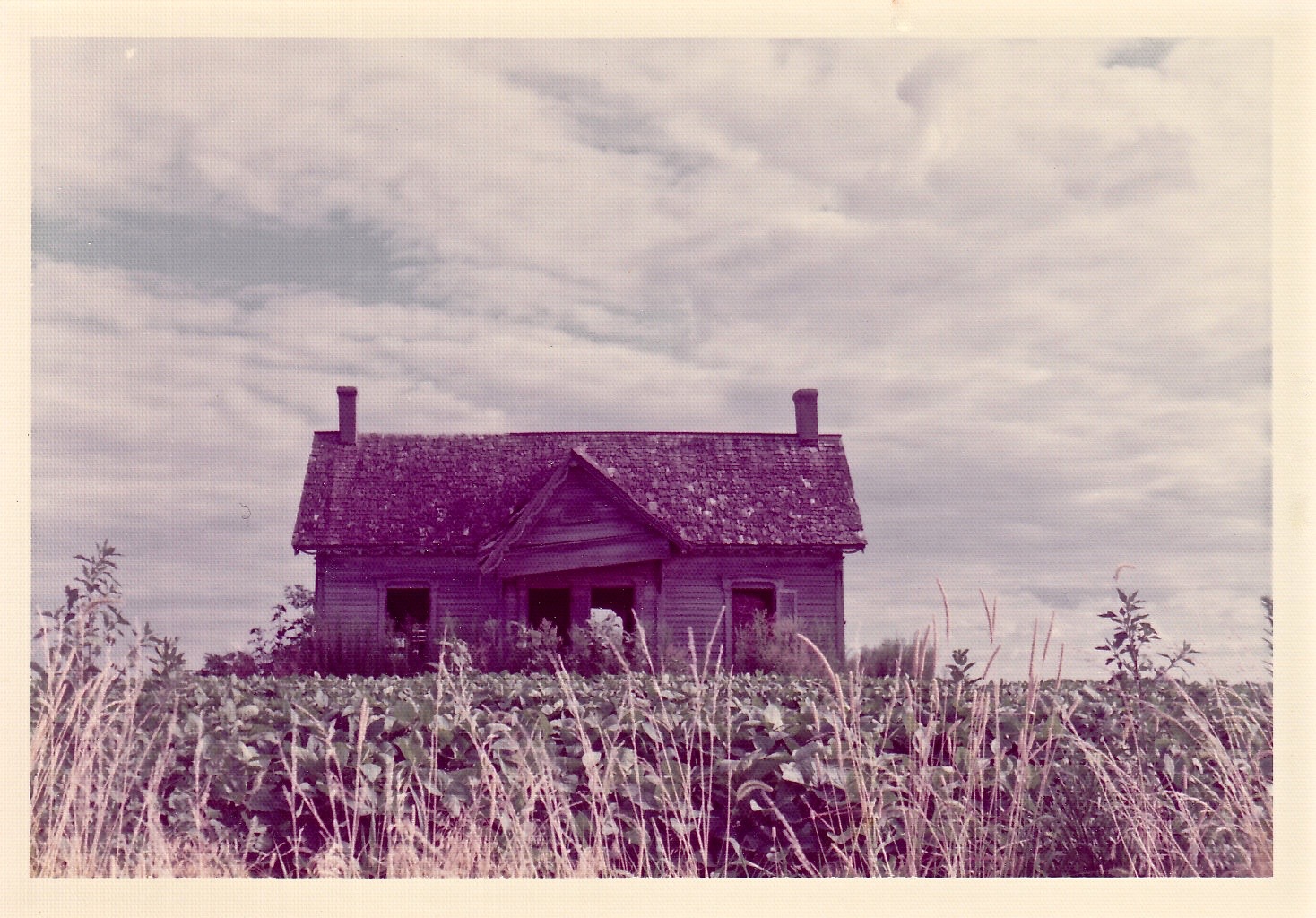
Decaying Farmhouse in Missouri Soybean Field

Photo by okcforgottenman, aka flycatcher

THE SUMMER HOME

When my dad bought the land
where the Big White River and Little White River joined,
I couldn’t believe that we owned land with trees on it.
While he plowed the small field,
I walked the woods and found the abandoned shanty.
Its door was open; in fact it could not shut.
Inside was a mysterious, sweet and fecund smell–
a mouse smell new to me
that I couldn’t stop myself from breathing in.
The mildew and the dust,
the musk of warm linoleum,
every new smell and sight was magic.

I was enchanted by this house emptied
of chairs and tables and beds,
yet full of the accumulated energy of past tame lives
and present wild ones:
the moving of leaf shadows
across the chipped linoleum of the L-shaped kitchen,
the dents on the floor where the kitchen chairs had set,
as though someone had taken care each day
to line up the legs in their holders.
Upstairs I found crayon scribbles halfway up the wall–
the arm reach of a three-year-old.

When I asked about the house,
my dad said that it was our summer home,
and the next time we went to the field,
I brought a broom.

I cleaned out the mouse droppings and the tumbleweeds.
I collected the peeled tile fragments,
imagining gluing them back again.
I washed out a quart canning jar at the pump
and filled it with spring water
and sweet clover,
putting it on the floor
between the kitchen chair holes
in the exact middle of the vanished table.
With the old shirt I found in the corner,
I rubbed mud and river sand
from the linoleum counter tops.
More sand worked as Ajax to scrub out sinks.

All summer long I worked on our summer home,
and for that summer and many summers to come,
I waited in vain for our move to the river house.

I sat on its screened front porch.
Outside the screen grew spearmint and peppermint.
On the top leaf of the tallest branch was a grasshopper,
the kind that left tobacco stains in your hand
when you held it.
All around me were the trees–
the swaying shedding cottonwoods
and scrub chokecherries.
It was a wealth of trees I’d never seen before
in the town where we lived on the bare prairie
nor on the roads we traversed for hundreds of miles
to see a movie or a dentist
or to buy clothes.

Around the screens buzzed the heavy flies,
their motors slow in the heat of July–
all the flies on the outside
wanting to get in
and all the flies on the inside
pressing the screen to get out–
like I longed to get out
to the freedom of trees
where black crows
and dull brown sparrows
rustled their wings
and flew from branch to branch.

In the distance, meadowlarks called
the only birdcall I ever recognized.
No squirrels, no chipmunks; but, rabbits? Yes.
My father said no bears,
but he’d told me the story of Hugh Glass,
mauled by a bear,
walking this river for a hundred miles
past this very joining of the Big and Little White,
in search of help;
and I could imagine one last bear or two
hidden in my woods.

So at night, at home in our winter house in town,
when he told the story I loved the best,
I was the one who discovered the bears’ cottage,
and the cottage was our summer home.
The chairs–too hard, too soft, just right—
I sat upon in turn,
taking great care every time to nestle each leg
back into its correct place on the kitchen linoleum.
And when I lay in the perfect bed of the little bear,
I could touch the crayon markings on the wall.

So when the three bears found me asleep
in the little bear’s room,
they weren’t really very scary;
but I ran anyway,
into my dark and shadowed owl-calling woods,
my woods still echoing the day lit fluted calls of meadowlarks,
their music shaken from the snarled leaves
in the evening breeze.
I ran to trees–
their leaves frosted by moonlight and the Milky Way,
vibrating with the power of the Big Dipper and Orion,
the Seven Sisters and the North Star.

Into the trees
to where I stored my memories
in the frog-croaking depressions under clumps of grass,
in the tangles of Creeping Jenny
and the fluff of dandelions,
in the sand hollows
that crept up from the riverbanks,
in the cocklebur and the chigger-infested grass,
in the crooks of cottonwoods and caves of thickets,
in the tiny cupped palms
of sweet clover and purple alfalfa,
in the wheat grass and the oats and trefoil.

The year my dad decided to expand the field
on the river bottom,
I pleaded, I cajoled, I promised, I prayed
for the summer home
where I had lived for neither one summer
nor one night, in actuality,
but where, nevertheless, I’d had faith
I would someday live.

Of course, there was no saving the woods
and summer house.
It was rich river land, prime for irrigation.
The trees were a waste of soil.
The summer home–everybody’s gentle joke on me.

After the cats and bulldozers were through,
I went with my dad to see
where trees had been ripped out,
the house burned to the ground,
the soil turned and planted
with crops that would build the land.
Their woods now furrowed soil,
the crows and sparrows
had gone to some other shaded place;
the mice, back to the fields.

My former references of trees forever gone,
the present references of sky and fence posts
too wide and new,
I wasn’t sure where my summer home had stood.
The house’s ghost destroyed by the bright sunlight,
the woodland paths replaced by tractor treads,
I watched instead a meadowlark
soar over brown fields and settle on barbed wire,
claiming the new field for its own.
With no house or forest left,
my only shade was chokecherry bushes,
my only chair, the pickup running board.
And so my summers at the river
vanished in the smoke of my summer home
and smoldering tree stumps.

But every night, my woods again threw still shadows
over the summer house,
and I ran once more the corridors of moonlight
cut through dense trees
like parts in a small girl’s hair.
I ran in the wet dew of the condensing summer heat.
I ran on the fuel of my need for magic
and wildness
and rivers
and trees.
I ran fueled by my need to be with something
that lived outside my window
as I passed long nights in my winter house.

It lay in the dark tapping of the trumpet vine branch
against my window
and the crunching of gravel
as someone walked by on the unpaved street–
out past midnight and I couldn’t tell who.
It lay in the pricking of the hair on my arm
as I stuck it out from the bed
and pressed it to the screen.

Always, in town, it lay outside of me–
except for when I floated the paths
of the woods surrounding the summer house,
joining it in dreams,
night after night and then less frequently
until the dreams came once a month
or once a year–
in darkness, always recognized;
but nonetheless forgotten in the light.

So by the time I saw the river field grown lush with corn,
I was a teenager in my first grownup swimsuit,
floating the milky Little White in an inner tube,
down to its junction
with the clear and colder-running water of the Big White,
my best friend next to me,
our cooler full of Coca-Colas and ham salad,
our conversations full of boys and music.

At the border of the field, to get to the river bank,
we crawled over the border of large tree trunks
laid horizontal, half-buried in sand.
I guess I knew they were the bones of my midnight woods.
I guess some part of me felt
the ghost of my summer house.
But, as I lay on my back on the submerged sand bank,
the warm water flowed so sensuously over my shoulders
and down my legs
that my suit seemed to peel itself
from my shoulders, breasts, thighs, calves.
And in a dream I floated the muddy water
of the Little White,
turning in the current
until the water seemed to flow inside of me,
floating me down
to the cool clear water of the Big White,
farther and farther away
from the summer home.

This poem was posted specifically as a response to THIS post on Red’s Wrap.

“The Summer Home” is excerpted from Prairie Moths–Memories of a Farmer’s Daughter, which is available Available on Amazon in Print and Kindle Versions and at Diane Pearl Colecciones and Sol Mexicana in Ajijic, MX


Wheat Cover 34 font

 Just as moths rise from prairie grasses to fly away, so did the author yearn to be free from the very place that nurtured her. Judy Dykstra-Brown’s verse stories and accompanying photographs give a vivid portrayal of rural life in the fifties and sixties, evoking the colors and sounds of the prairie and the longing a child with an active imagination feels for faraway places. From a small child curled up on the couch listening to her father’s stories of homestead days to pubescent fantasies of young itinerant combiners to her first forays into romance in the front seat of a ’59 Chevy, her memories acquire a value in time that she did not acknowledge while living them. Lovers of good poetry and those who miss the magic of childhood will relish Prairie Moths. (Excerpted from a review by Harriet Hart)

 

Mysteries in our Middle Lands

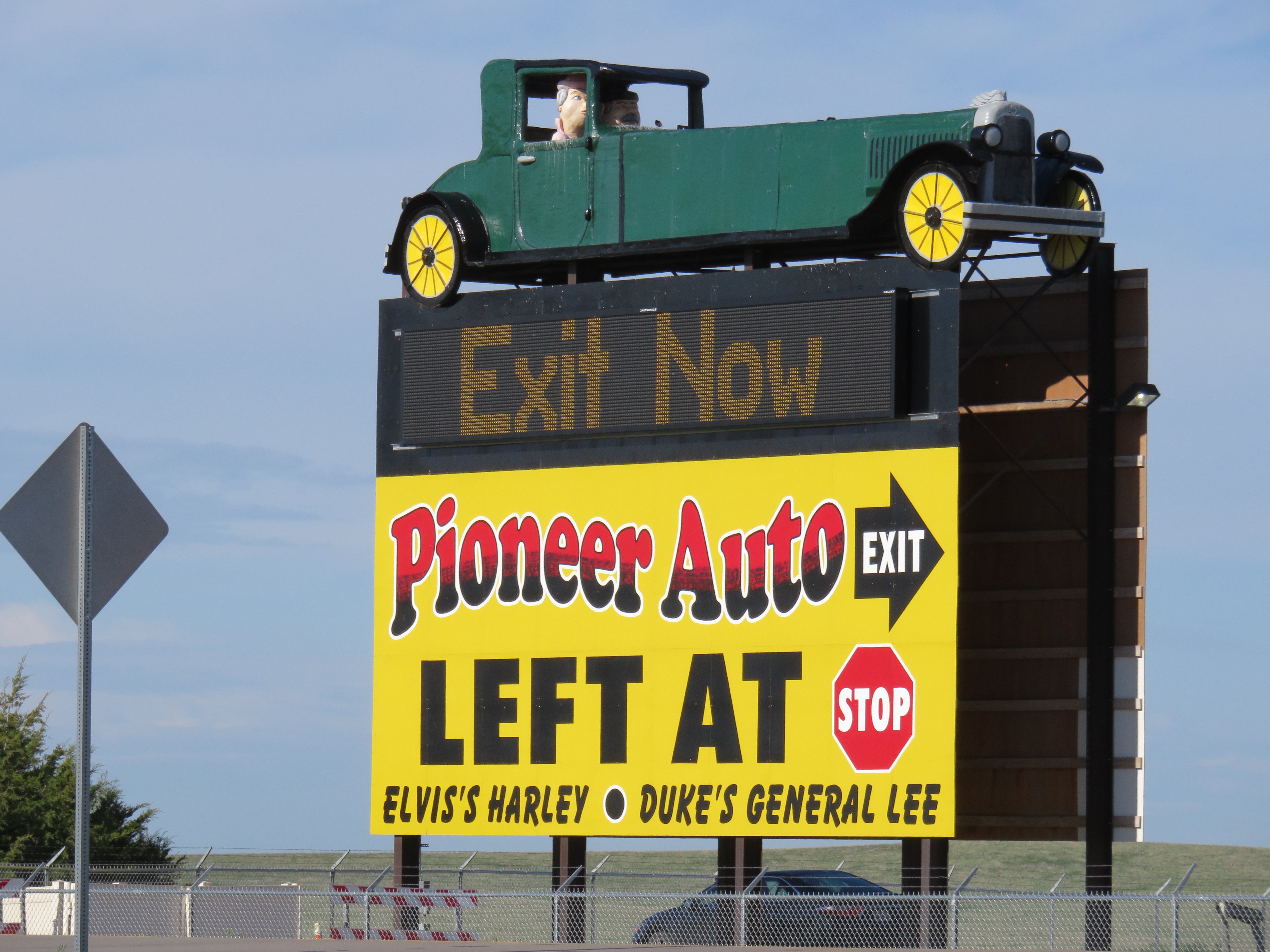
IMG_0087
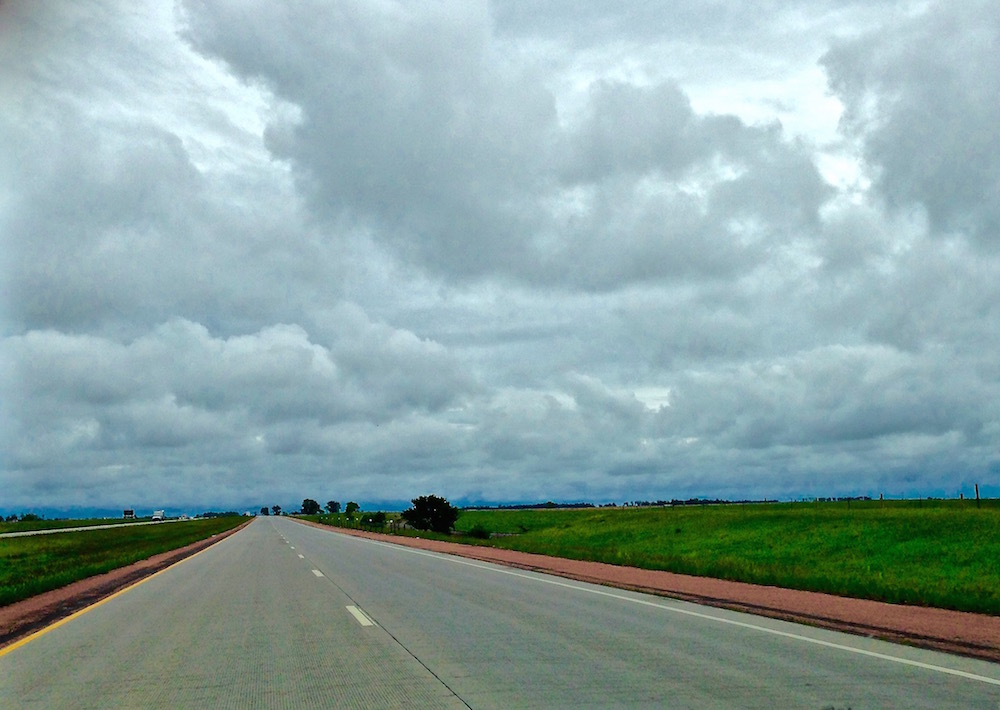
If you want to know where I came from, drive about 135 miles east from Rapid City, South Dakota, on Interstate 90 and look for the Pioneer Auto Museum signs!

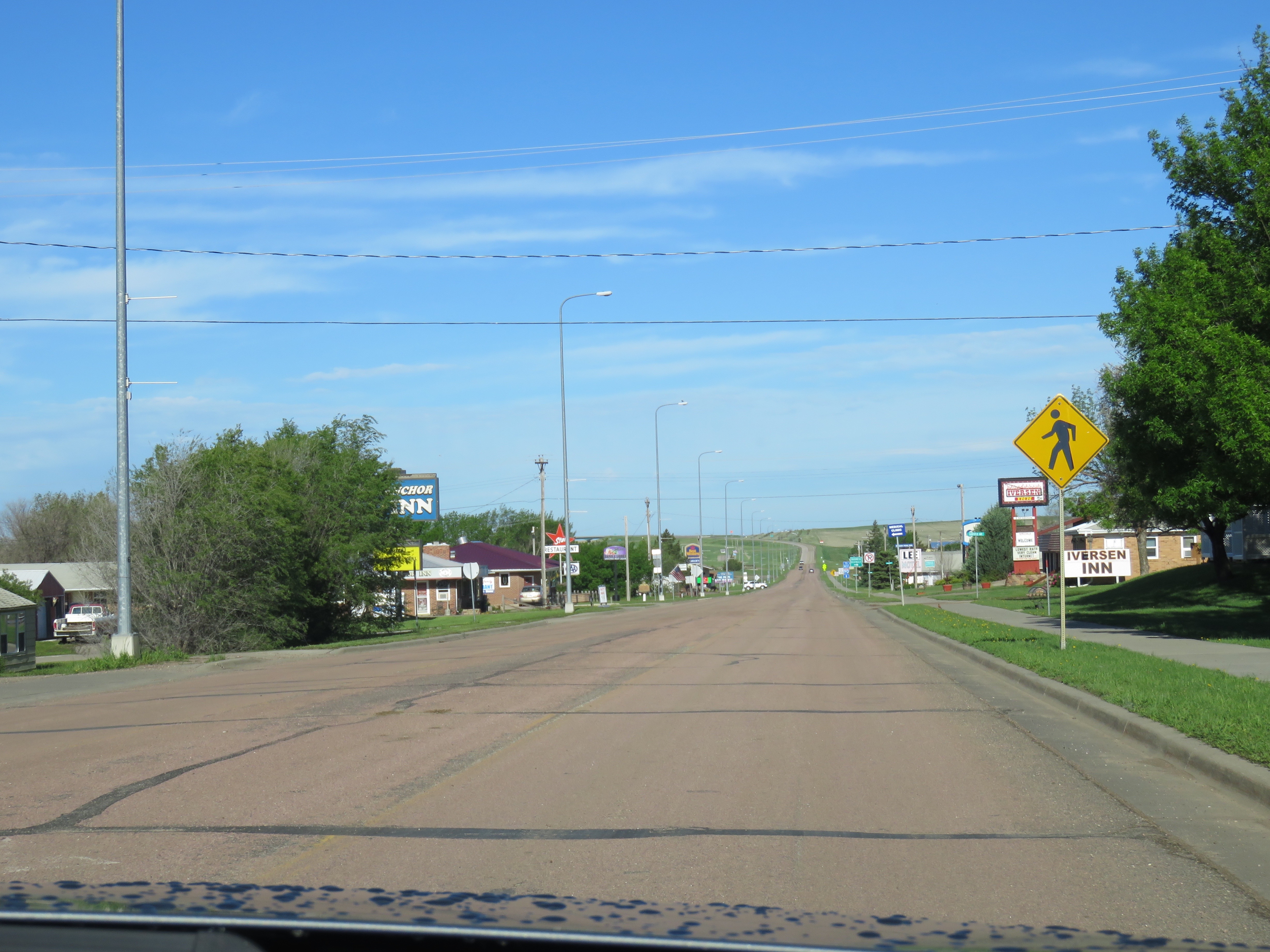
IMG_0084

This is the old Highway 16 that parallels the Interstate and that brings you into town.
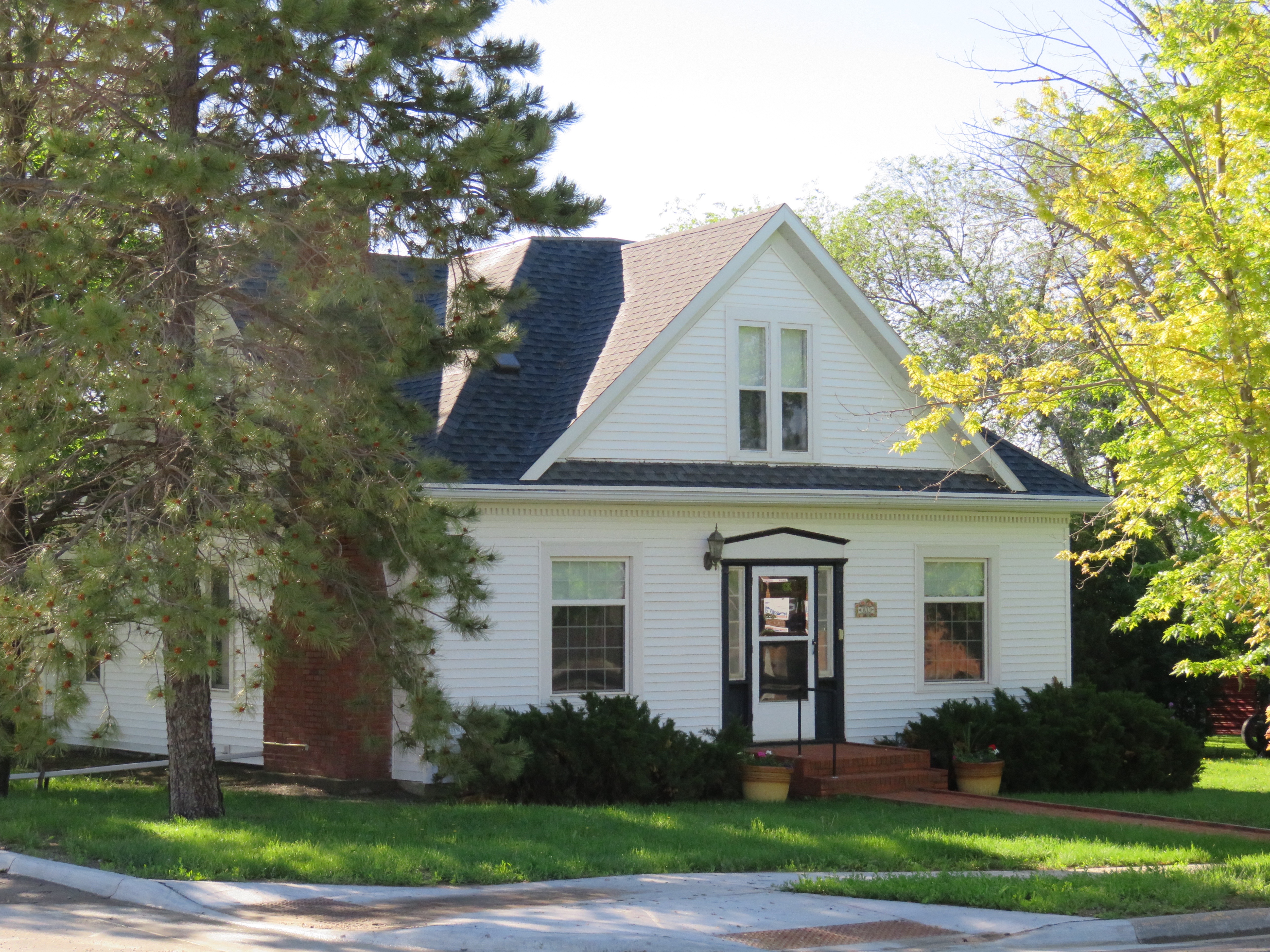
IIMG_0082
This is the house I grew up in. It once had a very big front porch that extended across the whole front.  My dad planted all the trees. My friend Joyce, who bought the house many years after my family left, added the fancy front door, shutters and brick steps.

IMG_0075
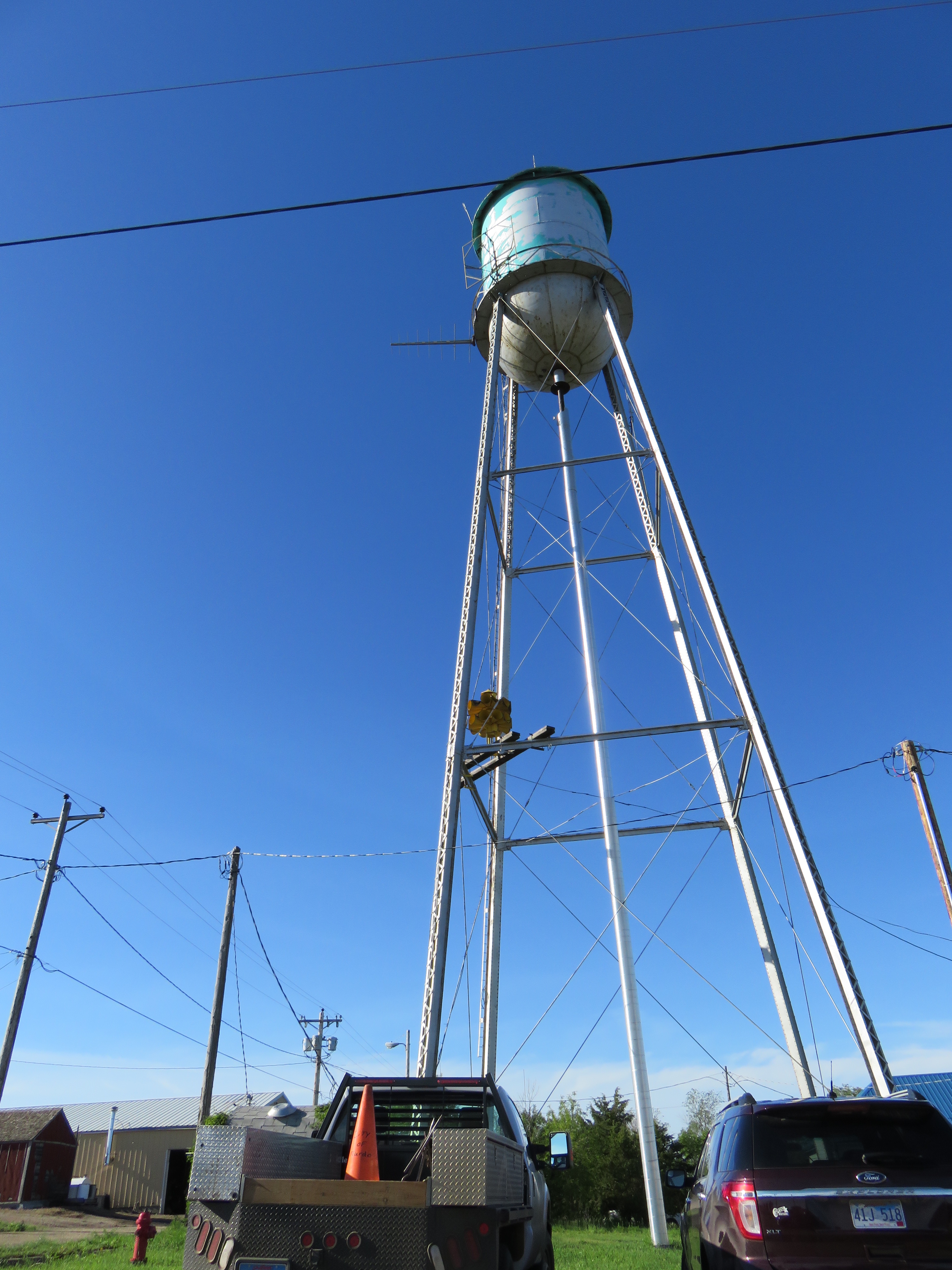
The old water tower still stands, but two more modern towers now store water from the Missouri River 60 miles away.

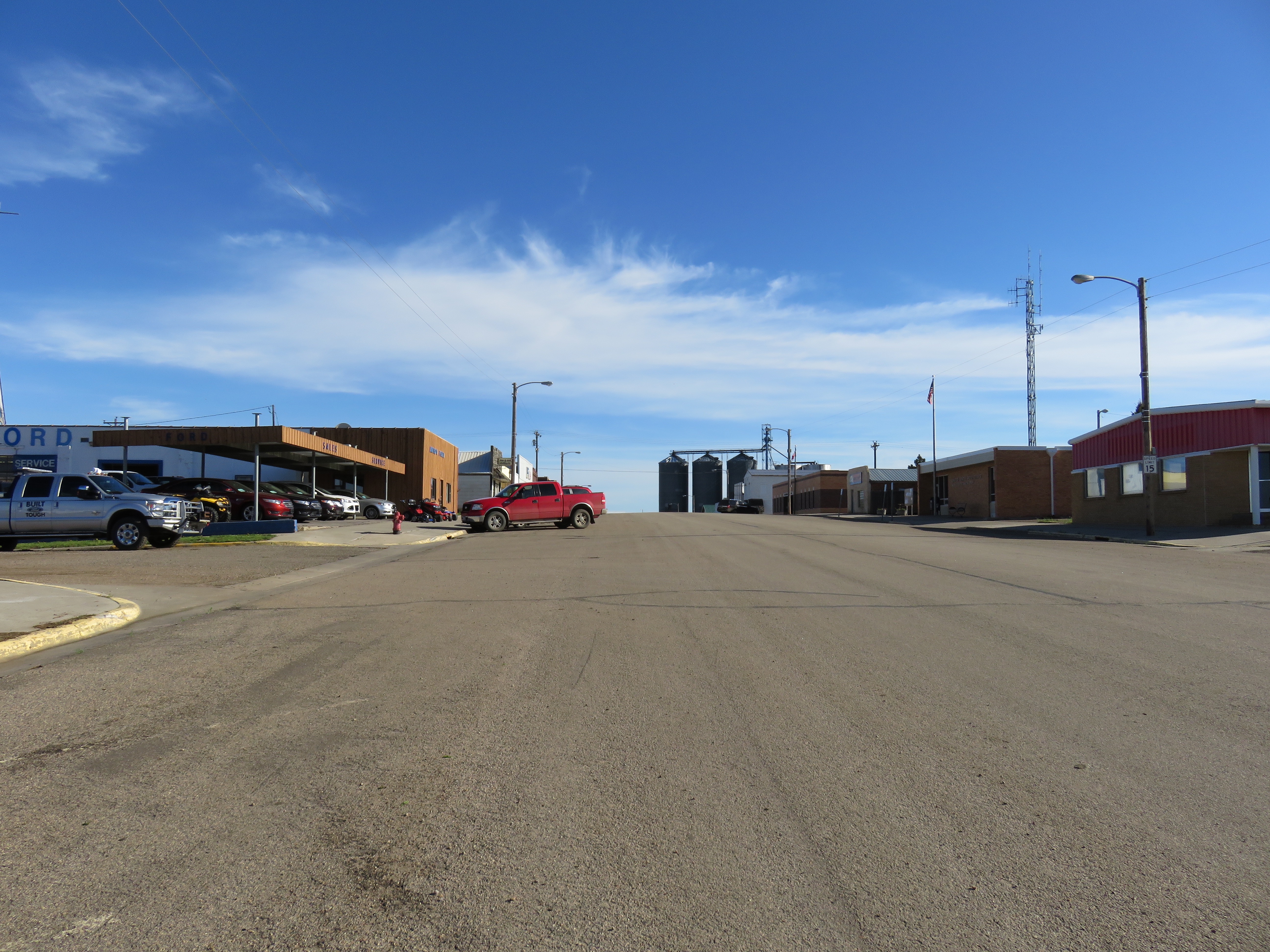
IMG_0078

The widest and perhaps emptiest main street in the world is not just an optical illusion.

IMG_0117
Head out of town past the cemetery and you’ll find the gate to the last house my parents lived in on the left.

IMG_0115IMG_0107What you won’t find anymore is the house, that blew away in a tornado.  The little shed is on the neighbor’s land.

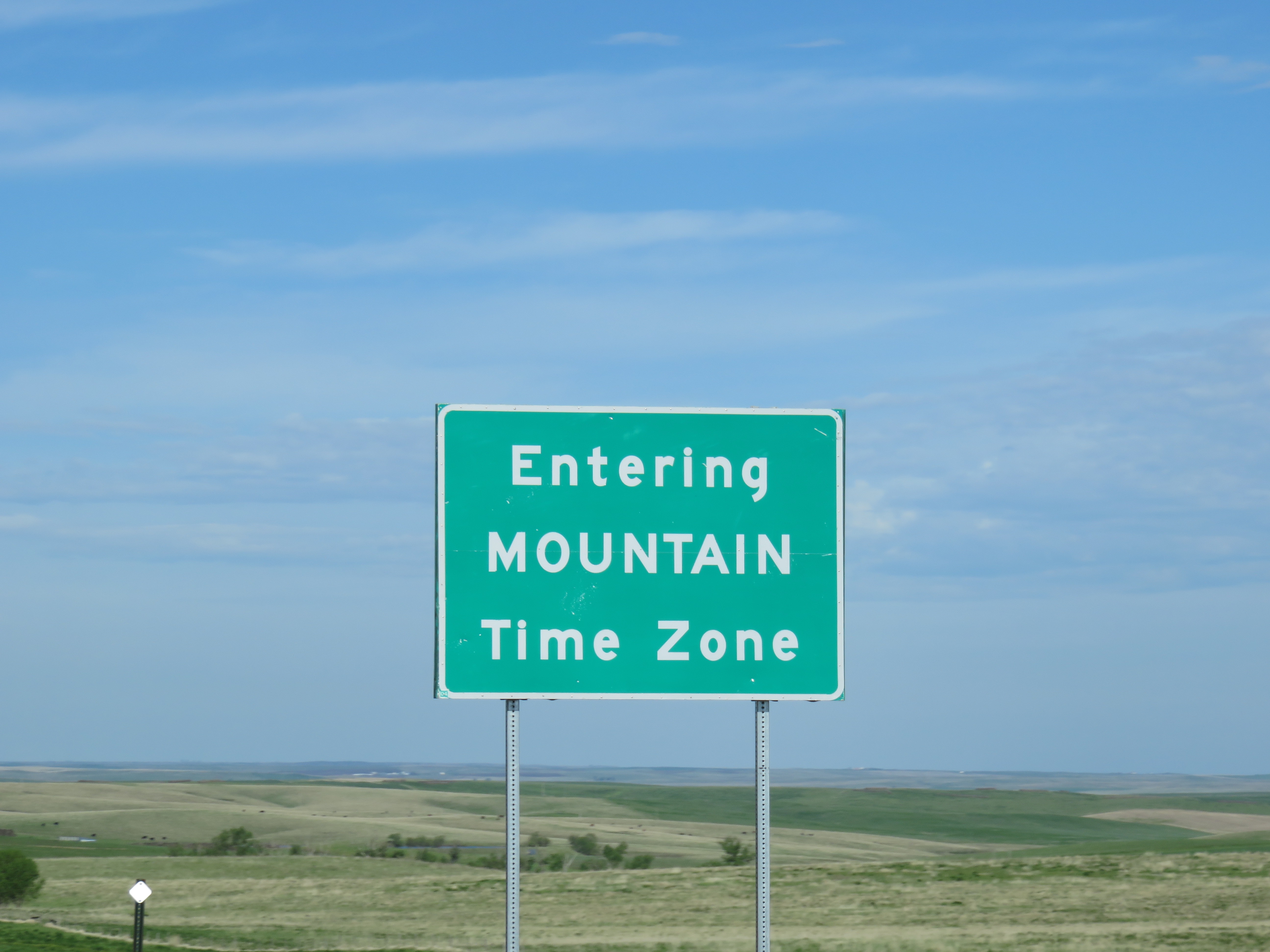
IMG_0122IMG_0150The The time zone change between Central and Mountain Time Zones that used to run right down the middle of our main street has been moved to the county line, fifteen miles to the west.

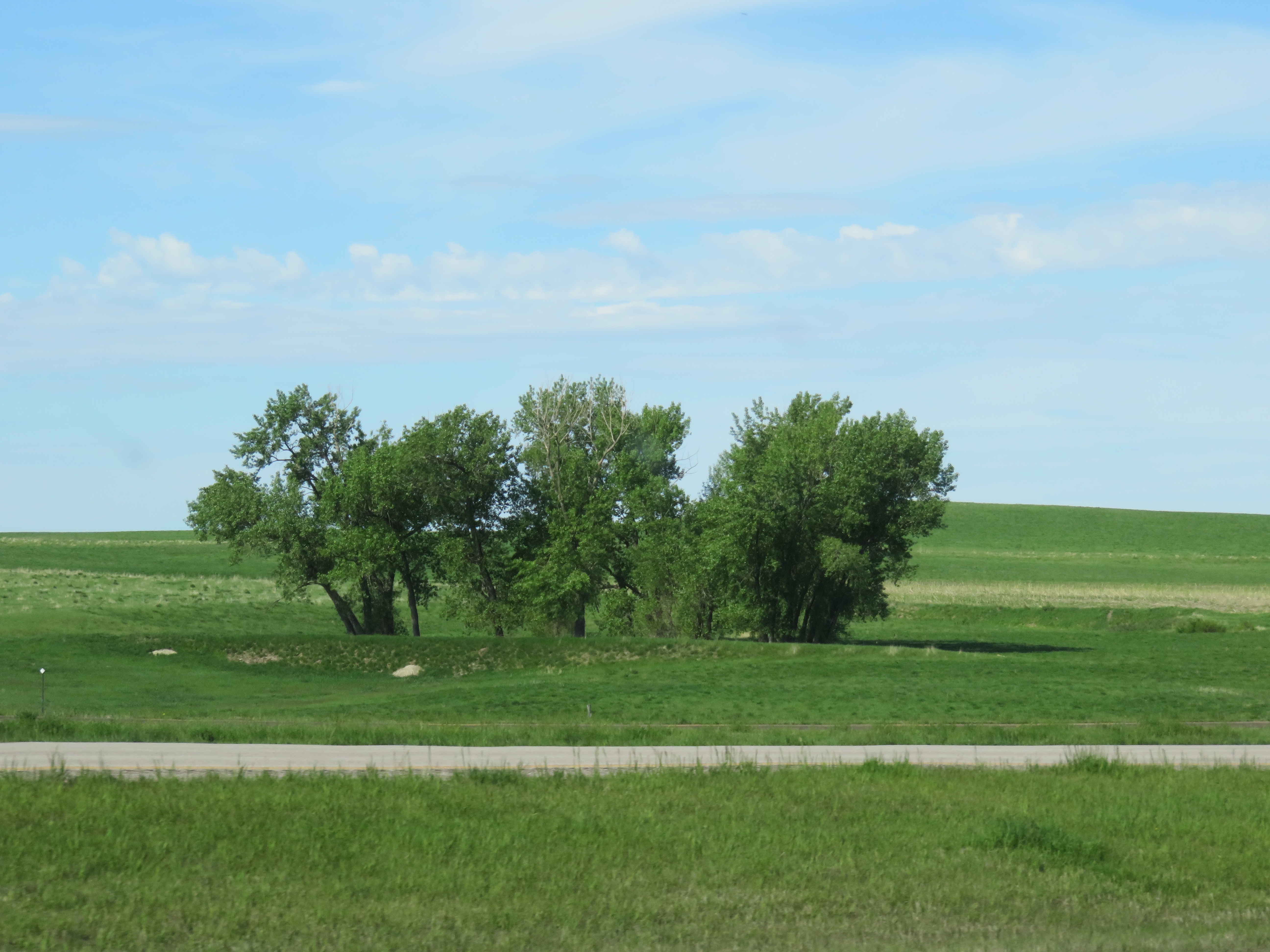
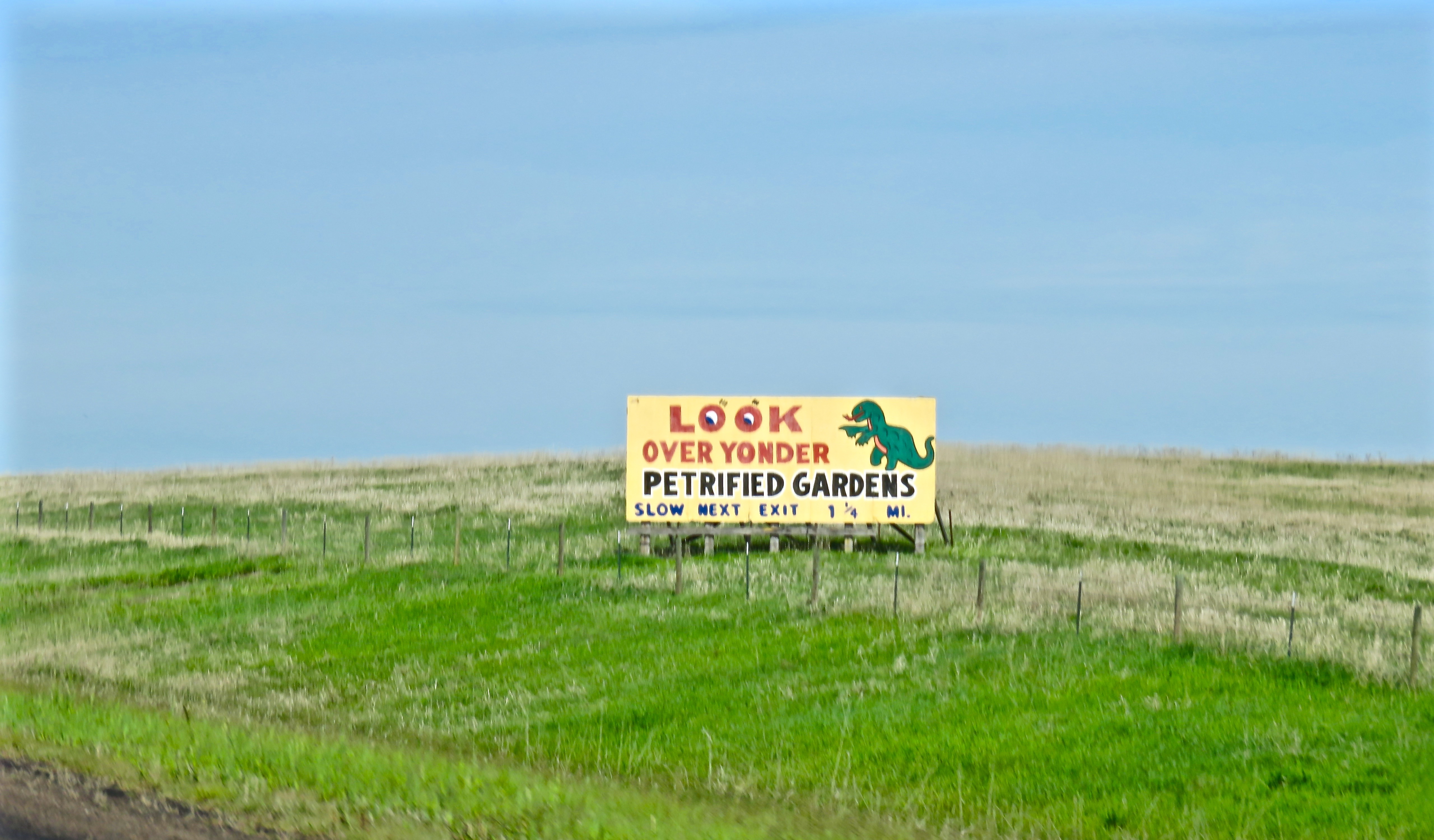
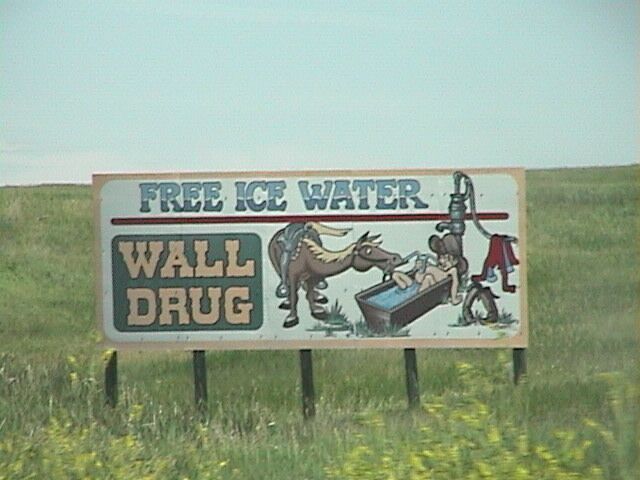
IMG_0135   IMG_0145As soon as you leave Murdo, heading west, start looking for the signs for Petrified Gardens and Wall Drug.  You won’t be able to overlook them!

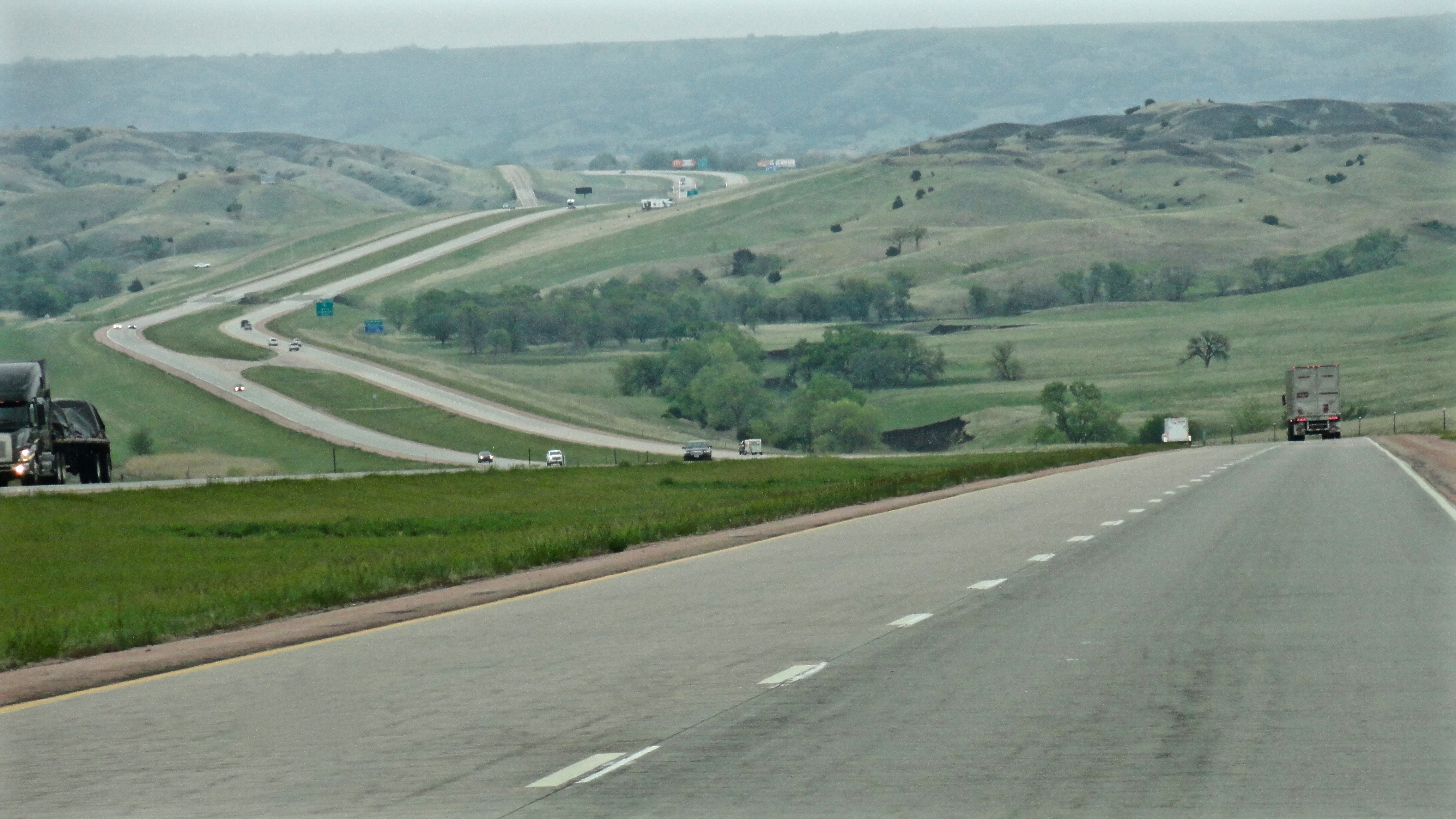
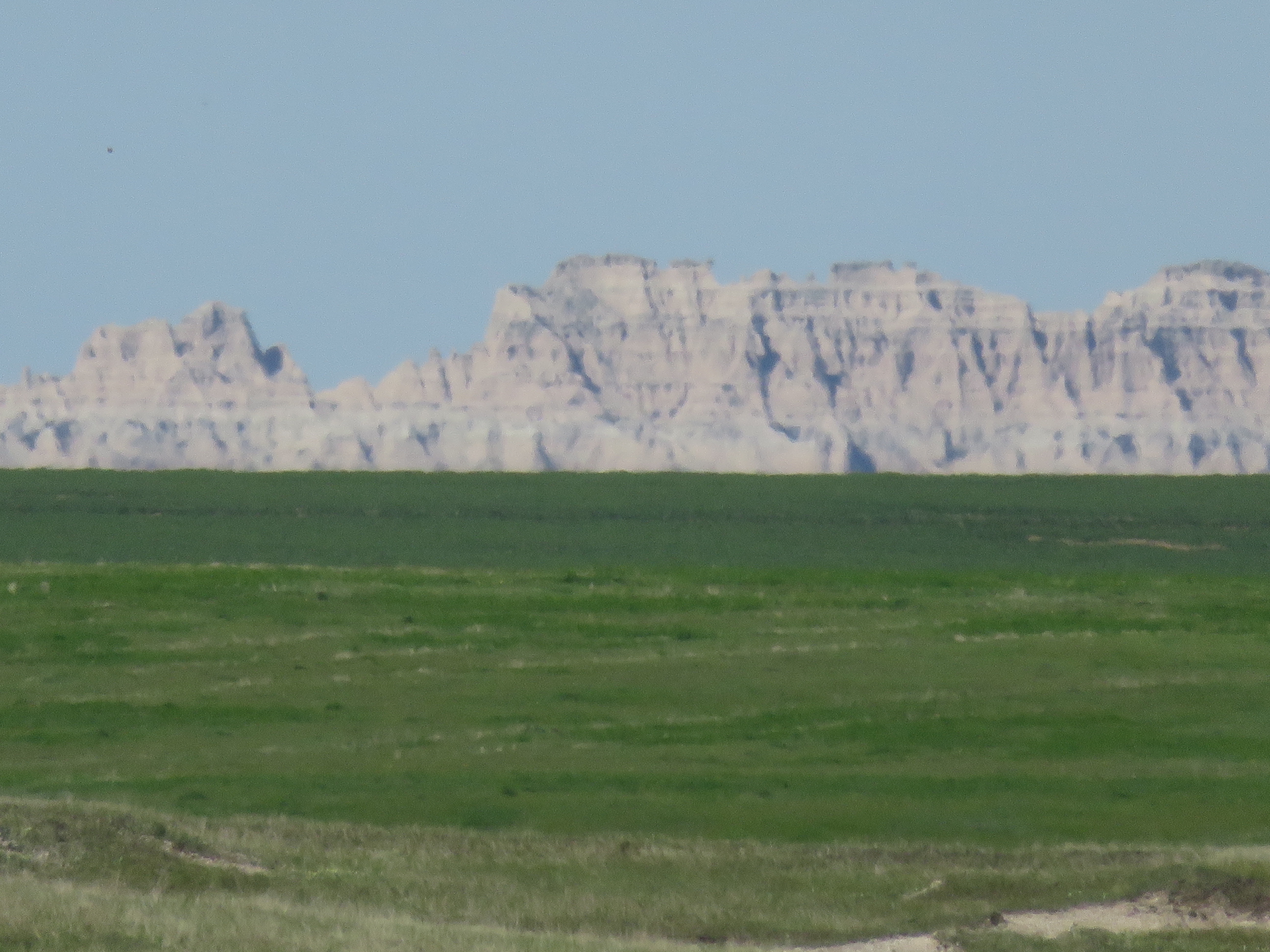
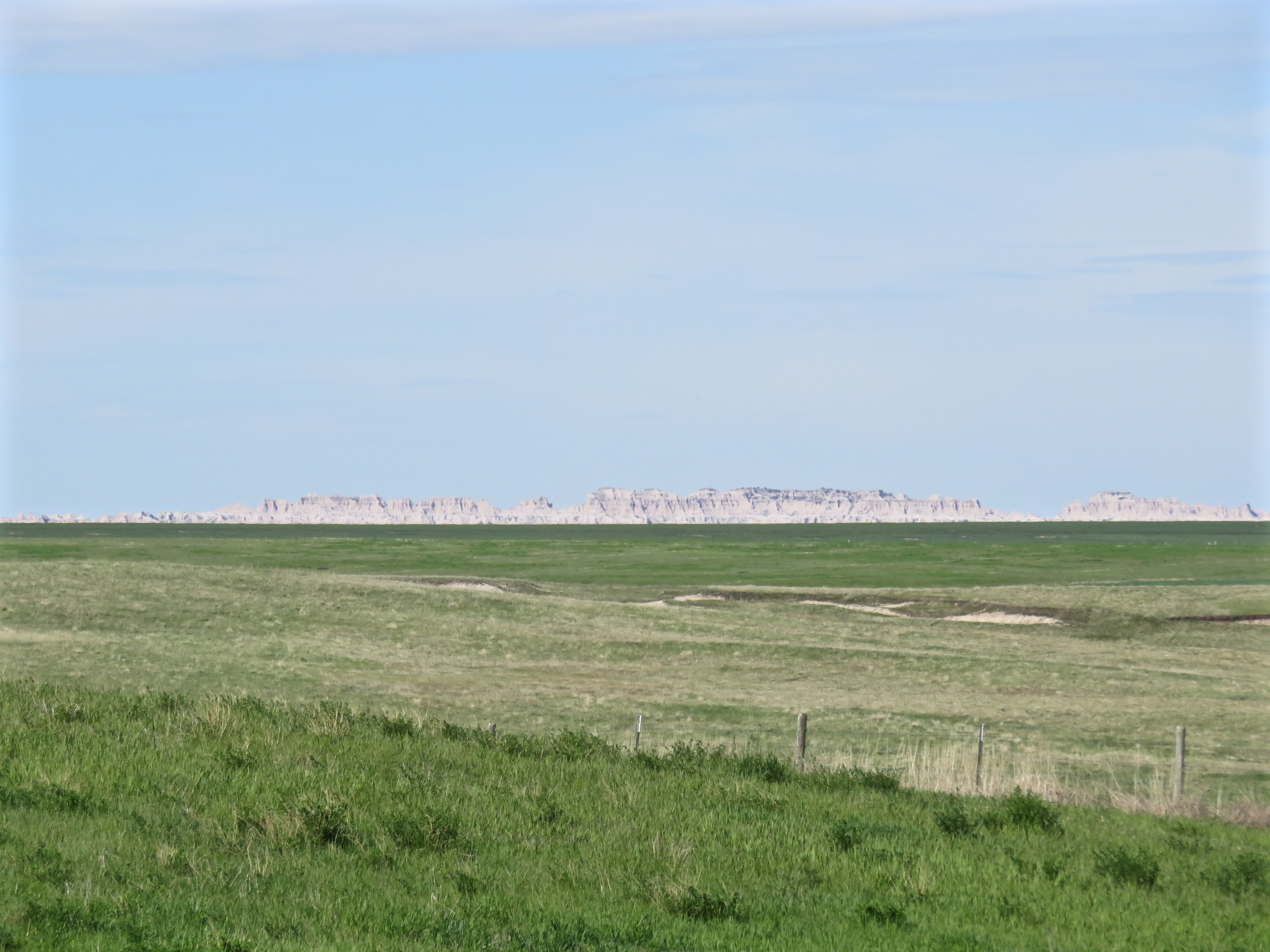
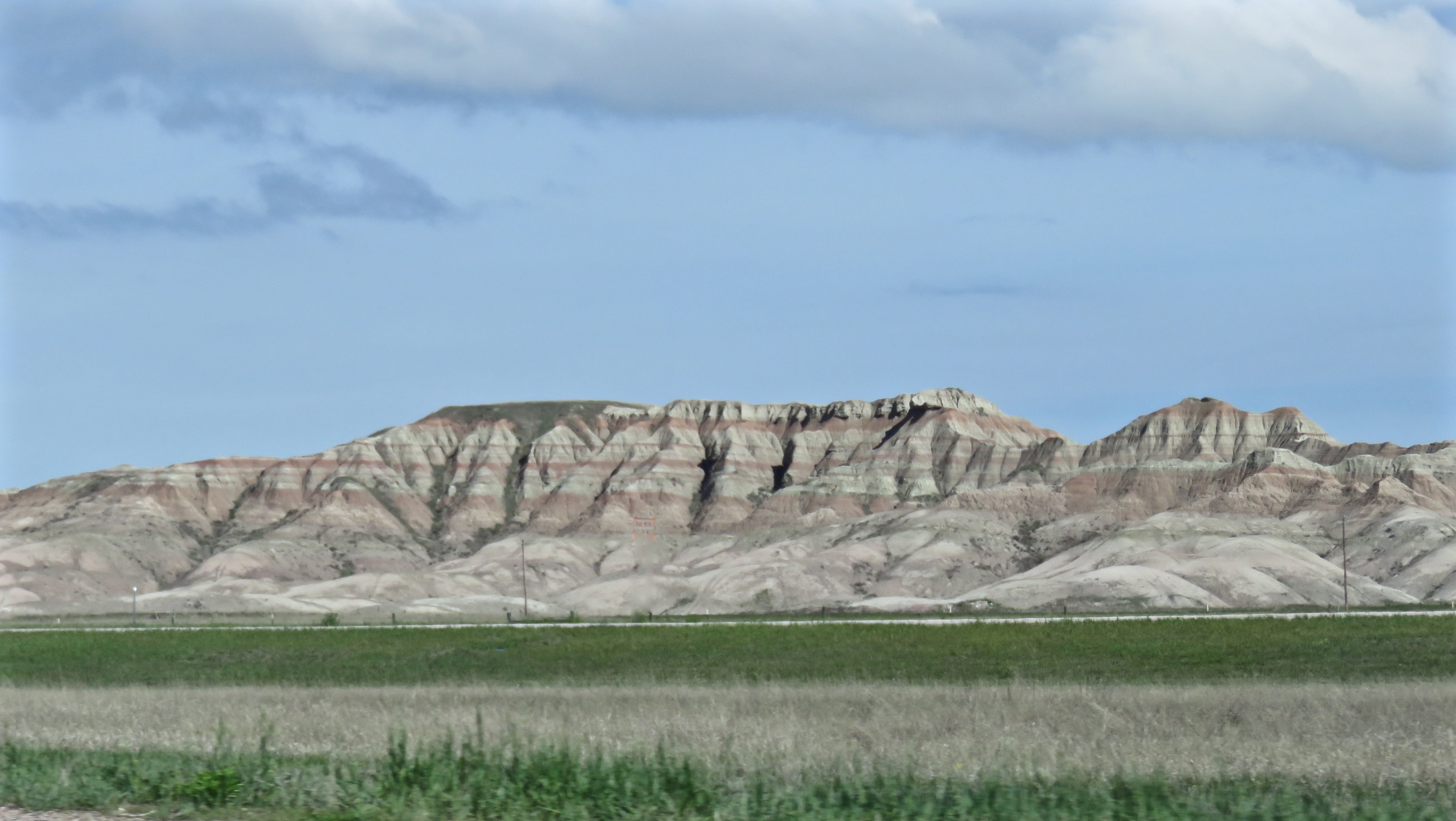
IMG_0155Nor will you be able to overlook the beautiful badlands.  Veer off the Interstate for a better view.  I’m including a few shots from the Interstate.
IMG_0127 IMG_0189  IMG_0156IMG_0187

If you don’t know about Wall Drug, read about it HERE

IMG_0181    Version 2IMG_0190   IMG_0131IMG_0160   IMG_0142  Version 2
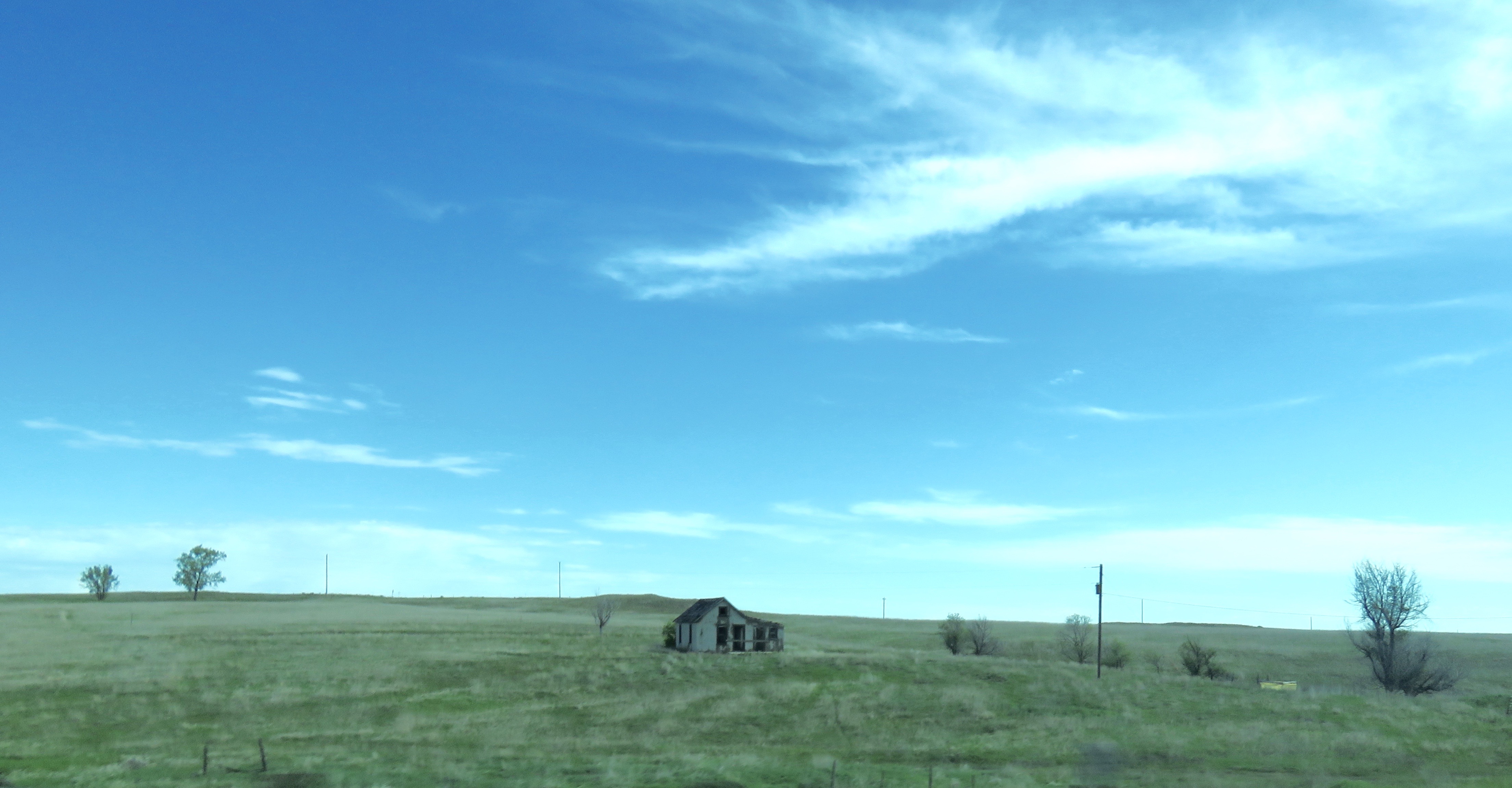
Plenty of beautiful scenery as you head for Rapid City, The Black Hills and Mount Rushmore.

So, that’s the rest of the story!!! I’m now back in Sheridan after driving thirty hours on the road–1758 miles in 5 days.  Great visits with my nieces and older sister, old school friends in three different towns,  and my cousins Sharon and Lisa in a fourth town…Talk about a whirlwind tour!!!  Rain most of the day for two days–today a rain of insects that almost completely covered the grill and windshield of the car…Always a new thrill in what looks like tame country.  Thanks for following along! And thanks, Patti, for doing most of the driving and planning!

You may click on these pictures for larger views.  Bet you knew that.

The Prompt: Tell us something most people don’t know about you.

https://dailypost.wordpress.com/dp_prompt/a-mystery-wrapped-in-an-enigma/

NaPoWriMo 2015, Day 2: Stars

                                                                    Stars

Sometimes, on an Indian blanket spread on the night-dewed grass, I became aware of them.
They were always there waiting in the ever-clear South Dakota nights.
Anything could have happened on a night like that,
Reclining with no ceiling over us,
Silence split by crickets, frogs, the chipped barks of dogs.

S
ummertime freed us to the great outdoors.
Traitors to our beds, we chose the long-grass cushioned backyard.
Attacks by neighborhood boys an exciting possibility,
Rescues by my bellowing dad, in jockey shorts, standing on the back porch.
Sleep not on our agenda for hours afterwards.

Slumber parties meant for anything but slumber.
Taking a walk at midnight and crossing the path of no one.
Air in the night a different elixir
Returning to roll in the grass in shortie pajamas—that pre-sexual thrill.
Stars of our own summer, we strutted our stage until the wee hours.

Something in the night freeing something in us.
Taken by the stars to other selves, far above us.
Aware of the mysteries laid out like a path in front of us.
Returning reluctantly to our pre-teen lives,
Safe beneath the dangerous stars.

The WordPress prompt today was to write about texting, but Since I have never texted anyone in my life, thought I’d tell you what life was like in a pre-text world. And here’s a picture to go with both the subject of texting (old-time style) and the above poem:
https://grieflessons.wordpress.com/2015/04/02/a-photo-a-week-challenge-muted-colors/

https://dailypost.wordpress.com/dp_prompt/its-a-text-text-text-text-world/

Up Against the Wall

Up Against the Wall

 Wall_Drug_Sign

If you haven’t heard of Wall Drug, you probably have never been to South Dakota.  Signs for one of the world’s oldest and best known tourist traps are spread out across the state and surrounding states as well as such far-flung locations as Antarctica, Afghanistan and Italy.  For me, it was an exciting stop along the only vacation route taken by my family for most of my young life, for Wall was stationed smack dab on Highway 16 between my even smaller town of Murdo, South Dakota and the Black Hills, where our summer vacation usually consisted of an overnight stay in “The Deer Huts” after taking one of my older sisters to the Methodist Youth Camp a few miles away.

The excitement of the Deer Huts consisted mainly of the fact that the bathrooms were all outside–little wooden enclosures marked by a half moon that my mother hated and I adored.  I loved the nighttime trip up the hill with a flashlight and the strangely reassuring sound of what had once been a part of my body making its dark descent down the long vertical tunnel–as though it was having an adventure of its own.  I loved the threat of animals watching me in the dark as I made my way back to the log cabin.  It was about as exotic as my life ever got before I finally left home for college at age eighteen and life really began. But I digress, for the true adventure that wound up at the Deer Huts always began when we got to the badlands–a series of sandstone hills and gullies that furnished the background for many a cowboy movie of the fifties.  Then, shortly after the badlands, came Wall Drug!.

You can read the full story of Wall Drug HERE.   If you are pressed for time, however, I will give you the shortened version. The whole phenomena of a drugstore in a small town of under 300 on a godforsaken prairie  in the middle of nowhere started in 1931 with a suggestion by the wife of the owner that they put up signs offering free water.  From there, the promotions grew into singing automated cowboy orchestras, stuffed longhorn cattle, a life-sized dinosaur, chapels, souvenir shops, other automated scenes, a restaurant offering such South Dakota fare as hot beef sandwiches complete with mashed potatoes and white bread swimming in brown gravy, homemade rolls, cherry pie and 5 cent cups of coffee with  free coffee and donuts offered to soldiers, ministers, and truck drivers.

I have pictures of me at age eight and age sixty-six, standing by a huge stuffed longhorn steer, bravely touching the horn.  The last picture was taken as my childhood friend Rita and I took our last long nostalgic trip across South Dakota. In the Wall Drug Cafe, we shared a hot beef sandwich, a cinnamon roll and a piece of cherry pie for old time’s sake, put a quarter in the slots to see the singing cowboys creak into action, still in tune after almost sixty years.

In this more sophisticated age, folks still stop at Wall Drug.  It’s possible their teenagers remain in the car, texting their friends or playing computer games with the air conditioning cranked up to dispel the scorching South Dakota summer sun, but I bet the little kids as well as the bigger kids who are their folks or grandfolks still wander the block-square expanses of Wall Drug, looking for thrills from another age and time. And somewhere within its cluster of rooms and passageways, Grandma can still buy an aspirin or get a prescription filled, then get a free glass of water to swallow it down with, Grandpa can still get a five cent cup of coffee and a little kid can taste his first delicious mouthful of South Dakota Black Angus beef, swimming in gravy and surrounded by reassuring slices of Sunbeam white bread and mashed potatoes.

The Prompt: Tourist Trap: What’s your dream tourist destination — either a place you’ve been and loved,https://dailypost.wordpress.com/dp_prompt/tourist-trap/ or a place you’d love to visit? What about it speaks to you?

Sweet Clover

Sweet Clover

Before our dad told us its real name,
we used to call it wild mustard.
What did we know about sweet clover except for its color
and that summer smell, cloying in its sugared perfume.
It filled the air and smothered the plains—
bright yellow and green where before
brown stubble had peeked through blown snow.

On these dry lands, what flowers there were
tended to be cash crops or cattle feed.
Sweet clover or alfalfa.
The twitching noses of baby rabbits brought home by my dad
as we proffered it to them by the handful.
Fragile chains we draped around our necks and wrists.
Bouquets for our mom
that wilted as fast as we could pick them.

Summers were sweet clover and sweet corn
and first sweethearts parked on country roads,
windows rolled down to the night air,
then quickly closed to the miller moths.
Heady kisses,
whispered confessions, declarations,
unkept promises.
What we found most in these first selfish loves
was ourselves.

The relief of being chosen
and assurance that all our parts worked.
Our lips accepting those pressures unacceptable
just the year before.
Regions we’d never had much congress with before
calling out for company.
That hard flutter
like a large moth determined to get out.
Finding to our surprise,
like the lyrics of a sixties song,
that our hearts could break, too.

Hot summer nights,
“U”ing Main,
cars full of boys honking
at cars full of girls.
Cokes at Mack’s cafe.
And over the whole town
that heavy ache of sweet clover.
Half promise, half memory.
A giant invisible hand
that covered summer.


The Prompt: The Transporter—Tell us about a sensation — a taste, a smell, a piece of music — that transports you back to childhood.

South Dakota Gumbo

South Dakota Gumbo

When the rains came in hot summer,  wheat farmers cursed their harvest luck, for grain sodden by rain just days before cutting was not a good thing; but we children, freed from the worry of our own maintenance (not to mention taxes, next year’s seed fees and the long caravans of combines already making their slow crawl from Kansas in our direction) ran into the streets to glory in it.

We were children of the dry prairie who swam in rivers once or twice a year at church picnics or school picnics and otherwise would swing in playground swings, wedging our heels in the dry dust to push us higher. Snow was the form of precipitation we were most accustomed to–waddling as we tried to execute the Xs and Os of Fox and Geese bundled into two pairs of socks and rubber boots snapped tighter at the top around our thick padded snowsuits, our identities almost obscured under hoods and scarves tied bandit-like over our lower faces.

But in hot July, we streamed unfettered out into the rain.  Bare-footed, bare-legged, we raised naked arms up to greet  rivers pouring down like a waterfall from the sky.  Rain soaked into the gravel of the small prairie town streets, down to the rich black gumbo that filtered out to be washed down the gutters and through the culverts under roads, rushing with such force that it rose back into the air in a liquid rainbow with pressure enough to wash the black from beneath our toes.

We lay under this rainbow as it arced over us, stood at its end like pots of gold ourselves, made more valuable by this precipitation that precipitated in us schemes of trumpet vine boats with soda straw and leaf sails, races and boat near-fatalities as they wedged in too-low culvert underpasses.  Boats “disappeared” for minutes finally gushed out sideways on the other side of the road to rejoin the race down to its finale at that point beyond which we could not follow: Highway 16–that major two-lane route east to west and the southernmost boundary of our free-roaming playground of the entire town.

Forbidden to venture onto this one danger in our otherwise carefree lives, we imagined our boats plummeting out on the other side, arcing high in the plume of water as it dropped to the lower field below the highway.  It must have been a graveyard of vine pod boats, stripped of sails or lying sideways, pinned by them.  We imagined mind soldiers crawling out of them and ascending from the barrow pits along the road to venture back to us through the dangers of the wheels of trucks and cars.  Hiding out in mid-track and on the yellow lines, running with great bursts of speed before the next car came, our imaginary heroes made their ways back to our minds where tomorrow they would play cowboys or supermen or bandits or thieves.

But we were also our own heroes.  Thick black South Dakota gumbo squished between our toes as we waded down ditches in water mid-calf.  Kicking and wiggling, splashing, we craved more immersion in this all-too-rare miracle of summer rain.  We sat down, working our way down ditch rivers on our bottoms, our progress unimpeded by rocks.  We lived on the stoneless western side of the Missouri River, sixty miles away. The glacier somehow having been contained to the eastern side of the river, the western side of the state was relatively free of stones–which made for excellent farm land, easy on the plow.

Gravel, however, was a dear commodity.  Fortunes had been made when veins of it were found–a crop more valuable than wheat or corn or oats or alfalfa. The college educations of
my sisters and me we were probably paid for by the discovery of a vast supply of it on my father’s land and the fact that its discovery coincided with the decision to build first Highway 16 and then Interstate 90.  Trucks of that gravel were hauled  to build first the old road and then  the new Interstate that, built further south of town, would remove some of the dangers of Highway 16, which would be transformed into just a local road–the only paved one in town except for the much older former highway that had cut through the town three blocks to the north.

So it was that future generations of children, perhaps, could follow their dreams to their end.  Find their shattered boats.  Carry their shipwrecked heroes back home with them.  Which perhaps led to less hardy heroes with fewer tests or children who divided themselves from rain, sitting on couches watching television as the rain merely rivered their windows and puddled under the cracks of front doors, trying to get to them and failing.

But in those years before television and interstates and all the things that would have kept us from rain and adventures fueled only by our our imaginations, oh, the richness of gumbo between our toes and the fast rushing wet adventure of rain!

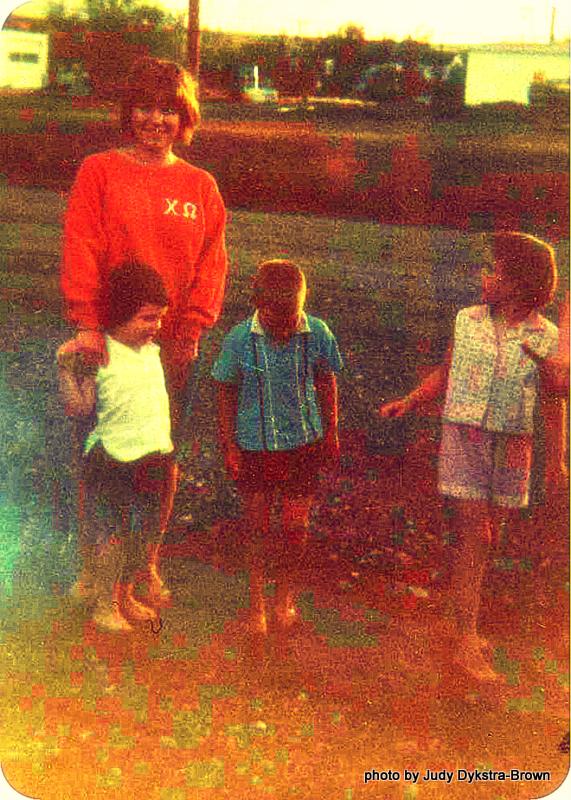
Writer’s note:  I know my sister Patti is going to read this and cry, and so I want to present you with this mental picture of her, college age, Levi cuffs rolled up above her knees, surrounded by five-year-old neighbor kids, enjoying her last big adventure out into the ditches of Murdo, South Dakota, during a July rain.

But wait!  A mere two hours of digging and another hour of editing has produced this proof of my former statement, so to augment your mental image, here is the real one:

Patty in mud 001-001

Not quite the gusher depicted in the childhood vignette, but nonetheless, Patti’s final puddle adventure. She had taken my visiting niece out. The next day the neighborhood kids rang our doorbell and asked my mom if Patti could come back outside to play! Ha.

The Prompt: Free Association–Write down the first words that come to mind when we say . . . home. . . soil . . . rain. Use those words in the title of your post.