Wallflower Bougainvillea
 I love this shy little wallflower, so I’m going to let her be the star in this late post.
http://ceenphotography.com/2015/10/08/flower-of-the-day-october-8-2015-dahlia/

Wallflower Bougainvillea
I love this shy little wallflower, so I’m going to let her be the star in this late post.
http://ceenphotography.com/2015/10/08/flower-of-the-day-october-8-2015-dahlia/
I was in such a hurry to get posted today that I didn’t explain the picture I used with today’s poem about the nature and interrelationship of good and evil––(In Spite of Our Wishes for All Good). A friend commented on the picture on Facebook and I wrote an explanation, then decided to edit it into my post as well. If you are/were curious about why I used that picture of the man with the machete to illustrate my poem, go Here to read the explanation at the end of the poem.
The real world is complex and sometimes none of the choices we have are good ones. If Attila the Hun is coming through, it’s not a matter of being moral. It’s kill or be killed.
–Theodore Postol

In Spite of Our Wishes for All Good
It seems for every good in life, there exists an evil.
Tomatoes suffer mildew and cotton has its weevil.
As north has south and light has dark, it seems the world is run
by drought balanced with rainfall and dark replacing sun.
It isn’t how we’d have it if the choice were up to us.
Who wouldn’t rather have the joys of life without the fuss?
But anima and animus and yin and yang are what
seem to keep our lives out of the same old rut.
As much as we might put off death if we had our druthers,
without it there would be no room for more sisters and brothers.
Would that the inevitable could just be delayed,
the game would turn out more like we wish it could be played,
but somehow the world’s demons like Isis and Attila
are the bitter flavors that balance the vanilla.
The words I write are hard to take when evil in this world
is visited on those we love and sadness is unfurled.
We all agree it isn’t fair that one should have good luck
while others suffer pain and sadness, buried in the muck.
Many try to change it but the changes never stay.
Night often cancels out what we’ve achieved by light of day.
The religious live on faith, but others curse the day
that they were born into a world that’s so suffused by gray.
For light and dark are always mixed in varying combinations.
Each day we choose our focus: good or abominations.
Those who focus on the bad confront it for us while
those others of us plant the crops and fix the broken stile.
Some preserve the joys of life while others fight the ills.
Some swallow the honey and the others bitter pills.
In this as well we find that nature provides opposites.
Some farm in the highlands while the others mine the pits.
But all are necessary for the progress of the whole,
for as the world keeps spinning, it functions as a bowl
filled with all the opposites the universe provides––
that force that makes it necessary that we all choose sides
and pull or push to keep the carousel securely spinning.
It would seem that in the good life, there must also be some sinning.
About the Picture: I just wrote this as a comment to a friend on Facebook who said she liked the picture above. After I’d posted it I decided others might be interested in the story, so here it is:
Wicked witch. Today’s Prompt: Wicked Witch–Write about evil: how you understand it (or don’t), what you think it means, or a way it’s manifested, either in the world at large or in your life.
Zeroing In
The Prompt: Show us a couple examples of your work where you have a strong, easily identifiable subject.
 I like lots of detail in pictures of rooms and people because those details tell a story.We can tell by the nacimientos on the buffet that it is Christmas time. That little two-necked clay cup on the table will create an entirely different story soon after this picture was taken. You can see that story HERE.
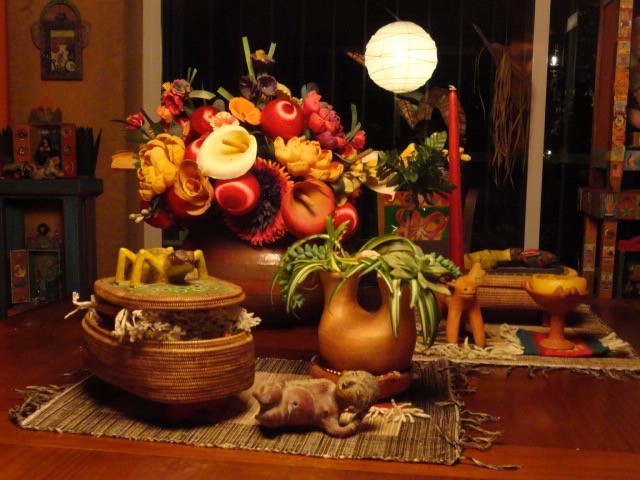 But I think this is a better picture composition-wise. There are still a number of details, but they are more unified as they are all grouped together on the table.
 I like this portrait of my friend a lot.
 Yet when I crop the portrait down to the eyes, they seem to tell a complete story of their own.
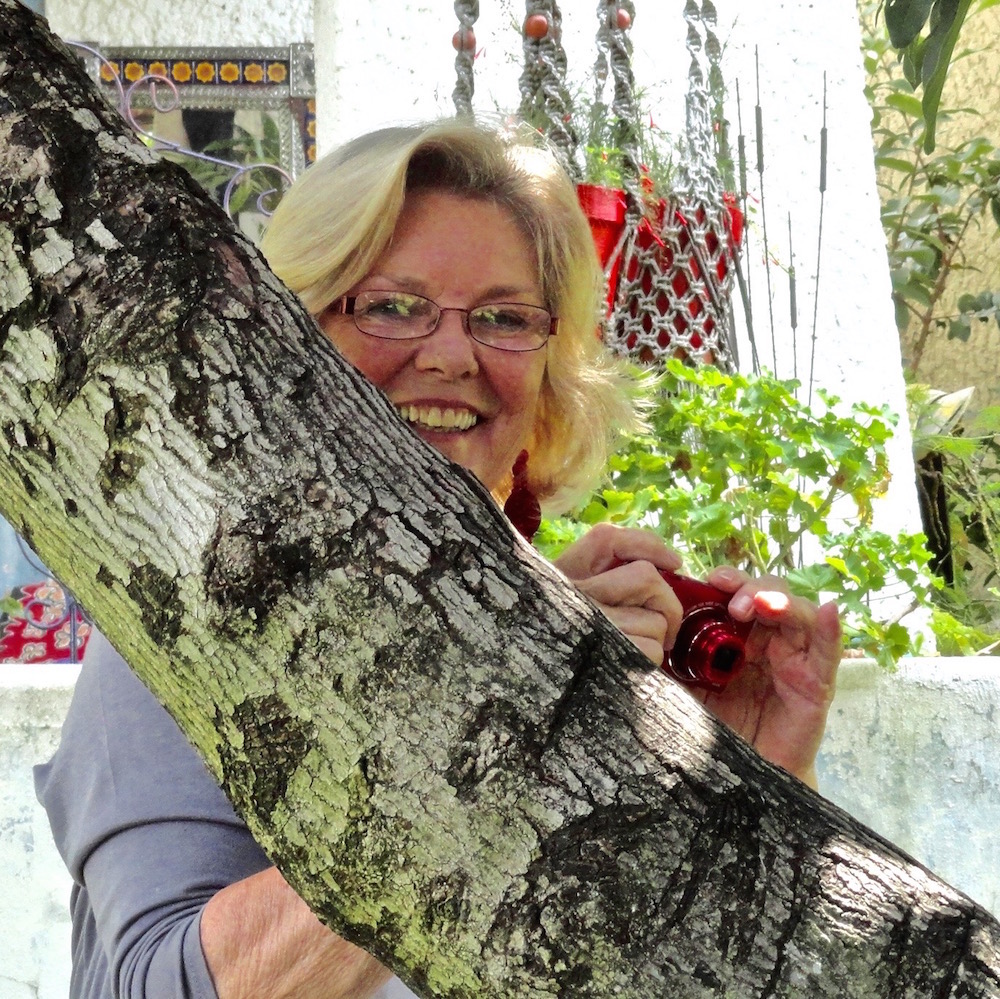 I took many pictures of my friend Audrey the day this photo was taken, but this was by far my favorite. It shows her good nature, reveals her camera and in my estimation, is more intriguing due to the limb she is behind.
************
Okay, now on to the second challenge. For the Gold Star Award, Find examples of your work that illustrate these three emotions: something that is beautiful or inspiring, something that makes you laugh, and another that makes you feel sad or melancholy.
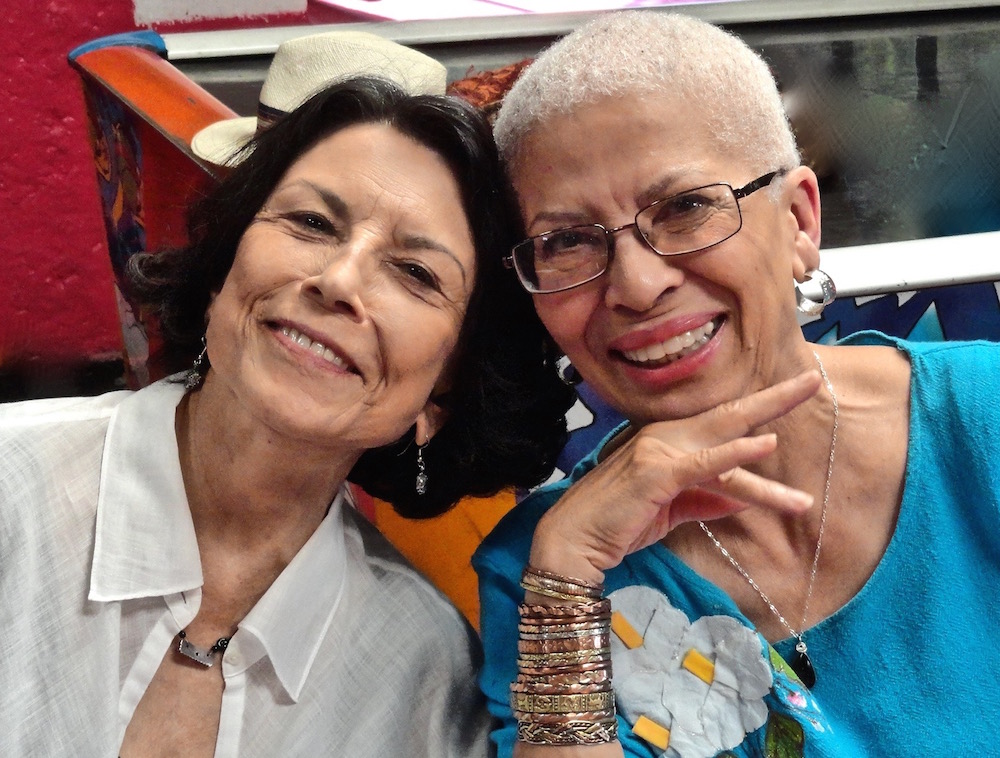 Here is another portrait that I love because they are both so happy. It is inspiring to me that they are obviously good friends who know how to enjoy themselves. I cropped this picture to make it more intimate and I think the cropping turned out right.
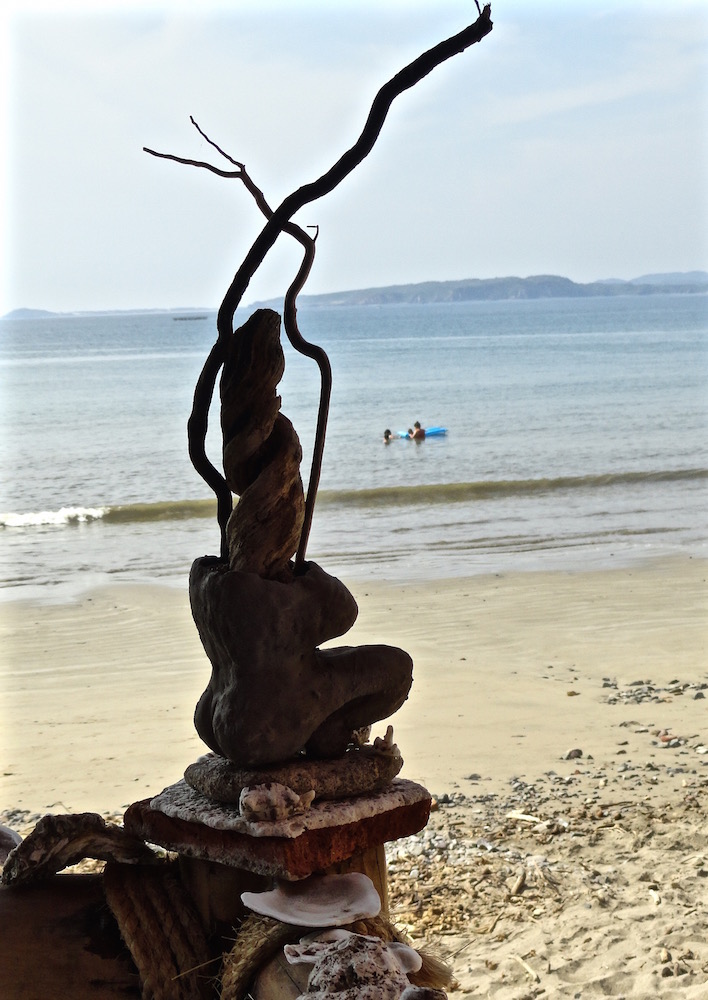
 These two shots of the same subject make me feel melancholy. Which do you prefer? In this case, I like the one with more detail because it is within those details that the story resides.
 I took this picture at carnival (mardi gras) Iin Ajjic. It is a raucous, flour-throwing, rowdy time. And of course, these fellows made me laugh.
Travel Theme: Intense

I believe Diego was ready for either breakfast or dinner. He had tried his hardest to be polite, but his mom was intent on her blog, so finally he let his wishes be known vocally. Things always get intense at my house around meal time!
 Little boy lost or simply little boy somewhat overwhelmed by a tall world? Either way, he looks intense to me!
 I think my friends Lach and Becky look very intense as they entertain a crowd at La Rueda. Alas, they are back in the states and La Rueda is no more, but the good news is that although they came to visit, they ended up buying a house and will be back down soon! We did the same thing. Came for one day, stayed ten and by the end of it had purchased a house. Mexico stirs up intense loyalties in those who get bitten by the bug!
http://wheresmybackpack.com/2015/10/02/travel-theme-intense/
The Prompt: What sort of music was played in your house when you were growing up and how has it influenced your life?
Story Songs
The Andrews Sisters, Les Brown and his Band of Renown, Spike Jones. These are the only records I can remember from my parents’ collection. When I got older, I listened to my 4 years older sister’s records: Pat Boone, Elvis–jitterbug music. When I got to record collecting age it was the era of the sad story: Johnny Get Angry, girls killed in car wrecks, My Boyfriend’s Back (and he’s comin’ after you-ooo.,) Red Roses for a Blue Lady. The songs were narrative and told pretty basic stories of love, death and teenage angst.
I think they did have an effect because I still want a song with a strong narrative. For this reason I like the Avett Brothers, Gillian Welch, Brett Dinnen, Chris Smither, Joe Purdy, Townes Van Zandt, Rickie Lee Jones, Steve Earle, Tom Waits…oh, lots of others–who tell stories and interpret them in their own distinctive way. I love harmony ala the Andrews Sisters–A modern equivalent is the Wailin’ Jennys. When I was small, in the days before TV, we had an big Victrola cabinet radio/record player that had a record changer so you could put a stack on. I still associate those songs of the forties and fifties with my parents.

Our living room with maroon rug, puce/maroon walls and chartreuse and maroon drapes. The Victrola can be seen in the corner–an important piece of furniture when the only other entertainment was books or weekend movies in the theater on Main Street. Those lamps are chartreuse as well, as are the planter and one of the candy dishes on the blonde coffee table. I talked about this room during yesterday’s prompt, so if you haven’t read it, you may find it HERE.
Bleached Hibiscus
 I can’t compete with that deep red, Cee, so I’m going in the opposite direction. Here is an hibiscus with the color drained out of it. I would love to have one that was really this color! (Or lack of color.)
I was given this flower today so want to share it. See: http://ceenphotography.com/2015/10/07/flower-of-the-day-october-7-2015-hibiscus-for-judy/
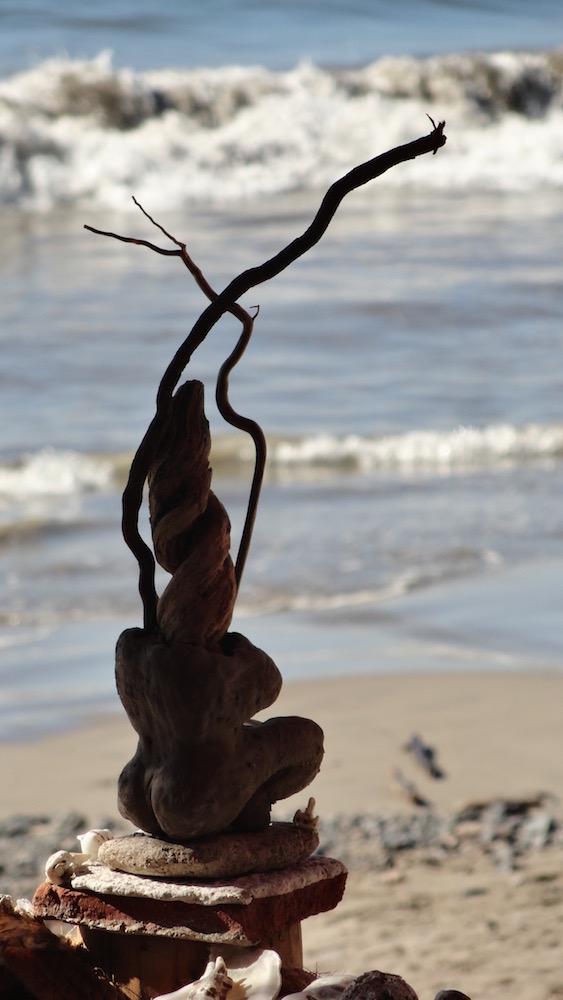
Assembled Palm Fruiting Stem Flower
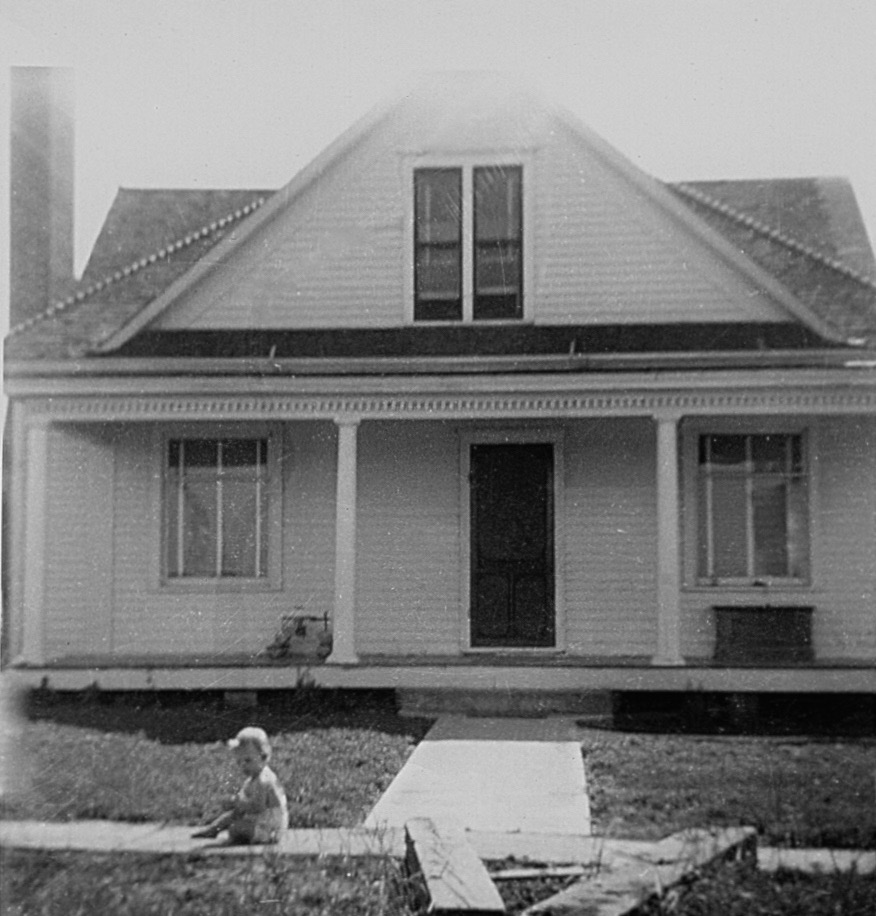 This picture must have been taken very soon after we moved into the house because I was 10 months old when my mom and dad bought it and that’s about the age I look in this picture. I see the twin to the “piano bench” mentioned in this story sitting on the front porch and my dad has already seeded the lawn which appears to be growing. Those boards were soon replaced by a thick layer of grass and a row of elm trees that grew up with me.
A House Divided
When I was ten months old, my father decided it was time to buy a house big enough for three girls and his wife. It wasn’t that he hadn’t offered my mother a nicer house long ago, but my mother had suggested he use the money to buy cattle instead, and it had been a good decision. By the time I was born, the ranch that my dad had begun when he purchased the 640 acre homestead of his parents had grown to over ten thousand acres. Some in town saw him as an opportunist, but as I see it, someone had to buy the land foreclosed on by the bank or given up on by men like his father who just did not have it in them to work the land and my father was a good guardian of the land and a generous benefactor to his town and church.
The house my father bought was a very large house owned by a man and wife who were horticulturists. My sister remembered a big room upstairs that looked like a laboratory but was actually a room used to grow plants. Since the house was both too big for his wallet and too big for one city lot, my dad, an enterprising man, actually bought half the house. My mother tells of seeing the men on the roof with saws, sawing it in half, then carpenters and plasterers sealing up the open walls on both houses.
She also tells of the perfect plastering on both the original walls and the new one—and after successfully moving the house the five miles into town on two flatbeds moving side by side down the night time highway, the shock of seeing the house slip off the jacks as they settled it on the foundation and hearing the plaster cracking and crumbling so that in the house I lived in, the surface of the walls was not exactly even—some seams jutting out a bit and not quite matched to the texture of the original plaster.
As a baby, I occupied the downstairs room that later became our dining room, but even after I was moved upstairs with the “big” girls at the age of 3, the place we ate 99 percent of the time was a sort of wide hallway between the living room and kitchen. We kids sat behind the table on what we called the piano bench, but it was actually one of the two bench-high dividers that separated the two parts of the living room. Wanting to create a more spacious feeling in the room, my mother had the two dividers removed so the living room became one giant room that extended across the entire front of the house. On the left part of this room that you faced as you entered the house was an entire wall of bookshelves, filled with books and my mother’s salt-and-pepper shaker collection.
One of the lower shelves was stuffed bottom to top with comic books—a fact that made our house a favorite with Jimmy Kerlin, who would sneak in the front door and sit for hours on the floor, poring over Mighty Mouse and Superman, Little Lulu and Richie Rich comics. Our favorite family story was the about the time we got home from a day’s shopping expedition in Pierre—sixty miles away, to find Jimmy sitting on the floor in the corner, nose in the last of a long progression of comics he’d been reading all day long. Unbeknownst to us, he’d been sitting there reading when we left in the morning, locking all the doors to the house. He had remained happily reading all day long.
Whether his mother noticed his absence has gone unremembered in our version of the story, but may remain central in his family’s telling of it, although I believe that other than his younger brother Tommy, all members of that family known to me are now deceased.
A genre of comic books Jimmy might have found little interest in was not to be found on those shelves, for what we called “love comics” were forbidden by my mother. She had told Jack Mowell, who was the the local pharmacist/comic-book vendor, not to sell them to us, but we had an agreement with him. So long as they were buried in the stack and not on view on it’s top layer, he merely asked us “how many” without inspecting what exact comic books we bought.
At ten cents each, we usually bought them ten at a time, so quite a few love comics could be accumulated so long as one “Archie and Veronica” comic was positioned atop the stack. This portion of our library was kept at our friends’ houses or buried far beneath our beds or mattresses. By the time we were the least interested in this questionable reading material, our mother rarely ventured into our rooms since we were the ones responsible to keep them clean and orderly, to make our own beds, change our own sheets and carry our own washed and ironed clothes from the back porch washer/dryer/ironing room up the steep wooden stairs to our rooms.
I was only 10 months old when we moved from the east end of town to that big house on its near western edge. By the time I had an actual memory of that house, it had been much influenced by the taste of my 11 years older sister, who painted our upstairs bathroom chocolate brown and chartreuse and our living room different shades of maroon and puce to coordinate with my mother’s choice of living room drapes: maroon-ish sansevieria leaves on a chartreuse background.
The couch was a greyish-toned sectional that took up a good part of one half of the living room. In the room with it was a big blonde modern coffee table—unusual in its day and covered with a chartreuse planter and ashtray (even though no one in our house smoked) as well as current issues of Redbook, Ladies Home Journal and The Saturday Evening Post. On the other end of the room next to the fireplace, another long blonde coffee table next to my dad’s comfortably padded and uphostered rocking chair was covered by stacks of his reading material of choice: True West, Saga, Argosy, Grit, and the Mitchell Daily Republic newspaper.
In at least one of his magazines of choice, there was always a centerfold picture of scantily dressed or nude women—which furnished me with one of my first glimpses of the sexual nature of the world that I would have otherwise had no idea about. Certainly, the love comics were tame by comparison, and I’m surprised that my mother didn’t see fit to remove those portions of my father’s magazine library; but she never did and from a very early age, I was attracted to them like a magnet the minute no other member of the family was around.
It was a good house to grow up in. There were three rooms upstairs—one room each for each of us girls, once I was old enough to graduate from the downstairs nursery to the girls’ dormitory upstairs. I think we were the only house in town with three bathrooms—one upstairs for us girls, one downstairs for my parents and anyone present on the main floor of the house, and one in our largely unfinished basement—to be used either by whatever hired man might be living down there or whomever was in urgent need of a bathroom when the two others were filled.
Only our living room was carpeted––in a maroon tightly woven carpet. The floors of all of the other rooms, including all the bedrooms, were covered in linoleum, the colors and patterns of which each of us was able to choose for our own rooms. Mine was green with big leaves that coordinated well with the yellow walls and my ruffled white bedspread covered in big yellow flowers with green leaves. My sister Patti, 4 years older, chose a charcoal linoleum with pink and white and black flecks—dark pink walls and white painted furniture. My 11 year older sister Betty chose a green motif with green and white and black checked drapes and bedspread.
Thus, from a very early age, my mother encouraged our developing of an aesthetic unique to our personalities. To my knowledge, the ordinary was neither encouraged nor demonstrated in our family. In seeking to be different, my mother taught me that it was okay as well—and this has been a guiding principal in my life.
Thus it was that the house I grew up in—from its very inception by my father who, lacking the finances or terrain to buy an entire house, had the ingenuity to buy half of one––to my mother, who stepped outside the bonds of conventionality in her color and fabric choices as well as her taste in decorating elements––helped to form aspects of my personality that sent me out in life not seeking to meet the expectations of others but rather to follow my own impulses—to Australia, then Africa, California and Mexico. Not bad for a little girl from Murdo, South Dakota, population 700, on the wide empty plains of South Dakota.
The prompt: Our House––What are the earliest memories of the place you lived in as a child? Describe your house. What did it look like? How did it smell? What did it sound like? Was it quiet like a library, or full of the noise of life? Tell us all about it, in as much detail as you can recall.https://dailypost.wordpress.com/dp_prompt/our-house/


