Category Archives: Family

Dia de Los Muertos, 2014

Dia de los Muertos, 2014

DSC08847

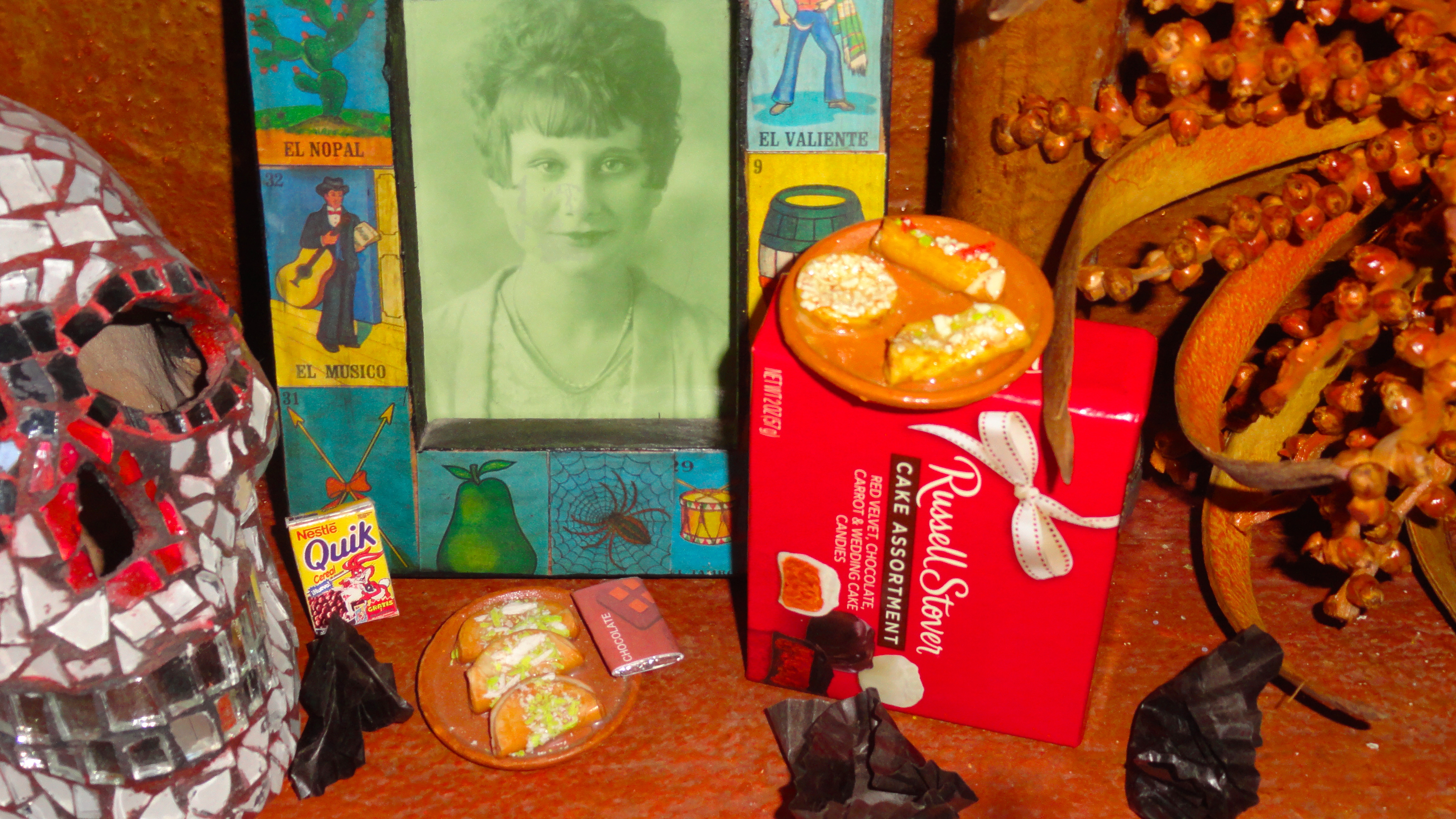
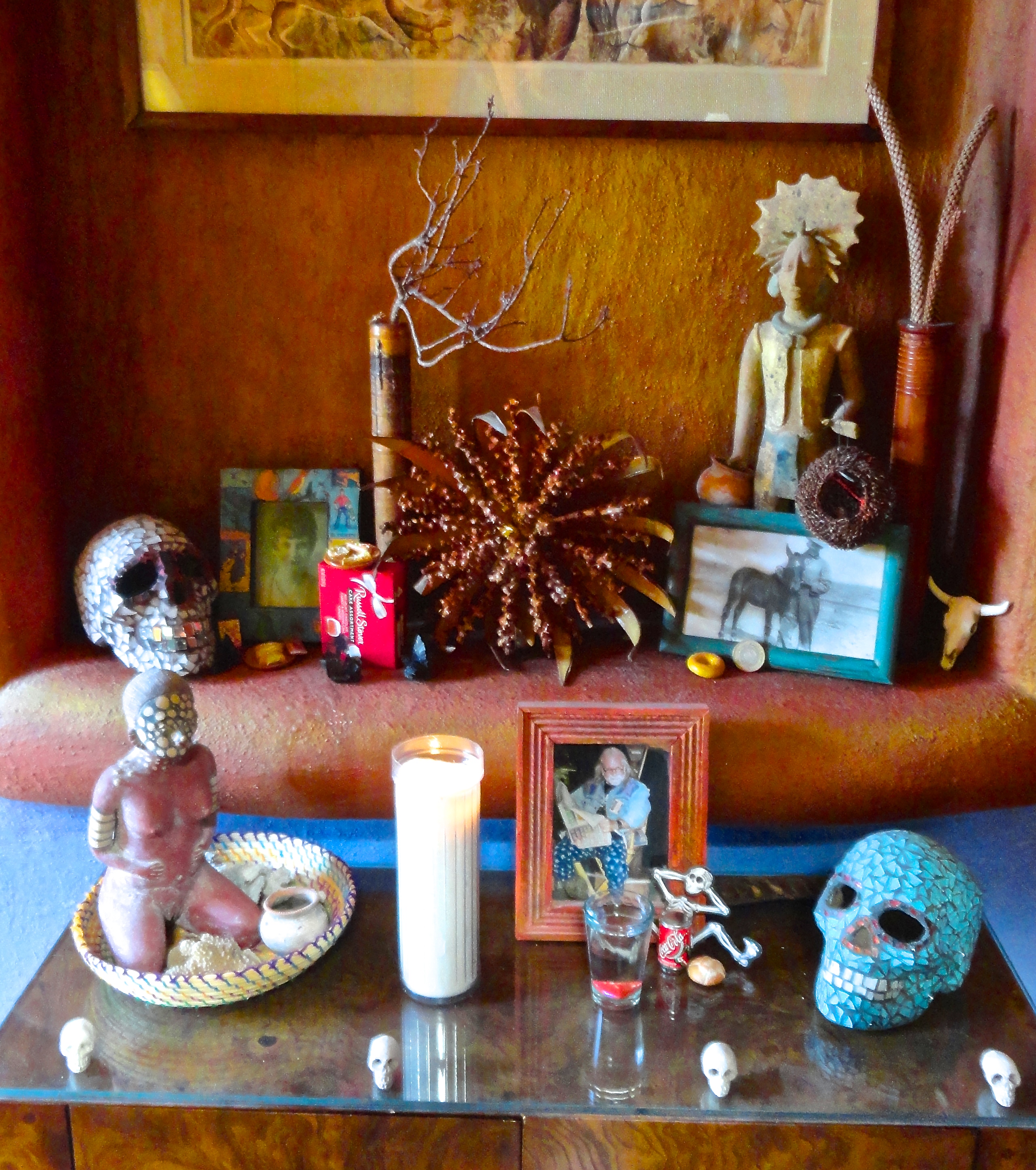
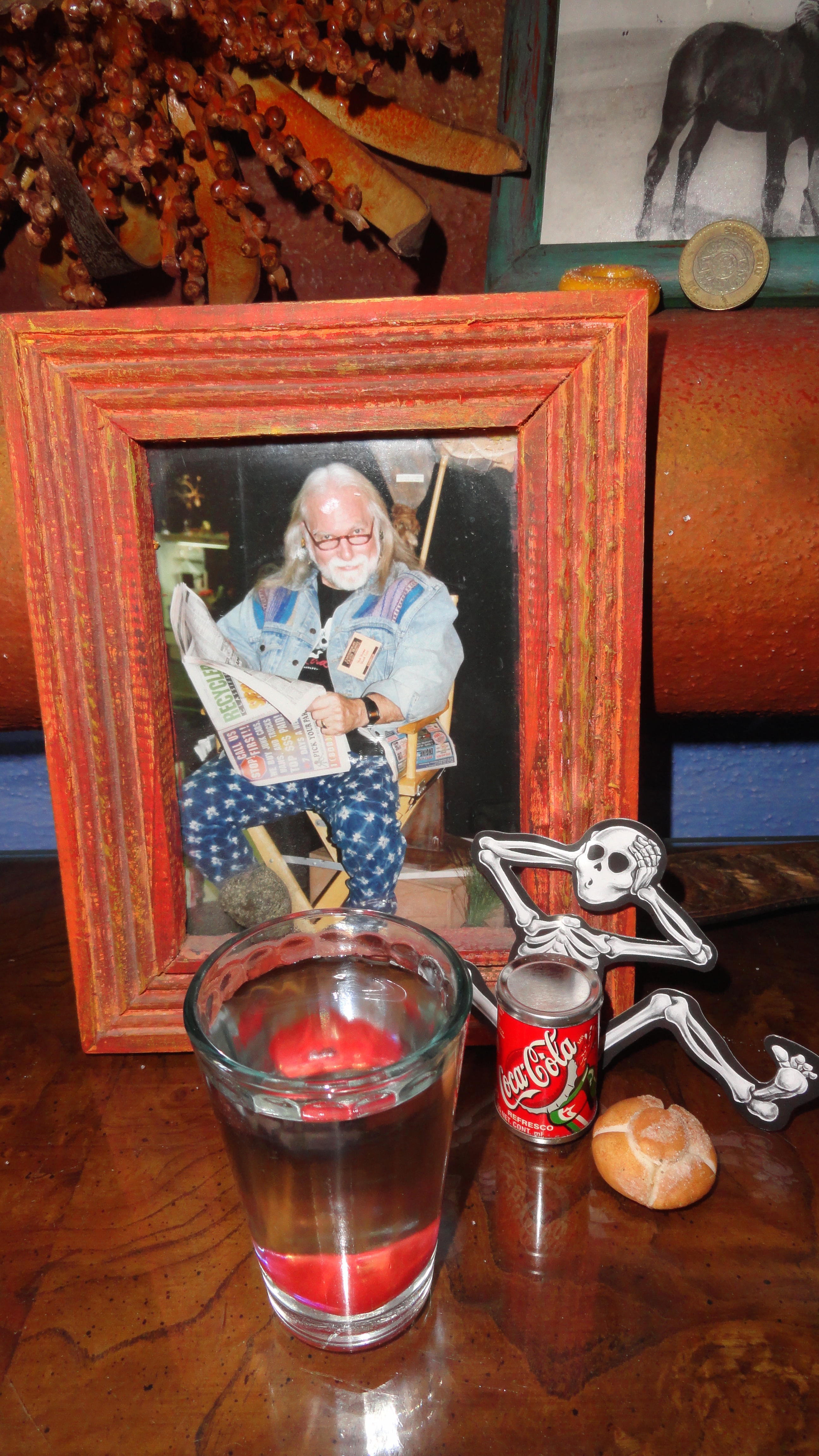
This is this year’s minimalist altar for my departed: husband Bob, Mother Pat and Father Ben. I wasn’t going to do one. Then Yolanda (my housekeeper) told me about a friend who didn’t  make a Dia de los Muertos altar for her mother who had recently died. This friend then went to see the elaborate offerings of her brothers and sisters, so she brought a rather poor specimen of a pumpkin and told them they could put that on her mother’s grave. That night she had a dream of walking through the graveyard. Every other grave was elaborately decorated with flowers and sweetly-scented candles and favorite foods of the departed: water, whiskey, tequila. When she got to her mother’s grave, there was no light and there were no offerings—only the one poor pumpkin. As she walked by, people shook their heads, and she left in shame. When she woke up, she went to her mother’s grave and took her fresh water, a candle, sweets, and all of the things her mother loved.

DSC08856

It worked.  I assembled an altar. Yolanda looked at it and told another story about how the water and candle help to create a breeze that brings the scent of the favorite foods to the departed. I quickly added a candle and a small glass of water with an ice cube—as Bob did hate a lukewarm Coke! When the ice cube melted, I added a small red heart to take its place. If you look closely, you can see it in the bottom of the glass.

DSC08852

It was my mother’s tradition to tuck a small box of Russell Stover candy into each of our Xmas stockings. One Xmas, we opened them to find only wrappers in each one. Over the course of the weeks before Xmas, our mother had opened each one, unable to resist eating the chocolates. So precedent decreed that I eat hers. You’ll see the empty papers littering the space around the box. (Yolanda, ever-respectful of tradition, helped by eating one piece.)

DSC08849

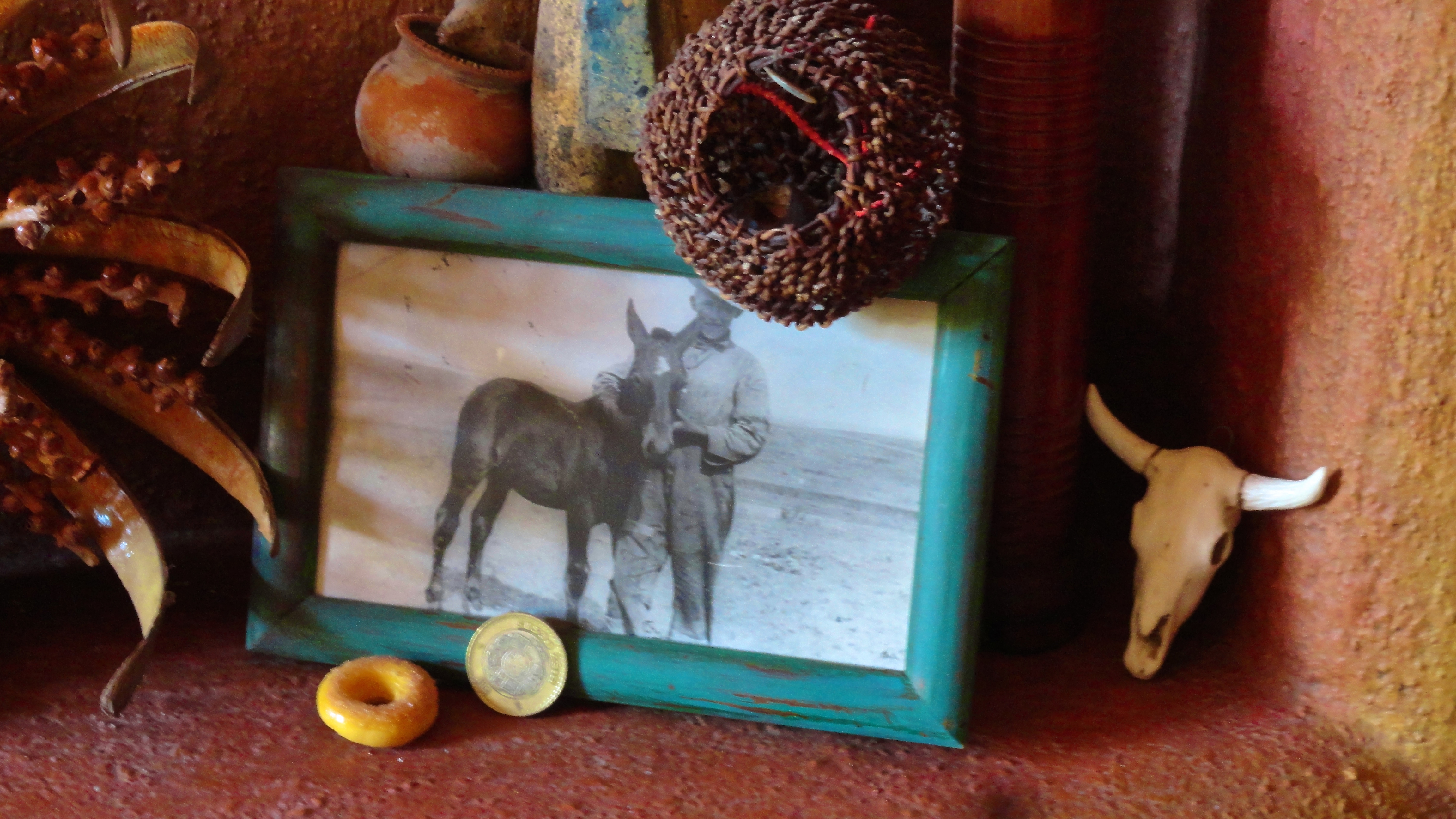
Although my father raised black Angus and Hereford cattle, this is Mexico, after all, so I think he’d forgive the long horns. A donut and a 10 peso piece complete his offerings. Last year I put a small glass of milk with cornbread crushed in it—his favorite cocktail. But this year the ants have taken over our part of Mexico, so I didn’t dare.

Strangers When We Meet

The Prompt: Delayed Contact—How would you get along with your sibling(s), parent(s), or any other person you’ve known for a long time — if you only met them for the first time today?

Strangers When We Meet

If I had met my parents when we all were sixty-seven,
(before she went on oxygen, before he went to heaven,)
would we have liked each other and found something to say?
As strangers, would we walk on by or pass the time of day?

My father liked to be the one spinning out the tale.
Beside his vivid stories, I think most of mine would pale.
He wasn’t a joke-teller or a purveyor of fictions.
It was true stories of his life that fueled his depictions.

And when his friends had heard them all, he’d tell them all again.
Though they stretched with every telling, still his tales never grew thin.
If fifteen wolves pursued him—a number that is plenty,
the next time that he told the tale, I’ll wager there’d be twenty!

When I returned from Africa with stories of my own,
I found that they weren’t good enough, for all of them had grown
with all my dad’s retellings, so the rhino I had snapped
a photo of, now chased me. (In reality, it napped.)

I think perhaps my mother would like my poems the best.
She’d like the rhyme and meter, the humor and the jest.
For I learned all of it from her when I was very small,
as she was doing rhyming before I learned to crawl.

I grew up with her diaries—all of them in rhyme.
She had them in a notebook and we read them all the time.
The tales of her friend Gussie, who wasn’t allowed beaus;
so they said they went to Bible study, though it was a pose.

Gussie’s mother baked two pies, (for coffee hour, they said.)
Her father said he’d pick them up. They said they’d walk instead.
They took one of her mother’s pies to those within the church,
then took the other with them as they left them in the lurch!

Their beaus were waiting for them in a car with motor running.
Instead of Bible reading, they preferred to do some funning.
To abscond with both the pies was something that they had debated,
but in the end they left one pie–an action that they hated.

Two sisters present were their foes. They were so prim and proper.
To steal one pie was lie enough—but two would be a whopper!
Mom’s entry in her journal is one I can still tell.
(Don’t know why it’s the only one that I remember well.)

Line for line, here’s what she said in metered verse and rhyme,
though it’s been sixty years since I heard it for the first time:
“We left that crowd of greedy Dirks to feast upon our pies.
We were so mad, like Gussie’s Dad—had pitchforks in our eyes!”

My mother burned this journal when I was just a kid.
I wish she hadn’t done so, but alas, it’s true, she did.
Perhaps she didn’t want to see us following her ways.
Instead of what she did, better to follow what she says.

But I am sure if she still lived we’d have a little fun,
sitting down together when every day was done
and writing all our exploits down, relaying all our slips—
saving for posterity the words that pass our lips.

And in the meantime, Dad would tell as long as he was able,
all those stories that he’s told at table after table.
In coffee shops and golf courses, at parties or a dance,
he would go on telling them, whenever there’s a chance.

And if we all were strangers, and none of us were kids,
we could relate our stories without putting on the skids.
Each would outdo the other as we passed around the bend,
with story after story till we all came to The End!!!

Casting Reality

The Prompt: Cast Change—You’ve just been named the casting director of your favorite television show (or movie franchise). The catch: you must replace the entire cast — with your friends and family. Who gets which role?

Casting Reality

Instead of casting TV shows with folks you’ll never know
I’d rather cast my life with actors from a TV show
that all of you have seen and so you’ll understand the jokes
better than if I had cast TV with common folks.

A lot of Grandpa Walton might go into making Dad—
plus one ounce of Archie Bunker (though he wasn’t half so bad).
He was a rugged rancher and an avid storyteller.
One day he’d recite Shakespeare and the other, he would beller
a song of mountain bootleggers or “Old Chief Buffalo Nickel,”
then construct towering sandwiches and top them with a pickle.
So I’d add some Leon Redbone and a bit of old Mark Twain,
a little bit of Dagwood and a whole lot of John Wayne.

Though my mother cooked and ironed, often with no thanks,
she also was a jokester who loved to think up pranks.
Though she was often zany, she wasn’t dumb at all—
a sort of Gracie Allen all mixed up with Lucille Ball.
Add some Cagney and some Lacey and a little Nancy Drew
and of another side of her you’ll start to get a clue.
She always loved a mystery and crossword puzzles, too—
and UFO’s and Halloween—things scary as a “Boo!!!”

Stacey London is the next to join my family cast.
What Not To Wear”—the show that she has starred in in the past.
Her role of saying “No” to this one, then a “Yes” to that,
(as in, “That one makes you skinny, but in this one you look fat!”)
was just exactly how my sister used to talk to me.
That this skirt did not go with that was plain for her to see.
As an older sister, she was free with such advice;
but often loaned me her own clothes which, I admit, was nice.

Though my oldest sister Betty’s not accustomed to go last,
she’s the one last family member that there is for me to cast.
She was my boss from my first breath, as she was then eleven.
And if she could, she’d boss me still, though I am sixty-seven.
And so I try to figure out whom she would choose to play her.
And though I’d pick Bette Midler, maybe I should Doris Day her.
She was a singer and a blonde, so guess that she will do.
And now I’ve finished casting a whole film you’ll never view!

Smoke

Smoke

She had met most of my stepchildren.
Was my husband similar? she asked.
Yes, he was talented and smart and funny.
But, he was very quiet, I said, and often sad.

He never believed he’d been the love of my life,
even though I’d told him so.
He’d raised a hand
to let it fall unused again, one time or more.
I hadn’t any children.
He always thought I’d leave.

For years I’d felt the cause of his unhappiness,
but his children told me he had always been this way.
Less angry with me than the others,
I had been, he told them, (but not me)
the love of his life.

He was a man who trusted few
and loved less.
He could not give what others demanded.
What better time to say I love you
than when asked for it, I pleaded–
his daughter, sobbing, on the phone.
But he couldn’t do it
for me, for her, for anyone.

What he wanted most he always had,
but he was blind to it,
wasting it all: the friends, the fame, the love.
Alone, he stared into the fire, into trees,
imagining tools and studios and sculpture
grander, in the end, than his energy to create it.

He had not been idle in his life.
Houses, children, art, tools, poetry—
he made them all, well and in great numbers.
Yet when he died, he said, “Imagine.
I had thought I’d be making art to the end.
Instead, I am so tired. I’m just glad to know
I have an excuse for feeling as tired as I do.”

They ate him up, his dreams.
We sent them up in smoke with him.

Daily post: Second Opinion—What are some (or one) of the things about which you usually don’t trust your own judgment, and need someone’s else’s confirmation?

(Instead of being about someone who needs someone else’s confirmation and advice, my poem is about someone who never could accept it.)

Grandma Steps Out


Grandma Steps Out

It is one thing to be born before the age of computers or television, but my grandma lived in an age before flip-flops! So it was that she was reduced to modernizing herself with a pre-flip-flop substitute: a pair of navy blue Keds canvas tennis shoes, stretched out over her bunions to a point near bursting. She wore these Keds daily, whether she was combing the sidewalks and ditches of our little town for lost balls and toys and Cracker Jack prizes or shuffling into church in her best navy blue crepe dress with black glass beads and cake crumbs decorating the bodice.

The prompt: Odd Trio Redux—Time for another Odd Trio prompt: write a post about any topic you want, in whatever form or genre, but make sure it features a slice of cake, a pair of flip-flops, and someone old and wise.

(This is a short one, so I’m also including a longer poem  written about the same grandma:)

Buried Treasure

She always wore a navy dress of heavy crepe
with dozens of small black buttons down the front.
Her jewelry, turned dull black
by some body chemistry that I share,
lay abandoned in her dresser drawer,
the food stains spilling down her front,
her new adornment.

Trunks in her house were filled
with ill-stitched pillowcases,
her handiwork
rendered less carefully year-by-year
as her eyesight failed—
her useless glasses repaired at the bridge
with thick amber glue
she bought by the box to sell
but never did.

Every Christmas, her gift to me
was one more from her cache of dozens
of small plastic lamps powered by batteries—
another failed scheme received in the mail
that had promised to swell her fortune.

Her china cabinet
was crowded to each edge
with 96 years of carnival glass,
milk glass and heavy Dutch beer mugs,
green dishes from soap boxes
and cut glass jelly goblets—
treasures doled out to us
one per visit towards the end,
as though she sensed
the inescapable.

The day of the fire, she didn’t want to leave her things:
canning jars full of Cracker Jack prizes
and other treasures mined from her pockets
after a neighborhood stroll.
They carried her, kicking and screaming, from her house
and put her in our car.
“All right, old girl,” my dad said,
and drove her 50 miles
to the nearest residence for the elderly.

I remember all of this
after a Christmas gathering with friends
as I clean food spills
from my Mexican-embroidered blouse:
how they bulldozed her house
with most of her treasures inside
and built a hospital on the land;
how it, too, now lies abandoned
in the dying town,
its cobwebbed rooms giving no testament
to that which lies below:
trunks filled with yellowing embroidered sheets and pillowcases,
shelf upon shelf of Mason jars
filled with the collection of her lifetime:
buried riches
whose containers have acquired a worth
far beyond the trinkets they contain.

And, why not one more?  If you’ve been reading me for awhile, you may have read this one before, so just skip it if you wish. It’s another one about my grandma and her sister.

“Sisterly Squabbles”

A little weep, a little sigh,
a little teardrop in each eye.

Grandma Jane and her sister Sue,
one wanted one hole, the other, two

punched into their can of milk.
(All their squabbles were of this ilk.)

The rest, of course, is family fable.
They sat, chins trembling, at the table.

When my dad entered, we’ve all been told,
their milk-less coffee had grown cold.

Reading

This post has been removed as a stipulation for submitting it in a poetry contest.

The Prompt: Middle Seat—It turns out that your neighbor on the plane/bus/train (or the person sitting at the next table at the coffee shop) is a very, very chatty tourist. Do you try to switch seats, go for a non-committal brief small talk, or make this person your new best friend?


Hail, Hail

                                                                        Hail, Hail 

My farmer/rancher father’s boots grew older with him, their wrinkles—like the back of his neck—born of weathering: rain, snow, mud and hot Dakota sun. They were so much a part of him that when he died, they were all my pre-teen nephew asked for, and he wore them out the rest of the way, until the soles peeled back and the leather with patina already long worn off, began to crack along the wrinkles and peel off.

Those boots reflected my father’s life, where things wore out. His clothes, his favorite chair—none were replaced for aesthetics or style alone—this practicality motivated neither by penury nor cheapness, but by growing up in a house where “making do” was a necessity.

But as in most things, there was one defining vain compulsion in my father’s life that broke him free from his mold. He loved new cars, as much for the pleasure of making the deal as for the smell of new leather and metal. The car dealers learned to call him when they got a car fully loaded, the way he liked it: automatic windows, power steering, power brakes, seats that tilted and slid back and forth and up and down by the touch of a switch. Whatever automatic feature was new that year, my father was up for it—big cars with fins, when they were in style, of every color.

The car salesmen would wait until the wheat crop had been harvested and then make the call, driving the car for sixty miles over the prairie to bring it to him for his perusal, like a new bride brought to a shah. They knew him well, and so when the bargaining began, they would accept his peccadillos. It was not the price he quibbled over, but rather the trade-in. “Well, I’ve got a combine that I need to trade in.” Once, three horses. And they learned this joy of trading was often what sealed the deal.

Later, when my sister married, her husband claimed my dad traded in his cars whenever they needed washing, but this was not true. Three years was a car’s usual shelf life, before he’d hand it down to whichever daughter of driving age needed a car the most. Packards and Cadillacs and Pontiacs were his choices of brands. For some reason, he reviled Fords. So that July of my thirteenth year, when the salesman brought the bright green Oldsmobile for my dad to view, we were sure this was the car he would turn down. My mother was not sure about the color and my dad was not sure about buying an Oldsmobile. He had no real reason. It was just a brand he’d never considered before, but it had all the bells and whistles. I think it was the first year that cruise control was offered, so it possessed that allure of new technology. And so it was that the car made it past any first inhibitions on both my mother’s and father’s parts and when the salesman drove away, it was in our “old” Cadillac and the shining green Oldsmobile became the new resident of our garage.

My oldest sister was married and gone, my middle sister seventeen—a year past legal driving age. Summer camp in the Black Hills was nearly 200 miles away, but over easily-navigated straight roads through bare prairie, the wheat having been cut early that year. So it was that my mom, worn pliable from 20 years of driving daughters hundreds of miles to doctor appointments and eye appointments and ball games and church rallies and singing contests and summer camps, decided my sister could drive me to camp that year.

My sister Patti and her best friend Patty Peck piled into the bench front seat. My best friend and I piled into the back. The trunk was full of two weeks worth of camping clothes. The pleasures of riding in a brand new car, just one week removed from its purchase, equaled the thrill of being off on our own. We rolled down the windows, stuck out our arms and let the hot July air stream through our fingers, stopped at Wall Drug for milkshakes, sang at the top of our lungs, and when our bare legs started sticking to the vinyl seats, closed the windows and enjoyed the air conditioning.

Three hours later, the black outlines of the hills that were our destination grew close enough to define the ponderosa pines that gave them their name. We cruised past Rockerville Ghost Town—a tourist trap where my oldest sister had worked a few years before—and turned off into Coon Hollow. My sister steered the car carefully over the dirt roads, fearing chipped paint or a chipped window from the occasional rock in our path. “Take Me Back to the Black Hills” we crooned, as we always did when we approached our favorite vacation spot. We rolled down windows once again to enjoy the scent of ponderosas and to hear the gurgling of the water as it rushed down the small river that paralleled the course of the dirt road that led back to the campsite.

“Black Hills Methodist Camp” read the sign. We stopped to take a picture before veering off onto the divided dirt road, and we had just caught site of the large log cabin that served as the mess hall when the first loud “Whump!” occurred. Then another and another and another. Terrified, my sister steered the car off into the trees as the hail grew larger and larger. We were facing the creek, which had grown wild with the churning of the hailstones hitting the water. They grew rapidly from quarter-sized to golf ball-sized to baseball-sized. The front window began to shatter. When one large hailstone seemed to pierce the roof of the car and land in my lap, I was out of my seat and over the back of the front seat onto the seat between the two Pattys before I could even think about it. As I remember it, I somehow managed this shift in position without ever removing my seat belt, but this, perhaps, is an exaggeration that occurred more in memory than in actuality. My friend, still in the back seat, held up the white ceiling light cover that had popped off when a huge hailstone had hit directly on top of it—showing that the rooftop was still unbreached

The entire hailstorm probably occurred over no more than a ten-minute period, but at the end of it, the stream in front of us was completely white with floating hailstones and the ground was covered. We climbed from the car, pushing through the hailstones in a shuffling motion to avoid slipping and falling on the huge balls of ice. The front windshield was completed marbled, every inch of our shining new car dimpled with deep depressions that equaled our own depression over what was going to happen when our mom and dad saw their brand new car! We were teenagers all and accustomed to that guilt that arose from a whole string of iniquities: dropping our mom’s favorite crystal bowl, staying out an hour past curfew, eating the last piece of pie. My sister backed the car out of the little turnoff she’d turned into hoping for some scant shelter from the hail and drove me and my friend the rest of the way to the registration in the mess hall, then she and her friend drove away. On the way home, they encountered a plague of grasshoppers that coated the windshield and they had to use bottles of Squirt to dissolve them from where they had become embedded into the marbled windshield; so this stickiness, dried in puddles on the hood of the car, added to the total devastation that greeted my dad’s eyes when his new “baby” was returned to him.

The feared recriminations never occurred. “Accidents happen. It wasn’t your fault,” said my dad. “I never really liked that color of green anyway,” said my mom. When my folks came to pick me up at camp, it was in a brand new rose-colored Pontiac Bonneville with a cream-colored top—the most beautiful car we ever owned. We met with no disasters on the way home, and four years later, it was the car I drove off to college six hundred miles away. My parents’ newest brand new car was a beige Buick that possessed none of the charm of the car now relegated to me, but did possess several new electronic features that I’m sure, for my dad, compensated completely.

The Prompt: You’re at the beach with some friends and/or family, enjoying the sun, nibbling on some watermelon. All of a sudden, within seconds, the weather shifts and hail starts descending form the sky. Write a post about what happens next.
Lost in Iowa

Lost in Iowa

We are lost in Iowa,
pulled off the highway onto a gravel road.
Not content to give himself totally over to the control of GPS,
he checked its suggested route last night and instead devised his own.
But now, lost, without a clue as to where we are,
we have pulled over
to contemplate our situation.

I open the door to catch a breeze.
The yellow blooms of sweet clover and purple alfalfa
line the little road.
Wild anise and tall marsh grass
complete a scene
of perfect rural quiet and suddenly,
I am no longer lost.
I am back on the running board of my dad’s beat-up red pickup,
waiting for him to finish mowing the lower field.
I’ve eaten one chokecherry
from a nearby bush
and my mouth is puckered
by it’s astringent sting.
I go back sixty years
as I drink icy spring water
from my dad’s metal water can
wrapped in wet canvas
to keep it cool,
then jump back fifty years more
to my dad’s youth,
to try to imagine how he felt
with the prairie stretching hundreds of miles
in every direction.
My dad, his parents and two sisters in a two-room house.
There was privacy in the barn,
a dog for company.

Their closest neighbor
an ancient Hunkpapa Sioux named Charley
in his dugout house
half a mile up the draw,
town an hour’s ride away or more by horse or wagon.
With no diversion of cell tower or satellite dish—
there was only his family,
the land and his imagination.

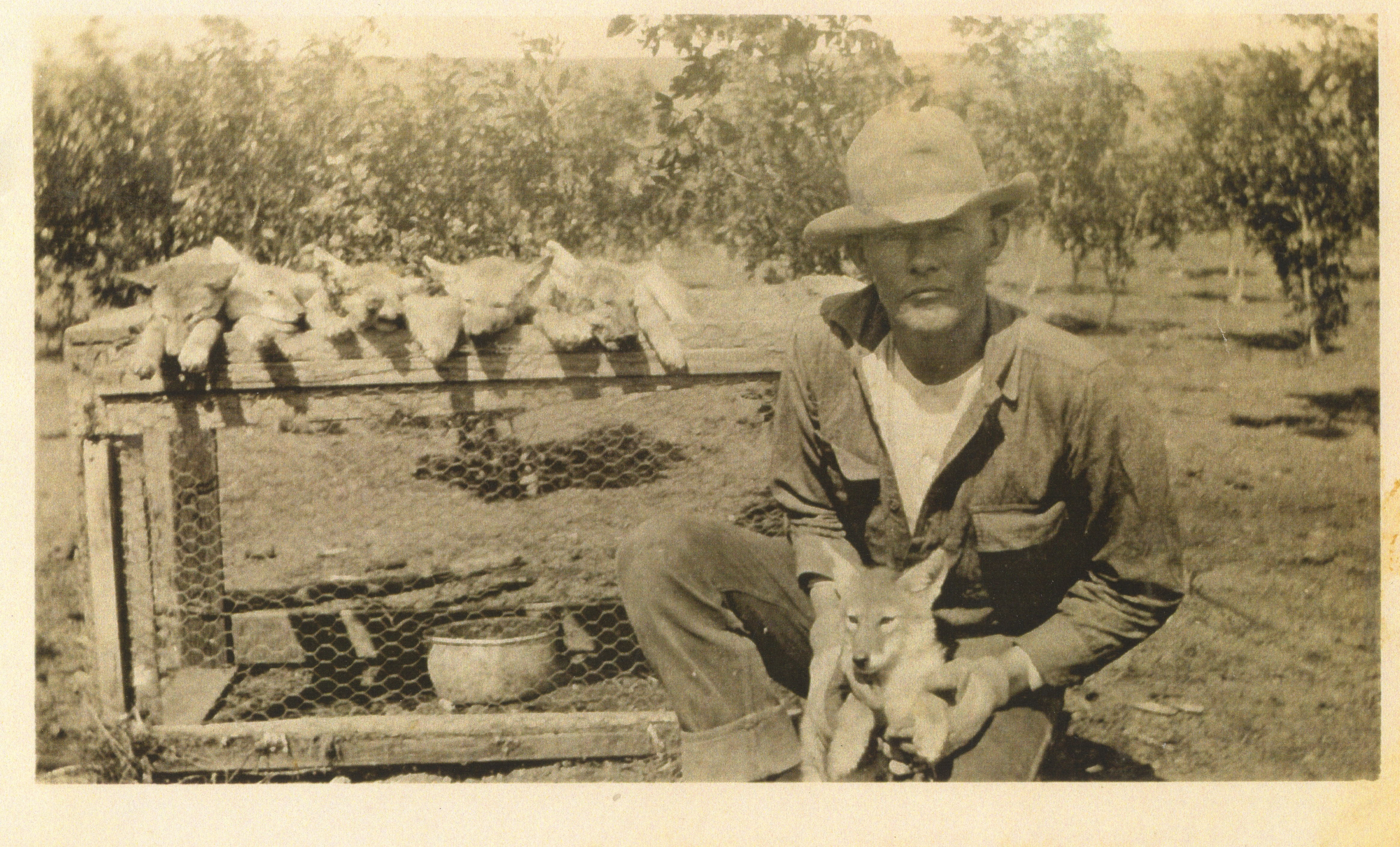
My dad killing the coyote,
then finding her pups and bringing them home.
What would his dilemma have been?
Did he raise them,
then turn in their pelts for bounty?
Did he release them,
and then never know when he killed a coyote
if it was merely a pest or a former pet as well?

What did he think when he lay in a patch of clover?
Did he smell the wild anise and imagine
the sweet stickiness of licorice?
Did he pick the wild asparagus
for his ma to poach?
Did he have the idle moments
with which my childhood was filled?

What child now lies in the grass,
looking for something for his mind to rest against?
What other traveler,
lost on a gravel road in the scorching sun,
opens her door to a breeze
that flows like water down an empty creek channel,
looks up from the GPS screen
that promises to restore them
to civilization’s knowing?
Will she, as I have, relieve her lost present
by losing herself in the past?

That girl who sat on her dad’s running board
who would journey so far to unimagined places,
still travels the mind back to pleasures
of a world it was possible to be lost in,
sweet clover and wild anise
giving a taste of precious emptiness.

In this age of machines that can guide us
so surely into a  future,
where we are often so found
that we are lost in it—
savor those mistakes
that bring us back
to flounder in ourselves.

We, too, know the way.

daily life  color006

Dad with sleepy coyote pups on South Dakota farm, 1924

The Prompt: Wrong Turns—When was the last time you got lost? Was it an enjoyable experience, or a stressful one? Tell us all about it.

I am cheating and publishing here a poem I wrote on a trip two years ago.

Dreaming A Path

Dreaming A Path

Dream, Fri. Oct 18, 2013

We were at a booth in a café. It was a huge room with booths on every side and each booth had a clock, or at least I thought they did. I don’t think I ever looked. Our alarm started going off and there was no way to turn it off. It was by me and I tried and tried but couldn’t get it off. I said I was just going to unplug it, but Patti said perhaps it was timed with all the other clocks at tables and then it wouldn’t match. I said couldn’t they just reset it when we left? Someone agreed, but still we didn’t unplug it and it went on and on and on. Very annoying. Our booth came equipped with a little dog. It was tiny and light with long very curly white hair that was in loose corkscrew very long ringlets. It was so adorable and affectionate. I held it most of the time. It had legs like wires that went straight down..very skinny…and it jumped a lot. When the waitress came, we told her about the alarm and she said yes, she’d noticed that it was going off…but she didn’t do anything about it. We told her how cute the little dog was and she said yes…but then it seemed like it was the little dog who had the alarm that was going off. We ordered and afterwards I was wanting a dessert but thought I shouldn’t order one. Patti was to my right and I suddenly realized she was eating a very rich chocolate dessert—a sort of fudge flan or very moist slippery cake that was hot with a hot fudge sauce over it. She offered me a taste. It was a very small rectangle…not very big…but I tasted it and immediately said I’d have one, too. It was incredible. Still, the alarm went off. It was driving me crazy! Then I woke up and realized it was my own bedside alarm. I reached up with my eyes still closed and tried to turn it off, but couldn’t find the control. Finally I picked it up, opened my eyes and found the control. It was 8:10. The alarm had been going off for 10 minutes!!!!

My interpretation:

I found this dream in a folder on my computer. I have no memory at all of having dreamed it, and perhaps that distance makes it easier for me to interpret it. In a few weeks, I turn 67. For the past year, I’ve thought repeatedly about death and the fact that if I’m lucky, I probably have only 30 years left. For some reason, that awareness is very stressful. I feel a need to finish everything I’ve started and never completed. Earlier, that consisted of a lot of sorting, construction of storage spaces and weeding out of the contents of my house. That effort is ongoing. What also happened, however, is that I have an incredible drive to get everything published that has been lying around in file cabinets for many many years as well as a need to write new work and somehow disseminate it. My blog is part of that effort, as are my efforts to get all my books on Amazon and Kindle.

Seeing this dream as if for the first time, I clearly see that theme of time running out coupled by a sense of alarm that I need to do something about it. The little dog shows the attractive quality (adorable and affectionate) of finally dealing with all these loose ends—(note all his corkscrew hairs). Those wiry little legs that kept him always active certainly reflect the urgency I’ve been feeling to write write write.

One aspect of this awareness in my real life for a time consisted of my fear that I will stop breathing. This often gets me up gasping at night to run outside to try to breathe. For some reason I haven’t had any of these panic attacks since I started writing every morning. What I interpreted as a growing fear of death and a dread of ceasing to exist was perhaps a fear of not living and creating while I am alive.

I think the interplay between my sister Patti and me in the dream reflects a number of things. One is a difference in our approaches to life. I think in a way, she is more of a rule-follower and since she was my immediate pattern for most of my earlier life, I think a part of me feels this same need, but this is coupled with an equal and stronger need to create my own path in a direction unique from my two older and very competent sisters and to break a few rules to do so. At a very early age, much as I admired and imitated my sisters, I felt the need to prove myself. To find something to know that they didn’t already know. I found this route when I started venturing out at an early age to find new ground where they had not gone before me. It led me first into the homes of friends and strangers where I saw life being acted out in a manner entirely different from my own home. The road led further—to summer camp where I was a stranger to all and vice versa. I loved being the stranger. In choosing a college, I fell back on the reliability and comfort of attending the same school my sister had attended, but in my Jr. year I took my first big leap—a trip around the world on World Campus Afloat. That early adventure in seeing dozens of new and strange cultures set my life path. I’ve been traveling ever since and have been living in Mexico for the past 13 years.

I believe this dream depicts the sense of urgency I’ve had my entire life to “do” something with experience. My art and writing allow me to turn off the alarm for the hours in which I practice them. That small dessert might symbolize the rewards of doing what I need to do to do so.

P.S. An interesting insight I have had just as I started to post this: (And, interestingly enough, wordpress will not accept my blog entry. Perhaps it is insisting I add this P.S. before it does so.) I just got back to Mexico from a visit to the states wherein I visited my oldest sister Betty who is now in the depths of the world of Alzheimer’s. While I was there, she seemed increasingly distressed by the fact that she can no longer communicate, but one day as we were sitting in the living room portion of her small apartment in a managed care Alzheimer’s wing, she motioned to the middle of the floor and said, “Look a that cute little white thing there—that fluffy little white dog!” This was the first incidence that I know of of her actually hallucinating visually, and for some reason it popped into my mind in relation to the little dog in my dream. All of these images—of our dreams as well as our daily life—remind us to live while we can and to do what is most important to us. In my case as well as my sister’s—to communicate. Too late for her, although she continues to try. Not too late for me.

P.S.S.  By the way, the instant I completed the above P.S., the wordpress page that had continued to not allow me to post this blog entry flashed the message:  What do you want to post?  Text? Picture?  I chose text and and you have just read it.

The prompt: Freudian Flips. Do you remember a recent dream you had? Or an older one that stayed vivid in your mind? Today, you’re your own Freud: Tell us the dream, then interpret it for us! Feel free to be as serious or humorous as you see fit, or to invent a dream if you can’t remember a real one.

Note in response to this prompt: (When I think of dreams, I think of Jung, not Freud, and he continues to influence my thoughts and actions much more than Freud ever did.)


Stepparents Day

Stepparents Day

She’s the lady who married your father.
He’s the fellow who married your mom.
Not really your actual parent,
like a date that’s set-up for the prom.
In other words, you didn’t choose them;
and also, they didn’t choose you.
But you now have each other as family.
There’s really not much you can do.

Sometimes you wind up as real buddies,
becoming a sort of strange friend.
Other times you feel resentful,
like you wish that their marriage would end;
and your dad would go back to your real mom,
or your mom would go back with your dad.
Then you realize that’s not really happening,
but only a dream that you had.

Then you notice your mom is now smiling
and your dad seems happier, too.
So you think you’ll just go with the flow now
and you give in and finally do.
You now have two happier families—
two places that welcome you in—
and decide that liking stepparents
is really not much of a sin.

Then you wonder why there is no day for
stepparents and grandparents, too,
and decide that this brand-new tradition
might just as well start now with you.
You declare July 1 to be chosen
as National Stepparents Day.
So even though it’s not official,
and the powers that be might say, “Nay,”

you throw on some burgers or hot dogs
and cook up a fresh apple pie
and buy your particular “steppie”
a nice box of candy or tie.
You tell her you know your dad’s happy
and tell her that you’re happy, too;
or tell him you’re glad your mom’s “single”
has turned into a table for two!

Let’s start up a national movement
to honor our stepparents now;
and ask for our step moms and dads and our grands
to come center stage for a bow!
So children all over this nation
can welcome their stepparents in
and acknowledge they’re part of the family,
exactly like regular kin.

 The Prompt : Familial Feasts. Yesterday was Father’s Day in many countries. If you could dedicate a holiday to a more distant relative, who would it be — and why?