Just have to share kStan(ly)’s garden with you. It’s zany and fun and recycling a lot of stuff that otherwise might go into a landfill or out into the ocean!!! The rest of her blog is pretty cool, too. Hit the below URL to be transported into her world:
https://kstanlyksays.wordpress.com/crazy-quilt-silly-space-sculpture-garden/
Category Archives: Uncategorized
Cee’s Odd Ball Photo Challenge, 2016, Week 24
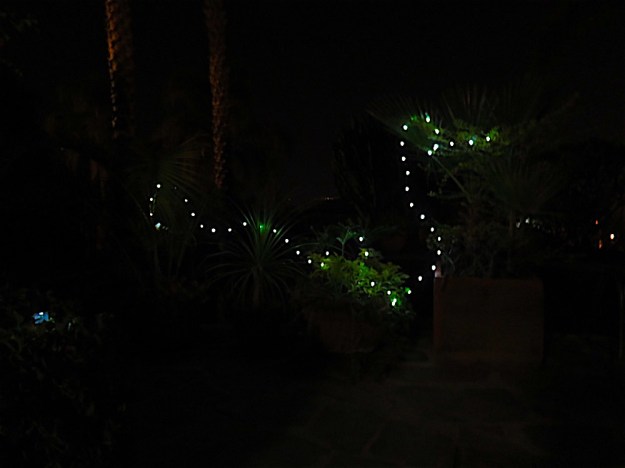
I strung these solar LED lights next to my pool and didn’t realize until that night when I was sitting at my desk which looks out on that scene that they are in the shape of a duck or a swan! I’ve been enjoying them for a few months. They are totally solar and come on only in the dark, except–no longer! When I was trimming the trees, I inadvertently cut through the copper wire.. Sob. No more LED fairy/duck lights.
https://ceenphotography.com/2016/06/12/cees-odd-ball-photo-challenge-2016-week-24/
Desert Trees: Sunday Trees 239
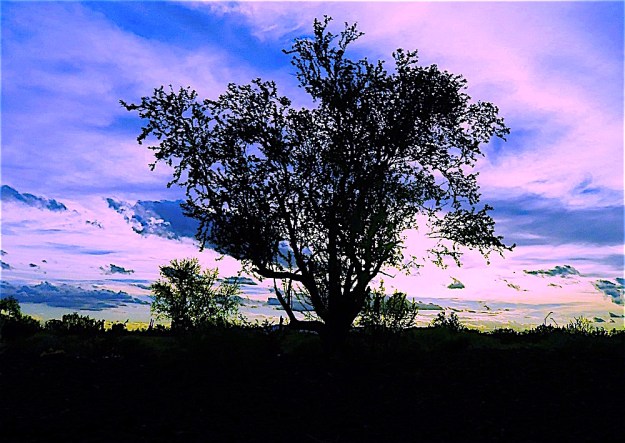
This desert scene with mountains, clouds, sunset and cacti barely discernible in the distance is definitely dominated by this little tree silhouetted in the foreground.
 https://beccagivens.wordpress.com/2016/06/12/sunday-trees-239/
Canna Lily: Flower of the Day, June 13, 2016
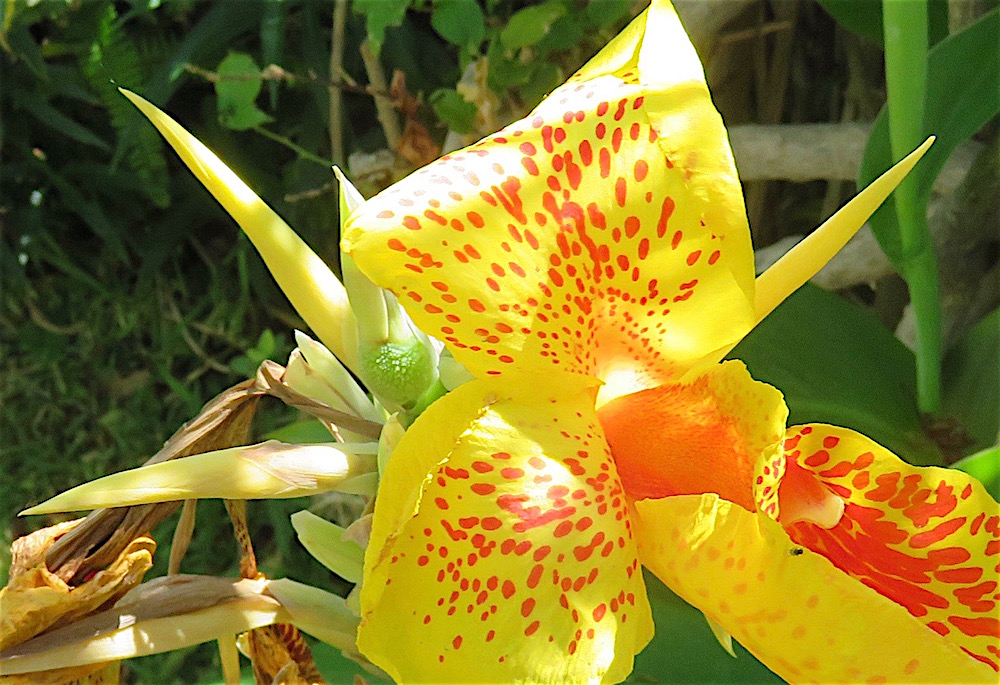
I love every stage of the canna lily, from the spears before the flowers have unfurled, to the individual blooms popping out of the spears to flower clusters.



https://ceenphotography.com/2016/06/12/flower-of-the-day-june-13-2016-bearded-iris/
Rebuilding Your Life after the Death of a Loved One
Since the WordPress prompt is “Rebuild” and I have written a book with that word in the title, I guess this is an obvious time to link to it here:
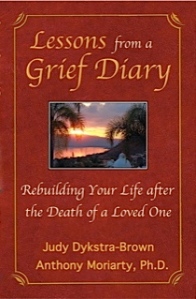
Now available on Amazon, in print and Kindle versions and in Bookstores, including Diane Pearl Colecciones, La Bella Vida, Jose Melendrez and Mi Mexico in Ajijic, MX.
Lessons from a Grief Diary: Rebuilding Your Life
after the Death of a Loved One
Judy Dykstra-Brown and Anthony Moriarty, Ph.D.
A widow’s grief diary chronicling the illness and death of her husband as well as the process of her recovery from grief over the next eight years is analyzed in alternating chapters by a psychologist. Includes methods of overcoming grief, suggested further reading and ending notes that summarize main points of the book.
Synopsis
When Judy let her husband Bob persuade her to buy a house in Mexico, little did she know that five months later, she would be moving into that house alone. Her diary takes us along through their initial adventures in Mexico, their return to California to sell off the contents of their home, her nursing Bob through his final illness and death and her move to Mexico. For eight years, she chronicles the triple challenge of dealing with the loss of her husband, learning to adjust to the culture of a foreign country where she knew no one and finding ways to find the positive in the most negative situations. Making use of his extensive research in the field of grief as well as experience gained through years of counseling others going through the grief process, Tony’s insightful comments on Judy’s thoughts and actions will serve as a guide for any reader suffering from the death of a family member or other loved one.
Readers’ Reviews and Comments
Having the courage to speak with unembellished honesty, Judy Dykstra-Brown begins by describing the move she and her husband Bob are planning to make to a more relaxed life in Mexico. As the van is being packed and plans finalized, Judy learns her husband is dying. In beautiful prose and poetry, she chronicles her grueling role of caretaker to Bob, their last days together and the death and rituals that follow. Knowing she will be leaving behind all of her support systems, Judy relocates to Mexico alone, sharing her intensely personal journey of grief, growth and finally the excitement of moving towards a different and full life. Uniquely, Anthony Moriarty follows each chapter with a psychological and/or mystical interpretation of the behaviors that accompany Bob’s processes of dying and Judy’s struggles with the loss of her husband. This is a must read for anyone who has experienced loss.—Romaine Presnell, Clinical Social Worker, mental health therapist at John Hopkins and in private practice, Supervisor of Counseling Services as Associated Catholic Charities and group facilitator for The Wellness Community, providing free services for cancer patients and their families.
This book combines the personal account of a woman whose husband has unexpectedly become ill and died with the commentary of an experienced clinical psychologist. The story is compelling, the theme universal, and the dual viewpoints of the authors give us unique and valuable insight into the experience of loss, grief and life beyond.—Amelia Stevens, M.D., Psychiatrist
After suddenly losing my partner of 8 years, the combination of emotions that battered me day-to-day left me lost with no idea of how to find my way back to a relatively normal life. I ordered and read a number of the best-selling books on the subject of grief, but felt none of them applied to me until I discovered this brave and startling book. The combination of Judy’s honest personal journey and Tony’s objective observations make this a very important book with which I was able to easily identify. Had I read it earlier, I seriously think my journey would have been shorter and less debilitating.—Linda Richards, Artist
With the hundreds of books available to help people navigate their way through the grief process, it is a rare find to discover one that approaches it from a whole new perspective. Lessons from a Grief Diary presents material from what I call Wise Mind, with an alternating blend of raw emotional disclosure combined with intellectual analysis and commentary. We get to travel along with Judy as she copes with the unexpected illness and untimely death of her husband and goes on to build a whole new kind of life on her own. Through her ‘real-time’ journal, she reveals nuances ofthoughts and emotions that are rarely spoken aloud. Tony’s intermingled commentary adds a perceptive depth of understanding, providing the reader valuable balance and insights into this complicated evolving process we call grief. Anyone seeking to better understand and explore their own experience of grief will find this book to be an optimistic and eminently relatable companion on their journey.—Joy Birnbach Dunstan, MA, Licensed Professional Counselor
Once I started reading this book, I could not put it down. I loved the way Judy dealt with the death of her husband as well as the way in which she expressed her feelings. So many things she did and felt were the same as my feelings and actions when I lost my husband. Her sense of humor, her sadness, her guts to push on will make you feel like you are her best friend. Getting Tony’s perspective also gives another window into Judy’s heart. If you have lost someone close to you, everything she says will make sense. If you have not yet lost someone close to you, it will prepare you for when it happens.—Audrey Zikmund, Widow for Two Years
Bereavement is a solitary, uphill climb. I watched my mother make the journey and to my child’s eyes, it took forever. Lessons from a Grief Diary is a candid account of the grieving process. It’s as if author Judy Dykstra-Brown is leading the bereaved individual into Dr. Tony Moriarty’s office where the three explore this complex emotional transitional state. I recommend this book to those who have suffered a loss, their families and friends, and to any of the professionals they turn to for help. Reading this book would have helped my mother and me.—Harriet Hart, Social Worker and Past Director of Rehabilitation, Manitoba Paraplegic Association
This book is a great trail guide for exploring the pathway through grief. We get to move between the powerful, surprising ways grief grabs us and the insights and understandings that give us something to hold on to as we pick our way through the boulders.—Georgia King, County Mental Health Counselor
Reading Lessons from a Grief Diary is the surest way to go from grief to joy.—Gloria Palazzo, Writer, Artist and Widow
“The reading of this book took me to a place where no other book has ever taken me and gave me a new appreciation of lakeside as a magical healing place. Thank you for that. It’s a big revelation for me—and a big step in accepting this place that I have always before thought of as just a place I was passing through. I actually read it in two nights—pretty fast for me. It was a privilege to experience this book.”––Candace Spence, Lake Chapala Resident
Bios
After earning her Masters in Creative Writing and Curriculum and Instruction at the University of Wyoming, Judy Dykstra-Brown taught English and writing for ten years in Australia, Ethiopia and Wyoming before moving to California to study film production and to work for a television production company. She studied writing at UCLA and in the Jack Grapes workshop, where she met her husband Bob, a poet and sculptor. After marrying, they moved to Northern California and exhibited their individual and collaborative work at galleries and art and crafts shows nationwide for thirteen years. She was curator of the Santa Cruz Mountains Art Center for three and a half years. After Bob’s death in 2001, she moved to Mexico, where she has continued to publish her work in English language print and online magazines, to read and speak for various lecture series and performance groups and to exhibit her retablos and mixed media sculptures at local galleries. This is her third book.
Tony Moriarty holds a Ph.D. in Counseling Psychology from the University of Illinois at Urbana-Champaign. He has been a Licensed Clinical Psychologist since 1978, working both in private practice and community mental health, where his clinical specialties include grief management. As a police psychologist, he was involved in the post-incident counseling of officers whose use of force in the line of duty had resulted in a death or serious injury. He recently retired as the Principal of Homewood-Flossmoor High School in Flossmoor, Illinois, where he developed a number of programs involving non-punitive methods of managing student behavior as well as two high school police resource officer programs. He has published more than thirty articles in the professional literature and is the author of three books prior to this one.
30 thoughts on “Books for Adults”
Since I have written a book entitled Lessons from a Grief Diary: Rebuilding Your Life after the Death of A Loved One, I guess this is an obvious place to establish a link to it.
A Certain (Lack of) Understanding

Choose One
Sign Language
I know our birth tongues aren’t the same,
but still I think words aren’t to blame.
It is your means of understanding
that convinces me you’re underhanding.
For every time I give you kisses,
it seems you go to other misses
in search of the translation tips
they give by laying on of lips.
My dear, if we were dumb and blind
then translation service of this kind
might make some sense, but I must say
your excuses will not work today.
Please have your translator of prose
stick this finger message up your nose!!!
Premature Ingestion
 Christine Goodnough issued a challenge for me to download this photo and use it as a prompt so here goes. (Permission was given to download without attribution.)
Premature Ingestion
Poached or coddled, scrambled, fried––
a potential chick has died.
You have no patience, that is clear
for the breakfast you hold dear
forestalls a lot of finger-lickin.’
This could have been a whole fried chicken!
https://pixabay.com/en/egg-fried-mourning-fun-funny-cute-1364869/
Mystery Flower of the Day, June 12, 2016

I love the bud nubs in the background of this photo as much as the blossoms on the front. I took this down in the garden and should remember what this flower is but alas, I don’t.
https://ceenphotography.com/2016/06/11/flower-of-the-day-june-12-2016-rose/
Craig’s List Confessional
Earlier today, I published a poem and at the end, left a pile of unused words that were free for the taking. Christine Goodnough rifled through them and came up with this poem, then left a free-for-the-taking list of unused words of her own, leaving a link to my refuse pile as well. I have dipped into each bunch of words again and used them all in the below poem, with the exception of the few left at the end that I pass on to any reader willing to make use of them in a poem. You’ll find our combined leftovers at the end of my poem and a link to to Christine’s poem above
Craig’s List Confessional
I’d like a mirror so I can see
if I display felicity
when someone whispers in my ear
the name of one I once held dear.
I know not what my heart may feel,
what passions I might dare repeal
now that my head is ruling me
instead of love for somebody
so long departed––no longer here
for so many a long-lost year.
If I could paint a picture of
the countenance of long-lost love
in monotone or multi-tones,
in stereo or monophones,
I hesitate to admit that
I fear the portrait might fall flat.
How often it has been my ploy
to act withdrawn or bored or coy,
as though the long-lapsed love I bore
is what steers my grieving core.
But, in truth, duplicity
is what in all simplicity
guides my actions and my thought
and turns me into love’s robot.
With paint cans colored various hues,
why do I always choose the blues,
rebuffing each potential woo
and dropping out of courtship’s queue?
And so, if love is not a ruse––
a mere excuse for whom to choose,
I stand here gawking, open wide,
with no place left in which to hide.
Respectability’s passe,
and pride too dear a price to pay;
for staying safe in grief’s tight room
is burial before the tomb.
And so my dear, this poem you view?
Pretend that it’s addressed to you
and join me in complicity.
Perhaps shared words can set us free.
I’m not a girl. You are no boy.
This poem is not a word-stuffed toy.
Should you respond with words that match,
it’s possible that we will catch
another chance to reach and choose
and maybe this time we won’t lose
the golden ring that does not bind.
This time we may find love is kind!
Okay, I dug deeply into Christine’s leftovers and rifled through mine as well. This is what is left in the poetic grab bag. Can anyone make use of the rest of our cast-offs? Here is what is left to you:
ooze booze cruise who’s whose choose lose news pews poos cues sues twos woos youse
doozie floozie twozie boo goo hue loo moo new poo sue soo sioux too to you What a spectacle! not respectable
Simple Gray
I am so happy that Christine stopped by my yardsale word giveaway. Her reward for taking some extra words off my hands was this wonderful poem that she conceived of!!! Now I hope someone takes the words she didn’t use and constructs yet another. Let’s see if we can get rid of all of these excess words!


“Look what they’ve done to my hide, Ma!”
Fellow blogger Judy Dykstra-Brown was having a yard sale on leftover words over at her blog, so I’ve claimed a few and used them in this bit of whimsy.
SIMPLE GRAY
And what’s wrong with simplicity
is what I’d like to know?
Before this rank duplicity
I could humbly come and go
without the public squawking
just like a bunch of parrots—
or little children stopping
to stuff my mouth with carrots.
For someone thought — insane-ness!
They’d add some brilliant hues
and liven up my plain-ness.
So now I’ve got the blues!
These artists brought their teacher—
I think they stood in queue
to add, each one, some creature
and make me into a zoo!
Now I wear this dumb menagerie.
Can you tell my face is red?
My own mother wouldn’t know me!
Are those rain clouds overhead?


Liked by you
Edit
Like
Edit
Like
Edit
Like
Edit
Like
Edit
Judy King
Like
Edit
Like
Edit
Audrey Zikmund
Like
Edit
Like
Edit
Like
Edit
Like
Edit
Like
Edit
Like
Edit
Like
Edit
Like
Edit
Like
Edit
Like
Edit
Liked by you
Edit
Liked by you
Edit
Like
Edit
Liked by you
Edit
Liked by 1 person
Edit
We can’t get Kindle here, but a regular book in your hand is very nice
Liked by you
Edit
Like
Edit
Like
Edit
Like
Edit
Liked by you
Edit
Liked by 1 person
Edit