Tag Archives: artists

Living between Two Worlds––an Interview with Kristina Trejo

Living Between Two Worlds

—An Interview with Kristina Trejo

Kristina Trejo
Kristina Trejo

In her 39 years, Kristina Trejo has worked in jobs from a receptionist at a sauna shop, to pretzel maker, but her soul work is as a pianist and batik artist. Her father, Ernesto Trejo, was a renowned Mexican poet and translator who earned his degree at California State University, Fresno, where he met her Anglo mother and began his long collaboration with Poet Laureate Philip Levine. After earning their degrees, her parents moved to Mexico City to facilitate his translation work. Here Kristina was born, moving back to the States with her parents at the age of two.

Kristina lost both of her parents at an early age—her father when she was ten and her mother when she was 17. She had already skipped two years of high school by that time, received her GED, and entered Fresno City College at the age of 16. With her mother’s death, she dropped out of college, taught piano for six months, and then travelled––ending up in San Francisco for one year, Fresno for one year, and Oregon for three years, then back to Fresno for a few months before travelling to Mexico City where she stayed for the next few years.

I interviewed Kristina at Pasta Trenta, a local restaurant where at the time she was playing the piano on Friday nights, and after we had ordered our meals, she settled in to tell me the rest of her story. “When I got to Mexico City, I felt complete—as though I had lived there for many different lives and as though that was where I was supposed to be.” She bought a piano and it was also in Mexico City that she perfected her skills in doing batik. “My mother was a pianist and batik artist. At the age of four I started begging for piano lessons. My mother finally relented when I was five, but although she herself was teaching piano, she insisted that I would probably learn more with a different teacher. It was at the age of ten that I found my mother’s batik tools in a box and asked her to show me how she created her pieces. Insisting it was too complicated and much too dangerous for a ten-year-old to work with hot wax, she promised to teach me when I was 18. But of course by that time, my mother had passed away and I had long ago forgotten about my desire to learn the technique of batik.

“One night, when I was 18, I had a dream that I had my own batik studio. I didn’t know how to do it, but in my dream I could. After that dream I felt an urgency to do batik for the rest of my life. So the next day, when my cousin sent me a gift of 100 dollars, I took the money and went all over the city looking for a book on how to do batik. I bought dyes, fabric, wax—all the materials my mother had used to do her batik but which she had quit doing before I was born. I read the book and taught myself the process, obsessing over batik until six months later, when I went to Belize and stayed in a house in the jungle where I was amazed to discover the friend we stayed with was a batik artist. It was there that my instruction began. When I moved to Mexico City, I found other artists to study with and thus began a lifelong compulsion.”

Batik

When Kristina came to a distant relative’s funeral in Ajijic ten years ago, she had no idea that she would decide to stay. “I came at a time when I needed it. Lakeside is a perfect place to still your mind and create––a perfect place to heal. Because it is positioned between two monumental natural things—the lake and the mountains—it is like you are being held safe in the middle of a peaceful embrace. The city of Fresno is situated in a valley where the air seemed trapped and full of chemicals. This situation was not conducive to music and art. There were a million people there––that many people––but fewer who appreciated art. In Ajijic, almost everyone appreciates art, music, and poetry. You don’t have to fight to be an artist. You can do it calmly in your own time and not worry about what you’re supposed to be doing. In Fresno, people thought you should be doing something serious. Here, being an artist is viewed as a serious profession.”

I asked Kristina about her goals. “My future goals? To continue following my heart about creating music and art, no matter how difficult the path. I just produced a new CD, so for the past year I was mainly obsessing over that. I don’t know how to think very far in the future because I think I was born without that part of my brain. I keep things very short term. I try to live in the present moment. There is something about the States that makes them think they can control the future. There, everyone has a five-year plan. It is very much a culture that lives under the illusion that they can control the reality we live in, but we don’t really know what is going to happen! Last night I was going to buy two bars of soap and then I thought, ‘Wait a minute. Do I even know I’ll be alive to use the second bar? If I finish this bar of soap, I’ll buy another one then.’ I stay focused on my work. That’s what keeps me going.”

At present, Kristina continues to show her batik in local galleries and restaurants. She plays piano at Casa Linda on Sundays from 11 to 1, and has collaborated with other musicians to produce her first album. “A beautiful recent spiritual experience that happened this year was to watch a huge flock of birds flying as one. The Spanish name for this is parvada, and that is the name of my CD. That flock of birds flying as one is the best answer I’ve ever gotten for why things have to be as they are. Why even question the timing of the universe? Have faith that everything is operating in a sacred design of how it needs to happen at the time.”

Batik 2

“I live between two worlds,” Kristina answered when I asked how it was to be a person of mixed heritages living in Mexico. “It is almost impossible to explain to each group exactly what the other one is about. Too often, I am seen as the ‘other nationality.’ It has always been that way. It is a lesson in how people view things. It’s hard for people to see things from two sides, but I hope to be a bridge, translating when needed, explaining cultural differences, and continuing to love both sides.”

At this point, the waitress brought our bill along with two mints in plastic wrappers, each of which contained a short quote. Kristina’s read, “A fish that fights the current dies electrocuted.” Mine read, “Money doesn’t make happiness. It buys it ready-made.” Somehow, they seemed completely appropriate in marking the difference between the two cultures that Kristina has been alternating between and living with her entire life.

This is an interview I did with Kristina that ran in the Ojo del Lago four years ago.  Since she has a new CD out, I thought I’d run it in my blog. Her new CD Betrayal of the Sun is on Bandcamp at  https://kristinatrejo.bandcamp.com/album/betrayel-of-the-sun. Check out her other albums and her Facebook page at https://www.facebook.com/kristina.trejo.9


Art and Acquisitions

(Click on photos to enlarge and read captions.)

Art and Acquisitions

Those who patronize fine art
start out congenial at the start
but then upset the apple cart
by arriving early at the mart
and increasing rate and pace
so they can win the prestige race
by obstinately using cash
to win the collector’s ten-yard-dash.

Marble statues and fine oils
are thus simply used as foils
used within the competition
between those whose one ambition
is to amass all those things
that a pile of money brings.

But in fact, it is the making
of great art, and not the taking
that produces joy in living.
Buying can’t compete with giving.

Prompt words for today are congenial, race, marble, obstinancy,   patronizeart

Happy Group

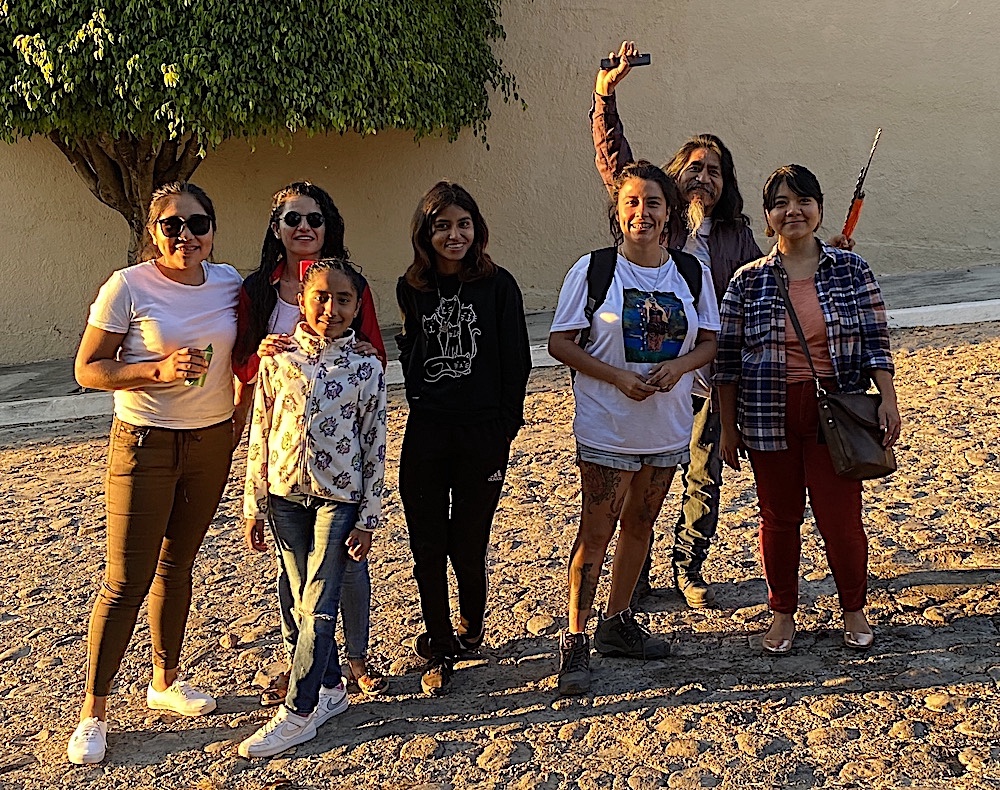
This cheerful group of young ladies from San Juan Cosala visited me today to see my art boxes for inspiration for the ones they are creating for a competition I’m sponsoring.The show will be held a Isidro Xilonzochitl’s studio in San Juan on January 22. That’s Isidro in back.

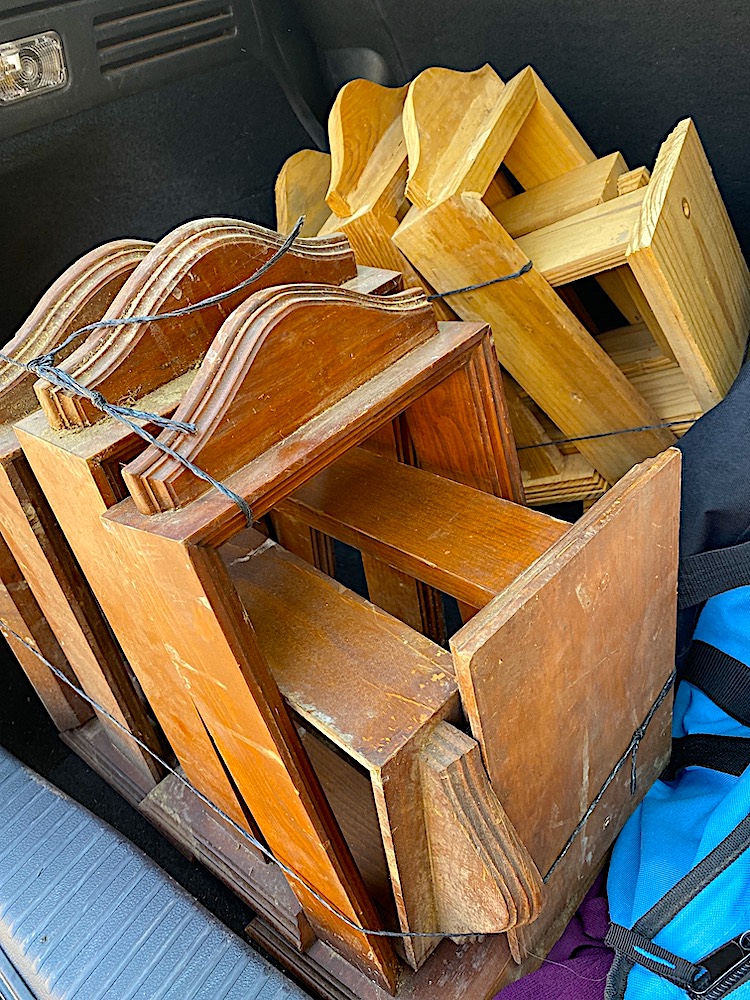
These are the boxes  with bases that I bought to give to the participants.They will need to add a back before creating their own response to the challenge.

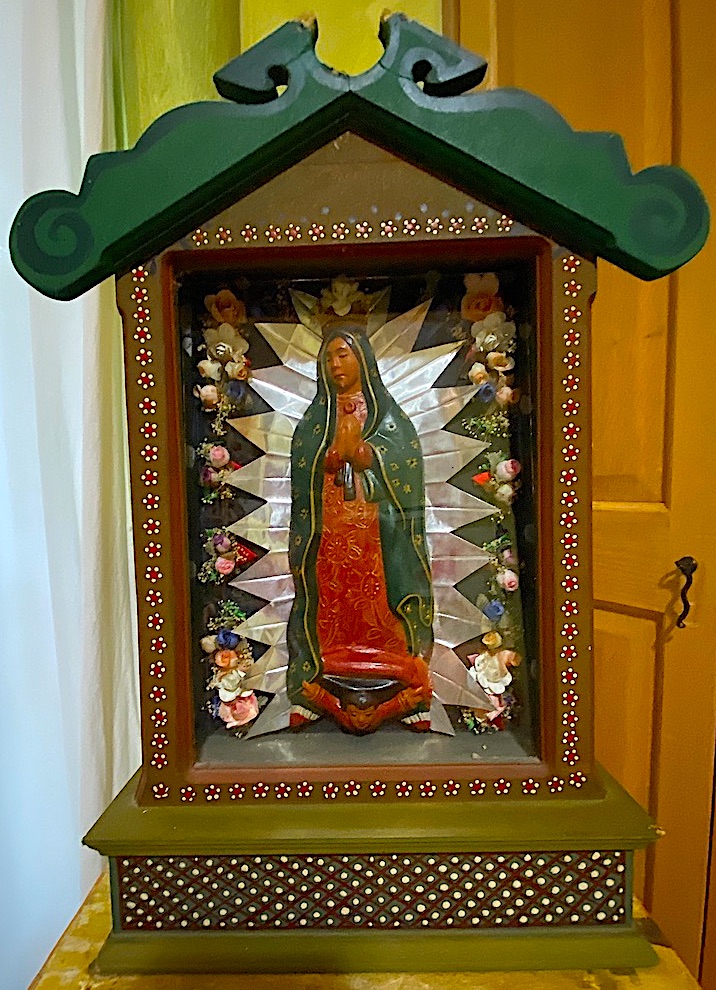
Here are a few of the boxes they saw at my house. These are all by me.

Click on photos to enlarge.

And here is another one by Belia Canals:

Can’t wait to see what these young ladies plus the four women who couldn’t come today create for the January show. This will be the first in a series of challenges and workshops I hope to conduct this year.

Nefelibadas

Nefelibata – A creative person who lives in the clouds of her own imagination or dreams. An eccentric, unorthodox person who doesn’t abide by the rules of society, literature or art.


Click on photos to enlarge.

For Ragtag’s nefelibada.

Nefelibata – A creative person who lives in the clouds of her own imagination or dreams. An eccentric, unorthodox person who doesn’t abide by the rules of society, literature or art.

Crafted Heart

IMG_3737
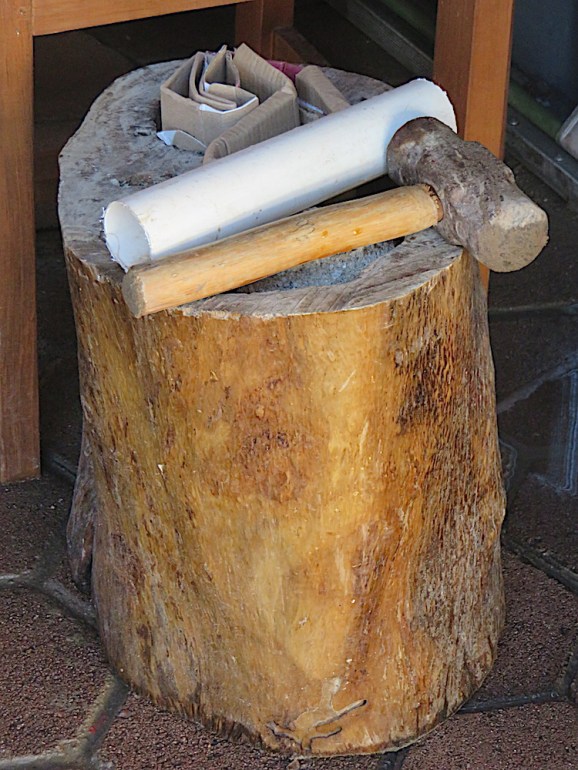
As an artist who worked in wood, stone, metal, paper, glass and any other material he could find to project his mental imaginings into concrete objects, my husband had mallets of many shapes, sizes and materials, but my favorite was the one he fashioned himself as part of the first gift he ever gave to me—the musical instrument shown towards the end of this post.

Crafted Heart

He handed it to me without ceremony—a small leather bag, awl-punched and stitched together by hand. Its flap was held together by a clasp made from a two fishing line sinkers and a piece of woven wax linen. I unwound the wax linen and found inside a tiny wooden heart with his initials on one side, mine on the other. A small hole in the heart had a braided cord of wax linen strung through that was attached to the bag so that the heart could not be lost. He had woven more waxed linen into a neck cord. I was 39 years old when he gave me that incredible thing I never thought I would receive: his heart—as much of it as he could give.

It was the first handmade gift I’d ever received from a man. Inside, over the years, I have put a lock of his hair and a tiny tiny animal of indeterminate species hand-cut out of wood by his youngest son and presented to me. Twenty-eight years later, this bag is all that is left of what was once my union with the man and his eight children from three different women. When he died, we returned him to the inevitable earth and all of the children returned forever to their real mothers.

The bag lies in a box with other relics of our past together: a silver heart brooch, another carved of wood with wings attached and, strangely enough, a miniature computerized hand piano. Years after his death, it struck a chord on its own, just lying on the shelf beside my favorite picture of him. One last dying gasp from the tiny gadget I’d put in his Christmas stocking but then grown tired of hearing him play and so had hidden away, only to enter our bedroom one night to find him playing it under the covers like a guilty pleasure hidden from the adults, although he was already in his sixties.

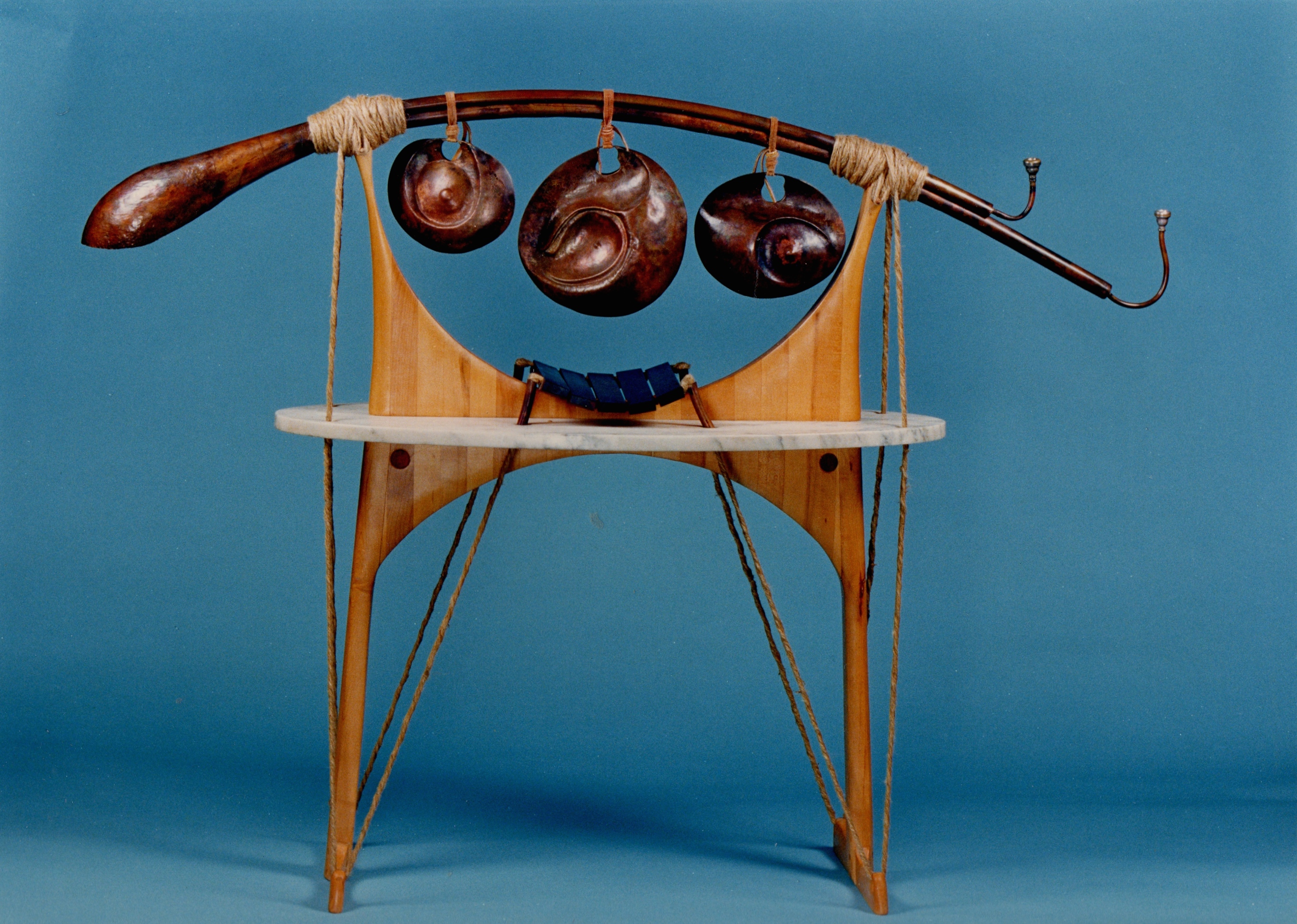
For our first Christmas, he gave me a large sculpture that was also a musical instrument—three hand-raised copper gongs in the shape of breasts suspended over a wooden keyboard played by rawhide mallets, (ironically, they are not shown in this photo)  the gongs suspended from the long horizontal neck of a copper wind instrument with two necks and two mouthpieces, so two notes could be blown at once. When he died, it was the sculpture chosen by his youngest daughter, and I let her take it. Now, the remnants I have of him are only the leftovers that remained after eight children had chosen. I was moving to another country and could not hold onto everything he’d given.

daily life color023

Sculpture by Bob Brown,1986.  4′ X 5.5′, wood, hand forged copper, marble and hemp.

                            daily life color024

                                 Miniature hand piano, 4″ X 2″

I moved away from most of those things we had collected over the years, but somewhere hidden away in the thousand objects in my studio is the small leather bag and the tiny hand piano, now forever mute, his father’s pocket watch, his biking medals and the other assorted pieces of his life that will one day wind up in a secondhand store in Mexico. All of our gifts finally melding with the parts of all those billions of other lives that strike their brief chord before blending, inevitably, back into the cacophony of the universe.


Some material in this post was posted four years ago. The prompt today is mallet.

Christine’s World

215208_1009555887586_5989_n

Christine’s World

Like many Canadians who winter in Mexico, Christine Gribbin has learned to seize the best of both worlds.  In Montreal, Quebec, she still maintains a busy life is the world of film and fashion, but when the cold winds blow, she retreats to the sleepy village of La Manzanilla 200 kilometers south of Puerto Vallarta on the Jalisco coast.  There she resides in the charming upstairs casita of artist Carol Lopez and pursues her own interest in painting.

The influence of the cheerful and easy going life of her landlady and the village at large can be seen echoed in both her art and her countenance.  I’ve been meaning to share her world with you for some time, but unfortunately the laid back life of the beach seems to be lost a bit in the more complicated life of interior Mexico, not to mention my trip northwards.  But here, at last, is a peek into Christine’s Mexican environs and art.  If I had been able to capture a more rounded view of her life there, I would have also photographed her on the dance floor or on the beach, sipping tequila with the regulars at Daniel’s sunset tequila soiree, or listening to music at one of the beachside palapa restaurants; but these views of her aerie and her paintings are what I was able to capture.  I hope they will adequately portray this vivacious and talented lady.
(Please note that the sketch of the woman’s face on top of the fridge is by Christine, but the painting behind it  is by Carol Lopez. You can see photos of Carol’s studio here.)

Carol Lopez Studio Peek

Carol Lopez is a La Manzanilla resident who like many others spends the hottest months in Canada.  Since I have been as charmed by her house as her art, I have decided to share both with you.

If you click on the first photo, it will enlarge and reveal the caption, which will be the story to go along with the photos of Carol’s La Manzanilla world. Clicking on the arrow will take you to the next photograph.


Thanks for coming along with me on this studio peek. Another will soon follow that covers the upstairs casita of Carol’s house–and the other artist who lives there.

For more information about Carol, go HERE.