Tag Archives: memories

Life Is Too Short to Be Afraid

Staid: adjective: sedate, respectable and unadventurous. “staid law firms”
synonyms: sedate, respectable, quiet, serious, serious-minded, steady, conventional, traditional, unadventurous, unenterprising, set in one’s ways, sober, proper, decorous, formal, stuffy, stiff, priggish

Life Is Too Short To Be Afraid

Life is too short to be afraid,
caught, traditional and staid,
serious, steady, lacking flair,
always well-clothed and never bare.
We were not meant for formal fare,
pinched and tucked with perfect hair.

We’re meant to flap and drag and wear
with tattered bits and unkempt hair.
Life’s meant to mess us up a bit
as we make use of all of it.
Not just the parts traditional,
decorous and conditional.

Take a chance to win or fail.
Face the flood and face the gale.
Jump right in with both your feet
when adventure you chance to meet.
Go out to meet the world with grace,
hand extended, face-to-face.

In this great apple called mankind,
live in the fruit, not in the rind.
In the messy, fragrant, toothsome center
be an enjoyer, not a repenter.
Buy life full-price and not on clearance.
Live on the pith and not appearance.

For all too soon it will be over.
That field you rolled in, full of clover,
will sprout small stones that bruise your spine.
The rich mussels on which you dine
will be something you’ll have to pass
for fear that you might suffer gas.

The places where you want to go
can’t be got to when you’re slow.
You won’t have the energy
to travel fast and travel free—
to hitchhike, backpack, hop a train
when you have rheumatism pain.

So gather ye rosebuds while ye may.
“Real” life will wait another day.
Be silly and take chances now.
Forsake the contract, pledge and vow.
Too soon the walker and the cane.
You never will be young again.

The Prompt:No Time to Waste—Fill in the blank: “Life is too short to _____.” Now, write a post telling us how you’ve come to that conclusion.


Hard Drive

The Prompt: Buyers, Beware? The year is 2214, and your computer’s dusty hard drive has just resurfaced at an antique store. Write a note to the curious buyer explaining what he or she will find there.

DSC01454

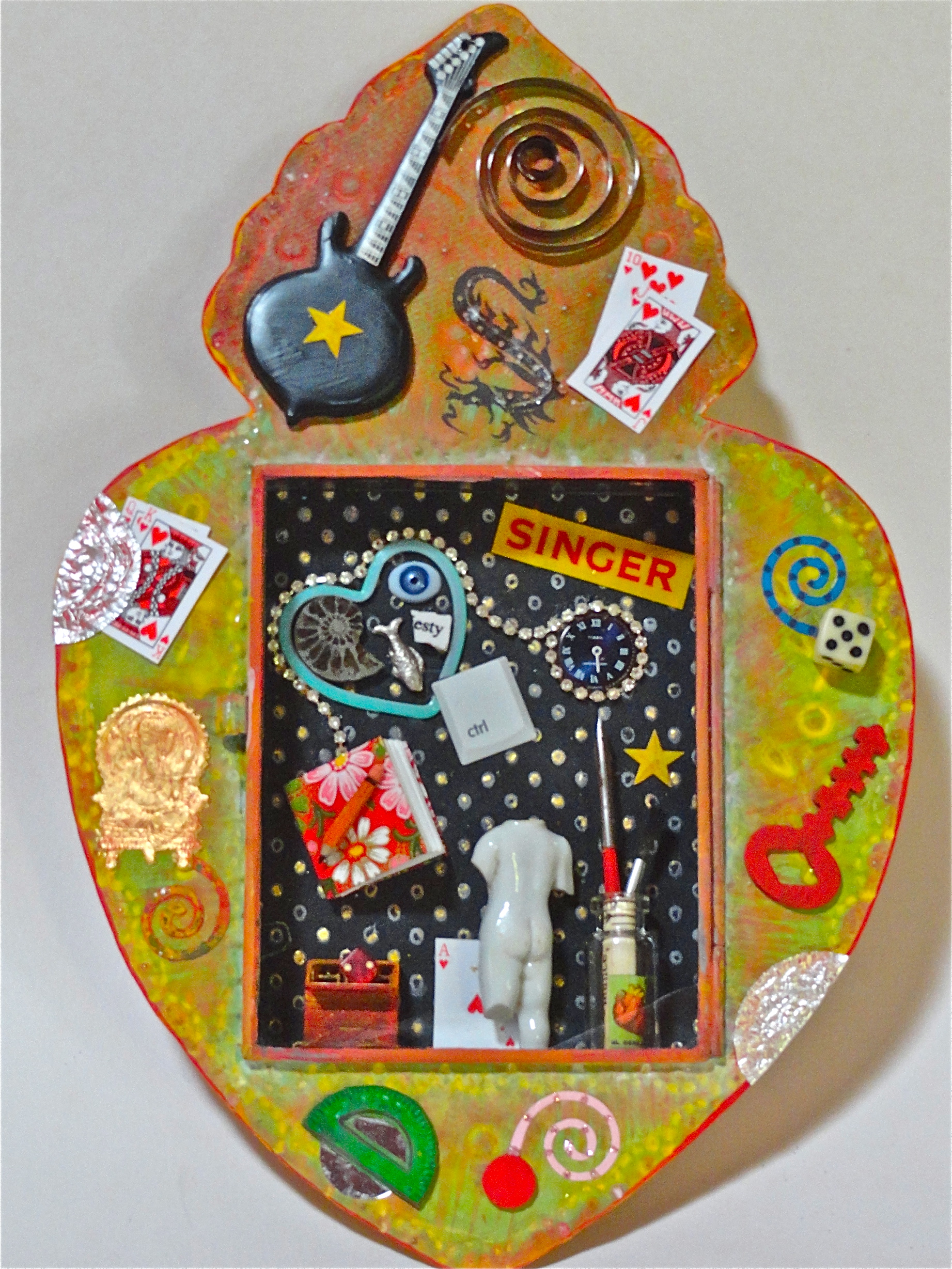
My Retablo, “Autobiography”

Hard Drive

If you long for mystery,
poems, facts and history,
long perambulations
and wild exaggerations,
recipes and letters and
episodes of Homeland,
Elementary, Sherlock, Friends,
a blogging site that never ends,

Emails, Youtube, Facebook notes,
starts of novels, copied quotes,
OkCupid pictures of
possibilities for love,
notes from nice guys, threats from creeps,
notes from guys who play for keeps,
friends who only write when drunk,
chain e-mails, jokes and other junk,

two hundred drafts of my third book,
(each one different, have a look),
kids stories and their illustrations,
the Christmas plans of my relations,
photographs of my whole life—
its happiness and pain and strife—
some successes but also follies,
fireworks, insects, gardens, dollies,

travel snaps and friendly faces,
rooms at home or foreign places,
birds and children, beaches, skies,
the camera lens is true and wise
and not as given to fraud and lies
as writings filtered through the eyes
of one who feels the joys or pains
of what she witnesses, then deigns

to try to change her reader’s mind
to accord with the type or kind
of thoughts she carries deep inside:
pride’s cutting edge, love’s waning tide—
things lovely, funny, jarring, rare.
So read this hard drive if you dare,
but if you fear a life laid bare,
I have one word for you. Beware.

Agustin’s Story

Update Dec. 14, 2017: I’m very curious about why, three years after I posted this story about Agustin on my blog, I’ve suddenly had over 200 viewings of it in one day. If you’re reading this, would you please add a comment to tell me how you came to do so? Thanks, and thanks for viewing it!

The Prompt: Second-Hand Stories—What’s the best story someone else has recently told you (in person, preferably)? Share it with us, and feel free to embellish — that’s how good stories become great, after all.

Agustin Vazquez Calvario: Renaissance Man and Good Samaritan of San Juan Cosalá

I have been told many stories by Agustin, and some day I will share them with you, but I think they’ll have more power if you know more about the man, so today I want to tell you about him.

                        DSCF7765_2

A number of years ago, a popular situation comedy in the U.S. was “Cheers,” a story about a Boston pub that became a home away from home for its regulars. Some of the lyrics from its enormously popular theme song were:

Making your way in the world today takes everything you’ve got.
Taking a break from all your worries, sure would help a lot. . . .
You wanna go where people know people are all the same,
You wanna go where everybody knows your name.

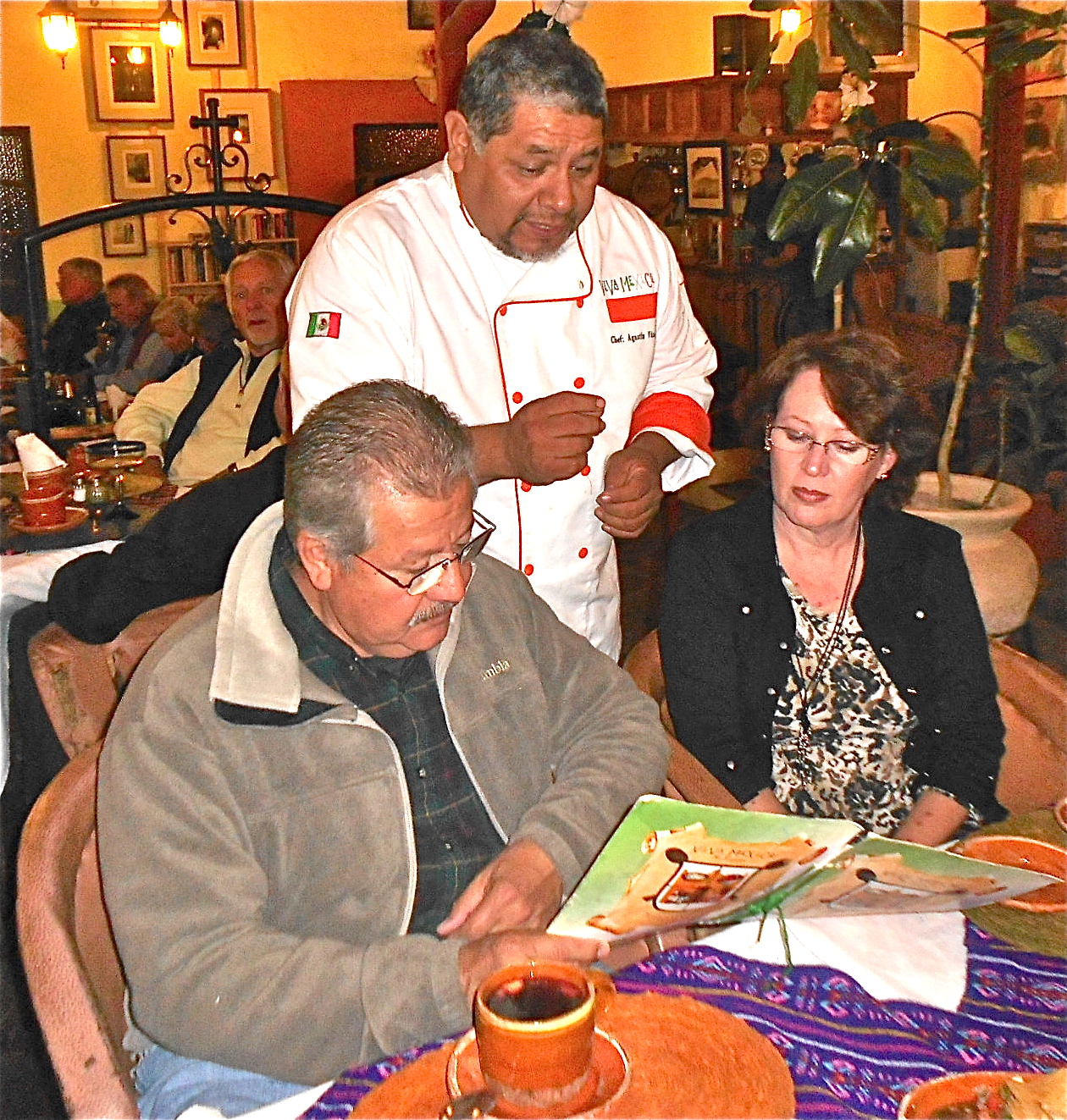
 In San Juan Cosalá, Mexico, a pueblo of 6,000 on Lake Chapala, about an hour’s drive away from Guadalajara, that place is Agustin Vazquez’s restaurant, Viva Mexico. It is a warm, art-filled social center for the community that in my opinion also happens to serve the best food lakeside. Here as in the rest of his life, Agustin functions as half scholar, half artist, surveying other restaurants, cookbooks, websites and even literature such as Like Water for Chocolate for recipes that will enable him to bring to life again Mexico’s rich culinary history.
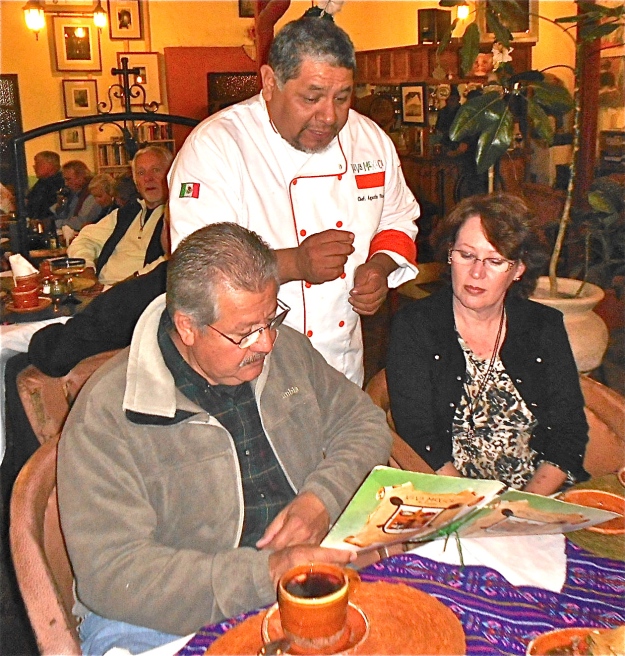
DSCN1347

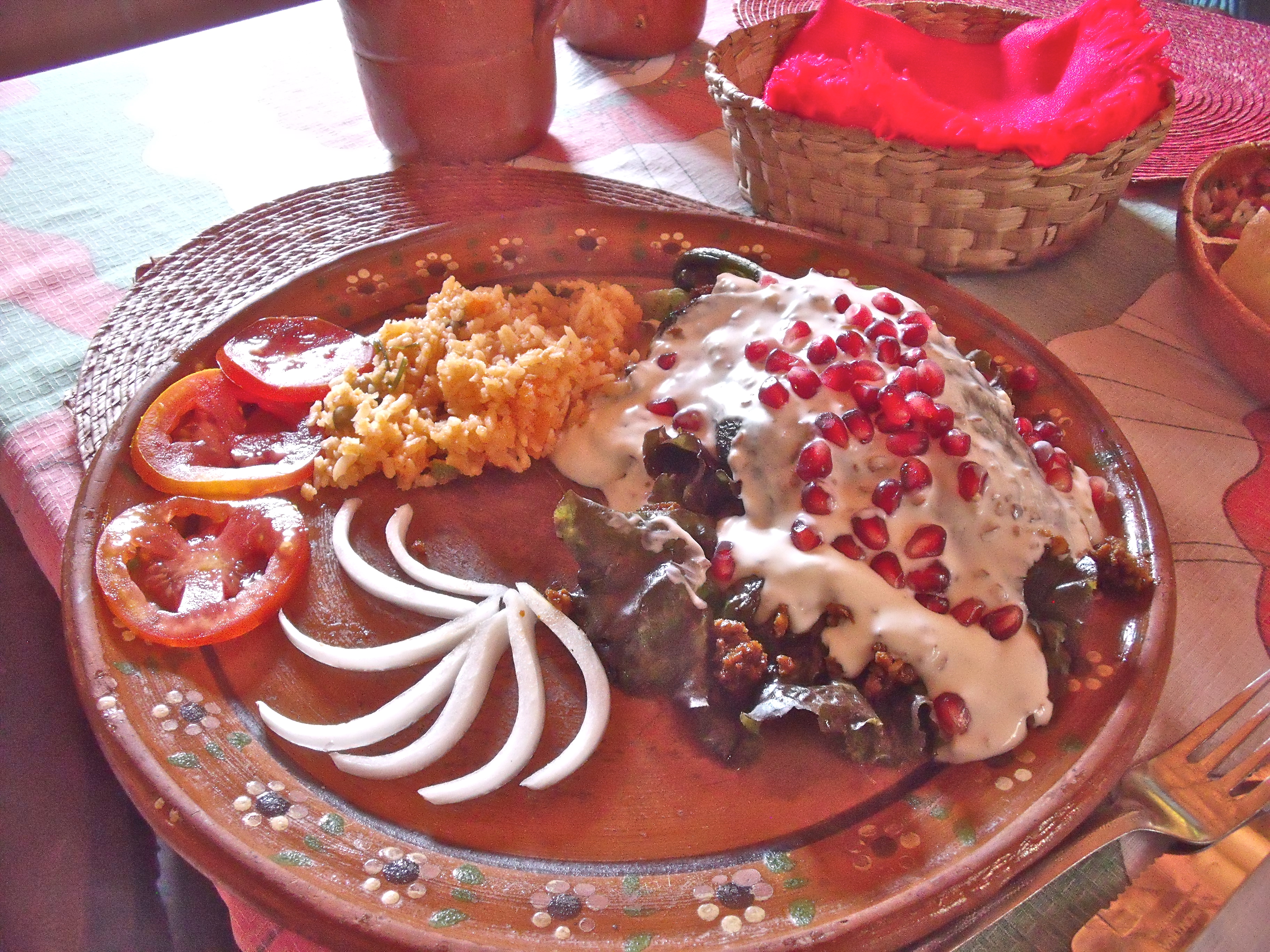
Quail in rose petal sauce is one such recipe which joins other special menu offerings such as fish fillets cooked in banana leaves with fresh herbs, chiles en nogada, pork shank, and ribs simmered in Agustin’s homemade sauce. Other traditional favorites are pozole (a rich pork and hominy stew) and molcajetes (beef, chicken or shrimp with sweet green peppers, onions, panela and other cheeses with a red or green sauce, cooked in a traditional stone receptacle). My favorite is a molcajete of chicken breast cooked in green sauce. Mmmmmmm. No one I’ve ever recommended it to has been disappointed, and I recommend it to everyone I see who is about to order.

More artistry is displayed in the presentation. Vegetables are fanned in flower shapes, organic lettuce supports the freshest tomato slices, and the entire plate becomes an artistic pleasure that makes one pause a moment to survey the plate before succumbing to the wonderful odors that presage delightful tastes and textures to be experienced.

DSCF8268Chiles en Nogada is a popular item on the menu.

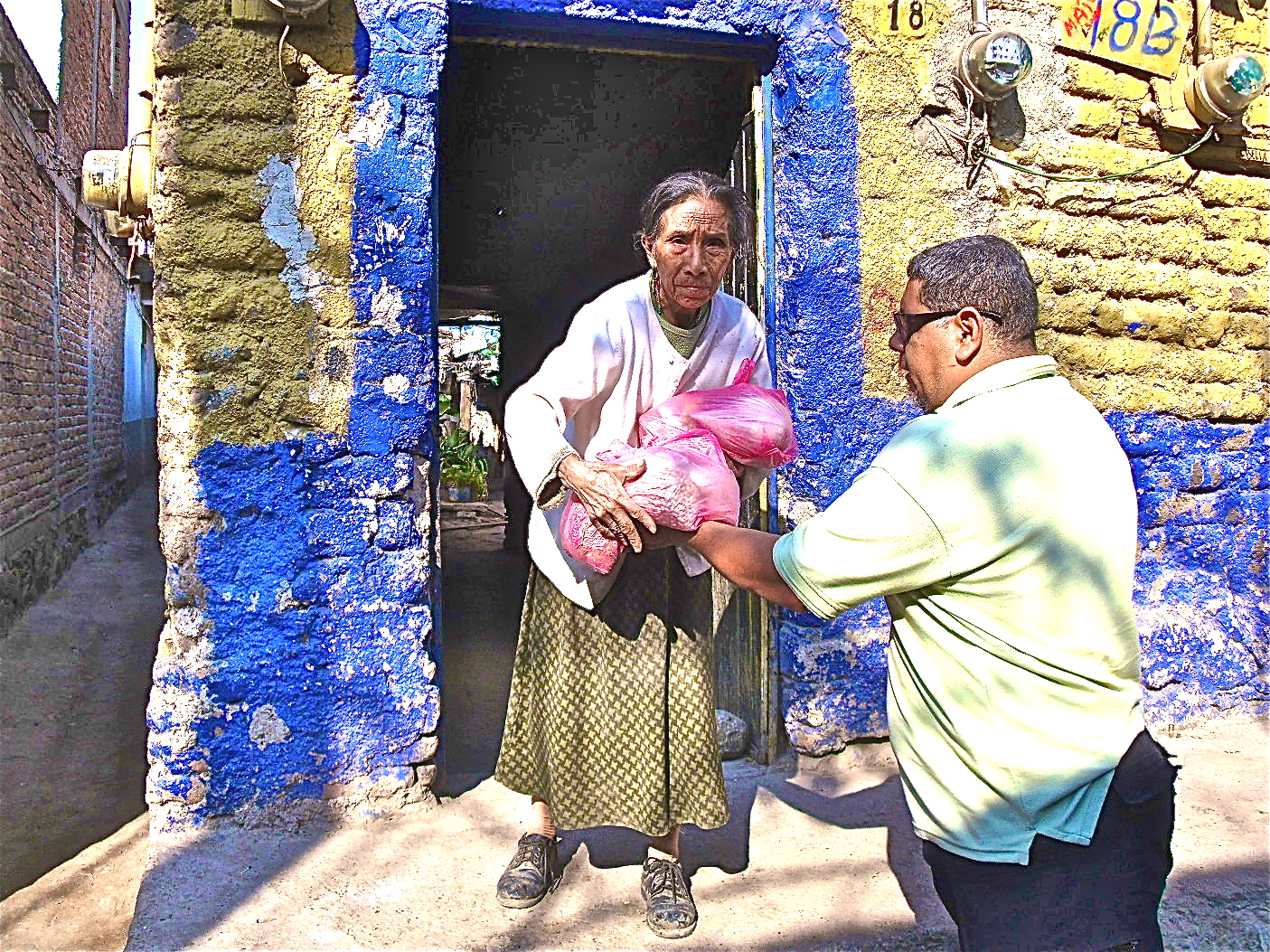
 A lifelong local resident who has his community and its people in his heart, Agustin is so busy that it is hard to imagine how he fits all of his obligations into one day, for his creation of one of the most popular restaurants in the area is just one small part of his life. He also helps to direct a charitable food operation that now feeds 100 families in his home village, personally purchasing the food and for years, delivering it to each family once a week. (Now the families come to receive their weekly ration from a new region of his restaurant  that serves as a storage space and dispensa for Operation Feed.) Since he joined the program a few years ago, his skill in bargaining has allowed them to double the number of families who are helped by the program. He does not allow them to reimburse him for his gas or his time.
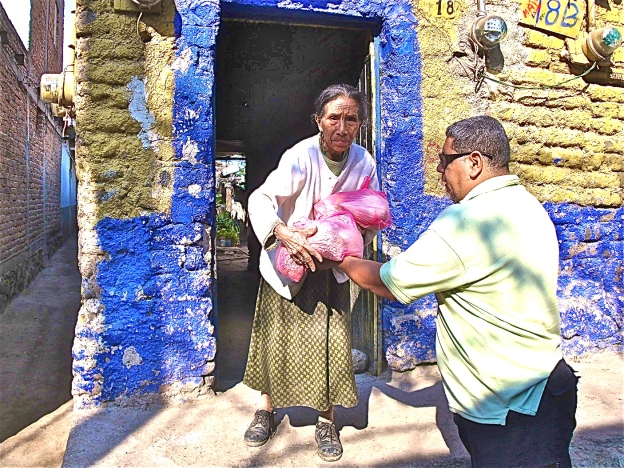
DSCF8675With his knowledge of the village, Agustin has cut the time for weekly food deliveries in half in the year since he has been doing the driving.

I first met Agustin in 2002  when I became involved with a group of local Mexican artists. Agustin, who at the time was working as a real estate agent and contractor, had long been their patrón (sponsor) and so when I approached them about helping to stage a children’s art experience where they would paint pictures on the theme of cleaning up the lakeside and their village, Agustin immediately became a major supporter of the project, helping to buy backpacks and school supplies for the prizes. When we staged a fundraising concert to send a young opera singer to the U.S., Agustin fed us all afterwards in what was then his Aunt Lupita’s pozole restaurant. At the time, it was dirt-floored, the simple kitchen was open to the air and parts of the restaurant were without a ceiling.
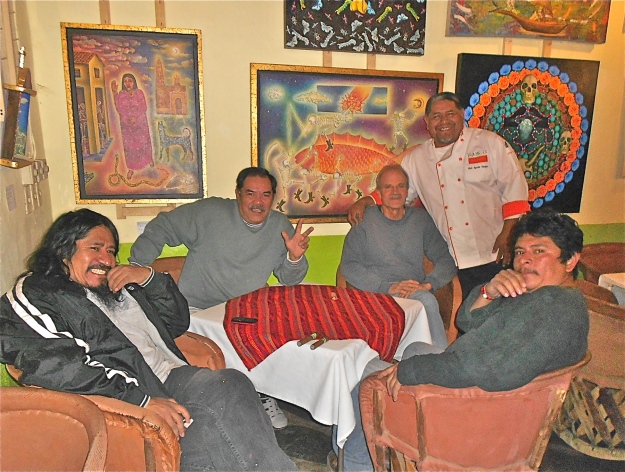
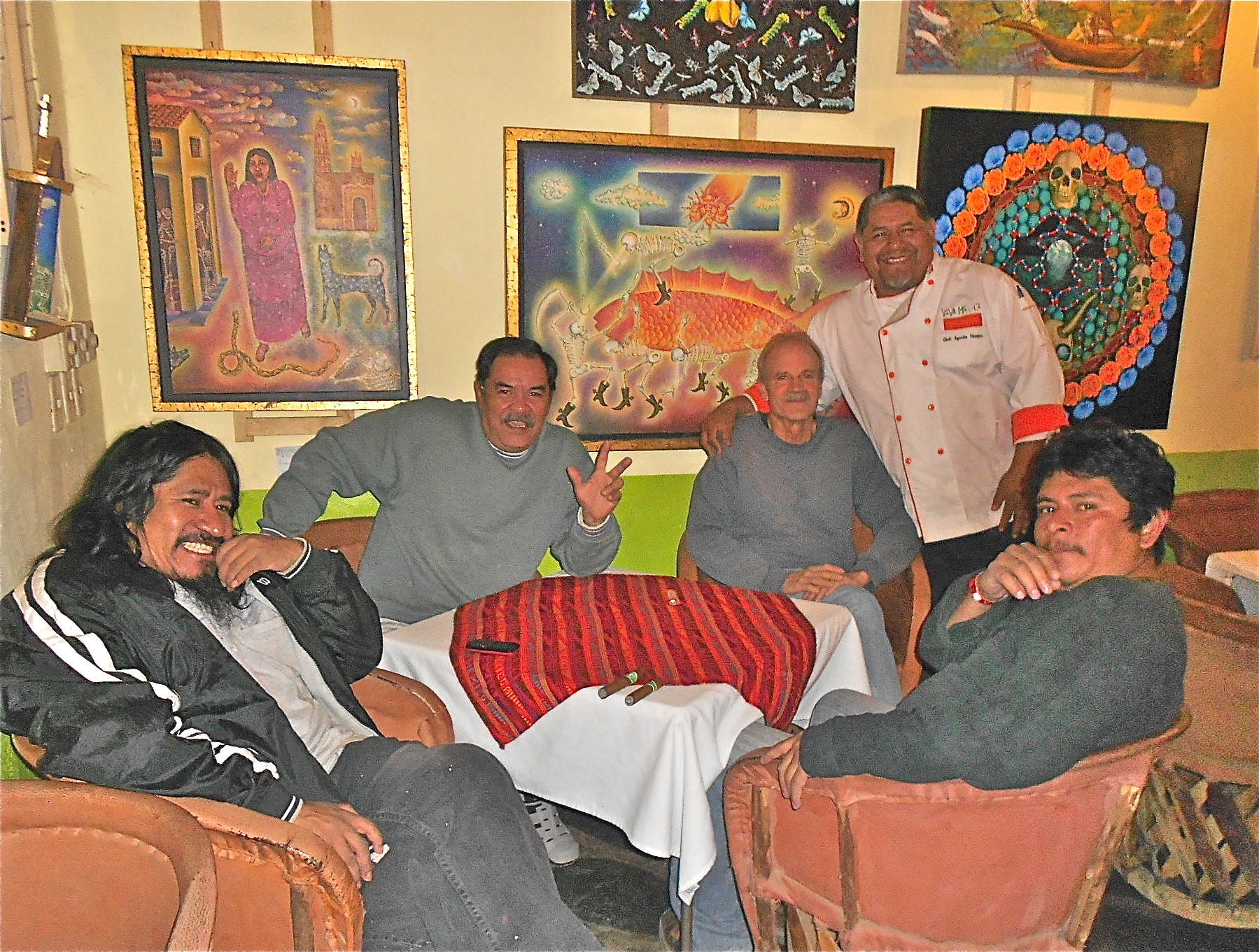
DSCN1336Agustin greets Isidro Xilonzochitl and other artists and friends who are regulars at Viva Mexico.

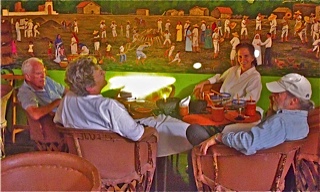
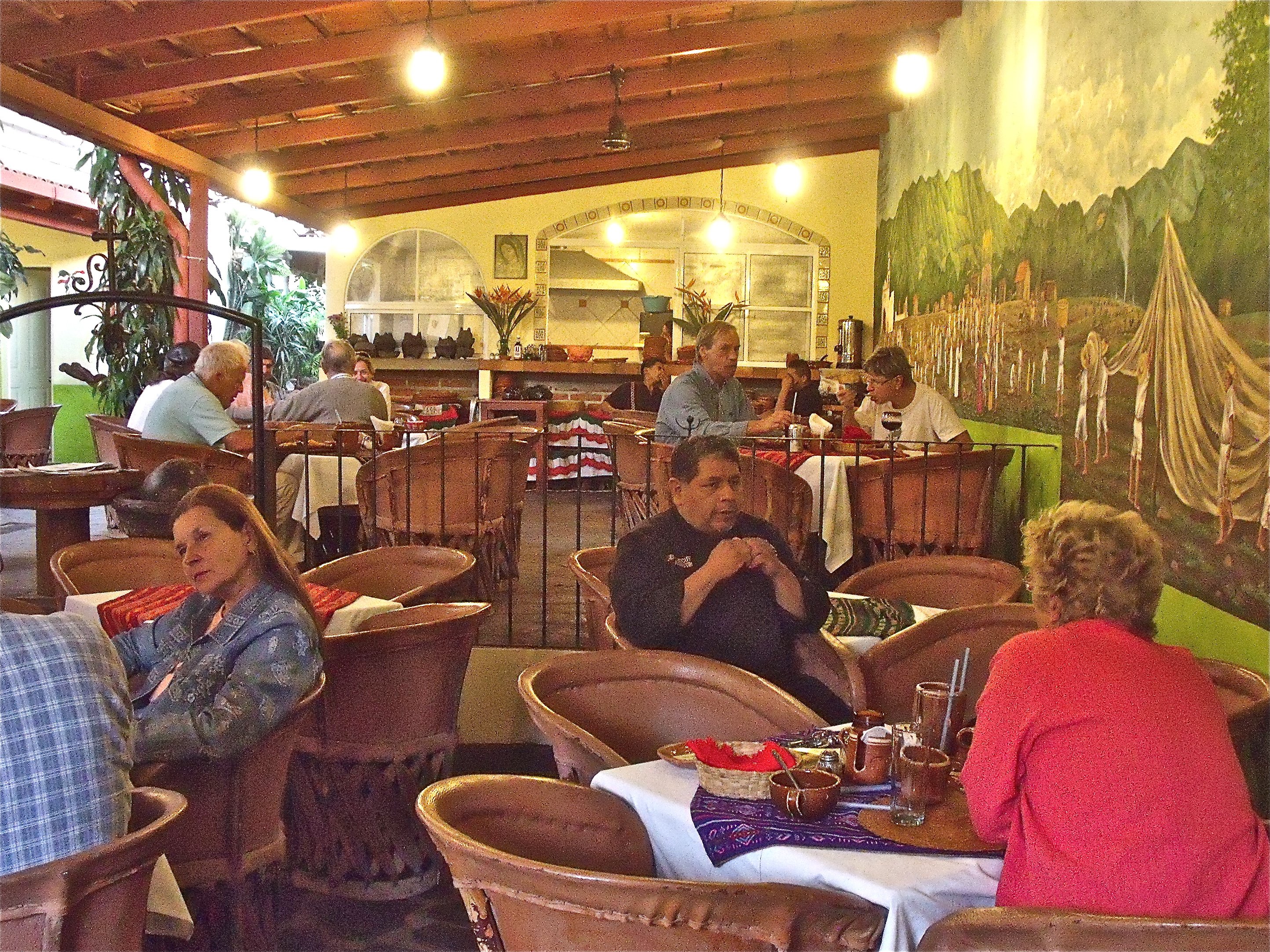
Now, ten years later, Agustin has added a beautiful stone floor, screened in the kitchen, added ceiling fans, colorful tablecloths and equipale chairs, purchased all new appliances and kitchen equipment, new bathrooms and a bar where local artists continue to meet most nights. If they are a bit short of money to pay for meals, it is fairly certain that they’ll be served a meal anyway. The walls reflect his support of local artists. Floor to ceiling on all sides, they are covered with their framed paintings, except for the east wall, which is entirely covered by a mural by Isidro Xilonzochitl. It depicts San Juan Cosalá as it was hundreds of years ago. “These guys—these artists and writers and musicians—have to be supported,” Agustin told me recently, “They are part of our community, as you, who live here also, are part of it.”

That statement forms the crux of the magic of a place like Agustin’s. It really is the place that binds us all—Mexican and expats—together. This first started to happen on September 12 of 2007, when weeks of rain were followed by a tromba (waterspout) that dumped water into the hills above the Raquet Club and the town, causing a tremendous downrush of water that brought boulders, dirt and everything in its path down the mountainside and into the town. Walls, buildings and roads gave way to the avalanche of water and rock, leaving much of the town devastated.

Agustin, who had recently purchased his aunt’s restaurant, stepped immediately into the fray, feeding the thousand or so displaced residents and relief workers three meals a day. Originally paying for the food out of his own pocket, he was eventually given food and aid by other residents, both Anglo and Mexican; and this is how the Mexican and Anglo communities were given a chance to mingle and get to know each other on a more intimate level. When I volunteered, Agustin first gave me a broom to sweep the dirt floor. By the end of the week, I was stirring huge pots of beef and waiting on tables as his restaurant filled three times a day.

The work was exhausting as Agustin and eventually, 25 volunteers, most of them family members, worked to provide three meals a day. By the end of ten days, this amounted to over 3,000 meals! By the time he had persuaded local politicians to take over this task, in addition to losing out on almost two weeks of income, Agustin was so in debt for supplies he had bought out of his own pocket that for two months, he questioned his ability to reopen the restaurant. Most of his knives, forks and salt and pepper shakers had been thoughtlessly carried away with carry-out meals. Teary-eyed, Agustin told me about local neighbors, poor themselves, who heard of his plight and offered him hands full of change to try to help, but in the end, he was still $75,000 pesos in debt.

With three sons and a wife to support, Agustin could not afford to take more of a break than was absolutely necessary, so mustering his courage, he somehow found the means to again open the restaurant which four years later has become the heart of the community.

Unknown
Any night of the week that you venture into Viva Mexico, you are likely to encounter one of these “regulars.”

What factors go together to create these great qualities of entrepreneurism, courage, generosity and artistic sensibility in a man? Knowing a bit more about Agustin’s history might give us a clue. When he was born in San Juan Cosalá in 1966, the midwife told Agustin’s mother that this child was different and special, that he would bring luck to his family and all around him. When I asked Agustin what quality the midwife had noticed, he did not know, but later when we talked again, I asked him if he had been born with a caul over his head, as this is the traditional sign world-wide that a child is destined to greater things.  When I described what this meant, Agustin nodded his head in agreement.  This is how the midwife had described it, but he had never known the term for it.

When Agustin was born, his father went to the United States to find work to support his family. At that time, Agustin was the fourth child but the first son born into a family that would eventually grow to five brothers, five sisters. Agustin himself began work at the age of six, cutting firewood or helping his grandpa with his fisherman’s nets after school. “My mother, she always pushed us to go to school,” said Agustin. “She could not read or write herself, but she was always encouraging me to look for another way to live. ‘I don’t want you to be like me,’ she said. Now I say the same thing to my sons.”

“I was a troublemaker in secondaria,” Agustin confessed to me, “because I always questioned the priest, wanting to know more.” Agustin credits Padre Adalberto Macias with changing the town through education. “He didn’t want me there, though, because all those questions were a disruption,” admits Agustin. Ironically, Agustin is now the man who drives to the Abastos (wholesale market) in Guadalajara each month to procure food and deliver it to Casa de Ninos y Jovenes, the residential school for disadvantaged youth run by Padre Adalberto.

In July of 1978, at the age of twelve, Agustin went north to the U.S. for the first time. His father put him in school in Lompoc, California for three or four months, but as one of only four Mexicans in the school, he was not treated well and he begged to be sent back to Mexico. Sadly, although he did manage to complete secondaria (tenth grade), there was no money to send him to preparatorio. Instead, at the age of 14, he quit school to blast rock at the Piedra Barrenada, the stone cliff north of the fish restaurants on the carretera (highway) east of San Juan Cosalá. “On Saturday and Sunday, I worked as a waiter,” Agustin told me.
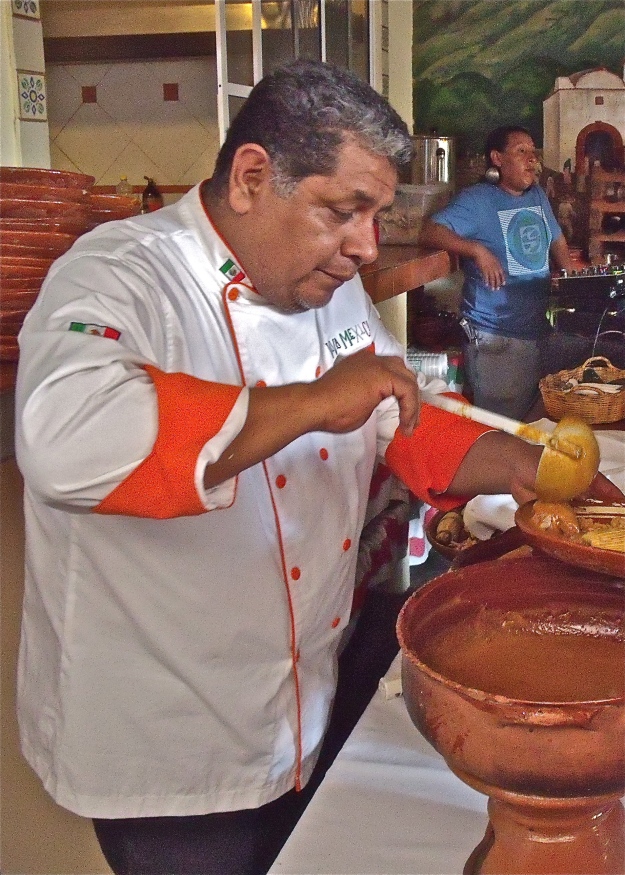
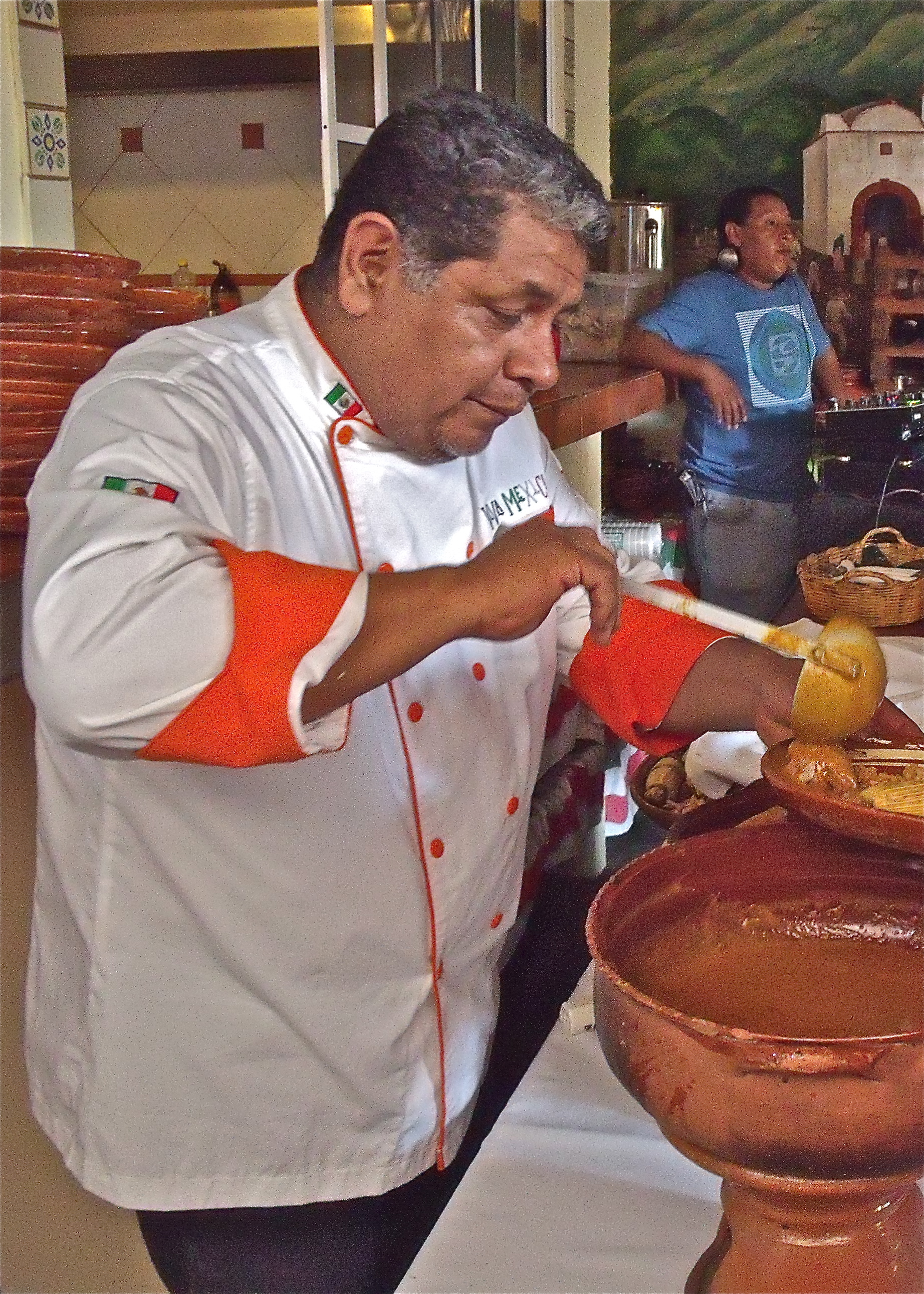
DSCF8508When Agustin accepted his first job as a waiter, did he ever dream that one day he would be serving customers in his own restaurant, wearing a designer chef’s coat that was the gift of a customer?

“I worked many jobs. I cut chayote plants and corn with my family. For one year I was a carpenter with my cousin. When a company came to export chayote to the United States, they made me manager at the age of 15, even though I was the youngest. I don’t know why. Next, I was a waiter at the balneario (hot mineral water spa) until I went to the states with my brother in 1984.”

It was his mother who had intended to go north to find his father, whom they had not seen for three years. She had heard rumors that he was very ill and living in Tijuana, but how could she leave with so many children to cook for, she asked, and begged him to go in her place. He lived for one month in the streets of Tijuana, looking for his father. When he found him, his father was in a hospital, having just undergone surgery. Once he recovered, they had no money to return home, so they went to the U.S. where this time, Agustin worked in the fields with his father for one year. “Cities on the borderline are horrible,” he told me. “They are so sad. Many people from different countries with no money to leave. So sad.” After one year of working in the states, he came back to Mexico to work in construction.

He went back one more time to the States, to get his ailing father so he could die in Mexico. When his father died in 1989, as the oldest son, Agustin inherited responsibility for the family he had been helping to support for most of his life. “My father was a generous man,” Agustin told me, “who would give his shirt if people liked it. When I was a young boy, my uncle, who remained in San Juan, had a pool hall. It was a long time before I knew that my father had given him the pool tables, and that the nets my grandfather used as a fisherman were actually my father’s nets. He was a nice man, my father, but he had to go to the states to support his family. He went to the states when I was born and worked there until I was twenty years old, when he came home to die.”

In 1990, Agustin married Antonia, a local beauty queen. “I saw her at a dance,” he said, and chuckled guiltily as he added, “She was with my friend, but when I saw her, I just had to ask her to dance, and so I took her away from him. My mother didn’t want me to get married, wanted me to wait. I was already feeding ten people in my family, but I wanted to get married, and so I did.
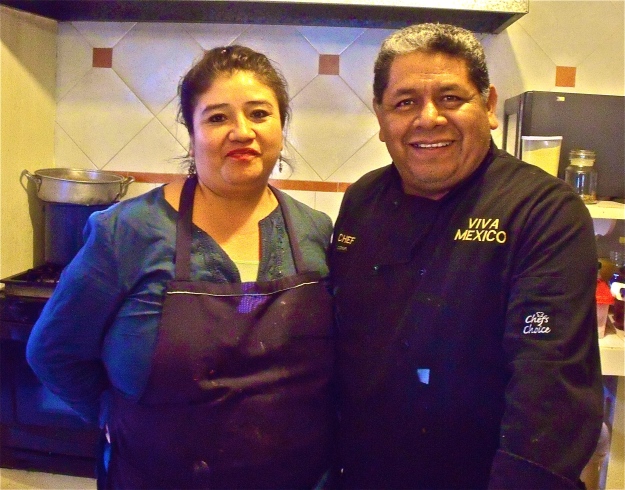
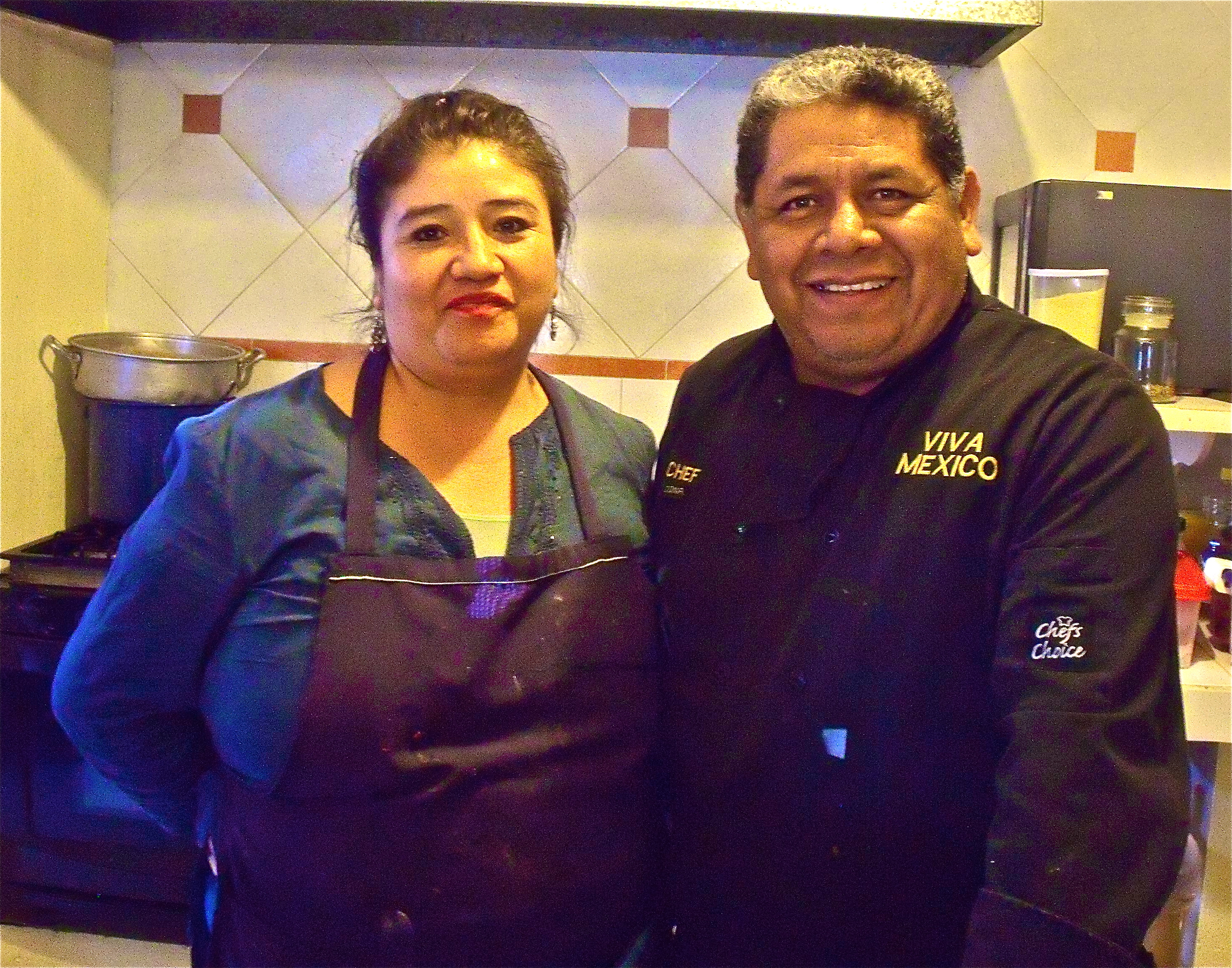
DSCF8364Twenty-two years later, Antonia and Agustin share cooking duties in their newly refurbished kitchen.

I was intrigued over how a young man with a wife and ten other dependents was ever able to become the self-educated, well-read community-minded restaurateur that Agustin is. “How did you ever manage to get where you are today?” I asked, and Agustin, a natural-born storyteller, pulled up a chair to the table where I sat over my molcajete and resumed his tale.

“I got a job at a restaurant in Ajijic that was run by a couple from San Francisco. They had three restaurants: in Los Cabos, Puerto Vallarta and here. The woman was very tough, but nice, and I learned a lot from her. For one thing, I learned to focus. Four people together couldn’t compare to her chopping. While I was there, they taught me how to cook and to flambé. They helped me to be in contact with people. First I replaced the chief of waiters when he was gone, and after that I was the replacement for the bartender, waiter and cook. At that place I learned everything, but after one year, I had to quit. The cold and hot probably hurt my hands, because I started to get their kind of bones–the kind that grow (arthritis.)”

“When I went to apply for a job at Mama Chuy (a resort hotel near San Juan Cosalá) my wife was pregnant with our first son. I had to have a job, so I feigned experience. When they asked me if I knew English, I said yes. When they asked me how old I was, I said 28 or 29, but I was really 23. Everything they asked me, I said I knew how to do—except for maintaining the pools. ‘No, I said, but I can learn.’ When they asked me how much I wanted to be paid, I said, ‘Whatever you want to pay me,’ and I was hired on probation.”

“I worked there for five years and learned to speak English. I learned a lot at Mama Chuy’s. My first day, a guy from Massachusetts who was a guest there asked me if I wanted to learn English. When I said okay, he told me to be there tomorrow at six. That first day, he gave me the book Aztec by Gary Jennings and told me to read 20 or 30 pages. It was in Spanish, and that night I told my wife that for me it was an insult for him to give me this kind of book. But my wife told me to do what he told me.”

“When I saw him the next day, he asked if I had read the book and I said yes, but when he questioned me, he knew I hadn’t. Then he explained why he gave me the book. ‘The first thing you have to know is who you are,’ he said, ‘This book will teach you your own history.’ That was when I learned that you should never say ‘can’t.’ What you want, you have to go for. From that man, I learned everyday English. All the people at Mama Chuy helped me. In the five years I was there, I learned so many things. That man was a snowbird who came back every year and he taught me so many things. We became good friends. He 88 years old now…and in the states with Alzheimer’s.”

“During this time and afterwards, I taught English to 400 to 500 people from San Juan: gardeners, maids, taxi drivers, and students. This made me feel okay. I taught them for free or for one peso per class to buy diapers for my sons. Afterwards, I went to one or two schools to teach as well.
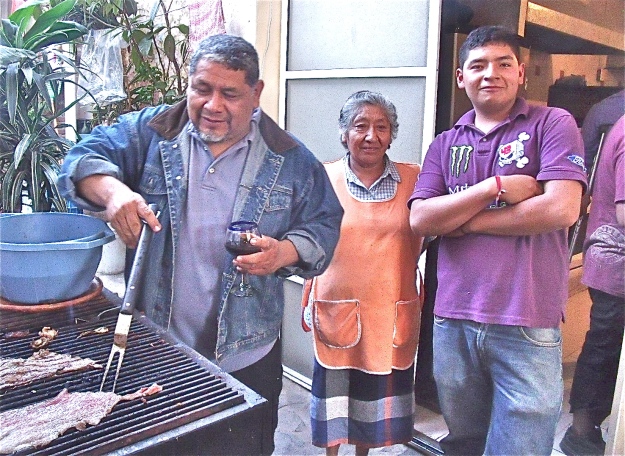
DSCF8754Three generations work together at Viva Mexico: Agustin, his Tia Lupita and his sons.

In the years to come, Agustin expanded his already extensive resume. First he became a contractor. “The best guys in town work for me,” he told me. “Just 5 guys. I don’t need more. They have worked for me for 18 years, whenever I need them.” When I asked him how he obtained his contracting experience, he admitted that here, too, he was self-educated. “I knew it in my dreams how to do it,” he confided. I was reminded of my recent trip to see Frank Lloyd Wright’s home and studio near Scottsdale, Arizona, where I had discovered that the same was true of Wright, who never had any formal architectural training.

“Trains pass by on a regular basis and I jumped on every one to see where it would take me.” said Agustin, referring to his ability to seize any available chance to self-educate. “The train, it doesn’t stop. You have to jump, run a little bit and get into the train.”

Other years were spent as a real estate broker. When he first was hired to work at Laguna Real Estate, he had no car, so he bought one. It was very hard, he said, because most of the customers were American and Canadian, so they preferred to work with the American and Canadian agents. He took classes in English, which were hard—a different level of English than he had learned formerly. In the first week, he sold a house, but received no commission.

For the next six or seven months, he sold no other houses and was ready to quit. The owner of the agency persuaded him to finish out the week. He made many phone calls, and ended up selling $2 million dollars US in two weeks. He worked there for five years, then changed agencies to work with another Mexican broker. “We took the leftovers,” he said, “the houses that didn’t cost so much, that the other brokers didn’t want; and we ended up doing six to seven closings a month.”

“If someone comes and offers me something, I will learn. Life is simple. We complicate our lives by wanting to have our own way. Like a bull. If you let him go, you can follow where he wants to go and it is easy to hold onto the bull. But if you pull, it’s not easy.”

When I asked him what his goals are for his sons, he answered, “Goals. I know my son’s life is not my life. I know it is his life. My first son is almost finished with University and will be an agricultural engineer, the second is in technical school to be a pilot and will be safe. The third (who quit school last year to support his girlfriend and baby, but who intends to go back to school next year) needs a push. This restaurant is for me, not necessarily for them. They need to find their own way. The people who work for me, I always try to help them as well.”

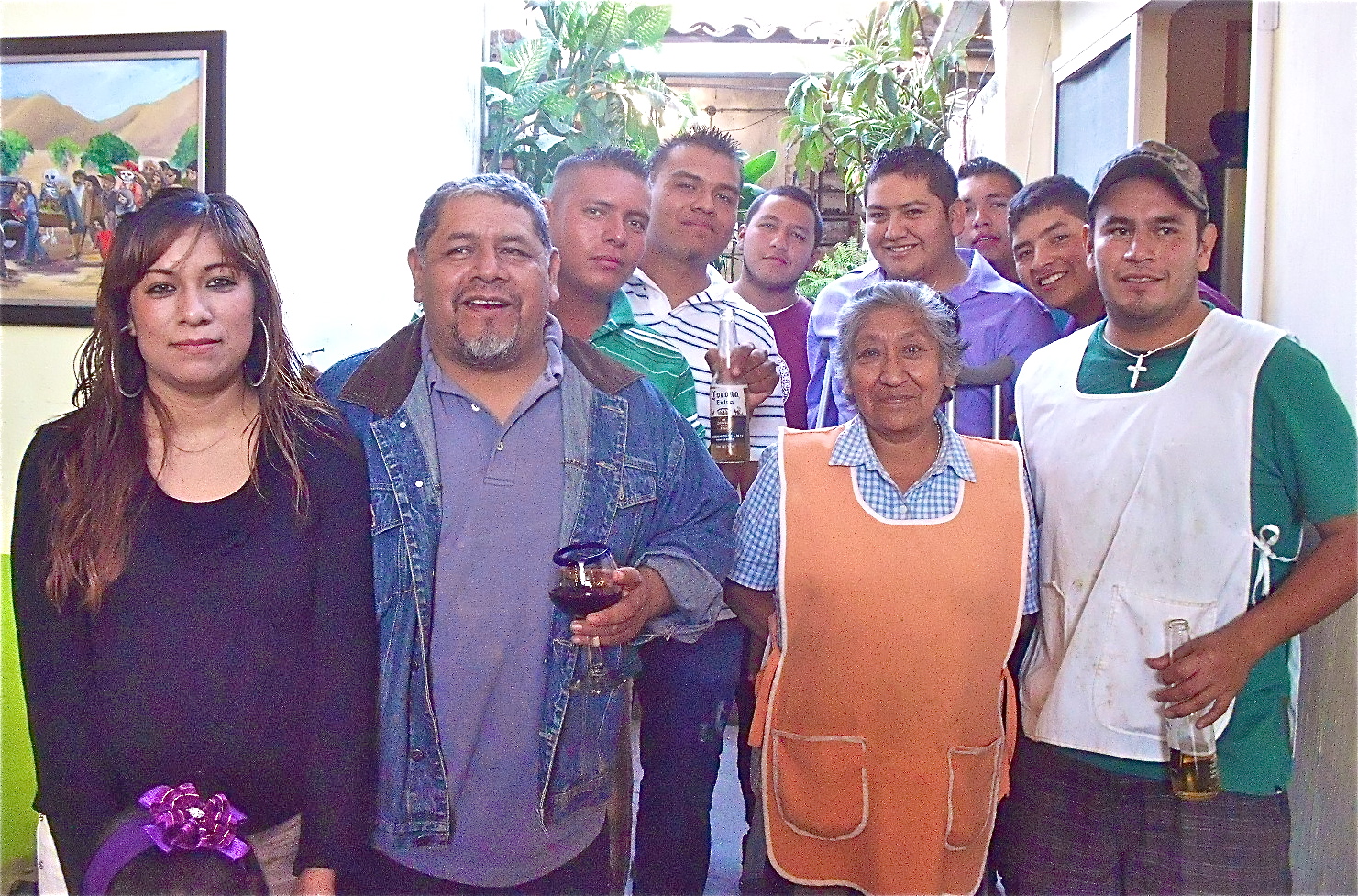
DSCF8757Agustin, his Tia Lupita and other members of his staff display their usual smiles.

“What is left in life for you?” I ask him, and he answers, “Travel. If I had only myself to worry about, I would travel. People who travel live twice in their minds. Instead, I read, for people who read travel in their minds. Outside of his three trips to the U.S., what traveling he has done is in Mexico—every state except Chihuahua, Veracruz or Chiapas.

I know from an American friend who has had much advice from Agustin about what books to read, that Agustin is widely and well-read. When I ask him his favorite authors, he says, “I’d have many of those. Gabriel Garcia Marquez, Octavio Paz, Juan Rulfo? Why not?”

When Ninos y Jovenes asked him to take over the purchasing  of food and supplies for their residence school for disadvantaged children, his answer was yes, and he added this monthly task to his weekly trips to Guadalajara to buy food for Operation Feed. When Earl Smithburg, the former director of Operation Feed, died, Agustin provided the buses to transport people to his funeral.

When I asked him to drive me into some of the areas worst hit by the tromba for a follow-up story two years later, the answer was yes. When I asked his construction company to repair my roof, the answer was yes, and I don’t believe I ever received a final bill. I’ve asked about this countless times, and he never quite remembers what the amount is that I owe him.

He has amazing skills: carpenter, mason, real estate broker, resort manager, construction design, construction manager, restaurateur and chef. In addition to this, he is an outstanding family man, father, neighbor and friend. It came as no surprise to me at all that when I asked him if he’d ever had his IQ tested that he said yes. With prodding, I got him to confess that his IQ was 144—genius level.

In closing, I’d like to quote just a few of the statements that people made when I asked them their impressions of Agustin:

“Agustin consistently puts his personal needs behind the needs of others. He always thinks of others first when making decisions that will impact those around him.”

“Agustin recommended this incredible reading list for me. He is a self-taught scholar. He was a big reason why I stayed in Mexico. He has a heart that includes absolutely everyone.”

DSCF7754Agustin takes time out to talk with one of his regulars; and yes, they were talking about books.

“He is the most unselfish man you will ever meet. He will give of himself by whatever means he has without thinking about the personal sacrifices that giving will cause.”

“He is a very trusting individual. If you pledge trust in return, you will enjoy a level of personal friendship that is truly without borders.”

“He is probably one of the last breeds of good old Mexican folk who grabs on to the land and to the culture of a bleeding patria (native land).”

“Humble and slow like an old dog who has been left the hard task of looking out to all those who depend on him and think of him as the ultimate guardian.”

“An absolute perfect host. He greets each person in his restaurant. If he is cooking at the time, he will wait until you are eating or afterwards, and then come up to your table, stand and talk for awhile, or if it’s a slow night, pull up a chair and talk to you.

“Multi-talented, really smart, Renaissance man. Genuinely cares about people. No haughtiness or pretense.”

“He has gotten to where he is by being absolutely nonpolitical. Everything he does, he does out of the goodness of his own heart, without a thought of his own gain. The help he furnished during the landslide was not for political reasons or anything other than that’s the kind of guy he is.”

“Agustin is an artist at work. He goes to the food sellers and warehouses for the charities he buys food for and he beats them down so badly on the prices that they aren’t making a whole lot of money.”

Energetic, generous, personable, devoted father, teacher, philanthropist, self-taught pillar of his family and community, a man with a heart of gold who goes out of his way to help others, Agustin Vasquez Calvario is a living testament to the truth that one person can make a difference.

(Viva Mexico is located two blocks west of the San Juan Cosalá Plaza at Porfirio Diaz #92. Call 387-761-1058 for directions or reservations.)

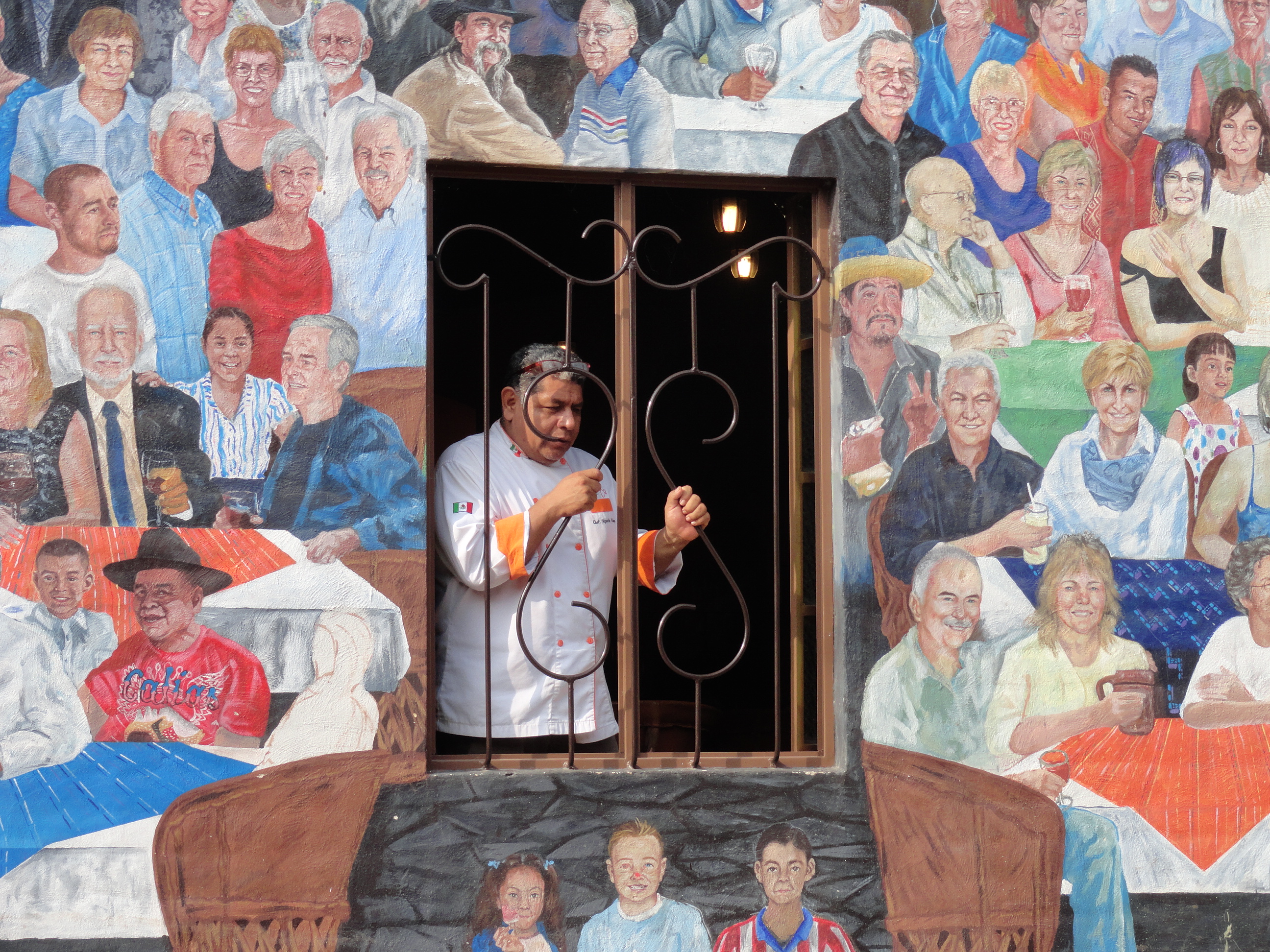
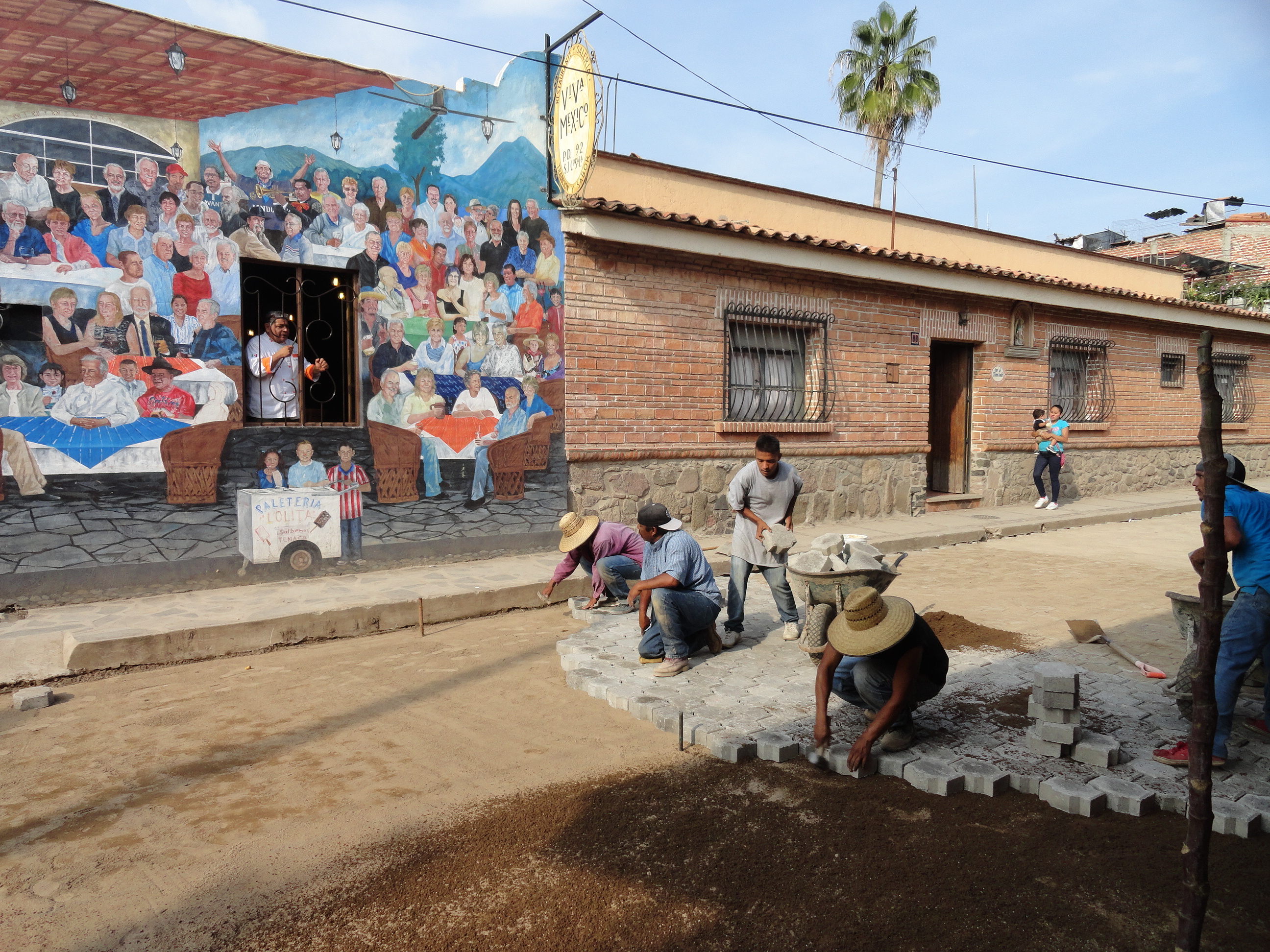
Judy’s note: This article was written a few years ago for an online magazine that is no more.  In the years since then, Agustin has created a huge gourmet kitchen and  doubled the size of his restaurant. The same artist who painted the mural inside has covered the outside of the restaurant with a huge mural that depicts the inside of the restaurant with every table filled with Agustin’s regular customers depicted.  I’m at a table in the front row with my best friends around me.  Sadly, I am the only one who still lives in Mexico.

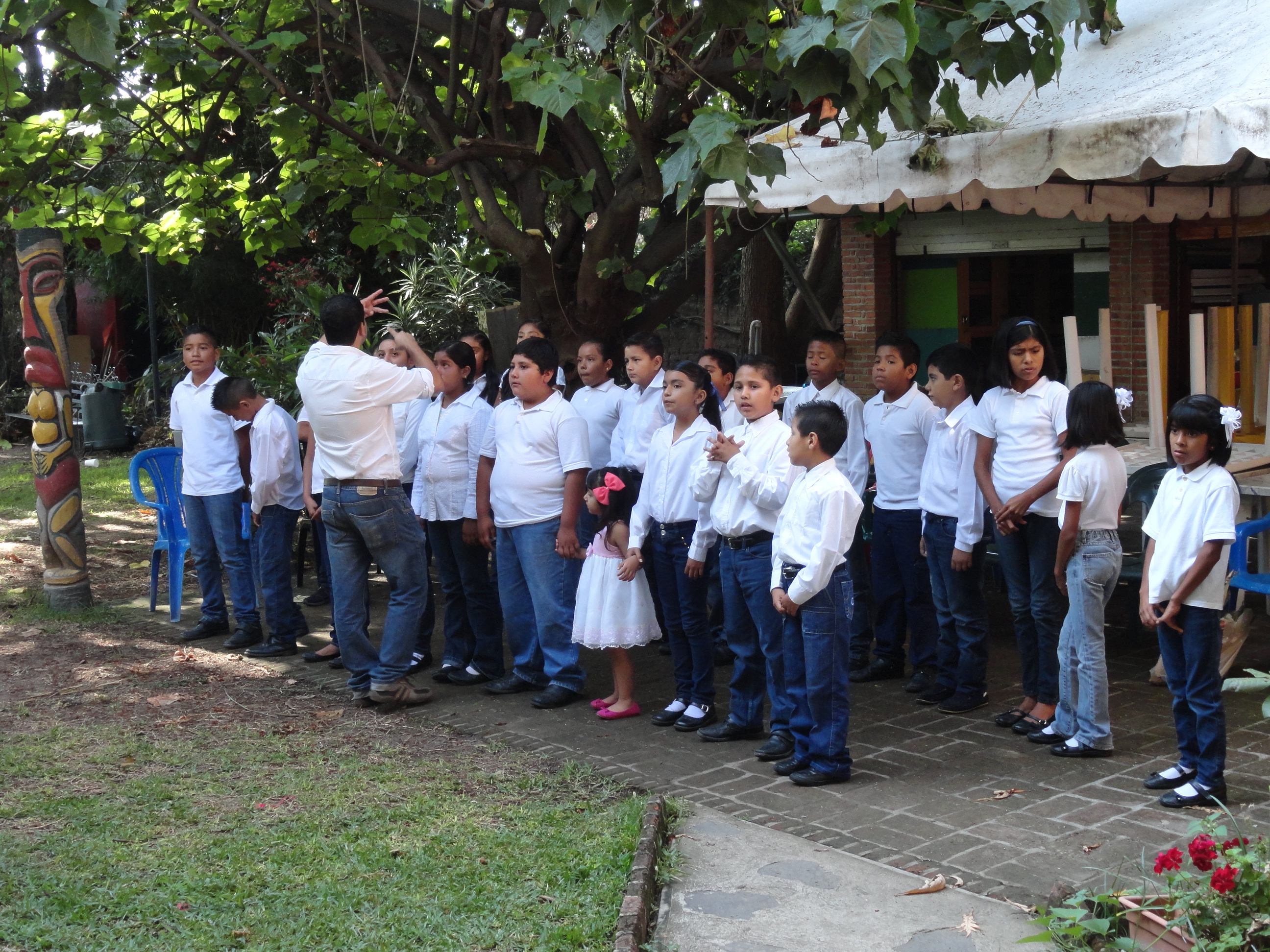
Agustin has had many health challenges that have forced him to slow down and allow others to share some of the responsibilities he has always assumed.  Although he has more helpers, new projects continue.  He teaches English to Mexican adults and children, a children’s chorus now meets in the new half of his restaurant that only opens on weekends. A children’s orchestra has been started with instruments provided by solicitation of locals supportive of Agustin’s continuing schemes to give the youth of San Juan Cosala something to do more interesting than drugs and alcohol.

DSC07577 San Juan Cosala Children’s Choir.  That’s Agustin’s granddaughter with the pink hair ribbon!

Twice a year, clothes are handed out here to the pueblo’s poorest and every week, food is dispensed to the 100 poorest families.  Meat, vegetables and fruit have been added to the rations which formerly included only dry foodstuffs and oil. Things change and change as things do, but one thing that never changes is that Viva Mexico remains the heart of the community:  both expat and Mexican.

DSC08075 DSC08074Changes continue as the real Agustin, customers and friends  all seem to be supervising the installation of new pavers that replace the former cobblestones of the road leading from the plaza to Viva Mexico.

UPDATE NOV. 29, 2016: We celebrated Agustin’s 50th birthday at Viva Mexico last night. See the story and photos in a new post HERE.

Dia de Los Muertos, 2014

Dia de los Muertos, 2014

DSC08847

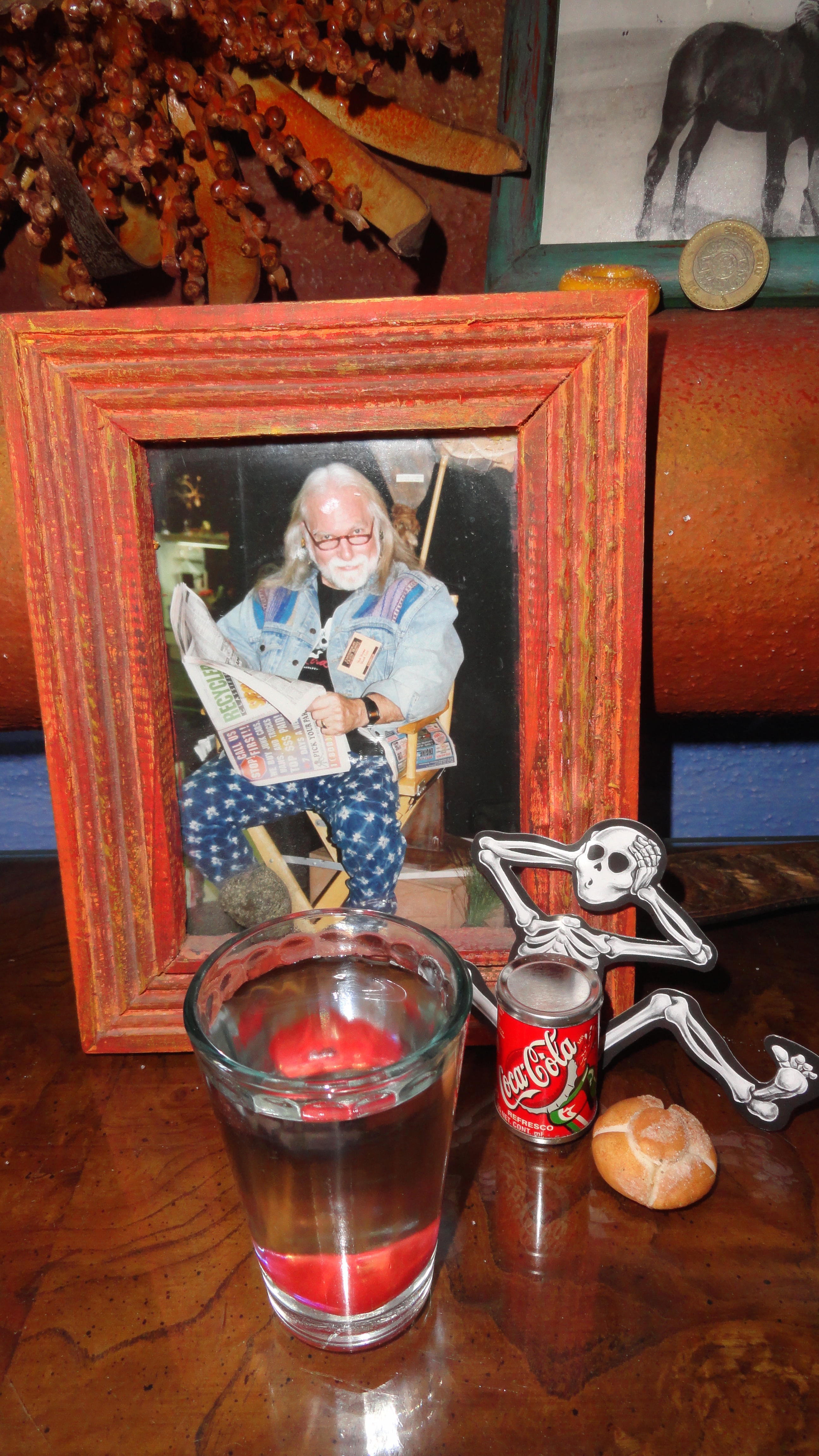
This is this year’s minimalist altar for my departed: husband Bob, Mother Pat and Father Ben. I wasn’t going to do one. Then Yolanda (my housekeeper) told me about a friend who didn’t  make a Dia de los Muertos altar for her mother who had recently died. This friend then went to see the elaborate offerings of her brothers and sisters, so she brought a rather poor specimen of a pumpkin and told them they could put that on her mother’s grave. That night she had a dream of walking through the graveyard. Every other grave was elaborately decorated with flowers and sweetly-scented candles and favorite foods of the departed: water, whiskey, tequila. When she got to her mother’s grave, there was no light and there were no offerings—only the one poor pumpkin. As she walked by, people shook their heads, and she left in shame. When she woke up, she went to her mother’s grave and took her fresh water, a candle, sweets, and all of the things her mother loved.

DSC08856

It worked.  I assembled an altar. Yolanda looked at it and told another story about how the water and candle help to create a breeze that brings the scent of the favorite foods to the departed. I quickly added a candle and a small glass of water with an ice cube—as Bob did hate a lukewarm Coke! When the ice cube melted, I added a small red heart to take its place. If you look closely, you can see it in the bottom of the glass.

DSC08852

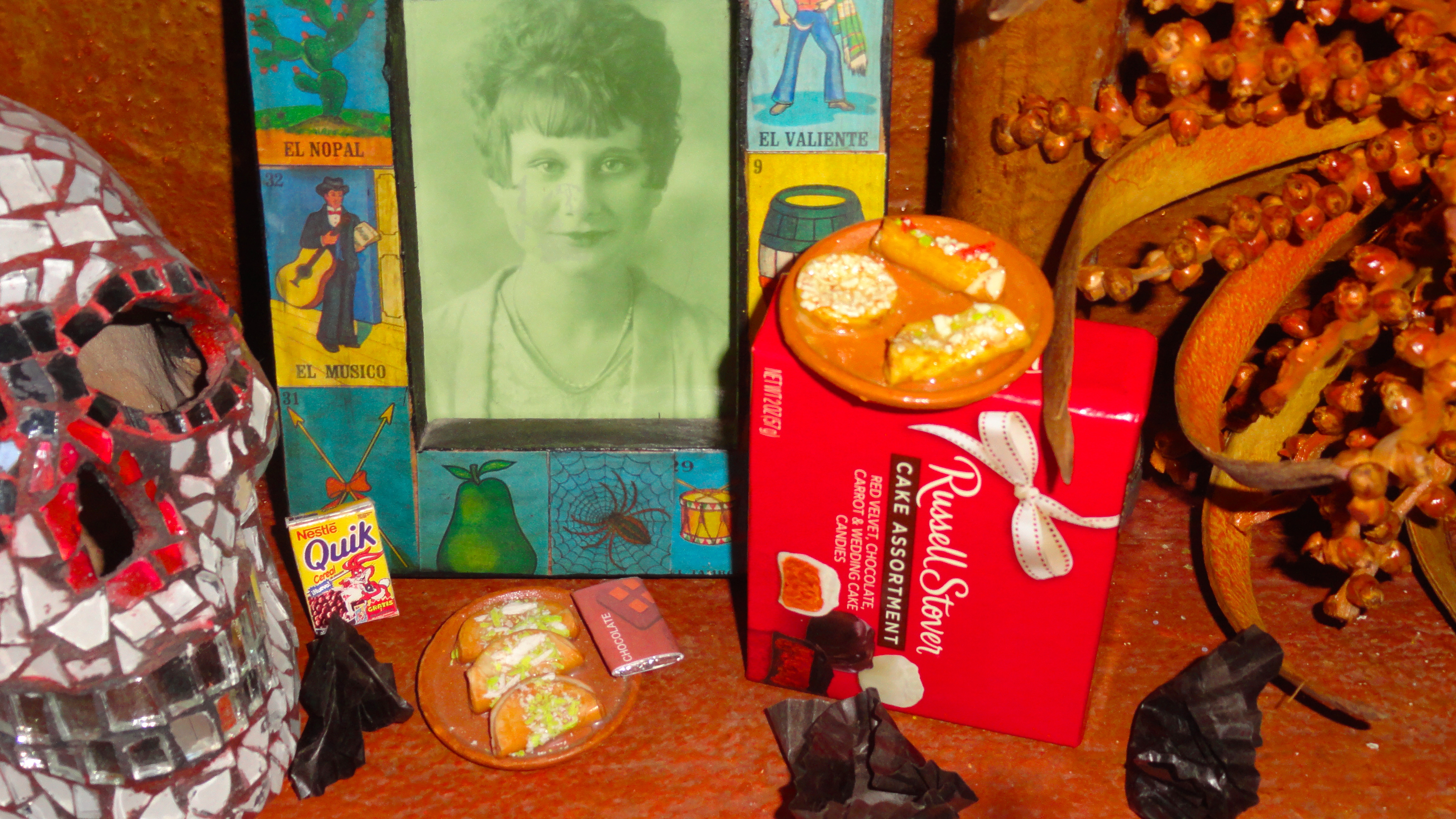
It was my mother’s tradition to tuck a small box of Russell Stover candy into each of our Xmas stockings. One Xmas, we opened them to find only wrappers in each one. Over the course of the weeks before Xmas, our mother had opened each one, unable to resist eating the chocolates. So precedent decreed that I eat hers. You’ll see the empty papers littering the space around the box. (Yolanda, ever-respectful of tradition, helped by eating one piece.)

DSC08849

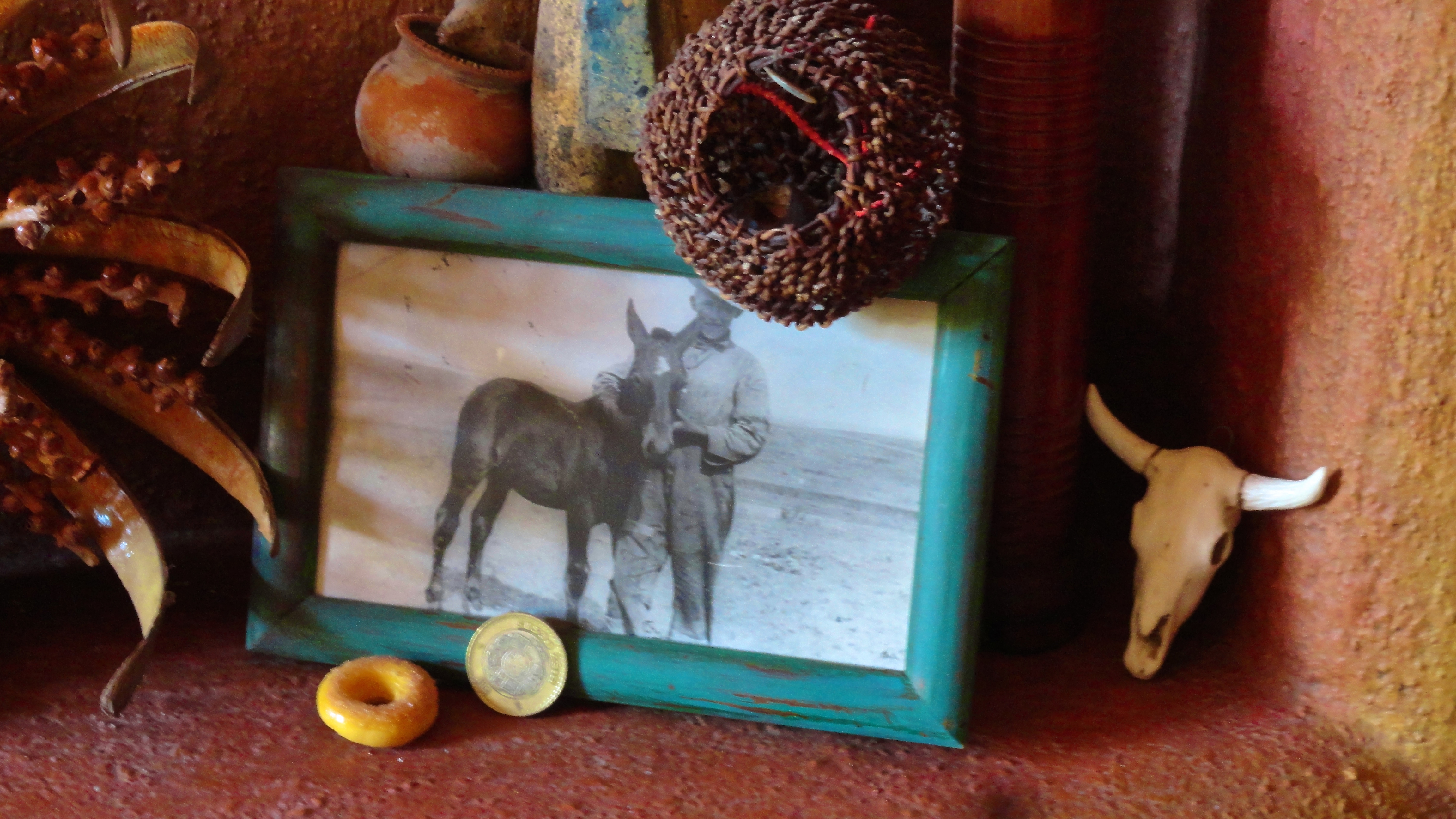
Although my father raised black Angus and Hereford cattle, this is Mexico, after all, so I think he’d forgive the long horns. A donut and a 10 peso piece complete his offerings. Last year I put a small glass of milk with cornbread crushed in it—his favorite cocktail. But this year the ants have taken over our part of Mexico, so I didn’t dare.

I’ll Have to Go

The Prompt: Finite Ceatures—At what age did you realize you were not immortal? How did you react to that discovery?

I’ll Have to Go

This journey of our lifetime is a one-way ride.
I realized the truth of this the day my father died.
But in the living of it, I forgot again—
concentrating on the present and where I had been
instead of thinking of the future and mortality.
There’s something in a busy life that sets the spirit free,
convincing us that we’re immortal. That we’ll always be.

The many times that I was made to see I might have died:
the time I was abducted and taken for a ride,
the time he held the gun up to my head and pulled the trigger,
as I fell to the street, somehow my life seemed to get bigger;
and I saw all of it at once, spread out there below me,
and somehow though I wasn’t dead, I felt that I was free,
and for awhile, I found it was enough to simply be.

There have been other times when death has had me in its clench:
the time not long ago when that limb missed me by an inch,
the time I nearly drowned when I knew I was gone for sure,
yet somehow, death rejected me—released me from its lure.
It’s just at night when I’m alone that all comes tumbling back
and I begin to calculate all that my life might lack,
and life becomes a tempting peddler opening his pack.

The places never visited, the loves I let pass by,
and all the other things I thought to do before I die
all tumble out to tempt me and I think perhaps I still
have some things to do before I climb that final hill.
I think, perhaps, there’s one more love. One journey yet or two.
So many things that I have left I always thought I’d do.
So I am getting ready—only waiting for my cue.

That’s why at night I lie awake, sometimes remembering.
At other times just wondering what this next year will bring.
If I am lucky, I have thirty years or more till death
takes away these memories and stills my final breath.
Until then, I’ll live life fully and go where I must go.
I’ll follow my own pathway and ignore the status quo.
Instead of drifting lazily, I’ll row and row and row!

Mommy Think

daily life  color018daily life  color018 - Version 3

The Prompt: Reverse Shot—What’s your earliest memory involving another person? Recreate the scene — from the other person’s perspective.

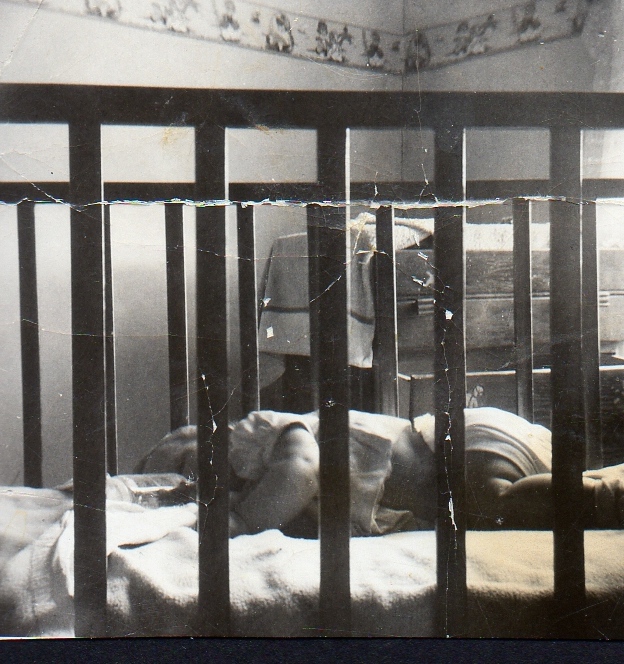
My earliest memory is waking up in my crib and making a noise to let my mom know I was awake and then watching her walk in with a big grin.  I remember very clearly thinking how delighted she was to see me and how anxious she must have been for me to wake up!  Ha!

Mommy Think

I can hear the baby stirring, but she’s quiet for now.  I guess I’ll try to finish the Daily Crossword before going in to see if she’s really ready to get up from her nap.  If she’s wet or restless, she always lets me know—the same gurgle as usual, but a bit louder, to make sure I notice.

The divan I’m lying on is so close to the open door to her room that there’s no chance I won’t hear her if she really needs me.  Hmmmmm. A Hawaiian goose.  I’ve seen that a dozen times.  Nene, I think.

Oh, Oh.  There’s that little singing purr.  She’s ready.  So much for the puzzle for a little while, until I get her changed, liquified and busy with her toys in her playpen.

There she is.  So adorable, peeking out from between the bars of her crib.  I can see her eyes dilate when she sees me, one chubby little arm reaching through the bars,  hand out, fingers spread.  Waving hello like her sisters taught her.  Face open in the biggest grin to see her mom.  It’s like looking in a mirror.  I can feel that same grin stretching my own cheeks.  I can’t believe I’ve created this sweet girl.  Me, the laziest woman on earth—I made this!

She’s gotten heavier and OUCH! those little fingernails need trimming.  She wraps her chubby legs around me like a vise.  Fat little toes for gobbling as I change her diaper.  That strange arrow birthmark pointing straight down and filling the vee between her legs like a direction signal. So strange.  My first child to have marks of any kind–the small port wine stain on her neck, and this larger brown birthmark in such an odd place. So glad this big one will never really show that much so long as she has any clothes on at all.

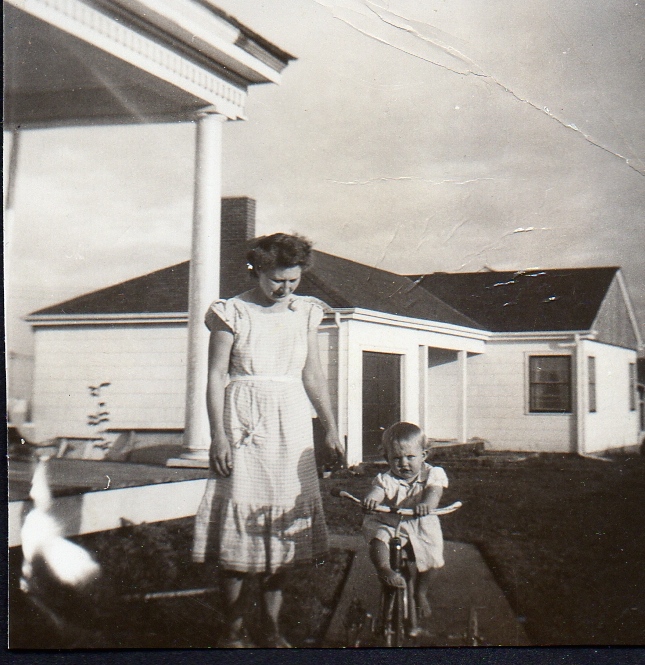
She’s perfect, so far as anyone else knows.   I’ll put her with a cookie and orange juice in her bottle into her playpen and finish my puzzle.  No need to change her clothes.  Her dad will be home soon for his afternoon break and he’ll have her filthy from his field clothes within seconds of entering the house.  They’ll both be asleep within minutes–him in his rocking chair with his feet up on the footstool and the glass of iced tea I’ve brought him sweating on his chair-side table, her stretched out on her tummy on his chest, little cheek pressed against his neck, wheat chaff and field dust on her sleeper and making light depressions on her cheek. I’ve never seen a man who loves babies more.  When we don’t have one of our own, he borrows them from tourists in the restaurant where he meets his friends for coffee in the afternoon.  “Want me to hold your baby for you while you eat?” he says, and they always say yes.  The novelty of the big farmer in the J.C. Penny’s khaki work clothes and the straw hat holding their little city baby?  They just wish they’d brought their camera in.

Hmmm. A South American Country.  Peru? No, that’s just four letters. Chile? There’s Ben’s truck.  Guess I’ll get the baby out of the playpen and have her waiting at the door for him when he comes in!

The Prompt: Reverse Shot—What’s your earliest memory involving another person? Recreate the scene — from the other person’s perspective.

(P.S.This is a pretty unremarkable post for my 300th posting, but I have an eye appointment in an hour so must hurry.  Perhaps I’ll do another post later in the day…It was fun trying to write from my mother’s perspective.  Sorry it had to be so hurried.)

(P.P.S. The eye doctor never showed up, although I waited an hour.  I was sure it said I had an appointment in my calendar.  I must need my eyes examined!)

2017 Note:  It’s been three years since Word Press used the prompt “recreate.” At that time, I used the prompt to make my 300th blog entry.  Now I have penned (or shot) my 3,444th entry, so it seems appropriate to reblog it.  Thanks for reading it—and perhaps for reading it again.


Bali-Bound


daily life color017 daily life color016

Bali-Bound

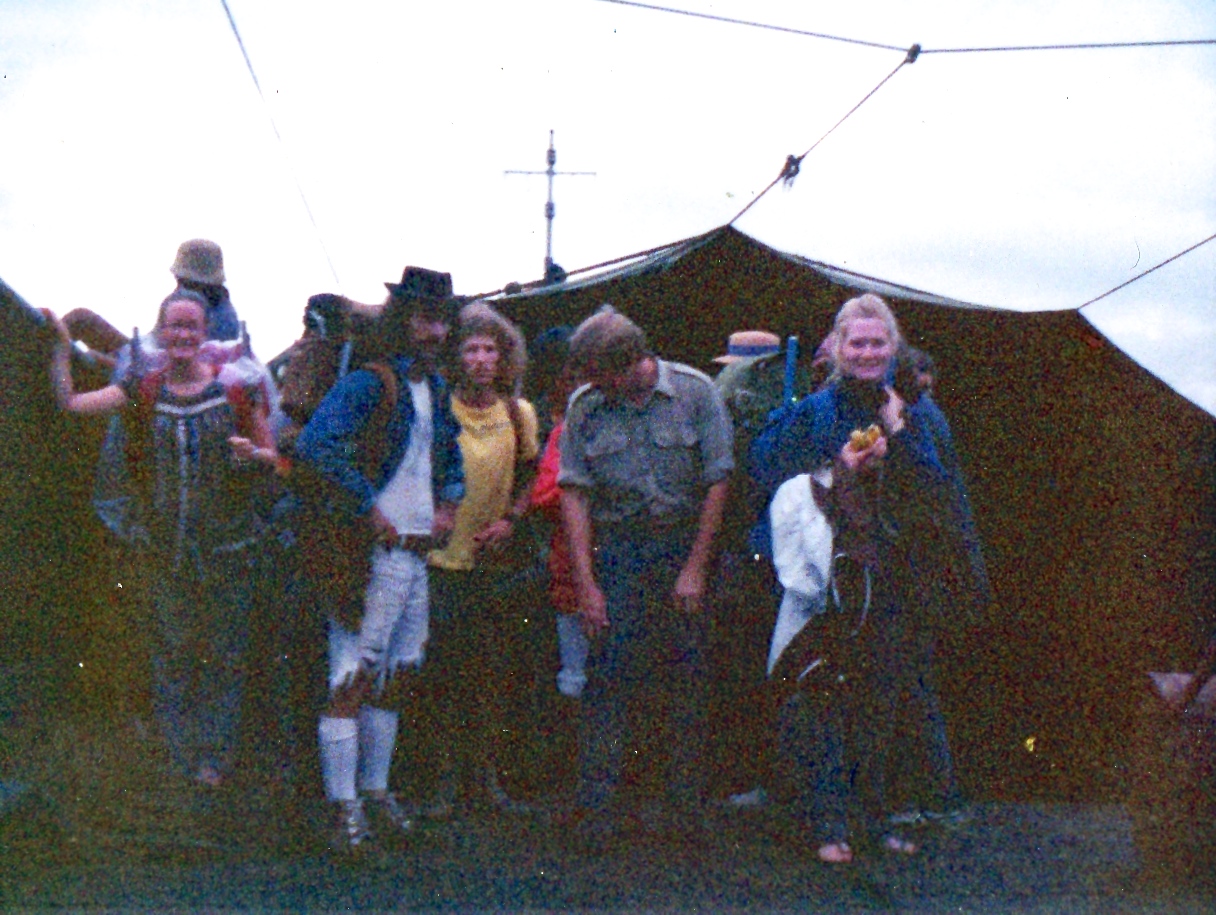
Germans, Aussies, Kiwi, Brit, Dutch, Canadians, Swiss.
I was the lone American who was pulled into this
adventure—just thirteen of us, including them and me
in a tank barge left from WWII, across the Timor Sea.
We did not know that Bugis pirates still set sail out there,
for we were young and reckless, and we didn’t care.
We still felt invulnerable. We would never die.
We all sought our giant chunk of the adventure pie.
We sailed all day and through the night and part of a new day.
Most of the cash that we had left was what we had to pay
to reach the west shore of an Island lashed by monsoon rain.
All bridges and all roads washed out, we searched for rides in vain.
A lonely store stocked not with much—some cans of cheese, two Cokes.
Not adequate provender for such starving, thirsty folks.
We crossed from Portugese Timor onto Indonesian ground.
Although we all had traveler’s checks, there was not much cash found
within our empty pockets, yet to Bali we were bound.
Still an unspoiled paradise—a haven with few cars
or partying Australians or honeymooning stars.

We stopped at one last little hut where I took off my sandals
to ease my feet, and thus were they made off with by some vandals.
And so it was that we set out through jungles vined and rooted,
fording rivers filled with leeches. I, alas, barefooted!
But chivalry was still in vogue and one or two or three
of my fellow travelers shared their boots with me
taking turns at walking barefooted for awhile
as we walked through the jungle, mile after mile.
Till late in the afternoon we came across an inn
(By then my resolution grown dangerously thin!)
Alas, we had no money for dinners and our room,
and here was where the two Swiss guys dispelled our sense of gloom.
They traded the two ten-speed bikes they’d carried or they’d ridden
most of their way around world—and they did it unbidden
by any of us, for we knew those bikes were like their kin;
and yet they gave up both of them for one night in this inn
for all of us, plus dinner—a repast full and rich,
and furthermore, our breakfast and the promise of a hitch
on a truck loaded with grain bags that was headed out tomorrow.
They did this for all of us and did not show their sorrow.
After showers poured from pails, (I noticed, I’d grown thinner)
some of us had a little nap and then a welcome dinner.
And when the Germans both pulled out their guitars for a song,
the sons of our innkeeper brought out theirs and sang along!
We all chipped in to teach the lyrics to Bobby McGee.
Our beds and food cost dearly, but the music was all free.

Next morning, we climbed high upon the grain bags for our ride
while Indonesians hung onto the rear and either side.
That truck looked like a peddler with his wagon piled high,
not with the usual notions, but with humans far and nigh.
We rode along uncomfortably, hour after hour.
No songs for us this long, long day, our mood was turning dour.
When it was nearing dusk, that truck gave one tremendous lurch
that very nearly threw us all from our precarious perch.
The Indonesians climbed on down and vanished all but one,
while the drivers told to us this next stage in our fun.
The axle cleanly broken, they would start out to get aid.
They’d come for us tomorrow—but they wanted to be paid!
We waved them off with promises—just one more awful bungle
and looked around for sleeping spots in this dense, darkening jungle.

We settled on a little hillock clear of trees and vine.
Rolled out all our sleeping bags. On what were we to dine?
One tiny little can of cheese and sardines in a tin
and those two Cokes we’d purchased—our provisions were most thin.
Hans had pellets with him meant for purifying water.
Guys headed out in search of it like lambs led to the slaughter.
The sky was darkening, but I knew I had to go to pee.
I headed down to where the trees afforded privacy,
pulled down my pants and put my hand, to balance, on a tree
when a sudden piercing pain shot from my hand through all of me!
I screamed and all my traveling friends came running down the hill.
I think of all my crises they were soon to have their fill.
I felt as though a burning dart had pierced through my right hand.
Toppled and now hobbled, I was unable to stand.

They helped me pull my pants up, sadly with a still-full bladder
as I heard the Timorese man say that it had been an adder.
I’d die within the hour, there was nothing we could do.
They emptied all their pills out and decided I’d take two
of everything we carried in our pockets and our packs,
for all of us were traveling with a drugstore on our backs.
To wash them down they offered up the ultimate in gifts:
the Cokes that we were hoarding, then they sat with me in shifts.

My finger swelled to such a size that the one ring I wore
cut off circulation until Peter cussed and swore,
“We’ll have to cut it off, so Trevor come here with your knife.
We have to cut if off of her to try to save her life.”
They put my hand upon a rock, I was delirious.
Trevor was looking rather green. Could they be serious?
He brought the knife down to my finger, but his wrist went limp.
The Germans gave a severe look, as though he were a wimp.
They told him to get on with it, but still he chose to linger.
“I just can’t do it,” Trevor said, “I can’t cut off her finger!”
“Not the finger, fool,” they said, “Just cut the ring away!”
And Trevor used the saw blade, for he had no more to say.
All night they held my arm aloft and manned the tourniquet,
It’s clear to me that I will be forever in their debt.
When I hadn’t died after an hour, the old man rubbed his eyes
and said it was another snake and I’d be paralyzed
on my right side but wouldn’t die—somewhat of a relief,
and still, I must admit I viewed paralysis with grief.

Eight hours later, still awake, I heard a distinct pop
and the swelling went down, but the throbbing did not stop.
Years later when I read “The Pearl” by Steinbeck just for fun,
when the baby nearly died, stung by the scorpion,
in just eight hours the swelling went down. That’s how I came to see
that it was probably a scorpion that had stung me.
They came with a new axle and we were on our way
and made it to our destination later that next day.
We caught a plane to Bali, but I got there in a haze,
to fall in bed where I was passed out cold for three more days.
Covered with red rashes from the rivers that we’d forded,
we were treated by the women in the houses were we boarded,
who tended to our wounds from leeches and our dysentery.
Yes, Bali then was paradise, but entrance wasn’t free.

Still, we’d paid the price and we were there right at the start,
before the rush of travelers destroyed some of its heart.
We rented bikes and rode the island, town to town to town
without meeting any traffic to try to mow us down.
A quarter for our rooms each night, a quarter for our lunch.
A lobster dinner for fifty cents—we were a happy bunch.
Processions down the streets at night, where gamelans abounded.
and temple ceremonies—all-in-all, we were astounded.
Magic mushrooms by the grocery bag cooked into omelets for us,
everywhere we went, the people just seemed to adore us.
Kuta beach was lazy then, and as we strolled along,
the most commercial thing we faced to buy was a sarong.
No beggars and no hawkers and no motorbikes to meet.
No half-an-hour to stand and wait to try to cross the street.
You might have guessed from hints I’ve given that there’s been a change.
Everything has altered now and become very strange.
Poppies restaurant—a tiny place in ‘73,
has grown into a restaurant chain with dishes gluten-free.
Hotels abound and hawkers flog their watches on each street.
Young Australians in each bar must drink to beat the heat.
We lived on just one dollar a day, in homes on Kuta Beach,
for there were no hotels yet anywhere within our reach.
There are more stories I could tell, and might, another day.
This tale has gone on for too long, so I must fade away.
But first I must apologize for this long-winded view
and say if you’re in Bali, we were there ahead of you!

The Prompt: Avant Garde—From your musical tastes to your political views, were you ever way ahead of the rest of us, adopting the new and the emerging before everyone else?


Coffee with No Ceremony!!

daily life  color014
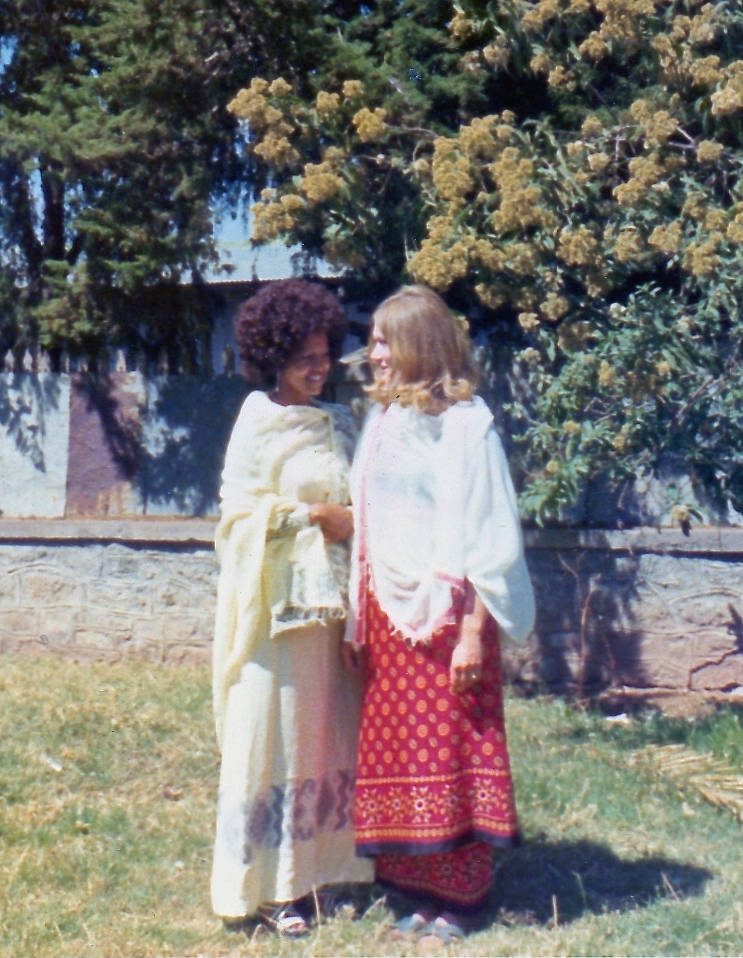
All dressed up for the coffee ceremony, but what is missing?

The Prompt: Dictionary, Shmictionary—Time to confess: tell us about a time when you used a word whose meaning you didn’t actually know (or were very wrong about, in retrospect).

Coffee With No Ceremony

I lived in Addis Ababa adjoining Mexico Square.
I ate injera every day. Had cornrows in my hair.
I thought I knew it all, and though my language skills were poor,
I knew enough Amharic to get by in any store.

Seated in a circle, on low stools around a flame,
We watched Demekech fan the fire—this ritual the same
in every house and every village all throughout the land.
The thick and sludgy coffee was always ground by hand.

Boiled in a clay carafe, then set aside to brew
as in another little pot, some corn kernels she threw.
The popcorn taken from the flame, the colo nuts were next.
Except—we found that we had none, and we were sorely vexed.

The coffee jug was sealed up with a fresh-wound plug of grass
ready for the pouring, but one aspect of our mass
was missing, so I said I’d go to buy some at the souk,
lest our hospitality give reason for rebuke.

These little shops were many, lining both sides of the street;
and at each one, I knew the custom—always did I greet
the owner with proper respect, and always, he said, “Yes!”
when I asked if he had colo, but I couldn’t guess

why no one ever seemed to want to sell any to me.
Always the same reaction—first the shock and then the glee.
So, finally, I walked back home. My failure I admitted.
Departing, I had felt so smart, but now I felt half-witted.

What had I done wrong? I knew that every shop had colo.
The problem must have been that I had gone to get them solo!
Returning empty-handed, I felt I was to blame.
Coffee without colo was a pity and a shame.

But my roommate and our guests and cook were really most surprised.
I must have asked for something else than colo, they surmised.
What did I ask for? When I told them, they dissolved in laughter.
They said that I was lucky not to get what I asked after.

For colo had two meanings, depending on the stress
put on the first syllable, and I had made a mess.
Instead of nuts, they told me (and this was just between us,)
­I had asked each souk owner—if he had a penis!

(This is a true story of only one of the gaffes I became famous for in the year and a half I taught and traveled in Ethiopia in the period leading up to the revolution that deposed Haile Selassie.)

Back and Forth

Back and Forth

If I should find a time machine, I might or might not buy it.
And even once I bought it, I might or might not try it.
To think about the future always makes me sweat,
for I am trepidatious about how bad it might get.
I foresee live-in bubbles for one or two or three
who merely turn on YouTube for whomever else they see.
Pollution would be too advanced to venture far outside—
the world turned way too violent for most folks to abide.

If I visited the future, chances are I’d see
the death of friends and loved ones—perhaps the death of me!
See our country crumble due to earthquakes or to slaughter.
See Monsanto poison food crops after ruining our water.
Our seasons turned to drought, tornado, hurricane and flood—
by turn made dry or spinning or blown away or mud.
I know there are alternatives, but I can’t help but doubt
that current politicians will let it all work out.

But if I went into the past, perhaps I’d also rue it.
I might just be happier if I chose to eschew it
I might see as a toddler that I was just a brat—
a little squirming dervish—graceless, spoiled and fat.
I might hear that my singing voice was just a bit off-key
and see the looks the others gave as they were hearing me.
If I encountered me, we might just end up in a fight
like ones I had with sisters—and discover they were right!

Yet, this probably won’t happen and perhaps it might be fun
to have another look at what I’ve seen and what I’ve done.
And though to relive some things would leave me feeling queasier,
I know that it would certainly make memoir-writing easier.
What fun to relive Christmases from year to year to year,
To see my mom and dad again, what’s more, to get to hear
all the stories of my dad and this time to record them—
to spend time with my sisters and to show how I adored them.

What fun to watch me with my friends— Rita, Lynn and Billy—
to see when we were children if we were just as silly
as little kids I see today who just seem to be reeling
with energy and foolishness and excesses of feeling.
I’d drive on roads with fewer cars to spots no longer there.
Go roller skating in Draper gym. Fall on my derriére!
I’d have a Coke in Mack’s Café and then I’d shop at Gambles.
Buy love comics at Mowell’s Drug and then expand my rambles

down to the playground monkey bars, where I would do a flip.
Then to the Frosty Freeze where I would have another sip
of orange slush and then I’d have to buy a barbecue.
(I fear that in my tiny town, that’s all there was to do!)
I’d skip ahead, then, many years, to 1971,
and fly off to Australia for adventures in the sun.
Then Singapore and Bali, Ceylon and Africa.
See everything as it once was, when it was new and raw.

Regrets? Of course. I’m human, and so I’ve had a few,
but over precognition, I prefer déjà vu.

The Prompt: One-Way Street—Congrats! You’re the owner of a new time machine. The catch? It comes in two models, each traveling one way only: the past OR the future. Which do you choose, and why?

Strangers When We Meet

The Prompt: Delayed Contact—How would you get along with your sibling(s), parent(s), or any other person you’ve known for a long time — if you only met them for the first time today?

Strangers When We Meet

If I had met my parents when we all were sixty-seven,
(before she went on oxygen, before he went to heaven,)
would we have liked each other and found something to say?
As strangers, would we walk on by or pass the time of day?

My father liked to be the one spinning out the tale.
Beside his vivid stories, I think most of mine would pale.
He wasn’t a joke-teller or a purveyor of fictions.
It was true stories of his life that fueled his depictions.

And when his friends had heard them all, he’d tell them all again.
Though they stretched with every telling, still his tales never grew thin.
If fifteen wolves pursued him—a number that is plenty,
the next time that he told the tale, I’ll wager there’d be twenty!

When I returned from Africa with stories of my own,
I found that they weren’t good enough, for all of them had grown
with all my dad’s retellings, so the rhino I had snapped
a photo of, now chased me. (In reality, it napped.)

I think perhaps my mother would like my poems the best.
She’d like the rhyme and meter, the humor and the jest.
For I learned all of it from her when I was very small,
as she was doing rhyming before I learned to crawl.

I grew up with her diaries—all of them in rhyme.
She had them in a notebook and we read them all the time.
The tales of her friend Gussie, who wasn’t allowed beaus;
so they said they went to Bible study, though it was a pose.

Gussie’s mother baked two pies, (for coffee hour, they said.)
Her father said he’d pick them up. They said they’d walk instead.
They took one of her mother’s pies to those within the church,
then took the other with them as they left them in the lurch!

Their beaus were waiting for them in a car with motor running.
Instead of Bible reading, they preferred to do some funning.
To abscond with both the pies was something that they had debated,
but in the end they left one pie–an action that they hated.

Two sisters present were their foes. They were so prim and proper.
To steal one pie was lie enough—but two would be a whopper!
Mom’s entry in her journal is one I can still tell.
(Don’t know why it’s the only one that I remember well.)

Line for line, here’s what she said in metered verse and rhyme,
though it’s been sixty years since I heard it for the first time:
“We left that crowd of greedy Dirks to feast upon our pies.
We were so mad, like Gussie’s Dad—had pitchforks in our eyes!”

My mother burned this journal when I was just a kid.
I wish she hadn’t done so, but alas, it’s true, she did.
Perhaps she didn’t want to see us following her ways.
Instead of what she did, better to follow what she says.

But I am sure if she still lived we’d have a little fun,
sitting down together when every day was done
and writing all our exploits down, relaying all our slips—
saving for posterity the words that pass our lips.

And in the meantime, Dad would tell as long as he was able,
all those stories that he’s told at table after table.
In coffee shops and golf courses, at parties or a dance,
he would go on telling them, whenever there’s a chance.

And if we all were strangers, and none of us were kids,
we could relate our stories without putting on the skids.
Each would outdo the other as we passed around the bend,
with story after story till we all came to The End!!!