Tag Archives: Wordpress Daily Prompt

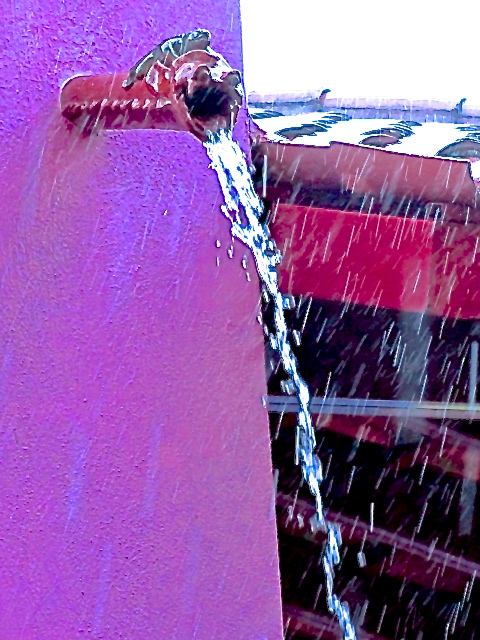
Rain

DSC08898 - Version 2

Rain

Gives an excuse
for that bright orange umbrella
and yellow overshoes
toppled over in the hall closet,
yet it is nighttime and I am old.
I lie under blankets on the sofa,
content with its comforting
rat-a-tat
on the plastic skylight
overhead.

It is a friend knocking
insistently,
calling me out to play.

Six years old,
Imprisoned by summer,
we were given occasionally
the refreshing release
of a hard summer rain.
Bare feet splashing,
we raced dry leaf boats
manned by our imaginations
through the caves of culverts,
down to those ultimate puddles
magnificent in their magnitude.

Sixty years later,
I am caught up in the currents
of that sudden rush downwards
and backwards to
a plastic umbrella
abandoned on the sidewalk
as we opened like  flowers.

Rain
hides tears.
Forces growth.
Cleans up our messes
and provides glorious new ones.
Washes away today
and grows tomorrow.

Addicted

Addicted

It’s altering our planet, or so the experts say,
but I fear I am addicted, for I take it every day.
As regular as clockwork–morning, noon and night–
whenever I have need of it, I take it as my right.

I can take it when I’ve planned to or also just ad hoc
when I need to go out shopping, to the dentist or the doc.
I can take it while I’m listening or take it while I’m talking,
but the one time I can’t take it is whenever I am walking.

It’s become a real compulsion, an addiction and a crutch.
I’d try to give it up but I enjoy it way too much.
Yet I do not need to search it out in pharmacy or bar,
for the thing I cannot do without is just my little car.

The Prompt: Think Global, Act Local–Link a global issue to your personal life.

See more writing on this theme at: https://dailypost.wordpress.com/dp_prompt/think-global-act-local/

Reminder

Reminder

Use it or lose it is advice that you might find
in books of pithy phrases or others of their kind.
Though trite, it seems to really work in matters of the mind,
which we should always try to use when we are in a bind.

Unfortunately, panic too often enters in
and takes the place of where our minds really should have been.
Our fears and doubts and terror creating such a din,
distracting us and so we lose what otherwise we’d win.

“I’ve lost my mind” are words that I have often overused.
(Another phrase the use of which is really much-abused.)
And although exaggeration is a sin widely excused,
it’s hyperbole when meant to mean that we are just confused.

I don’t think  we had these problems when we were in our prime.
Our minds were so much emptier and we had so much time.
We used our minds for calculus or conjuring up a rhyme.
Our wheels were always spinning and could turn upon a dime.

But later on in life our minds are full to overflowing.
We remember where we’ve been but often forget where we’re going.
We try to still go fast when it is fact we should be “Whoa” ing.
and letting life evolve away from simply being knowing.

A baby sleeps within the womb and out of it as well.
He ruminates and plays for years before the school bell.
And so perhaps re”tire”ment is a story we retell–
recalling us to rest and play  before that final knell.


The Prompt:  Use it or lose it.  https://dailypost.wordpress.com/dp_prompt/use-it-or-lose-it/

Sweet Clover

Sweet Clover

Before our dad told us its real name,
we used to call it wild mustard.
What did we know about sweet clover except for its color
and that summer smell, cloying in its sugared perfume.
It filled the air and smothered the plains—
bright yellow and green where before
brown stubble had peeked through blown snow.

On these dry lands, what flowers there were
tended to be cash crops or cattle feed.
Sweet clover or alfalfa.
The twitching noses of baby rabbits brought home by my dad
as we proffered it to them by the handful.
Fragile chains we draped around our necks and wrists.
Bouquets for our mom
that wilted as fast as we could pick them.

Summers were sweet clover and sweet corn
and first sweethearts parked on country roads,
windows rolled down to the night air,
then quickly closed to the miller moths.
Heady kisses,
whispered confessions, declarations,
unkept promises.
What we found most in these first selfish loves
was ourselves.

The relief of being chosen
and assurance that all our parts worked.
Our lips accepting those pressures unacceptable
just the year before.
Regions we’d never had much congress with before
calling out for company.
That hard flutter
like a large moth determined to get out.
Finding to our surprise,
like the lyrics of a sixties song,
that our hearts could break, too.

Hot summer nights,
“U”ing Main,
cars full of boys honking
at cars full of girls.
Cokes at Mack’s cafe.
And over the whole town
that heavy ache of sweet clover.
Half promise, half memory.
A giant invisible hand
that covered summer.


The Prompt: The Transporter—Tell us about a sensation — a taste, a smell, a piece of music — that transports you back to childhood.

The World Is Too Much With Us

People here are funny. They work so hard at living they forget how to live.”
Mr. Deeds Goes to Town (1936)

The World Is Too Much With Us

How was life when we didn’t know everything?  Back when there was no TV and when news got shared once a day on the radio and once on the door stoop in the morning?  We were so busy with our own lives that we didn’t spend every minute of every day bound up in the ills of the world.

Violence was a neighborhood game of cops and robbers, but nobody really ever identified more with the robbers.  It was more a game like kick the can, where you were trying to keep something away from the other side.  Violence was not the point and when I look deep, I know that a game of cowboys and Indians was no more an expression of prejudice than listening to a World Series game of the Yankees against the Dodgers was.

To rephrase a quote from Mr. Deeds Goes to Town (1936), I have to say that people of the twenty-first century are funny.  They work so hard at living they forget how to live. I include myself in their ranks.  I am so tied to my computer that I panicked recently when I spilled a Coke on it and had to go a few days without.  My day felt strangely empty even though I had an entire ocean and beach spread out before me and a small town full of people to talk to, a porch full of art materials.  But, I’d become so accustomed to my blogging world and even to talking throughout the day via Skype to a very dear friend, that I didn’t know what to do with a day that was just a day in one place with one set of people around me.

Existence has become a thing that has no value unless I can write about it and I don’t seem to be able to write anymore unless I am writing into a computer and sending experience out into the world.  I am committing, perhaps, even more of a sin than those teenagers glued to their hand devices, texting their friends. They, at least, are connected to someone,  whereas I simply talk to my computer and send out copies later.

Who is most at fault is not the point.  The point is that connection with the world at large that keeps some of us from a simple and private connection to the world immediately around us.  We know so much about so many things we really don’t have much control over, that we have become voyeurs. The entire world has become grounds for our gossip.  We are fascinated by the gory details, shocked but in a sort of fascinated daze that keeps us many times from realizing that this is more than a movie. This is reality.  Someone’s pain.  We feel it for those seconds and minutes and hours and days that the horrible action stays in the headlights of this rushing vehicle that is our world, but then we pass on and it is as though one program has ended and the next begins.  We think about world events in episodes.  Off with the old one, on with the newest slaughter or murder or coup or genocide or monster storm or hostage situation.

In the meantime the minor tragedies around us sometimes go unnoticed.  We are so fixated on the stories of major tragedies on the other side of the world that we forget the real people and small dramas going on around us.  We watch nature shows on television while ignoring what wildlife still exists around us.   We suffer the passion and pangs of romance as onlookers.  Observing the great chefs of the world takes up time we could have been baking chocolate chip cookies.  Watching Honey Boo Boo in horror becomes a punishment in comparison to  sitting in a playground, watching children living the world in real time.

Yes, what I write is hyperbole, but I think it is true, to a varying degree, of most of us connected to the technical world. It is like a horrible accident passed on the hightway that we are told by our mothers to look away from.  Who can resist?  No matter how much the gory scene may invade our dreams and turn them into nightmares, we cannot look away. And now with TV and the Internet, we could spend 24 hours a day watching such horrors. And often do.

There is such a thing as being too connected to too large a world.  This is why I disconnected the dish network and cable years ago.  The bad news still leaks through, as does the good news, but in quantities I can take and that leave time for real experience and a perhaps misplaced faith in the world and human goodness and yes, even my own goodness.  I am beginning to try to spend more time away from the computer–to simplify, if that is possible in this busy cluttered mess of a life I’ve once more collected around me.

I find the valuable elements slipping away and less energy to collect more around me.  Friends die and move away both physically or emotionally.  This is the process of life.  But it is also the process of life to stay engaged in a real way and to fight for meaning and value in our lives.  This should not be so hard.  There should not be so much to plow through to get to ourselves and what is really important.  The Mr. Deeds quote, in modern context, might be altered to read, “We work so hard at observing and being in contact with the world at large  that  we forget how to live in that world.”

The Prompt: Silver Screen–Take a quote from your favorite movie — there’s the subject of your post. Now, write!

Mexico Adventure, No Fatalities

Mexico Night Adventure, No Fatalities

Leaving that swinging small
coffee house art opening of a friend
with the party still roaring
behind me,
I shift to uneven cobblestones
to avoid the nightly
taco stand set up on the sidewalk,
knowing I must be careful,
but pitching forward anyway,
face-down in the dark street.

Seconds later,
still in thrall to the fall,
thwacked shoulder,
scraped palms.
As I lie in the street,
a crowd gathers
like otters to survey
this new intruder to their world.
I can’t stand up.
Lie groaning in the dark.

They offer twenty hands to help me up,
but I need to lie a spectacle  in the street.
Should they call an ambulance?
Can I not rise?
They ward off cars, enfolding me
in their curious and protective circle.
No way with any amount of help
can I push myself up from the street
on this pounding knee.
I become their Saturday night
entertainment.

At last, unable to bear the shock
of pressure on any part of either leg,
I scoot myself over on my bottom to the curb,
hoist myself up to sit on it,
and from there
my right leg can get contact with the street to push.
Two hands help me up and go around me
as I hobble the half block to my car.
Yes, I can drive.
But everything hurts.
“Muy Amable, Senor, y muchas gracias.”

At  home, a straight-legged hobble down the stairs.
Neosporin on the skinned and swollen knee,
Rum and Coke, Advil, Reumofan
in that order.
Arnica and Peyote gel rubbed in sore parts.
The safety and warmth of bed.
and eight hours respite
until that long climb up the stairs
to the last day of my own art exhibition.

It is hard getting old in any country,
but in Mexico,
cobblestones furnish
their own private Hell
that all gringos fall to,
sooner or later.

(The prompt was to tell about the last time someone was proud of you, but It’s hard to be proud in the dark on cobblestones in Mexico.)

Ice Cream Manifesto

Ice Cream Manifesto

It’s just a little kiosk in the middle of the street
between two one-way roadways, in the center where they meet.
There aren’t any tables. There isn’t any chair.
You have to stand out in the street to give your order there.

Mango or tequila, tamarind or corn.
As you can see, the flavors don’t agree with any norm.
They’ve ice cream made of purest cream , but they have ices, too,
in so many flavors that I always choose a few.

My favorite? Strawberry ice. Vanilla under it.
I get a cone so I don’t have to wait to plunder it.
I finish it as I drive home, licking all the way.
I give my dogs the empty cone. It always makes their day.

The cone is hard as any bone–sweet and chewy, too.
If I were a better mother, I’d arrange that they had two.
But though I know I’d enjoy two passing o’er my lips,
Later I would not enjoy their presence on my hips.

I love that little ice cream stand. Love it all to heck,
with its lovely homemade ice cream made in Jocotepec.
That pueblo is quite close to me. It’s just five miles or so.
So it isn’t that it is so very far for me to go.

The thing is that for me, ice cream is an impulse buy.
It’s not a major purchase, like a cake or like a pie.
If I just happen to be passing and see that fellow there
waving his ice cream scoops at me, right out in the air,

preordination says that I must stop and have one now–
a bite of crispy wafer cone, adorned with ice of cow.
I do not claim responsibility for decisions of this kind.
It’s a creative impulse, not a matter of the mind.

So if you’re a public servant–an official of this town
looking for new laws to pass, don’t tear this kiosk down.
Fill some potholes in the street or put a speed bump in.
For legislating ice cream bans is sure to be a sin!


The Prompt: Do or Die–You have three hundred words to justify the existence of your favorite person, place, or thing. Failure to convince will result in it vanishing without a trace. Go! (355 words, poetry police–so sue me!)

Mr. Cole

Mr. Cole

He lurked out in the hall as we all took our seats and came to order.  He took a drink from the water fountain, putting down what looked like a new briefcase as he did so.  He picked up the briefcase and made for the door, then turned and walked back to the fountain, putting his briefcase down as he took another drink.  He started for the door again.  Changed his mind and returned for another drink.  Then he squared his shoulders, picked up his case, re-rounded his shoulders and entered the room.

He was a little mole of a man—sniffy and hunched with scrunched-up eyes behind thick glasses.  When he entered the classroom, he looked straight down at the floor, as though he wasn’t sure one foot would follow the other without great attention.  He maneuvered his way to his desk and stood with his back to us.  He slammed his briefcase onto the desk, then removed it again, as though in indecision over whether he really wanted to stay at all.  Then he slammed it down again.  Removed it.  Slammed it down.

Finally, he moved around to face us and assumed a more teacherly demeanor.  He actually looked at someone in the front row for two seconds, before retreating back around to the back side of the desk, perhaps seeking some protection.

It was the first day of my freshman year in college. Next to me was a very new friend who not only lived in the same dorm but who also had just pledged the same sorority. We sported our bug-like black pledge pins on the fronts of our sweaters, a hand’s distance above the nipple, as we’d been instructed to wear them.  It was a bit like being in enemy territory, for we had already learned that the English department and the dormitories were not the best places to display our new status as Greeks so openly.  Our sitting together was a bit like circling the wagons on a westward journey.  We had each others’ backs.

“My name is Mr. Cole,” the dwarf said. “This is the honors section of Freshman English 101.”  He had facial ticks and a way of floating off into dreams.  Sometimes the end of a sentence just sort of wandered off, as though some other matter of greater importance had intruded upon his thoughts.  We did not disturb him in these reveries.  My new friend Linda and I would exchange looks and she would giggle the sexy little laugh that was her only laugh.  We both admitted, finally, to having a bit of a crush on him.

It was my first of many crushes on “different” men.  Men who had facial ticks or personality disorders that made others look on in horror or disgust just seemed to intrigue me, and my new friend was someone who gave validity to my strange behavior.  She, too, thought he was intriguing.  When we invited him to be a faculty chaperone for our pledge dance, he asked if he would be expected to function in the capacity of a bouncer and I assured him that no, it was more of an honorary position. To our surprise, he accepted, showing up with a tall willowy English department assistant who seemed herself to be of a literary bent.  I don’t remember if they danced, but I believe they dated for the rest of my college career.

You can see by my relation of these details how little I really knew about this man. On that first day in Freshman English, I remember being frightened and feeling inferior to the big town kids in the class.  If the truth were told, most of them were probably small town kids themselves, but coming from a town of 700, I thought of a town of 6,000 as a city , and I was sure that my own excellent academic record was more a result of comparison (there were 15 in my graduating class) than of true prowess.  Mr. Cole explained that instead of studying grammar, sentence and paragraph construction, that as honors students we would be expected to write an essay or story a week which would then be read in class and commented upon.

The night before our first writing assignment was due, my insecurity had kept me from committing a single mark to paper.  We had been given no topic and no direction.  This paper was to function as a sample of where we were on the continuum of writing skills.  This was to be my introduction to the strange gnomish man who had studied under Roethke.  Although I had no idea who Theodore Roethke was and no easy way of determining who he was in this pre-computer, pre-Google age, I had made one of my rare forays into the college library and found a whole section dedicated to his books in the poetry section.  So, I was about to be read by the student of a very important American poet.  And, I didn’t know what I was doing, really.  Our composition efforts in high school had been for the most part limited to essays and term papers.  I’d once written a humorous sonnet about Goldwater and Johnson and that was about it.  How did one go about writing a vignette, which as I recall was our assignment?  Midnight, one a.m., two a.m. ticked away on the smoking room wall as I sat looking at the blank page.

A fly, brought back to action by the hot light of my study lamp, worried my ear before buzzing off to pin itself to the wall. The smoke of my cigarette curled between us, and suddenly, in a sort of astral projection, I was that fly on the wall getting high on the fumes of a doobie that smoked in the ashtray beneath it.  The room was filled with the imaginary bodies of stoned kids splayed out on the floor or with headphones on their heads.  I started to write.  Forget that I had never smelled or seen marijuana, let alone smoked a joint. It was easier for me to imagine that fly getting high than to imagine myself doing so, but within a half hour, I’d completed the essay, set my alarm clock and had joined the fly in its herbally-induced sleep.

The next day, I placed my own sheet on the pile of papers on his desk.  Mr. Cole entered as usual, slamming the briefcase, removing it, slamming, slamming.  I had never been introduced to the term “Tourette’s Syndrome,” but many years later I wondered if perhaps this accounted for some of his oddness.  He would stand at the desk and crane his neck upwards, roll his eyes.  Sometimes he would look at one back corner of the room and then at the other, as though he were privy to some world and audience we had no access to. Seeing a film on Roethke, I wondered if he had patterned some of his odd behavior on his former teacher. This is just a scrap of a remembrance, so perhaps I dreamed it.  In this era of YouTube it would not be hard to check out.

Three days later, he was ready to discuss our vignettes.  There were many in this class, he revealed, who were able to put words down on paper but who were not writers.  There was one student, however, who had portrayed the truth in a way that the others had failed. This student had displayed courage in telling about a part of themselves that no one else had been willing to be vulnerable enough to display. He then read my essay as an example of superior writing to the entire class.

What I felt? Relief, certainly.  Pride?  Sorry, but yes.  I enjoyed being singled out.  After the class, other students came up to me saying they would not have had the courage to write the truth like that or to admit they’d smoked pot and applauded my success in exactly expressing what it was like to be stoned.  On the way back to the sorority house to do our pledge duties, my friend giggled and admitted she had never smoked pot.  “Neither have I,” I confessed, with a sideways grin at her.

I took three classes from Mr. Cole. In Honors Freshman English, I earned an A.  When I took creative writing from him a year later, he seemed to have me completely confused with another student who had taken a class from him the semester before.  He kept calling me Jenny and commenting on how my writing had improved.  The next semester, I took another class from him and in the margin of one of the first poems I wrote for him, he said, “Not quite up to the sudden fine standards you set for yourself last semester!”  I knew then that he was still thinking of me as Jenny and was disappointed that I’d returned to my former standards of mediocrity.  He’d given me a B+ on the poem.  I tried harder for the remainder of my last semester in his class, earned another A and would like to believe I lived up to his expectations. Of Jenny.

We do not always stand out in the memories of those we admire with the same clarity that they stand out in ours. What happened to Mr. Cole, I do not know.  As with many in our lives, when his importance in my own life ended, so did his existence.  I tried Googling his name once and found nothing, which may mean his own poetry books were published in a pre-computer era.  When I Google my own name, there are 209,000  entries listed, probably most having to do with some other combinations of my name, but most of the ones really referring to me have to do with writing. Probably all of those entries deserve a footnote of thanks to Mr. Cole, who was the first to find merit in my words and also the first to be deceived by them.

(You can see a 25-minutes YouTube video on Theodore Roethke here. Other than his reading style, he really doesn’t have much in common with Mr. Cole at all.)

The Prompt: Teacher’s Pet—Write about a teacher who influenced you.
China Bulldog

China Bulldog

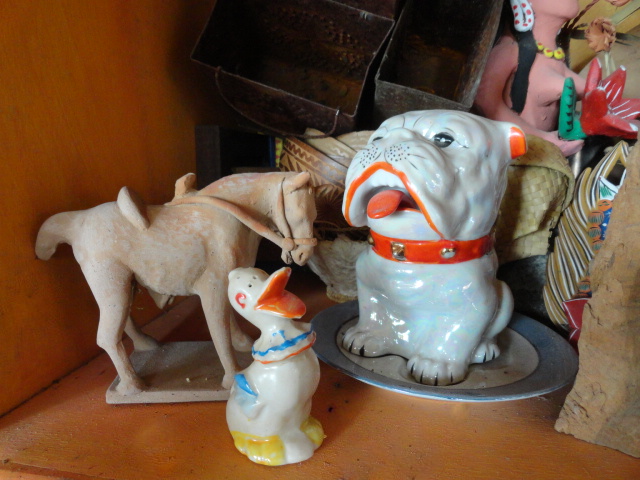
I dreamed last night that we were clearing out my mother’s house.  The front doors of all the kitchen cabinets had been removed and I was puzzled about this.  On the mantelpiece, I found China bulldog after China bulldog that was a replica of one I one my mother had told me to take home with me when I cleared out the house after my father’s death.  “Judy asked for this. You can fight over the rest.” said a note taped to the bottom.  A mayonnaise jar, it was of white glazed ceramic that had a rainbow sheen.  Its head came off as a lid and its bright orange tongue was the handle of a spoon.  The body fit into a depression in its saucer that had the outline of the bulldog’s feet and bottom so it nested a bit.

One of my first memories was seeing it sitting on the small triangular shelf in our kitchen.  My mother never used it and later, in newer houses where it didn’t suit the decor, it always sat within a cupboard.  My mother was too modern for China cabinets or knickknacks that didn’t match the color scheme.  When I was small, her taste went to magenta and chartreuse.  Beige and pink and turquoise marked the seventies, the turquoise and pink traded in for avocado and burnt orange in the eighties and back to a more understated green and beige in the nineties.

Whatever the color scheme, the bulldog never quite fit in, but it was the one object asked about by both of my sisters after the Loma Prieta earthquake.  I I was living in a house near its epicenter, and the bulldog had worked its way from the back of my kitchen cupboard to sit teetering on the edge, but it had not fallen.  It was one of the few things in a house packed full of art and artful objects that I chose to bring with me to Mexico.

I’d like to say that it has assumed a position of importance in my house in Mexico, but sadly, the China bulldog just never quite seems to fit in to the mainstream.  It has sat on a shelf in my studio for the past twelve years, somewhere near the back where it is safe but unseen.  But for some reason, if I were to be able to take one more object from my house, the China bulldog is what my mind falls upon. Perhaps it is time to think about why.

I often dream about a subject that ends up being my blog topic for the next day.  For some reason that topic fits into the prompt and so it is never very difficult for me to begin the day’s writing.  In this case, once I’d settled on the bulldog as my topic, I immediately remembered that in my dream I had found five or six bulldogs on my mother’s mantel.  Some were without bodies, all without their dishes.  Some were smaller than others and lacked the brilliant sheen or bright colors.  One seemed to be almost crumbling, as though it had been under water for a long period.  All were missing their tongues.

In the dream, I imagined my mother combing second hand stores and never being able to resist whenever she found a bulldog in the same shape as the one her older sister had given her when she was a child.  It’s been at least 100 years since she received that strange gift that was the only remaining thing that seemed to have been brought with her when she moved first from Missouri, then to Kansas and then to South Dakota, to marry my father.

She told me no stories about it and as I think about that, I realize she told me few stories at all.  Not about her wedding or my birth.  The stories in my family all centered around my father while her stories seemed safely tucked away on a shelf like the China Bulldog.  Perhaps that is why that one piece of all the pieces of my mother has assumed a center place in our memories. I know that my middle sister, who lived in the same town as my mother for the last six years of her life, has mourned her loss the most over the years.  My oldest sister, who was estranged from Mom for the last twenty years of her life, is in the throes of Alzheimer’s and so never mentions her at all.

It has been fourteen years since her death and I don’t think of her daily or even weekly, but every so often, something happens and the thought comes in a flash that I have to be sure to tell Mother about it; and for the past year, most of my poetry has been written in her joking, rhythmic cadence and rhyme.  Perhaps some essence of her that has been steeping in me for over sixty years has suddenly reached its saturation point and must come out.

And the China bulldog?  The dream? It is as though for all these years she has been trying to get it back, never quite replacing it but nonetheless not giving up the search.  And I can’t overlook the irony that it is these less perfect incomplete bulldogs that she chose to put on her mantel.  Is she trying to tell me something about beauty or the adherence to a dream or about giving up perfection to enter back into the quest?

My mind ricochets without finding an answer, but I continue to feel the prompt.  Perhaps there is reason in the name “wordpress.”  I feel that press to find meaning through words as I feel my mother’s gentle prod and communication through genes or memory or dreams, to leave perfect things behind and to get on with my life.

DSC09684

The Prompt: Burnt—Remember the prompt where your home was on fire and you got to save five items? That means you left a lot of stuff behind. What are the things you wish you could have taken, but had to leave behind?

Fresh Worms for Sale

Fresh Worms for Sale

Many have not come to terms
with the benefits of worms.
They find them repulsive and squishy.
Revolting, creepy, crawly, ishy.

But these folks tend to just react
without examining each fact
of all that folks could find to do
with worms if they’d just buy a few.

Granted, worms that wad and mingle
lack the charm of just a single
worm that can be used for bait
on a hook and with a weight,

but every person knows this use,
which always calls for worm abuse.
Worms, however, also toil
to break up and aerate the soil.

In jars with holes poked in the lids,
worms make good pets for little kids.
Good for hours of watching, they need
little care and little feed.

Worms don’t need collars, leashes, dishes,
never go against your wishes.
They are not barkers nor run-arounds.
None of the nastiness of hounds.

They have no hair to grow and shed.
You do not have to pat their head.
They have no other nasty habits
like gerbils, hamsters, cats or rabbits.

You don’t have to change their litter.
When traveling, you don’t need a sitter.
No vet bills when your pets are worms–
no fleas nor ticks nor mites nor germs.

Worms take up very little space
and may be trained to run a race.
And if you make a well-placed bet,
they just might get you out of debt.

The benefit of worms now told,
May I consider this worm sold?
Surely you’ll find much to do
with one or two that leave with you.

If you’re not a  fisherman
and if a pet’s not in your plan,
If you are a sadistic sickie,
just put one down your girlfriend’s dickie!*

*for the youth among us, a dickey is a turtle neck or collared inset
that may be worn under a vee-necked sweater or jacket to create the illusion that one is wearing a sweater or blouse under it.

The Prompt: Embrace the Ick–Think of something that truly repulses you.  Hold that thought until your skin squirms.  Now, write a glowing puff piece about its amazing merits.