Tag Archives: memories

Leftovers


Leftovers

When my father died forty years ago, it was in Arizona, where my parents had been spending their winters for the past ten years.  They maintained houses in two places, returning to South Dakota for the summers. But after my father died, my mother never again entered that house in the town where I’d grown up.

Our family had scattered like fall leaves by then—my mother to Arizona, one sister to Iowa, another to Wyoming. Both the youngest and the only unmarried one, I had fallen the furthest from the family tree. I had just returned from Africa, and so it fell to me to drive to South Dakota to pack up the house and to decide which pieces of our old life I might choose to build my new life upon and to dispose of the rest.

My father’s accumulations were not ones to fill a house. There were whole barns and fields of him, but none that needed to be dealt with. All had been sold before and so what was to be sorted out was the house. In that house, the drapes and furniture and cushions and cupboards were mainly the remnants of my mother’s life: clothes and nicknacks, pots and pans, spice racks full of those limited flavors known to the family of my youth—salt and pepper and spices necessary for recipes no more exotic than pumpkin pies, sage dressings and beef stews.

Packing up my father was as easy as putting the few work clothes he’d left in South Dakota into boxes and driving them to the dump. It had been years since I had had the pleasure of throwing laden paper bags from the dirt road above over the heaps of garbage below to see how far down they would sail, but I resisted that impulse this one last run to the dump, instead placing the bags full of my father’s work clothes neatly at the top for scavengers to find—the Sioux, or the large families for whom the small-town dump was an open-air Goodwill Store.

It was ten years after my father’s death before my mother ever returned again to South Dakota. By then, that house, rented out for years, had blown away in a tornado. Only the basement, bulldozed over and filled with dirt, contained the leftovers of our lives: the dolls, books, school papers and trophies. I’d left those private things stacked away on shelves—things too valuable to throw away, yet not valuable enough to carry away to our new lives. I’ve been told that people from the town scavenged there, my friend from high school taking my books for her own children, my mother’s friend destroying the private papers. My brother-in-law had taken the safe away years before.

But last year, when I went to clear out my oldest sister’s attic in Minnesota, I found the dolls I thought had been buried long ago–their hair tangled and their dresses torn—as though they had been played with by generations of little girls. Not the neat perfection of how we’d kept them ourselves, lined up on the headboard bookcases of our beds —but hair braided, cheeks streaked with rouge, eyes loose in their sockets, dresses mismatched and torn. Cisette’s bride dress stetched to fit over Jan’s curves. My sister’s doll’s bridesmaid dress on my doll.

It felt a blasphemy to me. First, that my oldest sister would take her younger sisters’ dolls without telling us. Her own dolls neatly preserved on shelves in her attic guest bedroom, ours had been jammed into boxes with their legs sticking out the top. And in her garbage can were the metal sides of my childhood dollhouse, imprinted with curtains and rugs and windows, pried apart like a perfect symbol of my childhood.

Being cast aside as leftovers twice is enough for even inanimate objects. Saved from my sister’s garbage and cut in half, the walls of my childhood fit exactly into an extra suitcase borrowed from a friend for the long trip back to Mexico, where I now live. I’ll figure out a new life for them as room décor or the backgrounds of colossal collages that will include the dolls I’m also taking back with me.

Mexico is the place where lots of us have come to reclaim ourselves and live again. So it is with objects, too. Leftovers and hand-me-downs have a value beyond their price tags. It is all those lives and memories that have soaked up into them. In a way, we are all hand-me-downs. It’s up to us to decide our value, depending upon the meaning that we choose to impart both to our new lives and these old objects. Leftovers make the most delicious meals, sometimes, and in Mexico, we know just how to spice them up.

The prompt: Hand-Me-Downs—Clothes and toys, recipes and jokes, advice and prejudice: we all have to handle all sorts of hand-me-downs every day. Tell us about some of the meaningful hand-me-downs in your life.


Casting Reality

The Prompt: Cast Change—You’ve just been named the casting director of your favorite television show (or movie franchise). The catch: you must replace the entire cast — with your friends and family. Who gets which role?

Casting Reality

Instead of casting TV shows with folks you’ll never know
I’d rather cast my life with actors from a TV show
that all of you have seen and so you’ll understand the jokes
better than if I had cast TV with common folks.

A lot of Grandpa Walton might go into making Dad—
plus one ounce of Archie Bunker (though he wasn’t half so bad).
He was a rugged rancher and an avid storyteller.
One day he’d recite Shakespeare and the other, he would beller
a song of mountain bootleggers or “Old Chief Buffalo Nickel,”
then construct towering sandwiches and top them with a pickle.
So I’d add some Leon Redbone and a bit of old Mark Twain,
a little bit of Dagwood and a whole lot of John Wayne.

Though my mother cooked and ironed, often with no thanks,
she also was a jokester who loved to think up pranks.
Though she was often zany, she wasn’t dumb at all—
a sort of Gracie Allen all mixed up with Lucille Ball.
Add some Cagney and some Lacey and a little Nancy Drew
and of another side of her you’ll start to get a clue.
She always loved a mystery and crossword puzzles, too—
and UFO’s and Halloween—things scary as a “Boo!!!”

Stacey London is the next to join my family cast.
What Not To Wear”—the show that she has starred in in the past.
Her role of saying “No” to this one, then a “Yes” to that,
(as in, “That one makes you skinny, but in this one you look fat!”)
was just exactly how my sister used to talk to me.
That this skirt did not go with that was plain for her to see.
As an older sister, she was free with such advice;
but often loaned me her own clothes which, I admit, was nice.

Though my oldest sister Betty’s not accustomed to go last,
she’s the one last family member that there is for me to cast.
She was my boss from my first breath, as she was then eleven.
And if she could, she’d boss me still, though I am sixty-seven.
And so I try to figure out whom she would choose to play her.
And though I’d pick Bette Midler, maybe I should Doris Day her.
She was a singer and a blonde, so guess that she will do.
And now I’ve finished casting a whole film you’ll never view!

Waiting for the Bell

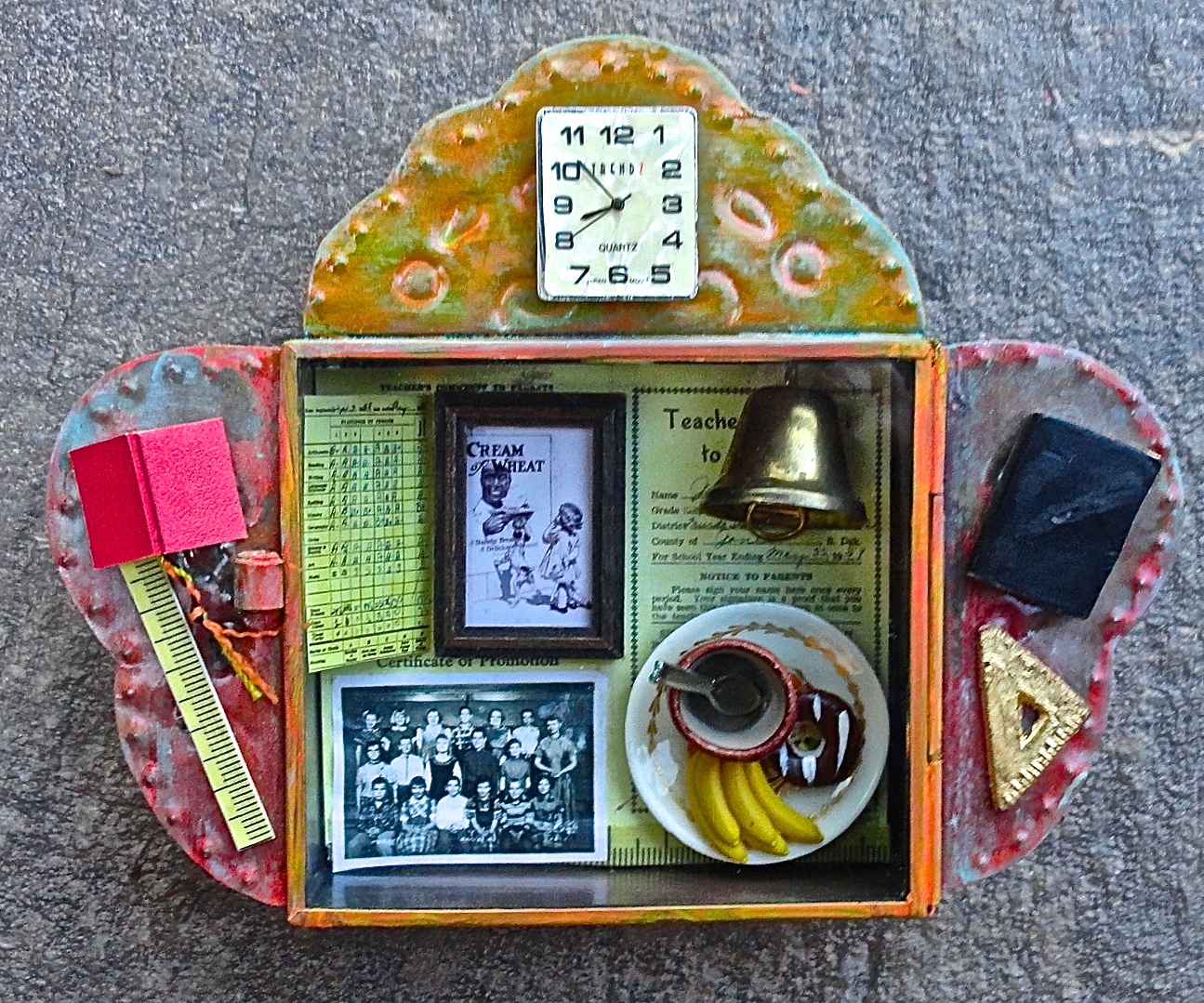
DSC07814Nine Minutes to Nine–Retablo by Judy Dykstra-Brown ( 5.5 X 7 X 1.25 inches)

Waiting for the Bell

From my upstairs bedroom window, I could see it all:
who got to school early to be first for tether ball,
the teachers driving up the street, avoiding children running
some children in the sandbox, and other children sunning
stretched out on the teeter-totters, waiting for a ride—
their friend the perfect size to balance, still locked up inside
cleaning off the chalkboards and dusting the erasers
with others who’d been tardy, or perhaps desktop-defacers.

We could hear the school bell toll the warning for
just one more bite of Cream of Wheat—no time for any more.
I stood and watched as sisters sprinted out the door.
Going on without me, for I was only four.
I waited then for recess, spread out on the grass
waiting for the hours and minutes just to pass.
Through open windows, I could hear all the teacher voices
quizzing all the children and listening to their choices.

The teacher on piano, the class singing along—
long before my school days, I’d memorized each song.
At 10:15, the bell was rung and big doors thrown out wide—
one hundred children, all at once, released to the outside.
Some ran to claim the swings and slides, or lined up for the games:
choosing sides for “Send ‘Em” by calling out their names.
But the creaking of the swing chains and whoops up on the slide
could not reveal the mysteries of what was sealed inside.

Year after year I watched and listened, storing up the clues
for the day that I could put on my new school shoes.
I’d have my school bag at my side while mother curled my curls
and keep it with me as I ate my breakfast with the girls,
spooning up my Cream of Wheat but listening for the bell
that warned the time was getting short for me to run pell-mell
across the street and up the stairs in brand new skirt and blouse.
I knew which room to look for.  I could see it from my house.

And then perhaps my mom would stand under our big elm tree
and the singing that she listened for would finally include me!

 The Prompt: August Blues—As a kid, were you happy or anxious about going back to school?

If I Followed the Wandering Poet

If I Followed the Wandering Poet

Who cares
if I swim naked in my pool?
All other human occupants
have left this neighborhood behind,
leaving more room
for possums, skunks,
birds, scorpions, spiders
and me.

I keep a closer company with them
than I do with any human these days.
Weeks ago, it was the orb weaver spider
who filled my mind,
but this week, I talk to the large caterpillar
with one rear antenna on his tail
as he sits for a day on the Olmec head
that guards my swimming pool.
Back and forth, back and forth I pass,
adding a look at him to my lap routine.
For one long afternoon,
he sits still—like Alice’s caterpillar,
but hookah-less,
meditating in this gray place.
If he were on my Virginia Creeper,
I’d be repositioning him
to the empty lot next door, but here
he seems to be a guest; and so some etiquette
keeps me from altering his placement
as he sits on stone, moving his suction cups in sequence
now and then only to alter his direction, not his place.

Recently,
I question if I’ve stayed too long
in this one place.
Is there something else
I may yet do?
So if you are a wandering poet
and you have a place you think I need to go,
please write of it
in the way you do best
and tell me why I have to go there.
And if you create a good argument and a better poem,
I will go to that place in much the same way
that I have come to this point
in my poem.
Blindly.
Open to what comes next.

This is neither a love poem nor a singles ad. It was prompted by a blog site called “The Wandering Poet” that I recently read. I think I commented, and then as I was ready to leave his/her blog, I caught sight of the “Follow” button. The phrase “follow the wandering poet” got stuck in my mind, leading to “If I followed the wandering poet” and this poem. The challenge is real. I will pick up and go to any place that any poet, male or female, makes irresistible by means of a poem. (Be kind. Choose nothing less for me than the best place on earth you know of. I, by the way, will do the same for you if you wish. Judy)

P.S.: Thanks, Wandering Poet. If I forgot to select “follow,” I’ll do it next time.

I will never cease being amazed at the incredible capacities of the human mind, because three days ago, I wrote the above poem for reasons explained above and the next morning I woke up repeating the lyrics “I will make you fishers of men, fishers of men, fishers of men.  I will make you fishers of men, if you follow me.” (an old Sunday School song I haven’t thought of for 50 years). Now this morning I woke up with the song lyrics, ‘I will follow him, follow him wherever he may go” running through my mind, only to go on the WordPress site to discover that the prompt for today was: Opening Lines—What’s the first line of the last song you listened to (on the radio, on your music player, or anywhere else)? Use it as the first sentence of your post.

All three days, “Follow” has seemed to be the prompt running through my mind and so I guess it is time to publish this poem, conceived of even before I’d heard today’s prompt!!!!

D-Picted (X-Rated)

                                                                               D-Picted (X-Rated)

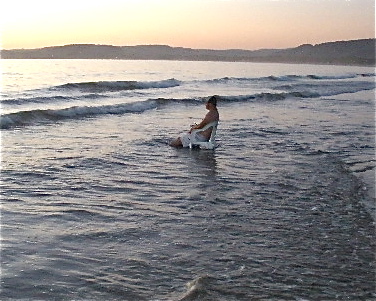
I was taking my daily sunset walk on the beach at La Manzanilla, Mexico when I came upon this idyllic scene. He was sipping a margarita and staring out to sea as the water ebbed and flowed—never reaching higher than his chair bottom. Of course, I had to comment.

OLYMPUS DIGITAL CAMERA

“Is the view good enough for you?” I queried, with a noticeable lack of originality.

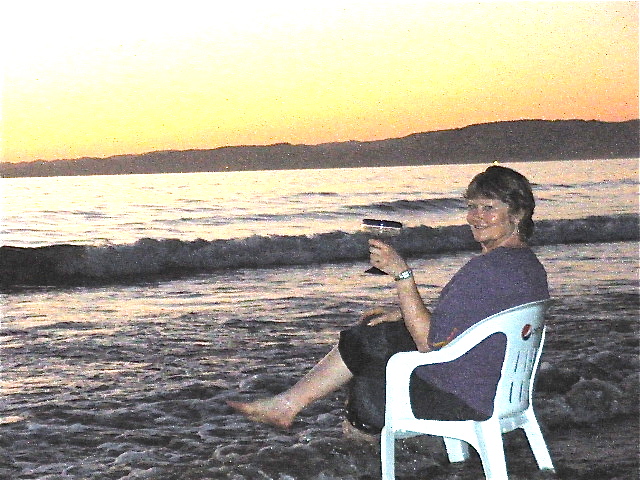
“Do you want to see for yourself?” he asked. He quickly rose from his chair and motioned for me to take his place, taking my camera from my hand as he handed me his Margarita.

OLYMPUS DIGITAL CAMERA

He told me to look his way as he turned the tide by taking a picture of me, and so I didn’t see at first a part of the landscape obvious in this next picture.

OLYMPUS DIGITAL CAMERA

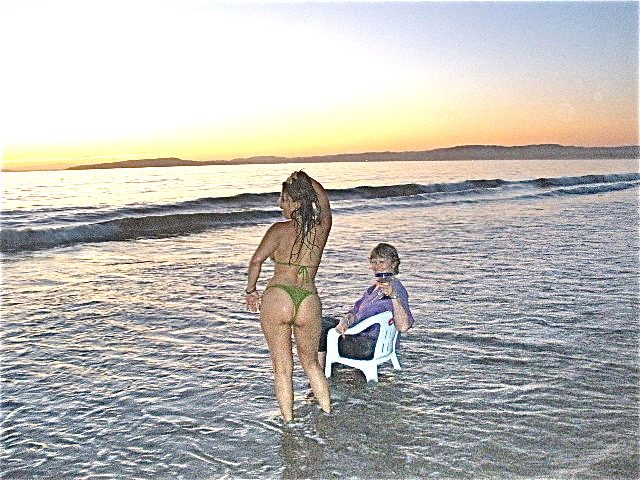
But as often happens in an evening tide, that object quickly washed ashore to enter my picture,

OLYMPUS DIGITAL CAMERA

and quickly dominate it.

OLYMPUS DIGITAL CAMERA

The End

(I promise.  This was not a staged incident.  It happened exactly as I describe it with no prompting by me.  I love getting out in the world.  No imagined story ever duplicates what happens in real life!!)

The Prompt: Edge of the Frame—We often capture strangers in photos we take in public. Open your photo library, and stop at the first picture that features a person you don’t know. Now tell the story of that person.

Special Note to viewers of my blog:  Please also see the next posting “Sur-Prize” to enter a contest celebrating my 10,000th viewing.

First Friends

DSC07187

The Prompt: Do you — or did you ever — have a Best Friend? Do you believe in the idea of one person whose friendship matters the most? Tell us a story about your BFF (or lack thereof).

First Friends

I am three years old, lying in my Mom’s room taking a nap. I can hear voices in the front room. The world comes slowly back to me as I rouse myself from the deep sleep I swore I didn’t need. I hear my mom’s voice and the voice of a stranger. I slide my legs over the side of the chenille-covered bed, balancing for a moment like a teeter totter before giving in to gravity and letting my feet slide through space to the floor below. I creak open the door, which had been left ajar. My mom’s voice gets louder. I smell coffee brewing and hear the chink of china coffee cups in the living room.

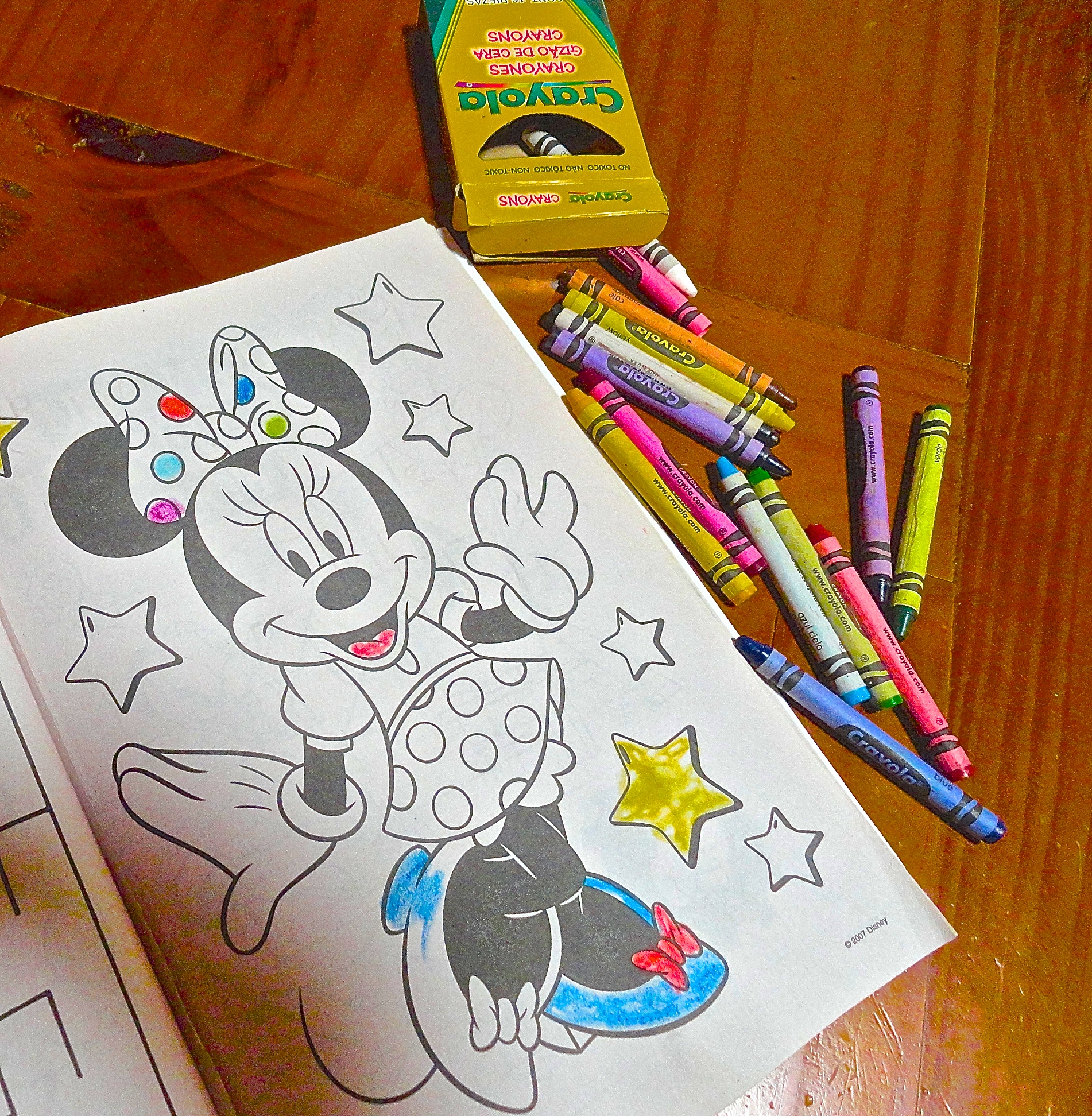
I hear a dull rubbing sound and move toward it—through the kitchen to the dinette, where a very small very skinny girl with brown braids is sitting at the table coloring in one of my coloring books. She is not staying in the lines very well, which is crucial—along with the fact that she is coloring the one last uncolored picture in the book which I’ve been saving for last because it is my favorite and BECAUSE I HAVE IT PLANNED SO THERE IS SOMEWHERE IN THAT PICTURE TO USE EVERY LAST COLOR IN MY BOX OF CRAYOLAS!

I sidle past her, unspeaking, aflame with indignation. Who could have—who would have—given her the authority to color in my book? I stand in the door of the living room. My mom is talking to a mousy gray-haired lady—tall, raw-boned, in a limp gray dress. My mom sees me, and tells me to come over and meet Mrs. Krauss. They are our new neighbors. They are going to live in Aunt Stella and Uncle Werner’s house two houses down. Did I meet their daughter Pressie in the kitchen? She’s just my age and Aunt Stella and Uncle Werner (who are not actually related to us, but just friends of my folks) are her real aunt and uncle.

The gray lady calls Pressie in to meet me. She is quiet and I am quiet. Then we go back to color at the table together. We drink orange juice and eat potato chips. We will be best friends for what seems like a lifetime but what is really only until we approach adolescence. I will have a love-hate relationship with her mother, who will continually set up competitions between Pressie and me to see who will win. She will try to coach Pressie first; but still, I will always win.

Pressie and I will play hollyhock dolls and dress-up. We play, sometimes, with Mary Boone; but her parents are too religious and don’t think we’re nice enough to play with her very much. I want to put on neighborhood plays and circuses, but none of the other kids want to perform. I want to play store and school, but Pressie eventually goes home to help her mother varnish the floors.

Pressie’s house is full of loud brothers and a sulky teenage sister. It is full of high school-aged cousins who tease us unmercifully and old ladies who come to play Scrabble with her mother. It is full of a missionary sister who comes back from South America and married brothers who come from Florida with babies that Pressie and I take charge of.

Pressie’s house is full of slivery floors that are always in the process of being varnished or de-varnished. There is one drawer in the kitchen full of everybody’s toothbrushes, combs, hairpins, hair cream, shampoo tubes, old pennies, crackerjack toys, rubber balls, lint, hairballs, rolled up handkerchiefs and an occasional spoon that falls in from the drain board above it. They have no bathroom—just the kitchen sink and a toilet and shower in the basement, across from the coal bin and the huge coal furnace. Their toilet has a curtain in front of it, but the shower is open to the world.

Sometimes when I am peeing, someone comes down to put coal in the furnace or to throw dirty clothes in the washtub next to the wringer washer. I pull the curtain tight with my arms and pray that they won’t pull it back and discover me, my panties down to the floor, pee dripping down my leg from my hurried spring from the toilet to secure the curtain. To this day, I have dreams about bathrooms that become public thoroughfares the minute I sit down. To this day, I get constipated every time I leave the security of my own locked bathroom.

Pressie babysits with the minister’s kids for money. I go along for free. She spanks them a lot and yells a lot. I think I can’t wait until I’m old enough to have kids so I can yell at them, but when Pressie is gone and the minister’s wife asks me to babysit, I don’t yell at them.

At Christmas I can’t wait to have Pressie come see my gifts: a Cinderella watch, a doll, a wastebasket painted like a little girl’s face, complete with yarn braids, books and toilet water from aunts, a toy plastic silverware set from my sister, stationery from my other aunt, playing cards, sewing cards, paint by numbers, a new dress. I run over through the snow to Pressie’s house to see her presents: a new pair of pajamas, a coloring book and new crayons, barrettes and a comb. In her family, they draw names. Quickly we run to my house, but she doesn’t pay much attention to my presents. She is funny sometimes, kind of crabby. The more excited I get, the more withdrawn she gets.

Later, I want to make snow angels in the yard and feed leftover cornmeal muffins to the chickadees, but Pressie wants to go home. Pressie always wants to go home. What she does there, I don’t know. She doesn’t like to read. None of us will have television for another five years. She doesn’t much like games or cards. I don’t know what Pressie does when she isn’t with me.

When she is with me, we take baths together and sing the theme music from “Back to the Bible Broadcast,” washing our sins away in the bathtub. We play ranch house in our basement. We pull the army cot against the wall and put old chairs on either side of it for end tables. We upend an old box in front of it for a coffee table. My grandma’s peeling ochre-painted rocking chair faces the army cot couch. We sneak into the hired man’s room and steal his Pall Mall cigarettes and sit talking and smoking. We rip the filters off first, which is what we think you’re supposed to do.

Pressie will always stay longer if we smoke. I blow out on the cigarette, but Pressie inhales. We smoke a whole pack over a few weeks’ time and then go searching for more. When the hired man starts hiding his cigarettes, we discover his hiding place and learn to take no more than four at a time so he doesn’t miss them. When he has a carton, we take a pack and hide it under the mattress on the army cot. My mother wonders where all the filters are coming from that she sweeps from the basement floor, but never guesses our secret.

Pressie spends more time with me than before, drops by almost every morning and always wants to go to the basement to play and smoke. Then the hired man finds another room and moves out and when Mrs. Church’s granddaughters come to visit, I will want to play with them but Pressie won’t. Then we will pair off—Pressie with Sue Anne, the girly one, me with Kate, the boyish one. We have a little war—mainly instigated by the sisters.

When the new farm agent moves in with two daughters—one a year younger than Pressie and me, the other a year younger than my sister Addie—I want to ask the girl our age to play with us, but Pressie won’t. I have a slumber party for everyone—all the girls we know. I invite the new girl, whose name is Molly, but no one talks to her much. She is shy and doesn’t push herself on us. No one else ever wants to include her. I go play with her anyway and spend the night at her house. Her mother is nervous, her dad cocky. Her older sister laughs nervously under her breath a lot, as does her mother.

Many years later, by the time we are in high school, everyone has accepted them. By then, all of those girls have parties where I’m not invited. They are always a little reserved when I come up to speak to them. Maybe they’re always reserved. How would I know how they are when I’m not around? Later, they all got to be pretty good friends. But in the beginning, I was everyone’s first friend.

“Adult”ery


JudycurlsJudycurls - Version 2

Unfortunate hairstyles of the past


“Adult”ery

I don’t remember, as a child, ever really thinking about what it would be like to be an adult in terms of where I would live or what I would choose as a profession. I do remember, however, two things I worried about.

First of all, I worried about what instrument I would play in the school band. I had two sisters, one eleven years older and the other four years older, who both played saxophone. As a matter of fact, there being 7 years difference in their ages, they both played the same saxophone! When I entered the sixth grade and was old enough to play in the starter band, I knew two things. #1: I had to play in the band because both of them had done so. #2: I had to find a way to be unique in doing exactly what they had done, and so I had to find a different instrument. This resolve was strengthened by the fact that my sister Patti was still using the “family saxophone.” As long as I was being different, I decided to stretch my uniqueness as far as it would go. No one in either the starter or the regular band had ever played a flute. It was exotic and not very heavy to carry. I would play a flute!!! Or rather, I would attempt to play a flute.

I faked it for two years, blowing energetically into the little hole as we sat in the band loft at games or marched along behind the regular band, practicing for parades or football games; but I never really developed much of a tone and my memory of which note was which was limited. It was really easy, though, to carry that little case about as large as a large pencil case the two blocks to the auditorium where our band practice occurred. My band instructor could not afford to be picky as there were only 200 students in the entire school system—grade school and high school combined—so every warm body available was required to flesh out the physical body of the band. If a few were miming, so be it. As long as they could stay in step for the marching band and didn’t play any really loud false notes, who would ever know?

When my sister left for college, she left the sax behind; and when I headed out for my first band practice as a high school freshman, I left that dread flute behind as I took sax in hand to continue the family tradition. I was not a whole lot better at it, but found something held between the lips and teeth was a lot easier than something held sideways and blown across and although the sax was heavier, it was held in a much more sustainable position than the flute, which was an exercise in arm isometrics as I held it aloft!!

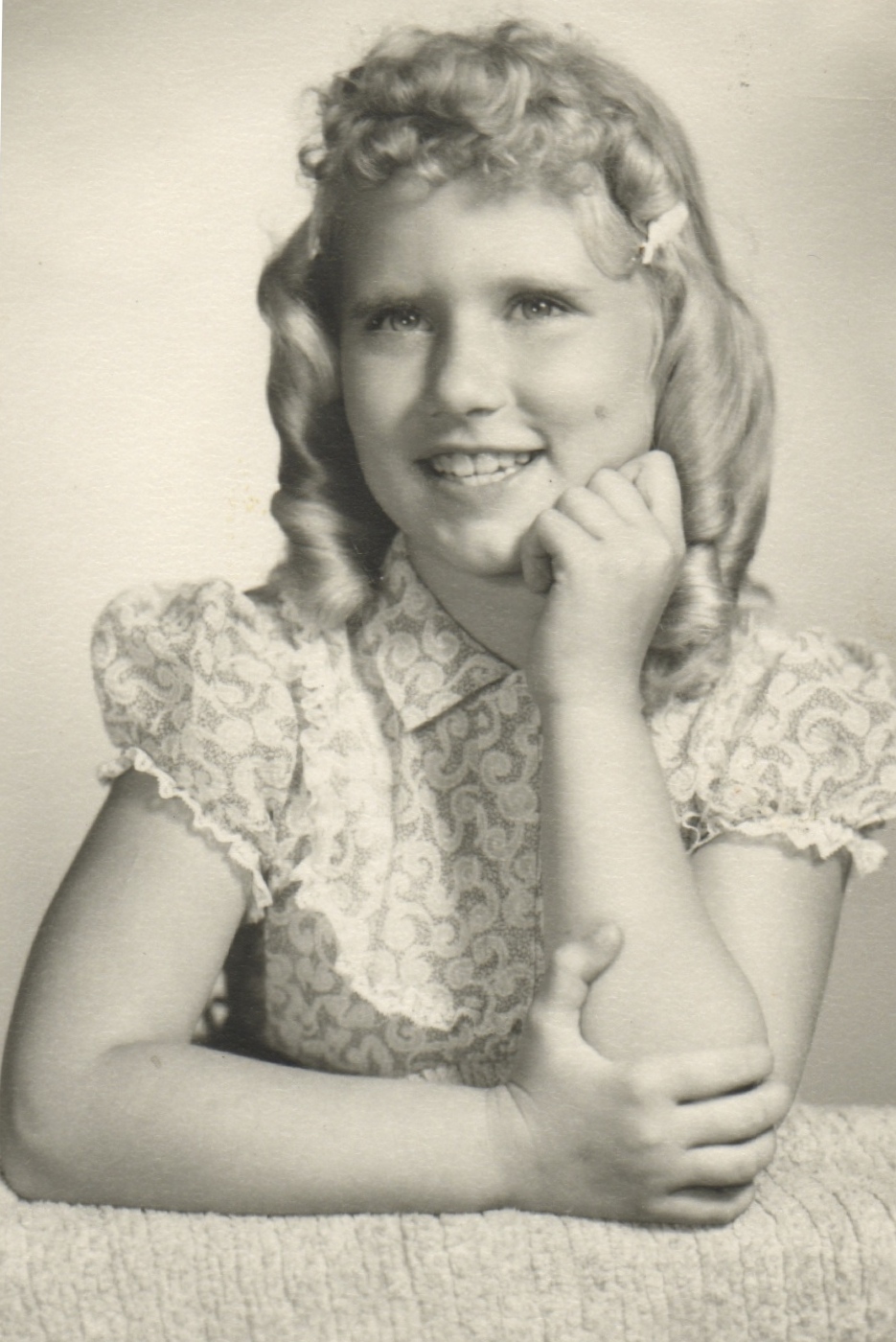
The second worry I had about growing up was how I would wear my hair. I would lie awake nights worrying about what hairstyle I would adopt when I could no longer sport the sausage curls my mother formed around her finger each morning. Shirley Temple, who had already grown to adulthood, needed to be replaced! My hair was too long, however, to duplicate Shirley’s bouncy little curls. It hung in fat tubes down beside my cheeks, offsetting my tight little bangs curled up each night in pink rubber curlers. For some reason, both my mom and I thought this made me look real good, and I am not exaggerating when I admit that there were nights when I’d lie in bed, tears streaming down my cheeks, worrying about what I would do when I grew up and could no longer wear curls!!

So now you know why I dropped the saxophone as soon as I graduated high school and why I had to move to Mexico to escape the shame of all those years when I allowed my mother to shape my esthetic sense of hair. I haven’t owned a curler of any type for 20 years. That saxophone was handed on to the next generation of my family and its mouthpiece, at least, met its demise when it snapped in two as my niece tried to grip it with the fourth pair of teeth in three decades. With a new mouthpiece, it survived four more years—hopefully this time with someone with more talent than I. I know not where it ended up. Probably in some second hand store or donated to some child who couldn’t afford an instrument. I hope it wound up with some talented individual who could restore its pride in itself.

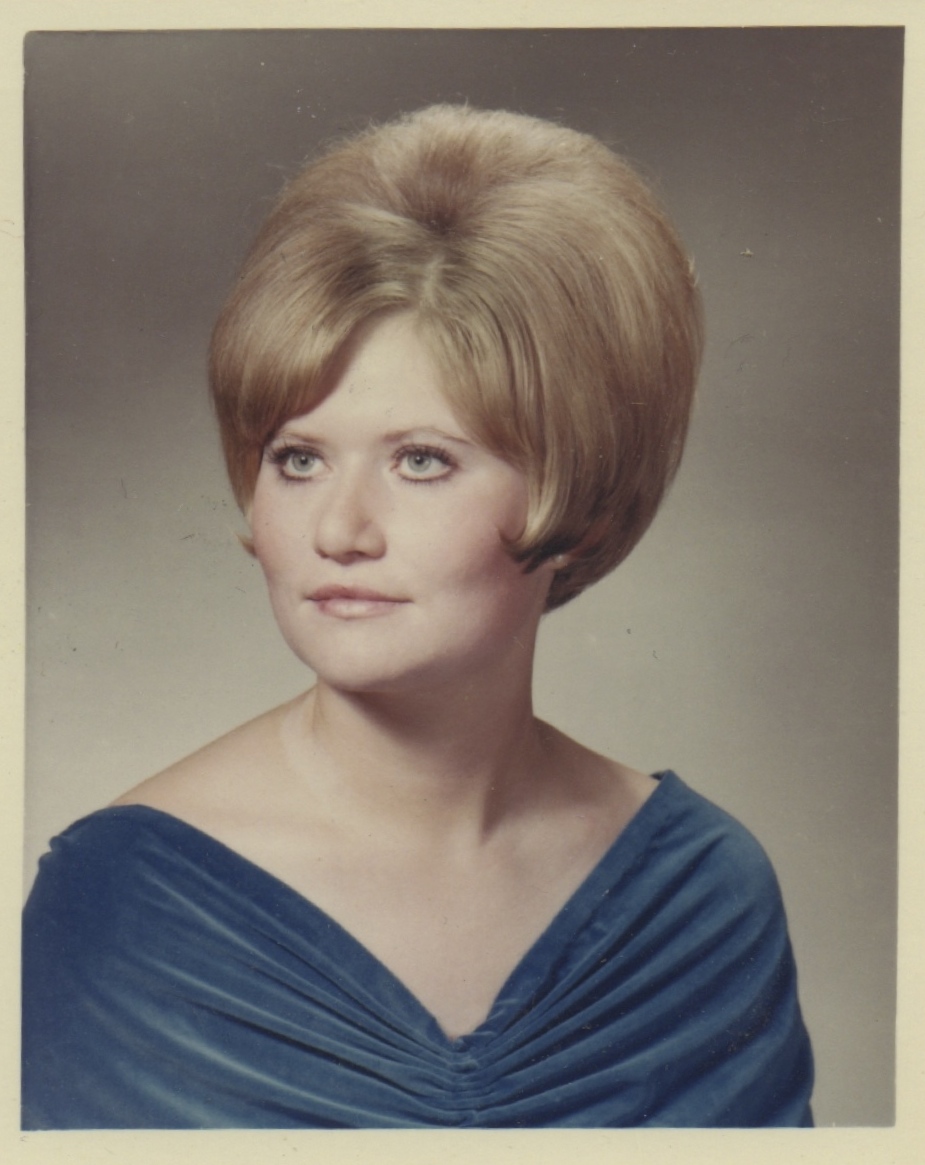
Now that I have been an adult for many many years, I have conquered most of its demands. I have found many hairstyles, only a few of them more ridiculous than sausage curls (see my college picture above as an illustration of this fact) and attempted only one additional instrument, the guitar. Having played only solo or in duet with a college friend who tried to mold me into Joan Baez but failed, I did learn about seven chords and learned to adapt a whole succession of seventies songs to fit into those seven chords. I played for sing-alongs with the kids I counseled at summer camp and for groups of little neighbors around the world, who would come to my house on Saturday mornings to sing silly songs. And I have that guitar to this day. But I haven’t played it for years and harbor no illusions about my prowess. It is there for visiting friends who want to play for me and as a big, cumbersome, hard-to-store reminder that I can choose my own failures as surely as my own successes.

I am an adult like other adults—growing more childish year-by-year, but in my regression toward soft food and adult diapers, I will never sink so low as to repeat some mistakes of my youth. Never ever more sausage curls or flutes held aloft like punishment. And never again will I try to be different just to be different. “The Far Side” has shown that this is nothing that really needs to be aimed for. We all grow odd enough just following the path of nature, thereby furnishing the humor for all the generations that follow us.

The Prompt: As a kid, you must have imagined what it was like to be an adult. Now that you’re a grownup (or becoming one), how far off was your idea of adult life?

P.S. Thirty years after high school, when I was doing an art show in Oregon, a man walked by my display and then did an about-face and came back and said, “You’re Judy Dykstra, aren’t you?”  I admitted the fact and asked him how he knew me.  He said he was 5 years behind me in school in the small South Dakota town where I grew up.  He was a country boy and since we’d never been in school together, I didn’t recognize him but did recognize the family name.

“How in the world did you even know what I looked like, let alone recognize me thirty years later?” I asked.

“Well, a bunch of us used to collect in the the school library and look at old annuals,” he said.  “I recognize you from your high school picture.”  Suddenly, it all came clear.

“You used to look at them to laugh at all the funny hairstyles, didn’t you?”   Sheepishly, he laughed and admitted it.  I had hit the nail (or the girl?) right on the head!!!!

Hail, Hail

                                                                        Hail, Hail 

My farmer/rancher father’s boots grew older with him, their wrinkles—like the back of his neck—born of weathering: rain, snow, mud and hot Dakota sun. They were so much a part of him that when he died, they were all my pre-teen nephew asked for, and he wore them out the rest of the way, until the soles peeled back and the leather with patina already long worn off, began to crack along the wrinkles and peel off.

Those boots reflected my father’s life, where things wore out. His clothes, his favorite chair—none were replaced for aesthetics or style alone—this practicality motivated neither by penury nor cheapness, but by growing up in a house where “making do” was a necessity.

But as in most things, there was one defining vain compulsion in my father’s life that broke him free from his mold. He loved new cars, as much for the pleasure of making the deal as for the smell of new leather and metal. The car dealers learned to call him when they got a car fully loaded, the way he liked it: automatic windows, power steering, power brakes, seats that tilted and slid back and forth and up and down by the touch of a switch. Whatever automatic feature was new that year, my father was up for it—big cars with fins, when they were in style, of every color.

The car salesmen would wait until the wheat crop had been harvested and then make the call, driving the car for sixty miles over the prairie to bring it to him for his perusal, like a new bride brought to a shah. They knew him well, and so when the bargaining began, they would accept his peccadillos. It was not the price he quibbled over, but rather the trade-in. “Well, I’ve got a combine that I need to trade in.” Once, three horses. And they learned this joy of trading was often what sealed the deal.

Later, when my sister married, her husband claimed my dad traded in his cars whenever they needed washing, but this was not true. Three years was a car’s usual shelf life, before he’d hand it down to whichever daughter of driving age needed a car the most. Packards and Cadillacs and Pontiacs were his choices of brands. For some reason, he reviled Fords. So that July of my thirteenth year, when the salesman brought the bright green Oldsmobile for my dad to view, we were sure this was the car he would turn down. My mother was not sure about the color and my dad was not sure about buying an Oldsmobile. He had no real reason. It was just a brand he’d never considered before, but it had all the bells and whistles. I think it was the first year that cruise control was offered, so it possessed that allure of new technology. And so it was that the car made it past any first inhibitions on both my mother’s and father’s parts and when the salesman drove away, it was in our “old” Cadillac and the shining green Oldsmobile became the new resident of our garage.

My oldest sister was married and gone, my middle sister seventeen—a year past legal driving age. Summer camp in the Black Hills was nearly 200 miles away, but over easily-navigated straight roads through bare prairie, the wheat having been cut early that year. So it was that my mom, worn pliable from 20 years of driving daughters hundreds of miles to doctor appointments and eye appointments and ball games and church rallies and singing contests and summer camps, decided my sister could drive me to camp that year.

My sister Patti and her best friend Patty Peck piled into the bench front seat. My best friend and I piled into the back. The trunk was full of two weeks worth of camping clothes. The pleasures of riding in a brand new car, just one week removed from its purchase, equaled the thrill of being off on our own. We rolled down the windows, stuck out our arms and let the hot July air stream through our fingers, stopped at Wall Drug for milkshakes, sang at the top of our lungs, and when our bare legs started sticking to the vinyl seats, closed the windows and enjoyed the air conditioning.

Three hours later, the black outlines of the hills that were our destination grew close enough to define the ponderosa pines that gave them their name. We cruised past Rockerville Ghost Town—a tourist trap where my oldest sister had worked a few years before—and turned off into Coon Hollow. My sister steered the car carefully over the dirt roads, fearing chipped paint or a chipped window from the occasional rock in our path. “Take Me Back to the Black Hills” we crooned, as we always did when we approached our favorite vacation spot. We rolled down windows once again to enjoy the scent of ponderosas and to hear the gurgling of the water as it rushed down the small river that paralleled the course of the dirt road that led back to the campsite.

“Black Hills Methodist Camp” read the sign. We stopped to take a picture before veering off onto the divided dirt road, and we had just caught site of the large log cabin that served as the mess hall when the first loud “Whump!” occurred. Then another and another and another. Terrified, my sister steered the car off into the trees as the hail grew larger and larger. We were facing the creek, which had grown wild with the churning of the hailstones hitting the water. They grew rapidly from quarter-sized to golf ball-sized to baseball-sized. The front window began to shatter. When one large hailstone seemed to pierce the roof of the car and land in my lap, I was out of my seat and over the back of the front seat onto the seat between the two Pattys before I could even think about it. As I remember it, I somehow managed this shift in position without ever removing my seat belt, but this, perhaps, is an exaggeration that occurred more in memory than in actuality. My friend, still in the back seat, held up the white ceiling light cover that had popped off when a huge hailstone had hit directly on top of it—showing that the rooftop was still unbreached

The entire hailstorm probably occurred over no more than a ten-minute period, but at the end of it, the stream in front of us was completely white with floating hailstones and the ground was covered. We climbed from the car, pushing through the hailstones in a shuffling motion to avoid slipping and falling on the huge balls of ice. The front windshield was completed marbled, every inch of our shining new car dimpled with deep depressions that equaled our own depression over what was going to happen when our mom and dad saw their brand new car! We were teenagers all and accustomed to that guilt that arose from a whole string of iniquities: dropping our mom’s favorite crystal bowl, staying out an hour past curfew, eating the last piece of pie. My sister backed the car out of the little turnoff she’d turned into hoping for some scant shelter from the hail and drove me and my friend the rest of the way to the registration in the mess hall, then she and her friend drove away. On the way home, they encountered a plague of grasshoppers that coated the windshield and they had to use bottles of Squirt to dissolve them from where they had become embedded into the marbled windshield; so this stickiness, dried in puddles on the hood of the car, added to the total devastation that greeted my dad’s eyes when his new “baby” was returned to him.

The feared recriminations never occurred. “Accidents happen. It wasn’t your fault,” said my dad. “I never really liked that color of green anyway,” said my mom. When my folks came to pick me up at camp, it was in a brand new rose-colored Pontiac Bonneville with a cream-colored top—the most beautiful car we ever owned. We met with no disasters on the way home, and four years later, it was the car I drove off to college six hundred miles away. My parents’ newest brand new car was a beige Buick that possessed none of the charm of the car now relegated to me, but did possess several new electronic features that I’m sure, for my dad, compensated completely.

The Prompt: You’re at the beach with some friends and/or family, enjoying the sun, nibbling on some watermelon. All of a sudden, within seconds, the weather shifts and hail starts descending form the sky. Write a post about what happens next.

Unwrapped Packages

daily life  color008

Unwrapped Packages

It is the difference between that present handed to you
by a person who says, “It’s only a tie,”
and a package under the tree
squeezed and prodded at—perhaps a corner loosened
or a hole poked in through supposed accidental handling,
pondered like a good detective show.

Who wants these mysteries revealed before their time?
What value in the present whose contents you already know for sure?
The magic of Christmas for some is that faith that the girl,
untouched by human lover, gave birth—and it is that sort of faith
that “saved” the world. If we knew the whole truth of that story
would all it prompted fall into the hole covered all these years by mystery?
The whole world seems to be standing more on what we don’t know
than on what we absolutely know empirically—what we can prove.

And so I look at the picture of my young mother
in her cotton housedress and saddle shoes
holding her baby in front of her in her stroller,
whole contraption, child and carrier,
a foot or two above the ground,
and there is mystery in the reveal.
I do not hear what transpired to cause this pose.
I do not know if my father caught her carrying me
from the porch to sidewalk and said,
“Here, Tootie, turn around,” and snapped the picture,
or whether my older sister planned the pose.
Or whether some movie star was snapped in a similar scene
and my mother and sister, like two conspiring fans,
planned the shot to steal the glamor formerly reserved
for “Photoplay” or “Look” or “Life.”

There would be no reel-to-reel
in any normal person’s life for years.
No movie camera to tell me exactly what my mother was like
or my sister or me before my memory took hold and even then,
my mind’s remembrance
more like reflections in a lake that color and change
depending on the clouds or rain,
distorting the light like moods.
My Aunt Peggy’s house,
always remembered as feeling like
the color chartreuse,
and I will never know why.
That smell of a friend’s house that became associated
with her memory more than any concrete proof of reel-to-reel
or spinning film of movie camera.

I do not know my mother’s voice at thirty.
I did not witness myself since birth
by either sound or sight.
There is a different mystery
to a past caught
in boxes of Kodacolor prints
curling and yellowing in a closet
than one documented like a science experiment
with every event taped and filmed.

Where does the mystery of you reside when you see yourself
so clearly, as others have seen you all along?
What does it leave for you to try to discover?
No tapes.
No film.
No Internet.
No Skype.
No YouTube.
No home movies.
All of our pasts were once wrapped up forever.
Only our fingers poking in the edges.
Only our voices asking,
“What was it like the day when I was born?”
What do you remember about the day when. . . .?

The Prompt: Can’t Stand Me—What do you find more unbearable: watching a video of yourself, or listening to a recording of your voice? Why?

Groundhogs in Sri Lanka

Groundhogs in Sri Lanka

Groundhog Day (the movie) was frustrating for sure.
When that same day kept happening, there seemed to be no cure.
But this was not reality. It really could not be.
And so to write about it has no appeal for me.

Instead I want to write about something on my mind;
and it, indeed, is something day after day I find.
When I look at my statistics on my blogging site,
I see the countries that have viewed my blog each day and night.

And when I see “Sri Lanka” occur day after day,
I wonder who that person is and what they’d have to say
if they could comment on the words that I have said to them
and wish that I could know a little more of her or him.

So if you read this message and know that it is you
who reads my blog, reveal yourself. Say who you are, please do.
I’ve been to Sri Lanka many years ago and saw
Colombo and the stupas—I viewed them all with awe.

The elephants in Kandy, the tea fields on the way,
the little inn called “Bird’s Nest” where we slept at end of day.
We climbed Anuradhapura, we stood beneath the tree
where Buddha sat 2,000 years ago. (How can this be?)

You probably weren’t born then so I’m sure we didn’t meet;
or as a babe in arms, perhaps you passed me in the street.
But nineteen sixty-seven (or was it sixty-eight?)
is very long ago and so I’m sure it’s not my fate

to reconnect with anyone I might have met back then
and it is not important what happened way back when.
To me, it is more vital to know what’s happening now,
and that is why a day or so ago I made a vow.

I mention this thing only to try to drive you to
share a little bit of what it might be to be you.
I’ve told you all my secrets, kept nothing back in shame;
so dear Sri Lanka viewer, please at least reveal your name!

 The Prompt: Groundhog Week—If you could relive the past week, would you? Would you change anything?