Tag Archives: poem

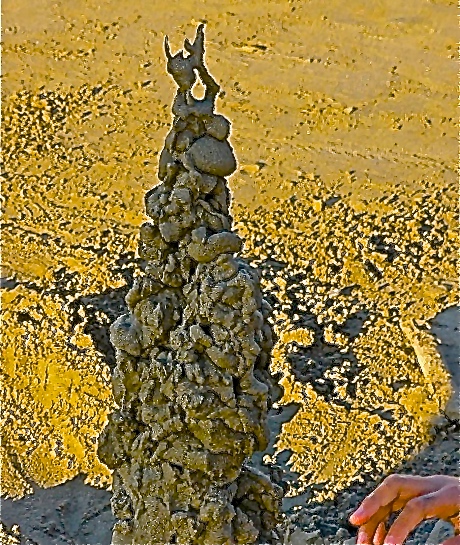
Sand Castles

(

Sand Castles

Under the sand are palaces, I’ve seen them in my dreams.
Vast halls and empty chambers smooth rounded at their seams.
Every wall is made of sand. Each ceiling, archway, floor
carved by master craftsmen–each digging at its core–
so magnificent, you’d think they were the stuff of lore.
You, too, are free to see them, but you must provide the door.

For the chambers are filled in, though they are there without a doubt.
You are the one creating them by what you will scoop out.
The beauty’s hidden in the sand, waiting in your sleep
for you to dig the castles out from where they’re buried deep.
All your day’s exhaustion your dream labor will abort,
for what you build in slumber is work of a different sort.

Sand brought to the surface is what you get to keep
of subterranean palaces dug out in your sleep.
As you build above ground castles in the world that we all know
you reveal the outward structure of the inner rooms below,
furnishing the magic that the world will see through you,
showing what’s inside of you by what you choose to do.

OLYMPUS DIGITAL CAMERA

The Prompt:  Just a Dream

See also: This!!!  (This video may be one of the most remarkable things you’ve ever seen in your life.  Don’t miss it!)

Fault Lines

Fault Lines

She lives up on a hillside far from the busy town,
and every year she lives there, she’s less likely to come down.
Her dog sits on her house’s dome and barks at all that pass.
One day she’ll likely join it, but for now she feels it’s crass.
Besides, she’s not that agile.  She seems to fall a lot–
merely due to clumsiness. A drinker, she is not.

She spends too much on artwork. The results hang down her halls,
sit upon her furniture and cover all her walls.
Her closets? Full to bulging with sizes large to small.
Her friends keep telling her there is no need to keep them all,
but to toss the ones that do not fit would cause her great duress.
She cannot throw any away, for next year she’ll weigh less.

Her refrigerator is her favorite scenic spot,
though entering’s an adventure with dangers amply fraught:
dog food barely balanced on a small sweet pickle jar
she has to brush against to get to where the short ribs are.
I’ve said that she is clumsy.  She doesn’t take her time.
This really isn’t new, for she was like this in her prime.

Her elbow strikes the pickle jar, the dog food comes out spinning.
They crash upon the tile floor. Our heroine stops grinning–
her thoughts no longer on the food but on the awful mess
of dogfood, pickles, broken glass–the rest you’ll surely guess.
The exercise that she will get mopping all this glop up.
will surely compensate for all the ribs she’ll later sop up.

And so she’ll lose her weight again and fit in that size eight.
As soon as this feat comes to be, he’ll ask her for a date.
Her dog will come down from the roof and she’ll come down the hill.
Her fridge and all her closets will suddenly unfill.
She’ll sell the art and cease to fall and fulfill all her scheming.
For the sixth thing true about her is that she’s prone to dreaming!

The Prompt: Far from Normal–Take a step back and take a look at your life as an outsider might. Now, tell us at least six unique, exciting, or just plain odd things about yourself.

For more writing on this topic go here: https://dailypost.wordpress.com/dp_prompt/far-from-normal/

Today’s prompt was really “Plead the Fifth” about a question we hate to answer.  We were given the choice of an alternate prompt, which is the one I chose, but ironically, it was one I didn’t want to answer so my post really fulfills both prompts.  Tricky.  If you want to see today’s prompt and other answers to it, you will find it:  HERE.

Odd Little Saturday Morning Poem

Odd Little Saturday Morning Poem

I lie in bed, flat on my back, head raised by pillows,
computer raised to eye level
by a wadded comforter over bent knees.
I listen to raised voices in the village down below,
the staccato of an inadequately mufflered car revving up,
a hammer falling on wood, birds in the coco  palms.
A pianissimo chorus of dogs spread
over the surrounding hills swells to a frenzied crescendo,
then falls silent but will swell again.

I have dropped obligations
like clothes shed for a lover.
My Saturday morning pool aerobics and zumba,
I slipped out of years ago.
Group luncheons hang from doorknobs and chair backs.
Committee meetings lie sloppily abandoned in the hall.

I have retired from the running of the world
to run my own small universe on paper.
Saturday morning is my brainstorm session
with “Me,” “Myself” and “I.”
“I” suggested feeding the dogs,
but they are quiet now, so
“Me” suggested we let them lie.
“Myself” laid out some words to dry
in the heat of the fire of our communal
inspiration, laying them smoothly on the page,
rumpling up others in her fist to send them sailing
to join the crumpled singles event invitations in the corner.

This slow Saturday morning dressing of pages
and stripping them bare
is a sort of ceremony celebrating seizing time
and making it my own.
Pages  fill up with passion, angst, anger,
irritation, joy, laughter, camaraderie.
There is more than one word for each.

Imagine such control over your world–
not having to live the world of any other.
If you could have any life you wish?
Imagine a Saturday morning  building it.


The Prompt:  Me Time–What do you like to do on Saturday morning?  Are you doing it now?

Empty Cup

Empty Cup

You would think there would be some remnant left,
but death was simple.
You were there and then you weren’t.
After one deep ragged breath
you were so gone that even your body
seemed to miss you.  That stillness
so irrevocable. So not right.

Our friends all came
to see the place where you had been,
bringing offerings
to fill the void.
It was a full-packed house–
your sons, their wives, your daughter–
eight of us filling out every hollow corner.

I slept in the bed meant for two,
trying to convince myself I was enough–
trying to fill in the space you left.
That empty cup.

The Prompt:  Cut Off–When was the last time you felt completely, truly lonely?

Sweet Clover

Sweet Clover

Before our dad told us its real name,
we used to call it wild mustard.
What did we know about sweet clover except for its color
and that summer smell, cloying in its sugared perfume.
It filled the air and smothered the plains—
bright yellow and green where before
brown stubble had peeked through blown snow.

On these dry lands, what flowers there were
tended to be cash crops or cattle feed.
Sweet clover or alfalfa.
The twitching noses of baby rabbits brought home by my dad
as we proffered it to them by the handful.
Fragile chains we draped around our necks and wrists.
Bouquets for our mom
that wilted as fast as we could pick them.

Summers were sweet clover and sweet corn
and first sweethearts parked on country roads,
windows rolled down to the night air,
then quickly closed to the miller moths.
Heady kisses,
whispered confessions, declarations,
unkept promises.
What we found most in these first selfish loves
was ourselves.

The relief of being chosen
and assurance that all our parts worked.
Our lips accepting those pressures unacceptable
just the year before.
Regions we’d never had much congress with before
calling out for company.
That hard flutter
like a large moth determined to get out.
Finding to our surprise,
like the lyrics of a sixties song,
that our hearts could break, too.

Hot summer nights,
“U”ing Main,
cars full of boys honking
at cars full of girls.
Cokes at Mack’s cafe.
And over the whole town
that heavy ache of sweet clover.
Half promise, half memory.
A giant invisible hand
that covered summer.


The Prompt: The Transporter—Tell us about a sensation — a taste, a smell, a piece of music — that transports you back to childhood.

Offers

Offers

When he asked me to marry him
and when we had to bury him–
these times inevitably set
wherein we find that we must let
nature have its way with us.
It does no good to rant and fuss.
Life’s made to reward, then abuse.
Its vagaries we can’t refuse.

All is part and parcel to
the next thing that we’re meant to do.
Good comes from bad and bad from good.
Birth, courtship, marriage, parenthood
fill our lives in marching order,
but every joy must have its border.
Birth leads to death. Love’s often lost.
To release life’s pleasures is the cost

of having and enjoying them.
Coal under pressure becomes a gem.
Remembering this must get you through
the next trial that’s set up for you.
Every day’s  an offer  you can’t refuse–
another pleasure to gain, then lose.
Life’s losses are also its seeds.
We lose our wants to gain our needs.

The Prompt: Set the timer for ten minutes and then tell us about an offer you couldn’t refuse.

South Dakota Gumbo

South Dakota Gumbo

When the rains came in hot summer,  wheat farmers cursed their harvest luck, for grain sodden by rain just days before cutting was not a good thing; but we children, freed from the worry of our own maintenance (not to mention taxes, next year’s seed fees and the long caravans of combines already making their slow crawl from Kansas in our direction) ran into the streets to glory in it.

We were children of the dry prairie who swam in rivers once or twice a year at church picnics or school picnics and otherwise would swing in playground swings, wedging our heels in the dry dust to push us higher. Snow was the form of precipitation we were most accustomed to–waddling as we tried to execute the Xs and Os of Fox and Geese bundled into two pairs of socks and rubber boots snapped tighter at the top around our thick padded snowsuits, our identities almost obscured under hoods and scarves tied bandit-like over our lower faces.

But in hot July, we streamed unfettered out into the rain.  Bare-footed, bare-legged, we raised naked arms up to greet  rivers pouring down like a waterfall from the sky.  Rain soaked into the gravel of the small prairie town streets, down to the rich black gumbo that filtered out to be washed down the gutters and through the culverts under roads, rushing with such force that it rose back into the air in a liquid rainbow with pressure enough to wash the black from beneath our toes.

We lay under this rainbow as it arced over us, stood at its end like pots of gold ourselves, made more valuable by this precipitation that precipitated in us schemes of trumpet vine boats with soda straw and leaf sails, races and boat near-fatalities as they wedged in too-low culvert underpasses.  Boats “disappeared” for minutes finally gushed out sideways on the other side of the road to rejoin the race down to its finale at that point beyond which we could not follow: Highway 16–that major two-lane route east to west and the southernmost boundary of our free-roaming playground of the entire town.

Forbidden to venture onto this one danger in our otherwise carefree lives, we imagined our boats plummeting out on the other side, arcing high in the plume of water as it dropped to the lower field below the highway.  It must have been a graveyard of vine pod boats, stripped of sails or lying sideways, pinned by them.  We imagined mind soldiers crawling out of them and ascending from the barrow pits along the road to venture back to us through the dangers of the wheels of trucks and cars.  Hiding out in mid-track and on the yellow lines, running with great bursts of speed before the next car came, our imaginary heroes made their ways back to our minds where tomorrow they would play cowboys or supermen or bandits or thieves.

But we were also our own heroes.  Thick black South Dakota gumbo squished between our toes as we waded down ditches in water mid-calf.  Kicking and wiggling, splashing, we craved more immersion in this all-too-rare miracle of summer rain.  We sat down, working our way down ditch rivers on our bottoms, our progress unimpeded by rocks.  We lived on the stoneless western side of the Missouri River, sixty miles away. The glacier somehow having been contained to the eastern side of the river, the western side of the state was relatively free of stones–which made for excellent farm land, easy on the plow.

Gravel, however, was a dear commodity.  Fortunes had been made when veins of it were found–a crop more valuable than wheat or corn or oats or alfalfa. The college educations of
my sisters and me we were probably paid for by the discovery of a vast supply of it on my father’s land and the fact that its discovery coincided with the decision to build first Highway 16 and then Interstate 90.  Trucks of that gravel were hauled  to build first the old road and then  the new Interstate that, built further south of town, would remove some of the dangers of Highway 16, which would be transformed into just a local road–the only paved one in town except for the much older former highway that had cut through the town three blocks to the north.

So it was that future generations of children, perhaps, could follow their dreams to their end.  Find their shattered boats.  Carry their shipwrecked heroes back home with them.  Which perhaps led to less hardy heroes with fewer tests or children who divided themselves from rain, sitting on couches watching television as the rain merely rivered their windows and puddled under the cracks of front doors, trying to get to them and failing.

But in those years before television and interstates and all the things that would have kept us from rain and adventures fueled only by our our imaginations, oh, the richness of gumbo between our toes and the fast rushing wet adventure of rain!

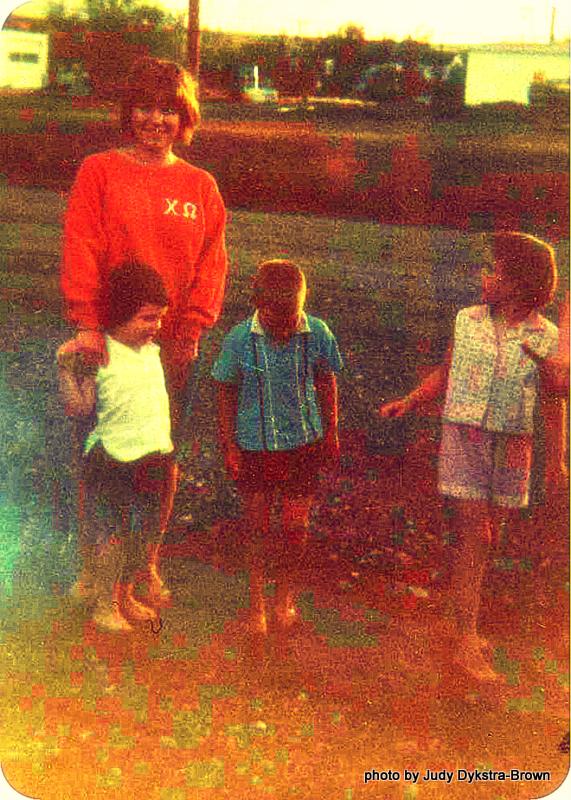
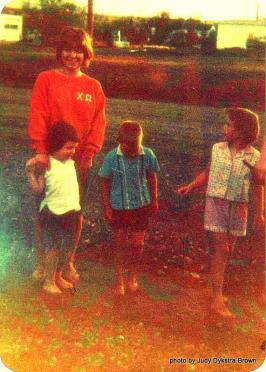
Writer’s note:  I know my sister Patti is going to read this and cry, and so I want to present you with this mental picture of her, college age, Levi cuffs rolled up above her knees, surrounded by five-year-old neighbor kids, enjoying her last big adventure out into the ditches of Murdo, South Dakota, during a July rain.

But wait!  A mere two hours of digging and another hour of editing has produced this proof of my former statement, so to augment your mental image, here is the real one:
Patty in mud 001-001

Not quite the gusher depicted in the childhood vignette, but nonetheless, Patti’s final puddle adventure. She had taken my visiting niece out. The next day the neighborhood kids rang our doorbell and asked my mom if Patti could come back outside to play! Ha.

The Prompt: Free Association–Write down the first words that come to mind when we say . . . home. . . soil . . . rain. Use those words in the title of your post.


Under the Skin

The Prompt: New Skin—If you could spend the next year as someone radically different from the current “you” — a member of a different species, someone from a different gender or generation, etc. — who would you choose to be?

Photo on 7-3-14 at 11.35 PM #2 - Version 3

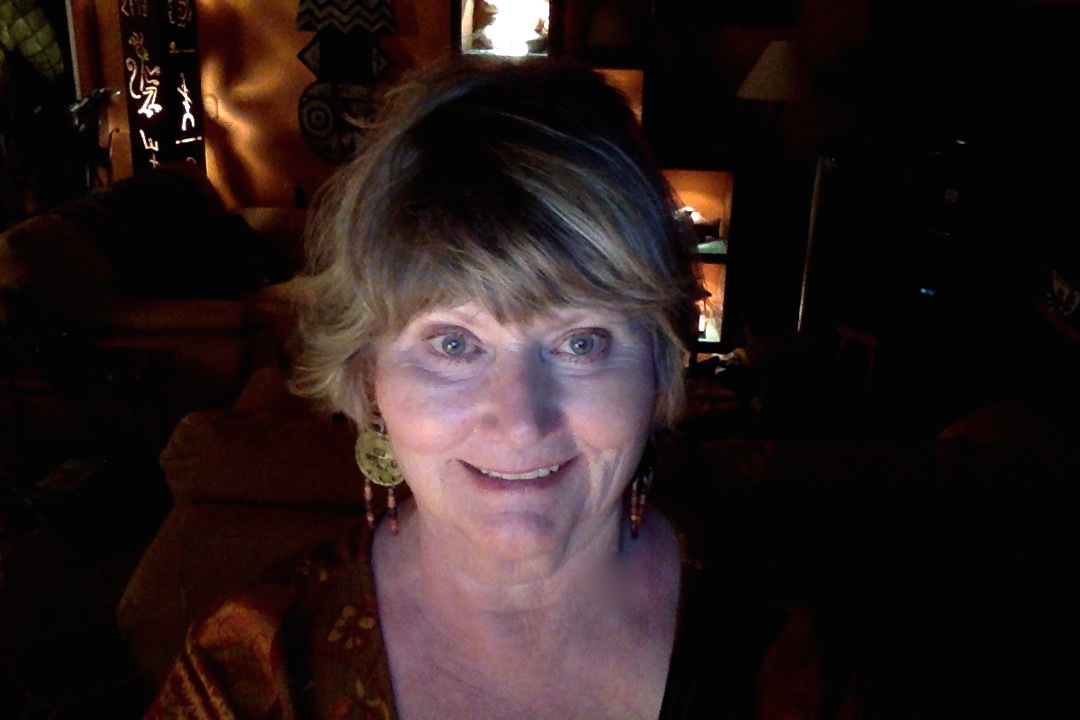
Under the Skin

Like the ugly oyster creates the lovely pearl,
I’ve made starts at being a better sort of girl.
I’ve starved and exercised until I made a brand new me,
hoping that a siren was what I would set free.
But no matter what I look like, whatever I could be,
At the end of all of it, I find I’m only me.

If I Were Water and You Were Air

The Prompt: For this week’s writing challenge, take on the theme of H2O. What does it mean to be the same thing, in different forms?
DSC01117

If I Were Water and You Were Air

I used to be restless water—
only the froth and currents
of a moving life.

Now I am still water,
sinking down to where
I can be found
by anyone willing to stand quietly
and look.

Is it true that moving water never freezes?
Is it true that still waters run deep?
Is it true that we are wed in steam?

“What if, caught by air,
it never lets me go?” I ask.

“But even water
turned to air
must fall at last,” you say.

“And what if I fall farther from you?”
I say. “Or what if I never again find banks
that open to contain me?”

I used to be swift flowing water.
Now I am a pool that sinks me deeper every year.
So deep, so deep I sink
that on its way to find me,
even air may lose its way.

https://dailypost.wordpress.com/dp_writing_challenge/ice-water-steam/

Lost Poem

 Lost Poem

A button pushed.
No lives lost.
Just newborn words,
vanished
and mourned.

Consider them
a sacrifice to the muses,
he says.

Consider them
parts of me
I’ll never remember again,
I say.