Tag Archives: art

The Art Lesson

Version 2


The Art Lesson

I look at Carolyn.
The teacher hovers over her bright shoulder.
We are sisters, bright and dark.
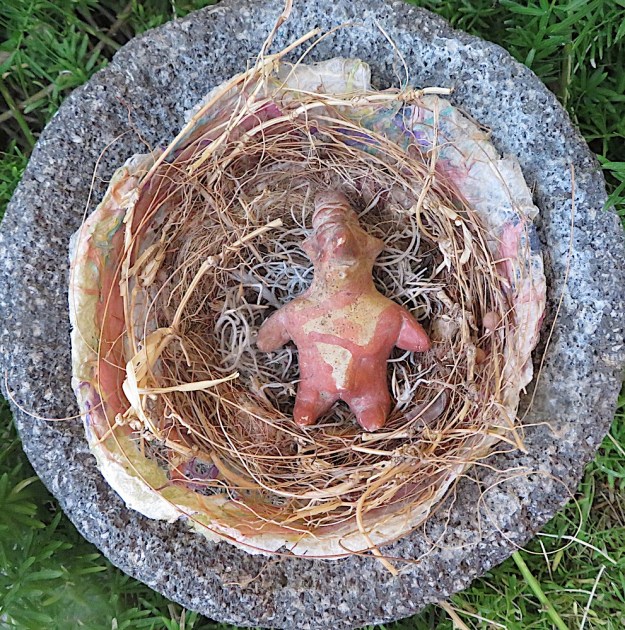
I stuff a bird’s nest into the hollow of the soft stone I have carved.
My mother will not like it.
She will only recognize the beauty
of the smooth hand
Carolyn has carved from alabaster,

That night, I stuff a snarl of Carolyn’s hair into
soft dung from the horse pasture.
I shape the Mimi spirit from the dung
and place it under the register in our room to dry.
When the cold snap hits,
the room takes on a feculent odor
and she wonders what is causing it.

For three days the Mimi spirit fills the room.
I reach under the register
and its outside surface crumbles in my hand.
I scrape its powder into a small pile.
The figure that is left I put in my pocket.
It is hard-baked.
The hand that held it smells like dead grass.
Some of the powder I sprinkle in a fine line
on the top of the frame around her vanity mirror.
The rest I save in my handkerchief.

The Mimi spirit I take back to class
to put in the nest.

My stone is a stone––
Hollowed,
grey.
with natural holes pockmarking it.
When no one is looking, I cut my finger with an Exacto knife
and collect my blood.
I unball my handkerchief.
I sprinkle the powder into my blood
to make a paste.
I take a fine brush from the cupboard,
paint the Mimi spirit.

They are all in front of me.
Carolyn. Andrew.
The teacher is in front of me.
No one notices.
I hear her laugh.
I pull a loose thread from my skirt
and wind it tight around my finger
until it turns white.

I take moss I’ve gathered from the oak trees
and I make hair.
I take the ankh-shaped clay tool
and scrape a hollow in the stomach of the Mimi doll.
I go to stand beside my sister,
taking the very small sharp paper-cutting scissors.
They are all watching her,
but no one watches the part of her closest to me.
She laughs, creating the diversion I need.
I quickly cut the very small piece
from inside a fold of her full skirt.
Later, she will blame it on moths.
I have told her about cotton-eating moths,
and she is a sister who always believes me.

I go back to my table at the back.
Still, not one has noticed me.
I trim material away from the part of the pattern I seek.
I cut out the very small figure of a child.
I roll the material I have cut away from around the child
into a tight wad
that I stuff into the new womb of the Mimi doll.
I roll the child into a ball
that I chew and chew
before swallowing.

I put the Mimi doll back into the nest in the stone.
Tomorrow I will pack it in a box.
Tomorrow I will wrap it in paper and ribbon.
Tomorrow I will give it as a gift to my mother.
Carolyn will give my mother the hand
and she will put it on her dresser
to display her bracelets and rings.
My stone will lie in its box
in my mother’s bottom drawer.

Next week I will steal into my mother’s room.
I will put the box under my sister’s bed for three nights.
I’ve already dug the hole beneath the willow tree—
in the soft soil where my father used to dig and dig.

Years from now, my mother will wonder where that box went.
Carolyn will have gone away before this, but not me.
I’ll say, “I don’t know, maybe Carolyn took it.”
My mother will slide her gold rings from the fingers
of the hand my sister carved for her.
She will love to stroke the cool hand.
But Carolyn will just keep going and never come back.

This is a poem I have written and rewritten over the past thirty years but which I’ve never published. It’s a dark poem and perhaps that is why I’ve never published it. I can’t remember what prompted it.  Certainly, nothing from my own life, but I recently found a folder of very old poems and decided to try to rework some of them. “The Art Lesson” is one of them. 

for dVerse Poets Pub Open Link Night.

Tracings


Click on photos to enlarge and see commentaries made about some during earlier postings.

Children are the parts of themselves that parents leave  behind when they die—actual physical tracings that will last for as long as their line reproduces. Yet, they have no control over what the children add to their genes to pass on down through time. Each generation melds together with the genes of other families to create a new assemblage composed of bits and pieces of the physical and mental characteristics gleaned from each side of the family to form a new identity.

Childless, I have only what I create to carry me forward into the far future—my poems, stories and books as well as the found object collages that I have created over the past eighteen years. In them I leave the tracery of my life—the long trailings of where I have been, whom I have known, what I have thought. But unlike children, they are glued down, painted, securely fastened to stay as I have intended them to be.

Vestiges of my entire  life story  are stored in them:  moments happy, sad, delirious, tedious, exciting, passionate, depressed, thoughtful, nostalgic. They are souvenirs of travel, heartbreak, reading, lost loves, found adventures.  I have no idea where they will eventually end up. In a trash heap?  On a table or shelf or in a box stored on a shelf? Or will they travel as I once did? Will the box that records Andy’s death end up back in Africa? Will that record of my early childhood school days wind up back in my prairie town?  Will some quantum miracle bring all of the items back to their origins by a force stronger than the one that bonded them together? Will the pieces fly apart, each going in its own direction?

Perhaps this is what happens to all of us at our death—subatomic particles flying back to some prehistoric origin, ready to start their journeys outward once again. Our whole lives are assemblages. Each of us assembles a life as much by our choice of what we draw into it as by what we are given by nature and by birth. Every life is, in a larger sense, a work of art; and how it is recorded—by human genes or by pinning it down on a board or in an assemblage or sculpture or representationally in a book or on canvas—is our choice.

Prompt words today are tracery, delirious, assemblage and identity.
https://ragtagcommunity.wordpress.com/2019/03/23/rdp-saturday-tracery/
https://fivedotoh.com/2019/03/23/fowc-with-fandango-delirious/
https://onedailyprompt.wordpress.com/2019/03/23/your-daily-word-prompt-assemblage-march-23-2019/
https://wordofthedaychallenge.wordpress.com/2019/03/23/identity/

Junk Art I Love and Own!!!

Jan Golik makes art out of junk. Literally.  Stuff she finds in spare lots, in the ditches along the road, in dumpsters as well as broken pottery and other castoff and broken things friends bring to her.  Yesterday I went to her studio and did a shopping spree. About the only place I have left for wall art is in the doggie domain, the room I added on to my house for my dogs to sleep and eat it.  They have their own mini fridge and cupboard unit with bins for dry food, drawers for cans, shelves and drawer for other doggie stuff such as tennis balls, leashes, toys, med. Now they’ll have their own little gallery. I already have two animal masks up. They’ll be joined by these fun pieces by Jan:

(Click on first photo to enlarge all and see full captions.)

Puesta del Sol: Thursday Doors, Feb 14, 2019

Click on photos to enlarge images.

Friends Christine and Rick from Gabriola Island, Western Canada, have made it their goal to transform the small posada they stay in every year into a little boutique hotel. For the past two years, they’ve been effecting many changes, including these decorations around the doors of each room. The little haven is a beehive of activity with musicians, poets and artists all contributing their skills. I’m going there tonight for a Valentine’s dinner. Yes, I’ll take photos!


For Norm’s Thursday Doors.

Egg Carton Posies


I had friends over to make these recycled flowers yesterday.  We still have at least one more  day to go, but these are the ones I stayed up all night last night finishing…Fun.

Click on any photo to enlarge all:


If you are curious about the process, this is what we did. You need egg cartons or dividers for the flowers, toilet paper rolls or other thin cardboard for leaves and stems and vines,  large sharp scissors, a glue gun or white glue, paint, paper towels and patience.

For Cee’s FOTD.  An addendum: https://ceenphotography.com/2019/01/11/fotd-january-12-2019-daffodil/

Embrace the Shake

Another wonderful sharing of a complex and quirky mind. If you are an artist or if you aren’t–this is a must-see.

Objectification

IMG_7804

Objectification

Objects are dependable. Objects are the best.
Objects do not leave you. They remain there at rest.
They soothe the eye with beauty or operate as slaves,
for objects have served us since humans lived in caves.
Since the first stone hammer or flint carved to a point,
objects have helped to feed us or to pretty up the joint.
Carved into a cave wall, a bison or a bird.
Art lasts for millennia. That’s why I find absurd
those who say things don’t matter, for what I have to say
is that it’s art that lingers. People just pass away.


img_1760-1

Fandango‘s prompt today was object. Before you start exclaiming in protest, I’ll issue the disclaimer that this is written a bit tongue-in-cheek. Albeit, I love art. Wouldn’t want to live without it.  But I do realize people are more important.

Fandango‘s prompt was object.

Juxtaposition

Click on any photo to enlarge all.

Juxtaposition

Artistic types must juxtapose
these to these and those to those
just for the contrast, I suppose.
Somehow, each artist simply knows
to vary hues that they impose
upon the subjects that they chose
to depict first in line and pose.

Poets may likewise words oppose,
and so may writers given to prose.
Composers also juxtapose
in sonatas or do si dos
whatever music sweetly flows
from saxophone, fiddle or Bose.

Shoulder to shoulder, nose to nose
such contrasts form the undertows
that draw attention, lift our lows
stir lethargy and banish woes.

As all these contrasts come to blows,
so our imagination grows.
Time enough to nap and doze
when life draws nearer to its close.
For now, stay open  to the shows
of all who seek to juxtapose.


The prompt today is juxtapose.

Crafted Heart

IMG_3737
As an artist who worked in wood, stone, metal, paper, glass and any other material he could find to project his mental imaginings into concrete objects, my husband had mallets of many shapes, sizes and materials, but my favorite was the one he fashioned himself as part of the first gift he ever gave to me—the musical instrument shown towards the end of this post.

Crafted Heart

He handed it to me without ceremony—a small leather bag, awl-punched and stitched together by hand. Its flap was held together by a clasp made from a two fishing line sinkers and a piece of woven wax linen. I unwound the wax linen and found inside a tiny wooden heart with his initials on one side, mine on the other. A small hole in the heart had a braided cord of wax linen strung through that was attached to the bag so that the heart could not be lost. He had woven more waxed linen into a neck cord. I was 39 years old when he gave me that incredible thing I never thought I would receive: his heart—as much of it as he could give.

It was the first handmade gift I’d ever received from a man. Inside, over the years, I have put a lock of his hair and a tiny tiny animal of indeterminate species hand-cut out of wood by his youngest son and presented to me. Twenty-eight years later, this bag is all that is left of what was once my union with the man and his eight children from three different women. When he died, we returned him to the inevitable earth and all of the children returned forever to their real mothers.

The bag lies in a box with other relics of our past together: a silver heart brooch, another carved of wood with wings attached and, strangely enough, a miniature computerized hand piano. Years after his death, it struck a chord on its own, just lying on the shelf beside my favorite picture of him. One last dying gasp from the tiny gadget I’d put in his Christmas stocking but then grown tired of hearing him play and so had hidden away, only to enter our bedroom one night to find him playing it under the covers like a guilty pleasure hidden from the adults, although he was already in his sixties.

For our first Christmas, he gave me a large sculpture that was also a musical instrument—three hand-raised copper gongs in the shape of breasts suspended over a wooden keyboard played by rawhide mallets, (ironically, they are not shown in this photo)  the gongs suspended from the long horizontal neck of a copper wind instrument with two necks and two mouthpieces, so two notes could be blown at once. When he died, it was the sculpture chosen by his youngest daughter, and I let her take it. Now, the remnants I have of him are only the leftovers that remained after eight children had chosen. I was moving to another country and could not hold onto everything he’d given.

daily life color023

Sculpture by Bob Brown,1986.  4′ X 5.5′, wood, hand forged copper, marble and hemp.

                            daily life color024

                                 Miniature hand piano, 4″ X 2″

I moved away from most of those things we had collected over the years, but somewhere hidden away in the thousand objects in my studio is the small leather bag and the tiny hand piano, now forever mute, his father’s pocket watch, his biking medals and the other assorted pieces of his life that will one day wind up in a secondhand store in Mexico. All of our gifts finally melding with the parts of all those billions of other lives that strike their brief chord before blending, inevitably, back into the cacophony of the universe.


Some material in this post was posted four years ago. The prompt today is mallet.

Carve

I’m at the beach and my friend Rachel is leaving soon so we need to go to breakfast, since I turned the fridge up too high and it froze everything–eggs, milk, butter. With no time to do a new post right now, this is a reblog of a piece from three years ago that is appropriate for the prompt today, which is carve.

Cast in Potato Salad, Carved in Stone

daily life color083 (2)
Cast in Potato Salad, Carved in Stone

The last thing I ever thought I would do would be to pose for a nude sculpture, but when I married a sculptor, I guess it was inevitable.  Since I never had children, this probably marked the longest period in my life that I ever lay nude being observed by a second party.  I remembered having no reservations about doing so, in spite of the fact that I am really rather modest–that is about revealing myself physically. Words are another matter all together.

My husband first sculpted me in plasticine clay. (No, not the ubiquitous Sculpey, but a very dense artist’s clay used to make the originals for bronze casting.) He then made a plaster mold followed by a rubber reverse mold that would enable him to make further plaster molds once he destroyed the plasticine original so he could reuse the plasticine.  After mastering the intricacies of wood carving, bronze casting, welding, clay, sandblasting, paper making and stone carving, he was in a difficult spot.  A tool junkie, he had already purchased or made every tool necessary for working in these media. How could he justify buying any more tools or building another studio addition to add to the seven studios he had already set up?

The answer came when our artist friend Diana moved to town.  Her medium was cast glass and Bob soon became fascinated with the process.  Of course, this necessitated the purchase of dozens of large jars of different colored glass casting pellets as well as books, chemicals and other supplies necessary for the process. Unfortunately, we already owned a large kiln, so he couldn’t justify buying a new pristine kiln to be used only for the melting of glass.  True, some molecules of clay might permeate the glass castings, but he decided at least for his first project, to use our existing kiln.

I can’t remember what his first few castings were, but after a few experiments, he decided that his first large glass project would be–ta da–a glass casting of his recumbent nude wife!

The thing was, this necessitated ordering a good deal more glass, and in the meantime, he had this wonderful rubber mold just sitting there unused!  He tried to busy himself with carving stone and wood, but meanwhile that mold beckoned!  Enter fate in the guise of the next show at the Santa Cruz Mountains Art Center, where we were both members.  And the next show was—Edible Art!  In addition to food-centered art themes, there was to be a cookbook of artists’ favorite recipes and the piece de resistance was an edible category, to be consumed at the reception!!!  Thus it was that I came to be cast in potato salad–first molded in “the” well-washed and disinfected rubber mold  and then fine-sculpted by Bob’s hands.

I must admit I felt some trepidation about first being viewed nude, then being consumed by my fellow artists and friends.  This smacked of the Donner party or some sort of sixties orgy, but how we suffer for our art.  I requested Bob not reveal who his model was and all went well.  Later, the judge told us that he would have won first place for edible art if I had not forgotten and used some of the water I used to boil the eggs to add moisture to the potato salad. I had forgotten that I always put a half cup of salt in the water to seal the eggs in case they cracked during the boiling process and that addition made the potato salad totally inedible.  The judges could do nothing but award his sculpture fourth place prize in place of first, right ahead of a jellybean mosaic in the Byzantine style, but behind my third place for my “Garden of Earthly delights!”

Yes, the glass grains did arrive and yes he cast the sculpture, but what happened during the further fiasco of my chain of nude effigies must be left to another time and post lest this one grow too long for certain (unnamed) friends to read.    Suffice it to say that once cast in potato salad, twice in glass, it seems only appropriate that my grave be marked by my magnificent if inedible body rendered into stone!!!  It will be the sensation of my little town, I can promise you.
daily life color084 (4)Version 2(photos and copy above taken from the Valley Press)